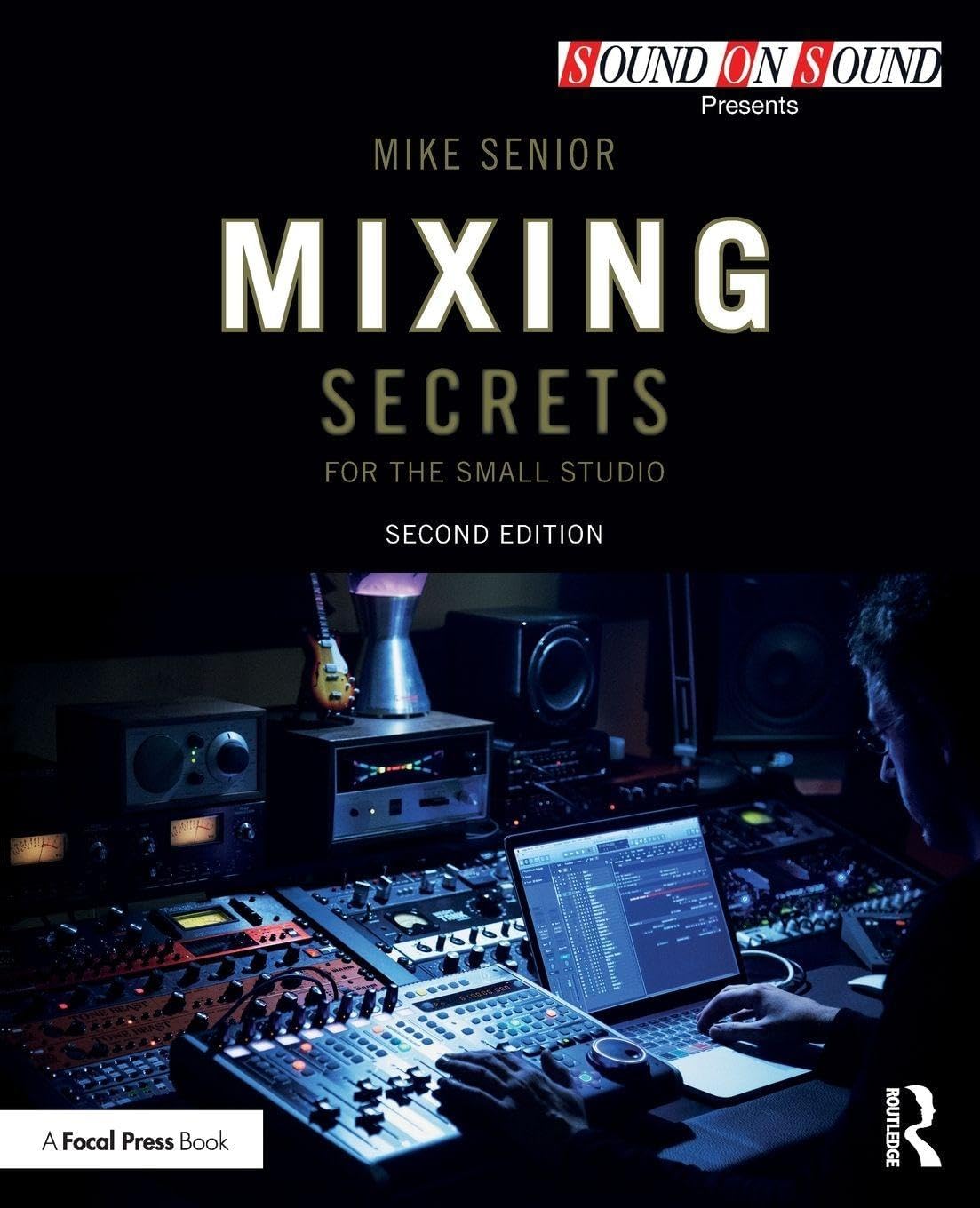
Mixing Secrets for the Small Studio (Sound On Sound Presents...)
Product ID: 88224755
Desertcart purchases this item on your behalf and handles shipping, customs, and support to Japan.
Discover how to achieve release-quality mixes even in the smallest studios by applying power-user techniques from the world's most successful producers. Mixing Secrets for the Small Studio is the best-selling primer for small-studio enthusiasts who want chart-ready sonics in a hurry. Drawing on the back-room strategies of more than 160 famous names, this entertaining and down-to-earth guide leads you step-by-step through the entire mixing process. On the way, you'll unravel the mysteries of every type of mix processing, from simple EQ and compression through to advanced spectral dynamics and "fairy dust" effects. User-friendly explanations introduce technical concepts on a strictly need-to-know basis, while chapter summaries and assignments are perfect for school and college use. ▪ Learn the subtle editing, arrangement, and monitoring tactics which give industry insiders their competitive edge, and master the psychological tricks which protect you from all the biggest rookie mistakes. ▪ Find out where you don't need to spend money, as well as how to make a limited budget really count. ▪ Pick up tricks and tips from leading-edge engineers working on today's multi-platinum hits, including Derek "MixedByAli" Ali, Michael Brauer, Dylan "3D" Dresdow, Tom Elmhirst, Serban Ghenea, Jacquire King, the Lord-Alge brothers, Tony Maserati, Manny Marroquin, Noah "50" Shebib, Mark "Spike" Stent, DJ Swivel, Phil Tan, Andy Wallace, Young Guru, and many, many more... Now extensively expanded and updated, including new sections on mix-buss processing, mastering, and the latest advances in plug-in technology. Review: Bite the bullet and buy the only mixing book you'll need - The first clue this book is valuable is the star ratings versus the used book price. Why do you think used copies sell for nearly as much as new? And what's the percentage of 5 stars? Those two indicators led to my purchase. Admittedly, I thought the price was steep but after reading I think it's a steal. Senior's book has a very logical flow and seems to consider absolutely every challenge mixers face. You will get the most from this book starting at the beginning and working your way through it, cover to cover. It's a very concise book and will require time to read because it never let's up giving you valuable information. I am a little at a loss for words in trying to explain how great the book is. All I can say is I've been writing music for over 15 years and have gotten better mixes through a lot of painful, time-consuming trial and error. I know what doesn't work because of MANY failures. But then I start reading this book and see Senior knows those same failures and offers the same logical solutions that worked for me. Even simple things like color coding tracks to quickly get around your mix can shoot the inexperienced in the foot, but here it is called out for you. The tips are endless and, again, the value of this book is somewhat immeasurable. Senior could make a fortune giving endless seminars just touching single chapters. My take from the book, and this will not sit well with some newbies, is that mixing is still a very hands-on, labor intensive art in its' own right. We live in a world where programmers offer us a bewildering array of affordable equipment past engineers would have sold their house for and could only dream of. Many new to mixing assume the software is the solution in and of itself and blame the programmers when things don't go as dreamed. Some keep buying plugins and add-ons looking for the golden sound solution and when those don't work they believe that if they only could afford what the pros work on their mixes could compete with commercial studios, but the fact is, again, human skill still has the edge. It's painful to know you can't just turn on auto tune and let it run unminded to correct a pitch. It's painful to know your expensive monitors leave you with nothing exciting if you don't know what you're listening for. It might also be painful to realize some songs, no matter who the mixer, can't be fixed because the arrangement is boring, confusing, not musical or too busy. But that's where this book is a Godsend. Rather than tinker at a problem until you lose your hair you can read this book which clearly spells out what you can do, what you probably can't and what you'd be a fool to undertake. Even better, the advice can be applied to a wide variety of set-ups and budgets. I've read the handful of low ratings and I see the same pattern- readers with unrealistic expectations and not enough patience to mix. That said, I'm not sure how anyone could rate the book so low and expect commercial (or even slightly good) mixing results. The book won't move the faders for you. To them I'd say they might be better off hiring a professional mixer. A million 'thank you's' to Mike Senior for this comprehensive and immensely helpful book. Seriously, if you're reading this I want you to know you've set the (very high) standard for this topic and I owe you a drink. Another million thanks to the editor (very succinct, great flow) and to the publisher for bringing this work to us. Review: Perfect For Serious Beginners - As a project studio operator, Mixing Secrets has been the single resource I can point to that got me over the hump and into the territory where I can begin seriously competing with established professionals - all while remaining on a humble budget. Mike Senior gives the novice the fundamental information necessary to understand and execute all basic mixing tasks as well as many advanced mixing ones. Where an advanced technique is not included the fundamental knowledge to understand it has nonetheless been provided. In other words, as a result of working through this book, articles on arcane mixing techniques become easy to digest, even if they aren't described in the book. More importantly, his pedagogy is extremely sound. He takes a complicated, non-intuitive, subjective, and non-linear process and gets the student through it as if it were simple, obvious, linear, and objective, all the while providing the student with the necessary caveats to understand where the process has been simplified to make it easier to learn. Therefore the student, as he gains experience, can incorporate a more fluid approach as necessary, skipping between various mixing tasks instead of doing them in the preset order that Mike lays out for beginners. The book has immense re-readability. The "Cut To The Chase" pages at the end of each chapter highlight the section's important points. I recommend tabbing them with post-it notes for quick review. Additionally, reexamination of any chapter reveals situation specific tips that become increasingly relevant as the student gains experience. For a person with a limited budget who is willing to put in the time to work through Mike's lesson plan, Mixing Secrets is an invaluable resource. It is a book designed to scale with your budget. As you become successful enough to justify more expensive equipment, Mixing Secrets will be there to help you make the most out of your time and effort. Additional value is derived by providing a firm and comprehensive foundation of mixing fundamentals. After reading Mixing Secrets, books and articles on more advanced topics become easier to grasp, even if they are written poorly. I recommend this book all the time to audio professionals who are looking for a good resource for their students, and I recommend it to any hearty bootstrapping project studio operator who wants to make the best use of his time and money while laying a strong foundation for his future development. It takes time to meticulously work through Mike's lesson plan, but I can't call that a downside since there are no shortcuts in the pursuit of excellence. There are, however, ways to maximize the effectiveness of your efforts, and this is the best I know when it comes to mixing.


| Best Sellers Rank | #903,401 in Books ( See Top 100 in Books ) #11 in Acoustic Engineering #31 in Music Recording & Sound (Books) #220 in Physics of Acoustics & Sound (Books) |
| Customer Reviews | 4.7 out of 5 stars 1,510 Reviews |
C**A
Bite the bullet and buy the only mixing book you'll need
The first clue this book is valuable is the star ratings versus the used book price. Why do you think used copies sell for nearly as much as new? And what's the percentage of 5 stars? Those two indicators led to my purchase. Admittedly, I thought the price was steep but after reading I think it's a steal. Senior's book has a very logical flow and seems to consider absolutely every challenge mixers face. You will get the most from this book starting at the beginning and working your way through it, cover to cover. It's a very concise book and will require time to read because it never let's up giving you valuable information. I am a little at a loss for words in trying to explain how great the book is. All I can say is I've been writing music for over 15 years and have gotten better mixes through a lot of painful, time-consuming trial and error. I know what doesn't work because of MANY failures. But then I start reading this book and see Senior knows those same failures and offers the same logical solutions that worked for me. Even simple things like color coding tracks to quickly get around your mix can shoot the inexperienced in the foot, but here it is called out for you. The tips are endless and, again, the value of this book is somewhat immeasurable. Senior could make a fortune giving endless seminars just touching single chapters. My take from the book, and this will not sit well with some newbies, is that mixing is still a very hands-on, labor intensive art in its' own right. We live in a world where programmers offer us a bewildering array of affordable equipment past engineers would have sold their house for and could only dream of. Many new to mixing assume the software is the solution in and of itself and blame the programmers when things don't go as dreamed. Some keep buying plugins and add-ons looking for the golden sound solution and when those don't work they believe that if they only could afford what the pros work on their mixes could compete with commercial studios, but the fact is, again, human skill still has the edge. It's painful to know you can't just turn on auto tune and let it run unminded to correct a pitch. It's painful to know your expensive monitors leave you with nothing exciting if you don't know what you're listening for. It might also be painful to realize some songs, no matter who the mixer, can't be fixed because the arrangement is boring, confusing, not musical or too busy. But that's where this book is a Godsend. Rather than tinker at a problem until you lose your hair you can read this book which clearly spells out what you can do, what you probably can't and what you'd be a fool to undertake. Even better, the advice can be applied to a wide variety of set-ups and budgets. I've read the handful of low ratings and I see the same pattern- readers with unrealistic expectations and not enough patience to mix. That said, I'm not sure how anyone could rate the book so low and expect commercial (or even slightly good) mixing results. The book won't move the faders for you. To them I'd say they might be better off hiring a professional mixer. A million 'thank you's' to Mike Senior for this comprehensive and immensely helpful book. Seriously, if you're reading this I want you to know you've set the (very high) standard for this topic and I owe you a drink. Another million thanks to the editor (very succinct, great flow) and to the publisher for bringing this work to us.
J**L
Perfect For Serious Beginners
As a project studio operator, Mixing Secrets has been the single resource I can point to that got me over the hump and into the territory where I can begin seriously competing with established professionals - all while remaining on a humble budget. Mike Senior gives the novice the fundamental information necessary to understand and execute all basic mixing tasks as well as many advanced mixing ones. Where an advanced technique is not included the fundamental knowledge to understand it has nonetheless been provided. In other words, as a result of working through this book, articles on arcane mixing techniques become easy to digest, even if they aren't described in the book. More importantly, his pedagogy is extremely sound. He takes a complicated, non-intuitive, subjective, and non-linear process and gets the student through it as if it were simple, obvious, linear, and objective, all the while providing the student with the necessary caveats to understand where the process has been simplified to make it easier to learn. Therefore the student, as he gains experience, can incorporate a more fluid approach as necessary, skipping between various mixing tasks instead of doing them in the preset order that Mike lays out for beginners. The book has immense re-readability. The "Cut To The Chase" pages at the end of each chapter highlight the section's important points. I recommend tabbing them with post-it notes for quick review. Additionally, reexamination of any chapter reveals situation specific tips that become increasingly relevant as the student gains experience. For a person with a limited budget who is willing to put in the time to work through Mike's lesson plan, Mixing Secrets is an invaluable resource. It is a book designed to scale with your budget. As you become successful enough to justify more expensive equipment, Mixing Secrets will be there to help you make the most out of your time and effort. Additional value is derived by providing a firm and comprehensive foundation of mixing fundamentals. After reading Mixing Secrets, books and articles on more advanced topics become easier to grasp, even if they are written poorly. I recommend this book all the time to audio professionals who are looking for a good resource for their students, and I recommend it to any hearty bootstrapping project studio operator who wants to make the best use of his time and money while laying a strong foundation for his future development. It takes time to meticulously work through Mike's lesson plan, but I can't call that a downside since there are no shortcuts in the pursuit of excellence. There are, however, ways to maximize the effectiveness of your efforts, and this is the best I know when it comes to mixing.
S**L
Thumbs up (and, if you are a "Newb", read this before purchase!)
First of all, let me say how impressed I am with the amount of information in this book. Not only that, I agree with other reviewers- chapters are concise and easy to follow. Over all, I am thrilled that I bought this book, as I think it will get very worn as I dive into the world of home studio recording. Clearly, I am a "Newb", so I have a lot to learn. For the benefit of the other newbs out there considering this book (buy it), this info might prove helpful... On page "ix" of the introduction, the author lays out a few key paragraphs: "What you will learn from this book", What you won't learn from this book", and "what you need to know already". In a nutshell: What you will learn: "How to achieve release quality mixes on a budget within a typical small studio environment"... I believe it. He even provides links that demonstrate before and after demonstrations. Nice. What you won't learn: The author describes this book as "platform neutral", so you can use it no matter whether you have Logic, Cubase, Protools, or whatever. Again, nice. What you need to know already: Sigh. Here is where I personally ran into trouble, because what I really need is a basic primer in the physics of sound... Hertz? Decibels? Sine Waves? Amplitude? Whaaaaaaaa? Studio set-up and session work flow? Hmmm? Hahaha- Actually, I would love more than a basic primer... I would really love to be able to get my head around these concepts, as I feel this is going to be really important the more involved I get. (Um, yeah. Clearly.) That said, this book is well written, and to my eyes, seemingly comprehensive, so I could hardly give the book a lower rating based on my lack of knowledge. I only wish I had known a better to primer to start with before, and in addition to, reading this book, as I am certain that this book would have been my immediate purchase afterwards. It is also important to mention that the author thoughtfully included some links for what he calls a "whistle stop" review. Very helpful, and I am definitely going online and trying to find as much info as I can. So, I guess what I am saying is that if you are like me, and you are missing these concepts, buy this book, and... another book that covers all these concepts. Which brings me to my question, as follows: Does anyone have any recommendations for us Baby Nerds, just out of curiosity? Again, wholehearted thumbs up on the book! Even though some of it is still over my head, I find it an accessible and interesting read. Thanks, Mike Senior! I'm a fan!
F**N
Good, not great book on mixing
This is a very good book on the nuts and bolts of mixing, written by the person responsible for each month's Mix Rescue column in Sound on Sound magazine. Mike Senior has impeccable credentials and years of experience in crafting mixes. And that shows through in the book. However, for all I wanted to, I could only give this book four stars. Why? The book is well-written, but the prose varies between very technical and familiar styles. It feels like his editors came in at the end and said, "Mike, this is a great manuscript here, but it seems technical and cold. Could you tart it up with a few colloquial expressions? A bit of badinage?" In the end, it makes the book feel a bit wonky. I'm not sure that the idea of "multing" tracks is a good one any more, leading to the possibility of phasing issues if parts of duplicated tracks aren't muted properly. These days, with most DAWs supporting addition of effects in segments of tracks, it's not necessary to mult to add an effect or an EQ to a particular section of the song - clip the track and add the effects you want to the clipped segment (I know that Sonar, Cubase, and Reaper support this - maybe you still have to mult in ProTools, but they're *always* behind the times). Similarly, I'm not positive that the notion of "fader stability" is a great one either. It's an interesting approach to telling if the mix is good, but in the end, it may be more of a distraction than an essential. That being said, the rest of the book, full of good advice on the nuts and bolts of the mixing process, is quite nice. So it doesn't hit 5 stars, just 4. Even so, it's well worth the price and this book should be part of anyone's production library.
I**Y
Best Resource for Home Audio Mixing
This is by far the best book I've read on mixing. I have read a couple of other books on mixing and mastering and hundreds of magazine articles on the subject. Mike Senior tells you not only what problems to look for but gives you multiple detailed solutions for fixing them! A lot of other books will go into long winded descriptions of the problems you may face, but rarely explain them in a way as easy to understand and most often they don't give you clear instruction on how to fix them. And, other resources are often DAW specific whereas Mike Senior gives you the tools regardless of the DAW you're working in. Let me tell what this book is not. It's not a manual for recording. This book assumes that you already have your project recorded (often from the perspective that you're working on someone else's project) and that you're ready to start mixing. It does not discuss proper micing technique, effects during recording, or basically anything to do with the recording process. This book also does not cover mastering in any form. Senior goes to great lengths to explain exactly how to get a commercially viable mix completed that's ready for mastering. Look elsewhere to learn about mastering. This book was a pleasure to read. While there is no lack of specific technical explanation, Mike Senior keeps it at a minimum for need to know topics only. Actually most of the technical jargon will be during the first 80 pages when he is explaining why it is so important for your monitoring environment to be up to par. But, I wouldn't recommend skipping over the beginning even if you think you know all about having the proper treatment for your mixing room. There is tons of excellent info in this section and Mike even calls it the most important part of his book. Otherwise, he often tries to throw in a few jokes and some witty banter to help keep it light. And, all of his advice is backed up by quotes from some of the top names in the recording industry. I'd like to mention that Senior also recommends a bunch of free plugins that can help you achieve the results he is. So, don't think that this is going to be a lesson in "you don't have the cash to get the gear necessary to get the job done." Seriously, if you've read my entire review then you're ready to click add to cart and check out. You can forgo reading any other source about mixing. Everything you need to know is right in this book. From monitoring, to timing and pitch, arrangement editing, and every type of plugin processing. Honestly, I didn't know there were so many different uses for reverb. FYI: I've been home recording, mixing, and mastering as an enthusiast for over 15 yrs. From techno to hip hop, and now rock with a live 6-piece band. We record 20 tracks simultaneously in our home bedroom studio. Since finishing this book my mixes are already 10x better than before and I've barely scratched the surface on implementing the techniques detailed in this book.
J**N
The book to buy if you really want to understand how to make great recordings.
About Mike Senior: Mike Senior has written many articles in Sound on Sound magazine, including the famous Mix Rescue articles (go to [...] for more great articles from Mike). I have always been very impressed with his knowledge of the audio world, so I expected a lot from this book, thankfully I was not disappointed. If I was going to sum up the book in one word, it would be this - Brilliant! This book is for the home studio owner who is starting out, who has some studio experience, and those like me who have over 20 years experience when not working my day job. I have read recording books before that talked about the basics and though helpful, they lacked meat. In the Mixing Secrets book, thankfully we don't have that problem. He talks about near field monitors, clears up a lot of misconceptions we hear on the recording forums, gets into building the raw balance, compression, and EQ. He does not just explain what compression and EQ is, but how to use them properly. He also discusses side chains, reverb, and stereo enhancements. He even offers you more information on his web site [...]. The next question you ask is, how is his writing style, is this a dry book that is hard to follow? The answer is no. I think with having written so many articles in Sound on Sound magazine, has helped him develop a style that keeps your attention and leaving you with wanting more. Another great feature is each chapter ends with a summary section (Cut to the chase) and even an assignment. Is there anything I did not like in the book? No not really. It would have been nice to have color photos in the book (which cost more for the pub company), but the blue highlights help the book look better than just the black wording. The cover has some material on the paper to help it hold up after many hours of serious reading. Though the books is excellent, it will not answer all your questions about recording (what book does?). Sound on Sound web site has a search feature for specific information on things like recording acoustic guitars that you might also find helpful. If you buy this book and Bob Katz Mastering Audio 2nd edition, you pretty much have everything covered. Real Life Application: So far the book has helped my drum mixes sound better, and I have a deeper understanding on using reverb, EQ and compression. So many on the audio forums ask, what is better Product A or Product B? Then they go on for pages and argue which piece of gear is better. By reading this book, you will learn the big question it not what gear is better, but are you getting the best sound you can with your current equipment. (He does get into quality of gear as well) With full time jobs, many home studio owners don't have enough time or knowledge to make great recordings. They tend to just buy higher end gear that they think will make their recordings better. To some extent the higher end gear can help, like upgrading your sub $1,500 or less monitors with Focal Twins or PMC TBII's. However understanding the Mixing Secrets explained in this book will help you out even more. A simple thing like using good acoustic panels and bass traps in your studio will make much more of an improvement than replacing your Audio Technica 4033 with a Neumann U87i microphone.
R**O
A MUST for the home studio owner
I have been a home recording musician for over 30 years and I have always believed that a decent quality recording was a result of good playing and good recording technique...not just gear. I have always made my way to various tips and tricks from several magazines and articles for insight on how to develop that technique - which is exactly how I stumbled across Mike's work in Sound on Sound's 'Mix Rescue' columns. Mike immediately gives you the impression that he is not only good at what he does, but he seems to be able to do it with the most basic tools and he can write to boot. It was a no brainer for me to pick this book up based on that. (For anyone curious, I would suggest they become aquainted with him and his work from SOS...great stuff) If you like what you read there, you are going to just LOVE this book. It's focus is to give a 'foundation up' approach to the recording process, and demystifies a lot of the things that I think trouble many home recordists today. The first number of chapters - about 78 pages, are strictly dedicated to listening and monitoring setup. To quote...'Even God's own personal control room won't help you mix you way out of a wet paper bag unless you know how to listen to what you are hearing'. There is a lot of attention to the details and the science of sound which I certainly appreciate. But more than that - I felt that there were many occasions where I felt like that fly on the wall, looking in on what a pro would do in a given scenario. To be specific, there is a section on multitracked/multimiked drums - here Mike gives you a sneak-peek of exactly what he would do to each track (about three pages worth), spending a lot of time showing you why the mute/solo and phase buttons are so critical to address before any processing such as compression or reverb enters the picture. I would have happily paid the price I did for the book for this insight alone! There is much much more that I can comment on..the book is jam packed with so many excellent quotes and references from big names in the biz -JJP, the Lord-Alge brothers, Alan Parsons, Phil Ramone, it goes on and on. All in all, I found it to be an easy read, and at times even quite funny. It has definately changed my perspective on recording, and the proof is in the pudding....my mixes have improved dramatically as a result. It will stay by my side at my desk for many many years. THANK YOU MIKE!!
D**N
Brilliant
This book is a fantastic resource that I expect will dramatically improve my mixing abilities. What more could you ask for than that? I've now read the book from cover to cover. I plan to read it a second time, working through each chapter's lessons, and then I'm sure it will become a fairly constant reference in my studio after that. I don't think the book is necessarily for everyone, which works out great for people like me. I think a complete novice would probably struggle with this dense book, while a pro can write their own (though I suspect that they would still learn from this book, just as the author - and his readers - profit by his many interviews with top mixing engineers). But if you're situated somewhere in-between rookie and pro, this book is pitched perfectly for your needs. That's me, and I've read a lot of books on the subject, but none this good. What I most appreciate about the book is that it is strategic, methodical, rigorous, and straightforward. By strategic, I mean that the author has a vision to which all the advice of the book is oriented: producing commercial grade audio mixes. Yes, there are lots of tactical tips sprinkled throughout the text, and they're quite helpful, but these are always in service to the greater goal. This is not a 'mixing tips' book, per se - it's something much better than that, a mixing strategy book. The book is also very methodical in its approach. The author walks you through the process from beginning to end, explaining what is important and what is less so, showing how each step needs to build on prior work, and helping readers understand why his procedural order makes more sense than whatever method (or none at all) people might be employing on their own. The author's approach is rigorous as well. Mike Senior clearly takes the art and science of mixing seriously, and he encourages his readers to do the same. He doesn't pull punches in telling us the scale of effort required to mix at the level to which he's trying to get his readers. I appreciated those benchmarks. They help give me a sense of what is required, and inspire me to go the extra distance in order to get there. Finally, the book is straightforward in the sense that Mr. Senior seems to be free of faddish biases or particular hardware/software fetishes. He's not selling anything other than better mixes. He is simply devoted to telling his readers what works. And, as an extra added bonus, he does so with humor. And some days, when it's just you and that recalcitrant song mix punching each other silly in the arena, you need that! But here's the most amazing thing of all. Mike includes his email address in the book. So I thought, what the heck, and I emailed him some questions. He responded promptly and thoroughly. That's really amazing. It's like having a company provide great customer support for their complicated product - only it's not hardware or software, it's a book! His willingness to support those of us in the field (see his website, Cambridge Music Technology) demonstrates a real love for the art itself combined with a rare generosity of spirit. Massive kudos for that! In short, here's the bottom line: If much improved mixing is your aspiration, and if you're serious about it, buy this book pronto.
J**L
Utile et passionnant
Mike Senior est un mixeur de talent qui s'est fait connaître en animant la rubrique "Mix Rescue" ("Sauvetage de mix") pour le magazine britannique Sound on Sound. Régulièrement, dans cette rubrique pointue, il a montré pendant des années comment il parvenait à sauver les mixages approximatifs que lui confiaient lecteurs et collègues. Avec des résultats souvent époustouflants. Eh bien, dans ce livre, il a décidé de révéler de manière claire, simple, mais néanmoins complète, la plupart des techniques et méthodes qu'il emploie lorsqu'il veut faire un mix de qualité. Simple, parce que Senior a des connaissances techniques manifestement très fouillées, mais il n'encombre jamais le lecteur avec des concepts inutiles, préférant l'inviter à essayer les trucs qu'il conseille et explique de façon accessible. Et ce livre est en même temps très complet, car il aborde une foultitude de thèmes sous un angle pratique. A tel point que l'on a tout de suite envie de se remettre devant la console de son DAW pour refaire ses mixes... Après le traditionnel chapitre sur le choix de bons moniteurs, il parle ainsi de façon approfondie de maîtrise de la dynamique (compresseurs, limiteurs, gates, expandeurs), du bon usage de l'équalisation (paramétrique, essentiellement), des meilleures manières d'établir une bonne balance entre instruments, des meilleures façons d'améliorer les fréquences rythmiques (doublage des lignes de basse avec un synthé, saturation, pitch shifting, utilisation d'échantillons), comment gérer reverbs et delays, etc, etc. Et comme l'a bien noté un autre commentateur, Senior explique bien de vrais petits "secrets", connus de tous les ingés son qui se respectent, mais souvent totalement ignorés par les débutants. Il en profite même pour conseiller quelques plugins utiles. Ajoutez à cela que même si le texte est assez technique (et en anglais), Senior possède une écriture agréable et un sens de l'humour très british. De plus, il émaille utilement ses propos de citations lumineuses de grands du studio: Jack Douglas, Gus Dudgeon, Bob Clearmountain, etc. Bref, la lecture de ce bouquin s'impose à tous les possesseurs de home-studios, quel que soit leur style de prédilection. Car Mike ne donne pas de conseils en fonction des genres musicaux, mais dans une optique globale d'élaboration d'un mixage. Les débutants y apprendront beaucoup plus que les professionnels aguerris, mais certains conseils du brave Mike pourront intéresser vraiment tout le monde. En fait, même si je ne faisais pas de musique, j'aurais eu plaisir à lire ce livre qui permet de mieux comprendre comment - concrètement - on enregistre et mixe la musique aujourd'hui. Indispensable? Et comment! Cerise sur le gâteau: Mike Senior vous propose de télécharger gratuitement sur le net des fichiers d'excercice pour chacun des chapitres de son livre (et même des fichiers de son "test" ainsi que... roulements de tambours!... d'excellents enregistrements multi-pistes (format wav et aiff) dans des styles très différents (rock, hip-hop, pop, etc.) afin de vous entraîner au mixage. Ce gars est génial!
G**T
Mixing Secrets is a fantastic book full of detail that will help any home ...
Mixing Secrets is a fantastic book full of detail that will help any home studio enthusiast no matter what your skills or gear are like. The book is broken down into key areas, all as comprehensive as the last. It covers proper monitoring and mix prep in the first hundred pages. Room acoustics, monitors, headphones, mix referencing, proper use of high pass filters, tuning and timing, comping and arranging; all are laid bare here. Seems like a lot of text until you really understand the issues being discussed. The next section of the book looks at building a mix using the tools most people would think about like faders, compression, EQ. Finally it looks at the “sweeteners”, reverb, delays, automation, etc. In each section you are guided carefully through basic principles into more advanced techniques. Mr Senior provides an excellent strategy and step by step process to help build a solid mix. As the book progresses there is an acknowledgement that this is structured in order to facilitate understanding rather than be a hard and fast process. I feel as though it is something I would stick with for a long time, though, as my mixing skills have increased hugely in the few months I've had this book. Understanding your mix in terms of the song's message and gearing up your mixing decisions to enhance the song seems to be the message. That might sound obvious until you appreciate the extent to which all our mixing decisions can influence the process. Well written and presented, despite being a huge subject, the content remains accessible. Personally, I think of this as a permanent reference tool rather than a quick read. I would advise everyone to do the end of chapter assignments. I have made quicker progress doing this and can honestly say I understand what and why I'm doing things now. It's one of those books that reveals new layers as you learn more. However, the real beauty of this book is that the Mr Senior clearly understands the home studio and the short cuts we will take when mixing tracks. He tackles these directly and offers great explanations for everything in his book. To support the book the author has a website that is ridiculously comprehensive. Book assignments are linked directly to the web content. Examples of effects and techniques abound. There is even a library of songs, broken down into individual tracks. These are free to download and practice everything that is in the book. If you have questions you are encouraged to use the online forums or contact the author directly via e-mail. I have contacted Mr Senior with a really tricky question and he responded with great advice that has given me much more understanding of the detail already laid out in his book. In this brief e-mail exchange I felt like he is really passionate about his books but also about the people using them. He was very supportive and encouraging in his responses. Seriously, buy this book. While you are filling your Amazon basket, take a look at another book, Recording Secrets For The Small Studio. It's the same high quality, same author, only spotlighting recording techniques as the title suggests.
K**様
不要な買い物をさけて必要な道具を買うために読みました
良い点 ・予算が限られた自宅スタジオで商用レベルの音源を作るために本当に必要な道具と使い方が書いてある ・著者のマイクシニアさんの解説が主だが要所では世界で活躍しているエンジニアやアーティストが話題の肝に言及しているので説得力が凄い。 ・話題の間の小話もいい。Q.ソナーワークスのあれってどうなの?A.それよりXXXのほうが優先的に先、とかQ.ヘッドホンだけでミックスってあり?ってな感じのリアルな疑問と返答パートも有用。 悪い点 ・英語 ・価格
N**T
😃
Not for beginners, Beginners u can go for audio engineering 101 by Timothy A. Dittmar
J**T
Sound on Sound Mixing book
Looks excellent so far. What I was hoping for. A handy read and reference book.
Trustpilot
1 week ago
3 weeks ago