🚀 Amplify your SDR game with precision and protection!
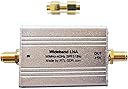
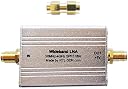
The RTL-SDR Blog Wideband Low Noise Amplifier is a bias tee powered, SPF5189Z-based LNA designed for wideband reception from 50 MHz to 4 GHz. Featuring an 18.7 dB gain and an ultra-low noise figure of 0.6 dB at 900 MHz, it significantly enhances signal reception quality. Equipped with robust ESD and overvoltage protection, it ensures durability in outdoor antenna setups. Compatible with 3-5V bias tee power sources, including RTL-SDR V3 and V4, this amplifier is ideal for professionals seeking to boost ADS-B and other RF signal performance with reliable, high-fidelity amplification.
| ASIN | B07G14Q6XX |
| Best Sellers Rank | #81,448 in Electronics ( See Top 100 in Electronics ) #488 in Audio Component Amplifiers |
| Brand | RTL-SDR Blog |
| Brand Name | RTL-SDR Blog |
| Customer Reviews | 4.6 out of 5 stars 326 Reviews |
| Manufacturer | RTL-SDR Blog |
| Material Type | Pcb, Electronic Components |
| Maximum Supply Voltage | 3 volts |
| Minimum Supply Voltage | 3 volts |
| Model | WBLNA |
| Mounting Type | Surface Mount |
| Number of Channels | 1 |
| Number of Items | 2 |
| Package Type Name | box |
| Part Number | WBLNA |
| Specification Met | Performance Specifications Met |
| UPC | 651989513519 |
| Voltage | 5 volts |
G**1
RTL-SDR Blog Wideband Low Noise Amplifier Bias Tee
I checked and it works ok with SDR with Bias-Tee!
S**N
does exactly as advertised.
Because there's no instructions, there are some adjustments you need to make for it to do it's best. 1. Connect it as close to the antenna and far away from the dongle as possible. 2. If your software supports it, turn down the LNA in your dongle if it has one. (RTL-SDR V3 has one) I used it for ADS-B decoding and had to switch from dump1090 to rtl1090 and the difference was amazing. dump1090 gave me about 10 planes max with a 50 mile radius, I switched to RTL1090 and I now get 20-30 planes on average with a 200 mile radius. (I live near a major city airport) Using the modded rtlsdr.dll in SDR#, I turned down the LNA to about 25% above 0 and I receive every police band (460MHZ) in the city with incredible clarity. This is an excellent product and just remember, you may have to change some of your settings, but it's well worth it, especially for the price.
D**P
Not magical, but a solid product
There’s a lot to like about this LNA, but it didn’t do miracles for me. This is my first LNA so I’m not sure what to expect, but I was hoping to be able to turn off all amplification on the SDR side. This allowed me to lower it, but not completely disable it. I am using it to amp for two sdrs so maybe that’s my problem. Maybe I need two. That being said, it’s built like a tank, accepted power from my old silver SDR, and I’m running it in a hot attic with no issues so far. Overall, a solid product.
F**N
Get ESD protection
This LNA is easily damaged from electrostatic discharge and should have ESD protection at its input if used with any antenna which doesn't have a loop which would otherwise short out any current, such as a folded dipole, J-pole, or a balun transformer upstream. An example of antennas where ESD could be a problem are discones, longwires and dipoles - any antenna where the two legs of the antenna don't have a chance to "short" out any electrostatic build-up. The static will reach a point where it can arc across and burn out the amplifier chip. Taking the LNA apart I saw what appeared to be a protection shunt diode but it wasn't enough. I watched it get destroyed in a storm in real-time - I didn't even hear thunder (yet) and it was gone from either lightning 15+ miles away or just static from the wind/rain around the antenna. My first suspicion was that water got through my weatherproof case I used but it was bone-dry when I analyzed it, with no signs of corrosion. The chip apparently fails to a short as the LNA was hot to the touch after the failure. That aside, it was a very effective LNA: ADS-B at 200+mi happened on a daily basis from a decent rooftop Diamond discone when the LNA was mounted on the mast as close to the antenna as possible.
S**T
Dig in, lotsa goodies possible, if you can figure out how!
Device is de-facto standard, 3rd party software can be hit or miss.
T**S
This a must have to filter noise with your SDR or other radio device
There is a night and day difference with this low noise amplifier when used with your software defined radio. The LNA will immediately improve the quality of the signals you receive in the applicable frequency range of the LNA. Its also relatively inexpensive.
B**B
Maybe a quality control issue - great when it works
Mine worked. The next one I ordered for my dad arrived DOA. The replacement arrived yesterday and I'll test it this weekend. When working, it does what it's supposed to - using it (turn on the Bias T) brings in signals that were unheard without it. It was the first thing I ordered after getting my RTL-SDR USB stick.
S**N
Works great.
Based on the SPF5189Z RF Amplifier IC this device essentially mimics the data sheet specifications according to my tests. I tested it over a voltage range of 3 to 5 volts and it works as advertised, although the gain starts to fall off by a little less than 1 dB from 3 to 3.3 Volts. A great feature of this amplifier is the addition of overvoltage protection to the input. There is a ESD suppressor diode and that is followed by a dual diode in a back to back configuration. That should be plenty of protection. If you are not going to be using this with a Bias T then you can open it up, move a jumper and add some power lads to the provided solder pads. Hooks right up to the V3 or V4 RTL-SDR (Be sure to look for the instructions on how to enable the Receivers Bias-T function before use). Bottom line: I would buy this again. Edit: I added a photo and some RF tests I made. The PCB shot details the circuit and features. The RF Gain shows the measured gain and the Input SWR shows the measured RF Input SWR. Note: On a receiver the input SWR is not all that important and a LNA by definition will have a less than perfect SWR because it is matched for low noise instead of optimizing the SWR, also the inclusion of the input protection will degrade the SWR. All in all the match is fine for all applications that this amplifier is likely to be used in.
M**5
Acars
Great product does as expected
I**N
Does exactly what it needs to
I can't easily verify the gain figures but it has helped immensely with reception of NOAA satellites around 137 MHz and 433 MHz data. Works fine using the Biastee in the RTL-SDR blog dongle and is easy to connect in the daisy chain from the aerial.
C**N
Must have for rtl-sdr
Can be as much 2x the range, depends on the situation, was able to pick up very weak signal from a long distance
M**.
Perfect
“Received item in good condition, thanks.” works well.
M**O
Funktioniert Fabelhaft für NOAA 137MHz
Funktioniert Fabelhaft für Wettersatelliten wie zB. für NOAA 137MHz. Eine Verbesserung um 100%. Wahnsinn, danke !!!
Trustpilot
2 weeks ago
3 days ago