Desertcart purchases this item on your behalf and handles shipping, customs, and support to Japan.
🎸 Transform your piezo quack into pure acoustic magic!
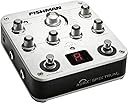
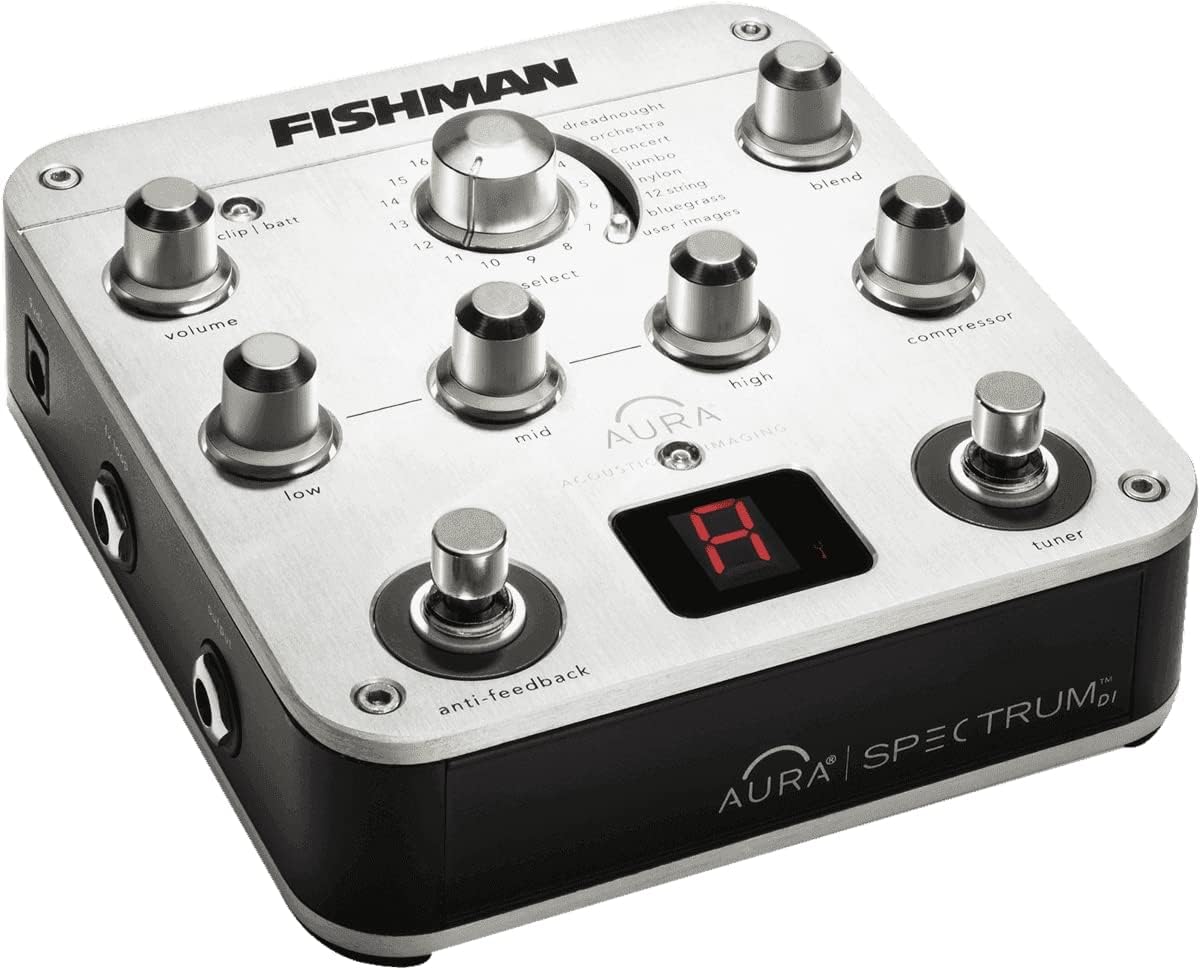
The Fishman Aura Spectrum DI is a professional-grade acoustic preamp pedal that uses award-winning Aura Acoustic Imaging technology to convert undersaddle piezo pickup signals into rich, studio-quality mic’d tones. Featuring 128 pre-loaded acoustic images, a 3-band EQ, one-knob compressor, built-in chromatic tuner, and automatic feedback suppression, it delivers versatile, natural sound for stage and studio. Its rugged metal housing and USB connectivity for image downloads make it an essential tool for serious acoustic musicians seeking pristine amplified tone.

| ASIN | B002KWG4QA |
| Amperage | 50 milliamps |
| Audio Output Effects | Compression, EQ |
| Best Sellers Rank | #47,827 in Musical Instruments ( See Top 100 in Musical Instruments ) #37 in Acoustic Guitar Effects #12,264 in Guitar & Bass Accessories |
| Brand | Fishman |
| Brand Name | Fishman |
| Color | Silver |
| Connector Type | 1/4 inch (6.35mm) audio jack, USB |
| Controls Type | Knob |
| Customer Reviews | 4.0 out of 5 stars 166 Reviews |
| Global Trade Identification Number | 00605609106797 |
| Hardware Interface | USB |
| Included Components | Aura Image Gallery software, USB cable |
| Item Dimensions | 2 x 3 x 6 inches |
| Item Dimensions L x W x H | 6.6"L x 6.1"W x 2.75"H |
| Item Weight | 454 g |
| Manufacturer | Fishman Transducers Inc. |
| Manufacturer Part Number | PRO-AUR-SPC |
| Model Name | {FEEDTITLE} |
| Model Number | PROAURSPC |
| Number of Items | 1 |
| Power Source | Battery Powered,Corded Electric |
| Product Dimensions | 6.6"L x 6.1"W x 2.75"H |
| Signal Format | Analog |
| Style | Aura Spectrum DI Pedal |
| UPC | 605609106797 |
| Voltage | 9 volts |
| Warranty Description | 1 year limited manufacturer warranty. |
J**B
Magic Quack-B-Gone box
I love the sound of a good acoustic guitar, but the sound of an acoustic guitar amplified with an undersaddle piezo pickup sounds terrible to me. Terrible. I've walked out on shows because of the buzzing, quacking piezo tone that sounds nothing like an acoustic guitar. A piezo pickup doesn't have a linear response. Of course it doesn't sound right, you are introducing distortion at the front end of your signal chain. Ick. Tragically, there are generations of young guitarists who seem to think that's what an acoustic guitar sounds like. Quaaaack. Some folks think this is an acoustic guitar modeler. It isn't. It will not make your Ovation sound like a Martin. It will not make your six string sound like a 12 string. There are boxes that will do such things (the Roland GR55, for example). What this box does is convert the undersaddle piezo output of an acoustic guitar to a mic'd sound of the same guitar using signal processing. The wizards in the secret Fishman laboratories hook up a guitar with its piezo pickup, and simultaneously mic the acoustic sound of the guitar. When they play the guitar, they electronically compare the mic'd signal to the piezo signal, and store the differences in an image file. When you play your piezo into the Fishman Aura Spectrum DI, it processes the piezo signal with the image to reproduce the mic'd signal. Pretty slick, huh? Science, man. Don't worry, you can still play religious music through it. I bought the Fishman Aura Spectrum DI hoping to tame the duck. It does! But it takes some time to match the image to the guitar. This can be particularly hard if an image is not available for your specific guitar. But there are enough images out there that you should be able to come close. For example, there is no image for my Luna AMD100, but after experimenting I found the Gibson Songwriter Deluxe Cutaway image sounds great on it. Even better, the different microphone models for this image have distinct personalities -- all good. The problems come when the image is mismatched with your guitar. The results can be all over the place. Some will nail the high end, but produce some strange resonances. Others will capture the low end, but produce a plinky high end. Some come tantalizingly close. In this, you can use it as an effect box if that floats your boat. For me, none of the mismatched images sound good. You sure can tell when you hit a well matched image. Boom! Magic! If all else fails, you can ship your guitar to Fishman and ask the wizards to make an image for your guitar. You can even select which microphones they will use. But it will cost you. The manual says to mix the image sound with the piezo. For me, the less piezo the better. I used to play out with a fairly high end acoustic through a magnetic pickup, and was never happy with the sound. I now play out with an inexpensive Chinese made guitar that costs about the same as the Fishman Aura Spectrum DI that is processing it. But I get a better sound than I ever did before. I've seen some folks complain about how much the unit costs. But if you can get great live sound with a modestly priced guitar through the Fishman, why expose your vintage Martin to the drooling, beer flinging hoards? This is a great technology, well integrated into a rugged, handsome, and convenient package. For me, it falls into the category of expensive, but worth it. And nothing else comes close.
B**T
Wow, what a difference!
I have a lot of colleagues out there looking for the perfect acoustic pedal for playing guitar. I’m very confident in saying - I found it! The Fishman aura spectrum IR is an incredible product. I play a 1974 Martin D 28 with and under-saddle pick up and a 2010 Taylor grand auditorium 214 CE with A Es-1 and I have struggled to get tones of their natural sound to the PA and into a Logic Pro DAW. The Fishman Aura does an outstanding job in both situations. For me it was a no brainer decision because it is very simple to use and packed with other features like EQ, Compression, and a Tuner all in the same mid profile footprint. There was little downside for me to purchasing with Amazon Prime as I get free returns for 30 days. I highly recommend trying it for yourself.
P**Y
Okay, I like it but...
If you're a gigging classical guitarist, you have to deal with amplifying your sound. Even a mellow coffeehouse crowd will bury a finger picked acoustic guitar with soft conversation. The problem with amplification is it tends to eat that beautiful tone you worked hard to perfect. Yes, a high end mic jacked into a state of the art audio system will hurl your listeners into tonal nirvana. Too bad no coffeehouse or eatery owns such a system. So we drag in our amps or play through terrible house systems. This is the environment the Aura Spectrum D.I. was designed for. CONSTRUCTION: This is a beefy and handsome device: heavy duty metal case, nonslip feet, smooth turning dials, sturdy footswitches and simple control layout. The control labels are too small to read while on the floor but no biggie once you memorize the layout. I assumed the image/patch would be displayed on the LCD but, instead, the LCD is reserved for tuner and bypass functions. SOUND QUALITY: According to Fishman, the Aura makes an under saddle pickup sound like a studio mic. As wonderful as the undersaddle piezo pickup is, it is not exactly natural in timbre or response. It's in the ball park but has definite electronic undertones: a tendency for harshness (piezo quack), increased sustain and electronic coloration. The Aura is supposed to simulate natural acoustic tone by blending an "image" of a mic'd acoustic guitar with the pickup signal. So does it work? My point of reference is a mix of my Neumann KM184 mic and the Cool Tubes pickup system on my Hirade TH90 and TH8SS classical guitars. Mixed 60/40 pickup and mic this combo is amazing through my Genz Benz acoustic guitar amp. I love this sound but it is a pain to carry around to gigs and it feeds back at even moderate volume. The Aura can be cranked louder than a real mic/pickup blend and, of course, the Aura is easier to transport than a mic and boom stand. The Aura boasts 128 images, but only 16 of them are for classical guitar. Luckily it has 16 additional user assignable patches. I promply filled them with nylon string images from the Aura Gallery and spend days working through the images. Only a handful of the images sounded decent to my ears. I found the images sounded best mixed between 9:00 (25%) and 12:00 (50%) with the dry signal. Even sparingly mixed, many of the stock images were overly bright with rolled off bass and lower mids. The best images were the ones I downloaded through the Aura Gallery III application, especially the Ramirez and Buscarino images. I was surprised there were no Takamine or Hirade nylon string images, especially given these are popular instruments for gigging classical guitarists. After days of knob twisting and auditioning through a Trace Acoustic TA50R and Genz Benz Shenandoah SHEN-CPK-8T I came to this conclusion: the Aura does not make a classical guitar with undersaddle pickup sound like it's mic'd. It also doesn't sound as good as an actual mic/pickup blend. Nevertheless, the Aura does sound different than a bare pickup and, with care, can impart a more realistic timbre while nixing the dreaded piezo quack. The secret is to find an image patch with a timbre close to your guitar and mix it sparingly, e.g., image mix set between 9:00 (25%) and 12:00 (50%) with the dry signal. And herein lies the catch: there is a serious shortage of good classical guitar image patches. NYLON STRING PATCHES: Most Aura classical guitar images are bright and scratchy, as if a rough fingernail or guitar pick was used. None of the images have the sweet round tone of a classical guitarist. And this bright scratchy timbre was consistent across the board from the budget Yamaha images to high end concert guitars. The resulting mix of dry pickup and image sounded more like a 1960s bossa nova player mic'd with a SM58 (upper mid EQ bump). Of course, finger style jazz players love that tone and it certainly has its place. But I'd be happy with just one great image created with Christopher Parkening or Pepe Romero tone! Please Fishman entice Chris or Pepe into your studio... TWEAKS: One of the attractive things about the Aura is onboard gain, 3-band EQ, compression and feedback control. Even with the acoustic image feature disabled the Aura makes a fine preamp and direct box (XLR and phone jack output). The EQ implementation is useful and focused towards the needs of acoustic guitarists. The range of adjustment leans towards fine increments so even a 90 degree knob rotation doesn't make a radical difference. These controls are designed for gentle tweaks and not extreme changes of tonal character. And what a great one-knob implementation of compression. The goal is to sound natural so, again, range of adjustment leans towards fine increments. Set from 10:00 to 12:00 just evens up your attack enough to sound smooth without killing off accents or dynamics. You can't really screw it up unless cranked to 11. The feedback feature works okay and I like the ability to notch out multiple tones. However, it can be slow scanning and zeroing in on individual feedback tones. I'm faster manually dialing them out with the notch filters on my Trace Acoustic amps. I wish Fishman included 16 or so nice hall and room reverb patches. It's a PITA to jack in another device just for a little reverb. POWER SUPPLY: I don't like relying on batteries for gigs and Fishman should include a wall wart for the 3 benjamins they squeeze out of ya. Better yet, allow the use of phantom power as the majority of acoustic guitarists jack into acoustic guitar amps or mixing boards with phantom power. TUNER: The Aura has a built-in tuner engaged via dedicated footswitch. Readout appears on a bright 1990s style alphanumeric display. Tuner performance is mediocre, suffering regular misreads of my guitars. The tuner built into my Cool Tubes preamp is faster and nearly 100% reliable. Oddly, the tuner works better with steel-string guitars so I assume Fishman didn't test it with nylon strings. The poor tuner is no biggie since all my preamps have tuners, but a modern LCD with patch ID and ability to save user settings (e.g., fav image, EQ, compression) would be nice. Also, wish the footswitch could be reprogramed for other functions, e.g., bypass or stepping through image patches. RFI: I live in a city full of radio and TV transmitting towers. Cheap pedals, amps and mixing boards act like radio receivers and it ain't cool to have classic rock stations randomly interrupting sets or tracks. I am happy to say the Aura is well shielded and is reasonably immune to RFI. LAST BLURB: The concept of blending samples of mic'd acoustic guitars is revolutionary and full of promise. Sadly, image quality and selection of patches are poor for classical guitar. Plus, image selections mainly revolve around differences in wood response and timbre. Sure a cedar top sounds different than spruce. However, Fishman missed the most fundamental and pronounced aspect of tone production: the touch of the human finger. I would rather have a silky toned artist like Manuel Barrueco create an Aura image on a plywood guitar than have a rough fingered dude pluck on a $25,000 Fleta... This product is optimized for acoustic steel-string players with a nod to gigging classical guitarists. Fishman could make the Aura into a killer processor/preamp for all acoustic guitarists with the addition of better nylon string images, control illumination and a bigger LCD with patch ID and ability to save user settings. Maybe someday Pepe will drop by Fishman with his Fleta and record an image. Until then, I really want to love the Aura Spectrum D.I. but I'll have to settle for the friend zone.
T**S
AWESOME pedeal...but no phantom power?!
EDIT: After about 2 years of LIGHT use, the power input jack is already broken. Still a great sounding pedal but I'm not impressed with the cheap quality. Hard to rely on products that break so easily. Battery power still works. I really like this DI. Obviously contingent on the acoustic instrument plugged in, it can really help improve the live sound of said instrument. What it will not do: This DI will not make your $200 laminate dreadnought sound like a $4000 dreadnought. Also, it won't make your acoustic guitar sound like a resonator guitar when on the resonator guitar image. What it will do: It will certainly take the "quack" out of your live tone when playing through a PA. It replaces the need to bring a tuner along with you as there is one built in that works great. It also gives you a lot of EQ flexibility. My main gripe (which is why I took a star off) with this DI is it cannot be powered via Phantom power from the board. Having said that, there is a 9V jack for power so that you don't have to rely on battery power. However, it would be much more convenient to just run an XLR cable to the DI that provides power and a signal like just about every other DI out there. Just like any tool, if you learn how to effectively use this DI, your live sound will sound much more true to the natural sound of your instrument.
B**T
Be patient! It can take time to find the right image!
It's easy to understand how this thing could get a bad review by someone who is impatient or doesn't fully understand what it is and what it isn't. To be honest, when it first arrived I'd have to admit I didn't fully understand what it was supposed to do to my guitar sound or how - I only knew what I was *hoping* it would do. Oh I had read the reviews and the online manual and seen a bunch of videos, but even then I didn't truly know how good I could get my guitar to sound or how I could make the Spectrum do it. It's an expensive piece of gear and if it didn't immediately make your guitar sound like angels singing right out of the box its easy to imagine a less patient person looking for the receipt and packing material 15 minutes in. What I've discovered after downloading all the public images from Fishman (a MUST) and trying several dozen images and settings for maybe 3 hours is that a pristine, miked acoustic guitar sound is possible, but getting there requires a lot of experimentation. Consider the variables: Each image is going to shape the sound source according to the microphone and guitar used to create it. Some of the combinations of guitar and microphone have a *dramatically* different effect on the source sound. An important point here is, either find your exact guitar make and model OR use the image wizard tool in the software to get a list of "similar" guitars. If you find an exact match you have an advantage because you just eliminated one of the variables. If not (as in my case - I have a 1984 Alvarez Yairi dred) you must resign yourself to loading several different combinations of guitar/mic images into the Spectrum and doing a lot of A/B comparisons. Other suggestions that may help find that one "sweet spot" image: 1. Eliminate everything else in the signal path. Plug directly into the amp if possible. 2. Keep everything flat, and no effects! Very important - you want to judge the subtle nuances between images on completely uncolored sound. 3. When you find a list of candidate images with the wizard, look up the guitars online and choose the ones that match the wood species of your guitar for back, sides AND top. 4. Understand that if you're playing through an image that doesn't match your exact make & model, your guitar is another variable in the equation that will inevitably color the sound. For example, it you're playing through a Taylor image and your guitar has more depth in the lower notes than a Taylor, the resulting sound might be a bit muddy or boomy, regardless of which mic is used. The trick is to try to match the make/model of the image as closely as possible in woods and acoustics to leave the microphone as the only remaining variable affecting the sound. I've been working with a few dozen images and I'm only now beginning to zero in on some that sound really nice with my guitar. And when I say really nice I mean REALLY nice. Be patient - this is not an effects pedal or a modeler. It will take some time to get the Spectrum tweaked just right to get that beautiful, natural sound you're looking for, especially if you can't find an exact match to your guitar.
R**.
Wanted to like it
I have a Taylor 314c with the ES2 pickup system. Great guitar, terrible electronics. I tried this pedal out in the hopes of improving that for stage but the pedal did not have my guitar (or one that sounded good). I tried loading more in but the software did not work well and my newish macbook pro would not find the pedal on USB. Returned.
M**Y
Fishman Aura Spectrum D.I.
I bought this on the reccommendation of reviews on line, here and elsewhere. And the reviews were right, this little box does everything I need. I was looking for a DI that would provide: a tuner, E.Q., feedback suppressor, and a pre-amp. I play a variety of acoustic instruments and needed a way to change instruments onstage without the noise associated with unplugging a guitar cable from a DI. The Fishman automatically mutes the signal when the tuner is engaged, cool! Now I can change from my guitar to mandolin or dobro without having to go to the PA to mute the channel. I wanted something that had all these abilities in one unit, having too many little boxes on-stage is a drag during and after the performance. Now for the images the unit provides. I don't have any of the guitars imaged, my stage acoustic is a strange cheap Korean guitar that I hotrodded,(tired of dragging expensive guitars to bars), so I just choose the image of the "Concert Guitar" and found a mic image that sounded the best. They all sounded pretty much the same, which all are actually very usable sounds. I knew and expected I wasn't going to make my guitar sound like a vintage Martin, or my cheap but very cool(vintage) Harmony electric mando sound like a Gibson, but my instruments sounded great and were pre-amped just right, all with just one box!!! CUSTOMER support, I had a problem with the first unit the vendor sent, it quit working a week after I bought it, just before a gig I was planning and needed it for. I went to the Fishman website and wrote a letter describing my problem and need (the gig was in one week), they understood my panic, sent me a new unit without requiring me to send the old one in first (Trust and belief in customers is a new experience for me), THIS was WAY cool and the new one came a day before the gig. In using the Aura Spectrum on the gig, I was pleased to find the feedback suppressor worked miracles, the sound man had me way loud in the monitor, with a loud low frequency making everyone nervous, I just stepped on the feedback button, and POOF!, it was gone. I could tune up various instruments and get levels very easily, all without leaving my chair (I have to sit down to play dobro). This was a new day for me, life was good, I am a happy customer!!
R**T
No ability to sample your own instrument unlike ToneDexter II, software problems on Mac?
One thing to note about this pedal is that you can't use it to make your own guitar profiles/samples. You are dependent on the online library and default IRs loaded in the pedal. Also, I found the software unstable and crashing on my MacBook Air. I like the Nux Optima Air and ToneDexter II (my favorite) because I can easily profile my own guitars and get a more realistic acoustic guitar tone from the pickup. The Optima Air is inexpensive compared to the ToneDexter II, but the ToneDexter II is worth the extra cost and much easier to use.
K**A
just love the sound of my guitar when going through this ...
Holy grail when it comes to acoustic guitar tone when playing live, just love the sound of my guitar when going through this pedal. The tuner is an added little bonus. Wouldn't play acoustically live without it. Pedal has heavy duty construction. Love it.
S**O
Selector y sonido
El sonido no tiene la calidad que esperaba y lo encuentro poco natural. El selector de instrumento no va suave y parece que se vaya a estropear. Esperaba una mejor relación calidad/precio.
T**Y
Makes scratchy DI signal into full / lush sound
For me - this is perfect. I play festivals with 1/2 hour changeovers & I need to plug in & sound good immediately. My Gibson J-45 pick-up is better than some but often the DI sound is scratchy & horrible. I sounds okay through a good acoustic amp but if I'm playing abroad or have to walk to a festival stage carrying an amp is impractical & cumbersome. The Fishman Aura takes your scratchy DI signal and turns it into full / lush sound like it would sound like if the guitar was mic-ed. A solidly built, high quality bit of kit. Things I would change: Swap the bass/middle/treble for a sweep eq & the anti-feed-back for reverb (so you can send the soundman your desired sound straight away). ps. The compression is also excellent. Throughly recommended.
D**T
Really love this
This DI really matches up to multiple guitars well the imaging software is accurate and then you just change how you want to present that sound throuhg "mic" selscetion in the settings. Really love this DI
B**R
A subtle bit of magic!
A great little bit of kit for very subtly enhancing the sound of your guitar! You can also download the vast library of mic'ed models of classic guitars, alternatively you can use some of the built-in pre-set effects. Basically, the aim of this device is to make your electro-acoustic guitar sound as if it was professionally mic'ed up using a variety of classic studio microphones, thus creating a more natural result. You can dial in as much of this to your sound as you like. There is also an on-board tuner and anti-feedback absorber.
Trustpilot
1 month ago
1 month ago