Desertcart purchases this item on your behalf and handles shipping, customs, and support to Japan.
🔌 Charge Smarter, Live Powered — Never Miss a Beat!
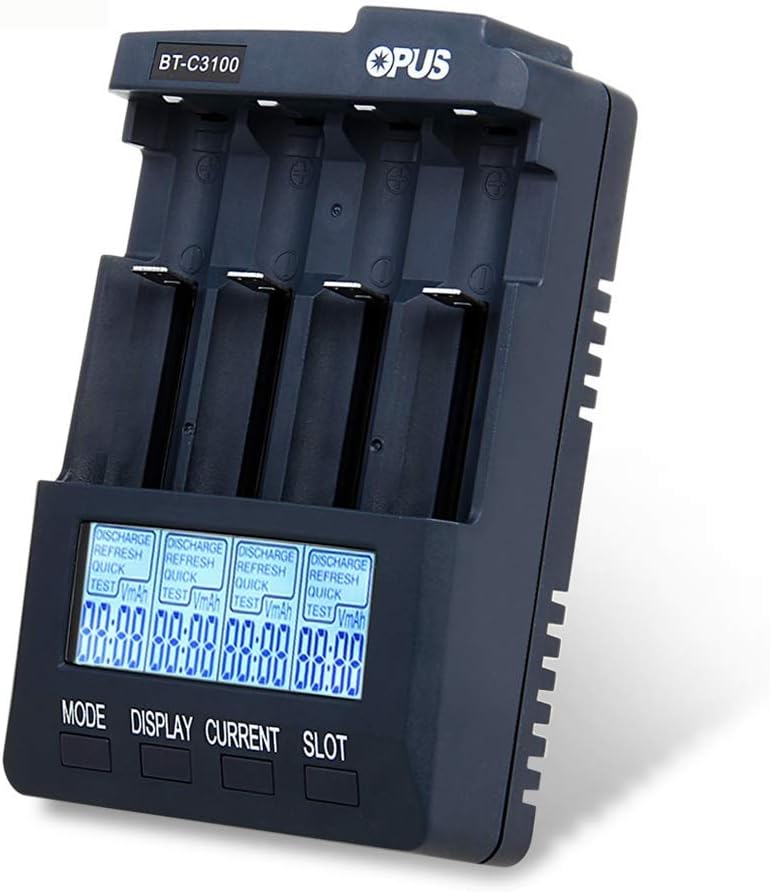
The Opus BT-C3100 V2.2 is a professional-grade universal battery charger featuring 4 independent slots that support Ni-MH, Ni-Cd, and Li-ion rechargeable batteries in multiple sizes including AA, AAA, and 18650. It offers selectable charging currents up to 2000mA, a clear backlit LCD for detailed battery status, and advanced safety features like overheat detection and thermal shutdown. Designed for power users and tech-savvy professionals, it combines versatility, precision, and safety to maximize battery life and performance.
| ASIN | B01852TBOU |
| Amperage | 1 A |
| Brand | OPUS |
| Color | purple |
| Compatible Devices | Rechargeable batteries (Ni-MH, Ni-Cd, Li-ion) in sizes AA, AAA, 10440, 14500, 16340, 17335, 17500, 18490, 17670, 18650 |
| Connector Type Used on Cable | US power plug |
| Current Rating | 2 A |
| Customer Reviews | 4.5 out of 5 stars 803 Reviews |
| Input Voltage | 240 volts |
| Item Dimensions D x W x H | 1.54"D x 3.86"W x 5.67"H |
| Item Weight | 8.32 ounces |
| Manufacturer | GBlife |
| Mfr Part Number | US126488801M |
| Model Number | US126488801M |
| Number of Ports | 4 |
| Output Voltage | 12 volts |
| Product Dimensions | 1.54"D x 3.86"W x 5.67"H |
| UPC | 713524837594 |
| Unit Count | 4 Count |
T**S
Outstanding Battery Tester/Charger
Out of the Box: The unit came with the base station, and power supply and Manual. Pros: I found these to be very well design elements of this unit both before, during and after using it: Modes: There are 5 different modes that can be selected for the unit to perform. Charging, Discharging, Refresh, Test, and Quick Test. Having this many options for your batteries is quite nice! Overheating protection: It has a temperature control monitor and a cooling fan built into the system and it does a very nice job. But that doesn't mean you shouldn't monitor the batteries. When you get a "heater" on you hands, the unit will keep dumping more and more power into that bad battery and struggle to keep the unit cool. I have a laser temperature unit to keep track of the batteries. Display: I found this very useful. you can cycle through all the settings the unit is currently set for without disrupting the process, including the current status of the process that it is doing. Current: This is my favorite part of the unit. You can charge or discharge 4 cells at the same time at 1000mAh or 1 amp for Lithium Ion cells. you are also given charging options of 200, 300, 500, 700, 1000, 1500 and 2000mAh. However for the upper charging mAh options you have to use certain slots and only 2 can be done at the same time. Voltage meter: Now I only use the voltage from my multimeter as the actual voltage of a cell. But this unit isn't dumb. If it reads that the voltage of a cell is low, it will not simple start dumping the selected mAh current you selected into the cell. It automatically drops the current down to a very small "trickle" charge until the voltage comes up enough to start putting in the selected current. I like this feature! Backlit Display: You have the option of having the backlit display on all the time or having it turn itself off after a preprogrammed amount of time. Multiple Cell options: Way too many to list here, but trust me this baby can handle all kinds of batteries. Cons: Resetting: I've not figured out what the conditions are that cause this unit to reset during the charging process. It's not over heating, or power drops or the power supply, but for some reason the unit will auto reset to the default charge settings which are 500mAh. the only thing I have figured out that overrides this is to select all the bays and cycles through the modes back to charge and setting the current back to 1000mAh. Very frustrating indeed considering how much I like this unit. Fans: While I did list this as a big Pro, it is also a Con in the fact that there is a balancing problem with how these units are manufactured. The fans will try to spin up and make a hell of a noise because they are out of balance or something. This happens multiple times until finally they start to spin up without issue. I've learned to live with it, but it is something to consider if you are planning on buying this unit. Wish List: More powerful power supply unit. The PSU that comes with the device does a good job, but it is only rated at 12DC and input of 100-240V at 50/60Hz and the output is 12v DC at 3.0A, which seems odd that it can charge at 4A. So IMO a more powerful PSU is needed. Personal experience: I'm building a DIY powerwall for my house, and I have 1000's of 18650 cells to process. I have 5 of these units working around the clock and other than the Con I listed regarding resetting (which only happens on the oldest unit) these babies do a great job! Bottom Line: Overall this product works as advertised, and performs perfectly on both large and small jobs. Recommendation: Damn Good Buy!
A**W
This saved me from needlessly buying new batteries!
A few years ago, I purchased AA and AAA Nickel Metal Hydride (NiMH) rechargeable batteries from Duracell and Rayovac, along with the Duracell 2-cell quick charger. After a few months, multiple batteries showed as "defective," and I was irritated that I had a bunch of batteries less than a year old that had gone south. I decided, on a whim, to purchase this charger based on several YouTube videos and the charger's ability to test and charge cells individually. I figured it would also be a great way to test individual cells in rechargeable power tool battery packs that had failed so I could replace bad cells and resurrect the battery packs (which I have yet to do). I first decided to place two "fully charged" batteries from the Duracell charger into this charger, and was amazed to find the Duracell charger had only charged the batteries to 1.08 volts! These batteries should be around 1.5 volts fully charged, and should be charged when they drop to 900 mV (0.9 volts). No wonder I could only get about 20 minutes of intermittent use out of those batteries! So I grabbed the allegedly-defective batteries, and found their charge level to be around 0.8 volts, which is below the recommended minimum voltage. After a short while in this charger, I had 4 fully-charged batteries. I decided to run them through this charger's testing mode, and discovered all of them were at or above the rated capacity printed on them. Multiple test runs confirmed the results, so I was quite relieved to find my batteries were not defective, the Duracell charger was the problem all along! In the months since purchase, and dozens of charge cycles, all of my batteries still test perfectly with no degradation of capacity. I was even able to bring back to life some dead NiCd AAAs from dollar-store solar lights, although I would NOT recommend this charger for that purpose as the charge current is too much for repeated use on smaller cells. The charger is able to charge 18650 cells, although I have not used it for that (yet). The internal fan that dissipates heat during the battery testing feature is silent - you have to put the charger right next to your ear to hear it. The user interface is a little bit clumsy to figure out at first, but once you become accustomed to it, it's not too bad. The ability to change the display readout to show voltage and charge current is a nice feature. When batteries are fully charged, the unit automatically switches to a very low "trickle charge" to safely keep your batteries at 100% charge for when you need them, so there's no harm in leaving the batteries in the charger indefinitely. This charger now has a permanent spot on my desk, literally a foot from my computer. It has certainly earned that spot, and what I paid for the charger was cheaper than replacing all the batteries my Duracell charger falsely claimed were defective - and those new batteries would have eventually ended up in the same undercharged condition and falsely labeled as defective. In that regard, this charger essentially paid for itself.
I**N
Fantastic Charger
Mostly charging 18650's and 26650's, but this is the best charger I've used so far. Started with an old Nitecore 2bay, then to a LUC2, up to a LUC 4, and next to a XTAR VC4. The LUC4 and VC4 ended up having issues with the voltage output, which is why they were replaced. I still have a VC2 charger for travel and have no issues with that one after about 2 years, but that's for when i'm on the road. First off, this comes with everything, which is sadly not the case with other chargers, but here you don't have to worry about buying an extra power supply like with the VC4. Second, the fan (in v2.2) is awesome. Unlike my other chargers, I've yet to remove a battery that is hot after charging. I always let the batteries rest before use, but I still like that they aren't hot after charging. The fan can be loud, or just high pitched, so I wouldn't want this thing in my bedroom...on in the master bath, but anywhere else is fine as it's almost always easily tuned out (its running right now in my home office and I can only hear it after mentioning this). Third, the charge is accurate with a wide range of options and voltages to choose from. I've already tested and fixed one battery, but other than that I usually just charge at 500ma, which it had no problems doing in all four slots. I even went up to 1kma and it had no problems in all 4 slots. I replaced the LUC4 and VC4 because after a year, the charging became inconsistent even with new batteries; time will tell if this charger will do the same but it's working better than the others so far. The display takes a little getting used to and selecting different charges for different bays can be a little wonky, but it's easy to figure out and get used to. Over all I'm very happy with the charger and would recommend it over XTAR, Efest, and Nitecore's chargers.
W**1
Not Perfect
My interest in the Opus BT-C3100 V2.2 charger/tester is for use with Li-ion rechargeable batteries, and this review will not discuss uses for the other battery types that this charger can be used with. The only two functions that are useful for Li-ion rechargeable batteries are “Charge” and “Test.” The reason is that Li-ion batteries can be recharged a limited number of times. Each cycle of discharge and charge brings the battery one cycle closer to the death of the battery. Most major brand Li-ion batteries specify the life of the battery to be 500 cycles. CHARGE Not only can you set the charging rate for each slot, but the display for that slot will display “FULL CHARGE,” leaving no doubt that the battery is fully charged. It will also allow you to see the final voltage of the battery and also how many mAmp hrs. were actually loaded into the battery. After a full charge the charger won’t apply any charging current to a Li-ion battery. If the battery stays in the slot with power still connected to the charger, it will begin to charge again if the voltage drops to 4.03V. TEST The Test function does the following in sequence: Fully charges the battery. Fully discharges the battery Fully charges the battery. You can see that there are two charging cycles and one discharge cycle with this function. They all affect the life of the battery and shorten it more than the “Charge” function. The value of the “Test” function is to test the actual capacity of a battery compared to its published capacity. I use it only once on any battery. That lets me know what to expect from that battery. Published capacities are seldom what the actual capacity is, and all too often, much less than published. In general, I have found actual capacities to be very consistent for a particular brand battery. For example, both Fenix 18650 and 21700 batteries had 95% to 96% actual capacity as the published capacity. I found that EBL 18650 batteries had about 76% actual capacity as the published capacity. The one surprising finding was that the EBL 16340 had 97% actual capacity compared to published capacities. That means to me that each battery from each manufacturer needs to be tested once. ACCURACY You might be concerned about the accuracy of the Test function because, after all, this is an inexpensive instrument. I am more concerned about the consistency of the results. I can mentaly adjust for inaccuracies, but not inconsistencies. I have tested and charged over twenty different batteries from three manufacturers. The results are amazingly consistant. The voltage of Fully Charged batteries has been exactly the same for all batteries. The percentage capacities for same brand and type batteries is so close that it scares you. DOWNER There are many good things about this instrument, but a big downer is that it won’t accept 21700 protected batteries. I believe that 21700 protected batteries are the wave of the future. Instruments that don’t support them are soon to be history. My current 21700 Fenix flashlight has its own charging connection built into the flashlight, but that doesn’t allow a Test. There is a way around this issue - make an adapter. I did that, and the results are great. I recommend this instrument if the 21700 limitation doesn’t bother you, but I have downgraded my rating from 5 stars to 4 stars because of the 21700 issue. 12 VOLTS The batteries I use with this instrument are mainly for emergency lighting when power is out. I have rigged a 12 Volt auto battery as a power supply to recharge lighting and cell phones at these times. That means that my battery charger needs to have a 12Volt power supply capability. This instrument is 12Volt powered, but the power is provided by a 120/12 Volt adapter. If you need a 12 Volt power supply cord, it requires 12 Volt Universal Connector, available on Amazon. Just make sure it has more than 3 Amps capacity.
B**N
Solid charger, good features, good price: just be sure you get the v2.2!
So, considering the plethera of crap Li and Ni chemistry chargers on the market for dirt-cheap I was a little skeptical of this one: needless to say my skepticism wasn't well placed here. I've looked at chargers twice the price with half the features, even the newest chargers from XTAR. While they are pretty universal they aren't quite as flexible as the Opus. Now, a bit of info here, The BT - C3100 and BT - C3400 are pretty much the same charger IF, and *ONLY IF* you get the V 2.2! This is very important as they've updated the PWM circuitry and Microcontroller in the 2.2 to fix a pulse current issue with the wall adapter (it was getting a good 12 Volts DC, but the wall-wart was rated for 3 Amps and the charger was pulsing it at close to 5, not too save with High voltage (120 here in the states) AC on the wall side of that plug). I tested this with a few different batteries: 18650s (LG HB6s for my mechanical squonk mod, and some LG HG2s for my Reuleaux RX200) and some NiMH AA and AAAs. All the voltages tested fine after a full charge, even after sitting for 12 hours post-charge, all charge ranges were in spec and the charger's 'Charge test' mode even reported the correct mAh of the cells. The only inaccuracy I could possibly see is the 'quick test mode': this tests the ESR (Equivalent Series Resistance) of a battery, in other words, how much power the cell can provide without an overheat, voltage sag, or current losses. The reason for this inaccuracy is contact resistance, some prrtty special equipment is needed to get a good ESR reading especially in the milliohm ranges. Now, only real downside is it's not easy to change the charge current once a charge starts and charges start QUICK, there's no button press to pause or even start a charge cycle. That said it's easy enough, just press 'slot' to select the slot you want and cycle the modes back around to charge, once the ma starts to flash press current until desired charge current is reached (always charge smaller Ni chemistry cells and Li chemistry cells at 200 - 300 ma and no more, it avoids overheats, potential battery vents and damaging the cell, larger cells are fine to even 2 Amp charges, IE: 26650s). Another quick downside is the fact that the device seems to have no 'memory' of the last 'charge test', this can be a PITA especially since the test can take a w hile with large cells. All and all a very good buy and a very full-featured charger for the price (IF you get the v2.2!). Sorry for the long-winded review. :P
T**N
Works Really Well
When I saw the price of this battery charger and tester, I almost passed on buying it. I went ahead and bought it to give it a try based on the reviews. I am glad I went ahead and got it. I really like the fact that you can charge as many batteries as you want to charge, from a single battery to four at once, with this charger and tester. I also like the way it plugs into the wall outlet with the transformer plugging into the outlet and having a cord so it can moved around on the counter while the batteries are charging. I had several old rechargeable batteries and I knew some of them were not good anymore and with this charger I was able to charge and test all of my AA and AAA NMH and NiCad batteries. I found four batteries that were no good and would not take a charge and was able to get four batteries that would not charge with a standard charger to take and hold a charge with the discharge refresh cycle built in to this charger and tester. I want to note here that I had tried to charge the batteries that came back to life with a standard battery charger they came with for two days before placing them in the new charger, but the new tester showed they had not taken a charge and showed zero voltage when first put in the new charger and tester. The ability to find the bad batteries is reason enough alone to warrant the purchase of this charger. The fact that it will actually bring some dead batteries back to life, instead of just getting rid of them to a recycling station is a great feature and makes it an even better value. After changing some of the original settings I did unplug the unit to reset it to the factory charging settings. The fact I had to unplug it and start over again was not a big deal to me but was a bit of an inconvenience. I also like the fact that this unit has a fan that runs when needed to help keep the batteries and the charging unit cool. I didn't notice any overeating problems when charging either the good batteries I had or the batteries that were no longer any good. I would definitely buy this charger and tester again based on the experience I have had so far. I wish I had bought it sooner so I could have gotten rid of the batteries that weren't any good.
J**E
Great individual cell charger and characterization for reclaimed 18650 cells.
I have two of these and use them to charge reclaimed 18650 Li Ion cells from old laptop batteries. It does a great job of this and will tell you individual cell impedance in milliohms and total capacity in milliamp hours (you set the discharge rate at up to 500mA for the latter). Note that max charge rate is 500mA---it can take overnight to charge a fully depleted 18650 3Ah cell due to the CC/CV charge method. I then match up cells and use them in 2 cell LED flashlights. A typical laptop battery will yield 6 to 9 cells and that gives you plenty for LiIon flashlights and the cells typically are 1.5 to 2.9aH cells. The ones you buy with the flashlights say 3Ah, but only test ~0.6Ah---you can even tell by the weight difference. This charger/analyzer will prove it to you. There are essentially 4 independent chargers/analyzers. If you use it for cells larger in diameter than the LiIon 18650 you will not be able to charge 4 at a time (ex---if you charge D cell batteries you can only charge two at a time from a physical/space constraint). Nice backlit display (blue) for easy reading. Took awhile to ship it. Note it has a cooling fan that runs during the discharge cycle that puts out a bit of noise---not a lot, but enough to be pesky if you're trying to watch a movie while it's charging.jl
M**R
Not a bad charger, but it does not last long.
This is a fairly reliable charger, until it isn't. For me, it took about 4 years before it started acting strangely. I have always had the transformer on a surge protector, so the fact that we lose power here often shouldn't be an issue. Symptoms were the LCD display will wink out, and give a 2.2 error on initialize. It can then not detect your batteries properly, or re-detect incorrectly while they are charging. When it does this, it can overcharge and overheat them. (Ask me how I know) So be careful after you have had the unit for a while. Also, the transformer will spark if you have it plugged in, then plug it into the charger. There is no surge protector in the transformer. I got about 4 1/2 years out of it. So when purchasing it, know you will need to replace it after 4 or 5 years. Other than that, I have had no issue with it.
B**S
Very nice charger/tester
This is a great little 4 cell charger, charges cells 4.17 volts which I have confirmed with my Fluke multimeter to be correct. Does a quick internal check for resistance and a comprehensive refresh cycle, which takes forever if have to many cells. Don’t hesitate this and the Lakota are the best.
C**.
Buena calidad de materiales pero LCD dañada
Acaba de llegarme este cargador, por todos los buenos comentarios que tiene decidí comprar este, sin embargo me llegó dañado de la LCD, algunos indicadores no encienden, por lo que procederé a hacer un cambio con la esperanza que el segundo me llegue en buen estado, por el momento solo por eso pongo 2 estrellas, con la intención de subirlo a 5 estrellas una vez probado el segundo intento
A**S
Excellent charger
Works as expected
Trustpilot
3 days ago
2 weeks ago