Buy anything from 5,000+ international stores. One checkout price. No surprise fees. Join 2M+ shoppers on Desertcart.
Desertcart purchases this item on your behalf and handles shipping, customs, and support to Japan.
๐ท Elevate your story โ shoot like a pro, no fuss, all flair!
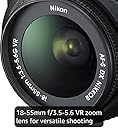
The Nikon D3100 is a lightweight, entry-level DSLR featuring a 14.2MP DX-format CMOS sensor and a versatile 18-55mm VR zoom lens. It offers full 1080p HD video recording with continuous autofocus, a user-friendly Guide Mode for learning photography, and fast 3 fps shooting with 11 autofocus points. Perfect for millennials seeking to upgrade from smartphones or point-and-shoots, it balances professional image quality with intuitive controls to capture life's moments effortlessly.
| ASIN | B003ZYF3LO |
| Age Range Description | Kid |
| Aperture modes | F3.5โF5.6 |
| Are Batteries Included | Yes |
| Aspect Ratio | 3:2 |
| Auto Focus Technology | Phase Detection, Contrast Detection |
| Autofocus | Yes |
| Autofocus Points | 11 |
| Best Sellers Rank | #118,393 in Electronics ( See Top 100 in Electronics ) #152 in DSLR Cameras |
| Bit Depth | 12 Bit |
| Brand | Nikon |
| Built-In Media | Battery, Battery Charger, Body Cap |
| Camera Flash | HotShoe,Built-in pop up |
| Camera Lens | High-performance Nikon super integrated coating, rounded 7-blade diaphragm, 11 elements in 8 groups |
| Color | Black |
| Compatible Devices | Computers, External Storage Devices, Remote Control Devices, TVs |
| Compatible Flash Memory Type | SDHC, SDXC |
| Compatible Mountings | Nikon F (FX), Nikon F (DX) |
| Connectivity Technology | wired, wireless |
| Continuous Shooting | 3 FPS |
| Crop Mode | 3:2 |
| Customer Reviews | 4.5 out of 5 stars 1,236 Reviews |
| Digital Scene Transition | zoom |
| Digital Zoom | 6.7 |
| Digital-Still | No |
| Display Fixture Type | Fixed |
| Display Maximum Resolution | 230,000 pixels |
| Display Resolution Maximum | 230,000 |
| Display Type | LCD |
| Effective Still Resolution | 14.2 MP |
| Expanded ISO Minimum | 100 |
| Exposure Control | Automatic |
| External-Memory Size | 2 GB |
| File Format | RAW, JPEG, WAV, MPEG-4 AVC/H.264, AAC |
| Flash Memory Installed Size | 1 GB |
| Flash Memory Type | SD/SDHC/SDXC |
| Flash Modes | TTL |
| Flash Sync Speed | 1/200_sec |
| Focal Length Description | 18-55 Millimeters |
| Focus Features | Multi, Spot, Continuous |
| Focus Mode | Manual Focus (MF), Single-Servo AF (AF-S) |
| Focus Type | Automatic with Manual |
| Form Factor | DSLR |
| Generation | 1 |
| Global Trade Identification Number | 00018208254729 |
| HDMI Type | Type C Mini HDMI |
| Hardware Interface | AV Port |
| Has Color Screen | Yes |
| Image Capture Type | Video |
| Image Stabilization | Digital |
| Image stabilization | Digital |
| Item Weight | 1.3 Pounds |
| JPEG Quality Level | Basic, Fine, Normal |
| Lens Construction | 11 Elements in 8 Groups |
| Lens Type | zoom |
| Manufacturer | Nikon |
| Manufacturer Part Number | 25472 |
| Maximum Aperture | 3.5 f |
| Maximum Focal Length | 55 Millimeters |
| Maximum Image Size | 14.2 MP |
| Maximum Shutter Speed | 1/4000 Seconds |
| Memory Slots Available | 1 |
| Memory Storage Capacity | 1 GB |
| Metering Methods | Multi, Center-weighted, Average |
| Minimum Focal Length | 35 Millimeters |
| Minimum Shutter Speed | 30 seconds |
| Model Name | Nikon D3100 |
| Model Number | 25472 |
| Model Series | D3100 |
| Movie Mode | Yes |
| Night vision | No |
| Number of Diaphragm Blades | 7 |
| Optical Zoom | 3 x |
| Phase Detection Sensor Points | 1 |
| Photo Sensor Resolution | 14.2 MP |
| Photo Sensor Size | APS-C |
| Photo Sensor Technology | CMOS |
| Real Angle Of View | 28.6 Degrees |
| Recording Capacity | 10 Minutes |
| Remote Included | No |
| Screen Size | 3 Inches |
| Self Timer | 10 Seconds |
| Sensor Type | CMOS |
| Series Number | 25472 |
| Shooting Modes | Automatic, Scene Modes, Programmed Auto, Shutter Priority, Aperture Priority, Manual |
| Skill Level | Amateur |
| Special Feature | TFT-LCD with 230K pixels and a brightness adjustment |
| Specific Uses For Product | Photography |
| Supported File Format | RAW, JPEG, WAV, MPEG-4 AVC/H.264, AAC |
| Supported Image Format | RAW, JPEG, WAV, MPEG-4 AVC/H.264, AAC |
| Total Still Resolution | 14.2 MP |
| Total USB 2.0 Ports | 1 |
| Total USB Ports | 1 |
| Total Video Out Ports | 1 |
| UPC | 018208919574 018208254781 018208254729 |
| Unit Count | 1.0 Count |
| Video Output | NTSC, PAL |
| Video Resolution | FHD 1080p |
| Viewfinder | Optical |
| Viewfinder Magnification | 0.8x |
| White Balance Settings | Auto, Cloudy, Color Temperature, Daylight, Flash torch, Fluorescent, Incandescent, Shade |
| Wireless Technology | EyeFi |
| Write Speed | 3 fps |
| Zoom | Optical |
M**6
Takes excellent pictures and gets out of the way while doing it
This Nikon D3100 is a phenomenal deal for non professionals, the rest of us people that want to take family and travel shots. I've owned DSLRs since 2004, starting with a Nikon D70 and then moving to D40, D200 and Canon Digital Rebel XSi 12.2 MP Digital SLR Camera with EF-S 18-55mm f/3.5-5.6 IS Lens (Black) and Canon EOS 40D 10.1MP Digital SLR Camera (Body Only) . Those are all excellent cameras, but this Nikon D3100 is better than all of those in one crucial area, the area that matters: it takes excellent pictures without having to fiddle with the settings between shots. Yes, the other cameras are better in other respects: They have more buttons to change settings without delving into menus, they are bigger (is that a plus?), heavier (another plus?), and have better specs (1/500 flash sync speed for D70 and D40), but in the end I would have to fiddle with the settings to get the best results: change the white balance, fiddle with the ISO (my Canons would default to ISO 400 for flash shots, why? Who knows. That meant disabling auto ISO and choosing ISO settings manually), the exposure (+0.7 indoor, 0 outdoor), and so on. D200 was noisy at higher ISO, D70's pictures tended to be cool (i.e. not warm), 40D had cool custom buttons (C1, C2, C3, very cool), but I found its ergonomics worse than XSi or any Nikon; why place the on/off switch at the bottom of the body? Who knows. Fortunately, new Canons have fixed this). This D3100 also makes the D3000 and D5000 obsolete. The D3000 is slow and noisy at high ISO. The D5000 only shoots 720p (not 1080p), no autofocus in movie mode, less resolution. Old technology. What sets the D3100 apart from all the other cameras above is this: set the camera in P (program) mode, auto white balance, -0.3 exposure compensation, slow flash sync mode (for people shots), auto distortion correction on (great!), auto chromatic aberrations correction on (great!), and you are set; now you can concentrate on the only aspect of photography that matters: composition, i.e. framing your shot in the best possible way. There must be a photography mantra that says, "thou shalt buy the D3100, and the D3100 will set you free." Now this is if you shot jpeg. If you shoot raw, you can then use a program like DXO, Aperture 3 , or Adobe Photoshop Lightroom 3 to further play with the pictures. My workflow with the XSi was to shoot raw, then use DXO to batch process all the pics according to two settings: people (low contrast, no saturation added) and landscape (contrast, saturation, etc.). DXO would then batch-remove lens distortion, chromatic aberrations, vignetting, apply custom curves, change white balance when necessary, and apply its (almost magical) auto lighting settings to make the shots pop. For now DXO does not have a custom module for the D3100 (still too new of a camera), so I'm shooting jpeg for now. Once DXO adds the module for the D3100, I'll takes shots in both raw and jpeg fine and compare the jpegs straight out of the camera with the raw images processed with DXO. I'm curious to see the comparison. This is great, not only for you, but also for your non-photographer spouse; my XSi took phenomenal shots, but I had to know how to set it. Can you imagine me going to my non-photographer wife and say, "okay, when you take indoor shots of our kids, set the camera on A mode (Canons expose for ambient light in A mode and adjust flash for fill, that's great), +0.7 exposure compensation, ISO 400 or 800, white balance on cloudy, and shoot." My wife was lost at "okay." Sure the custom modes on the 40D would have helped, but the 40D is old technology; can it take 1080p video? I didn't think so. Plus, what lens are you going to use with the 40D? The 17-55 IS? Great lens, but who wants to spend $1,000 for a non-weather sealed 17-55 dust collector (google Canon 17-55 and dust)? Will 17-55 be enough for your telephoto shots? Your kids' baseball games? Didn't think so. What about the Canon 18-200? Sub-par quality, noisy, overpriced. Back to the D3100. Auto white balance (the second most important thing after composition) works great, even indoor (no cloudy setting necessary), the only changes are extreme situations (outdoor shade, or indoor fluorescent or tungsten lights at night, but that is true with every camera. Why that is is beyond me; can't they make smarter cameras that account for these situations as well?); movie mode is excellent; yes, the mic is mono, but that's okay for family use (and that's why you buy this camera; if you are pro, you landed on the wrong page); if you really want to push it, you can use this camera for video, your iphone/ipod touch for audio with an app like FourTrack, and then sync video and audio in post with the excellent Singular Software Dual Eyes program. Your choice. Matter is: DSLR video can look awesome if used the right way, but keep in mind its limitations: jerky camera horizontal panning will give you the infamous jello effect (courtesy of the CMOS sensor), so pan slowly. You'll also have to play with autofocus vs manual focus settings sometimes; I've used the camera in autofocus; it has worked great so far. What lens(es) should you use with the D3100. You should sell the (excellent) 18-55 that ships with the camera. Quality is good, but not enough reach. You can sell it for $140 or so. Take the money and use it toward a more useful lens. What lens? The target market for this camera is moms and dads that want to take shots of their kids; even advanced amateurs like me don't want to travel with a camera bag full of primes and heavy zoom lenses that you have to swap every 10 minutes; this is 2010 (almost 2011), for crying out loud; choose a single zoom and enjoy life and photography; I would use the excellent but underrated Nikon 18-105mm f/3.5-5.6 AF-S DX VR ED Nikkor Lens for Nikon Digital SLR Cameras , the excellent (but expensive) Nikon 16-85mm f/3.5-5.6G AF-S DX ED VR Nikkor Wide-Angle Telephoto Zoom Lens for Nikon DSLR Cameras , or my choice, the jack-of-all trades, the Nikon 18-200mm f/3.5-5.6G AF-S ED VR II Nikkor Telephoto Zoom Lens for Nikon DX-Format Digital SLR Cameras . Yes, yes, if you check sites like Photozone, they will tell you that the optical quality of the 18-200 is not as good (or consistent) as the 18-105 or the 16-85, but it's good enough for moms and dads bitten by the photography bug. A great shot of your kid at 200mm is better than no shot with either of the other two lenses. The optical superiority of the 16-85 disappears at 135mm or 200mm, simply because it can't do it. The 16-85 and the 18-200 are about the same price. The 18-200 will set you free. It won't help you if your kids play baseball at night (too slow), but you'll have to live with it, unless you are willing to drop $2,000 on a Nikon 70-200mm f/2.8G ED VR II AF-S Nikkor Zoom Lens For Nikon Digital SLR Cameras . Sure, we'd all like a 16-300 VR VIII lens with a 20-stop VR reduction, constant 1.4 aperture, with optical perfection, weighing only 500 gr. and below $1,000, but alas our engineers are not as good as the random mutation and natural selection that gave us our eyes ;-0 My settings: Display mode: detailed photo info > check RGB histogram and data > Done (why? You want to check if you are clipping the red, green, or blue channels) Transition effects: OFF Set picture control: portrait (for people shots) Landscape: for, well, landscape shots: increase sharpness to 4 (D3100 shots are unsharpened by default) Image quality: raw + jpeg fine (or jpeg fine, if you don't want to mess with raw) White balance: auto (I played with the settings to A1, A2, A3, but images were to yellowish for my taste, as if my kids had jaundice). Auto works fine Auto ISO: on Min shutter speed: 1/30 (1/15 if you have steady hands) Max ISO: I set 800, you can push to 1600 or even 3200 (your choice) Standard ISO: 100 Active D-Lighting: on (it works well) Auto distortion control: on (Great) Movie settings: 1080 24p. You can also do 720 at 30p for less jerky movements Info display format: i prefer classic black (your choice) Auto info display: off Image comment: your choice. I have my name, copyright (haha), and phone number Beep: off (please) AEL-AFL button: I only lock exposure, not focus. My accessories: 67-to-77 ring adapter (if you have the 18-105 lens) 72-to-77 ring adapter (if you have the 18-200 lens) 77mm haze filter. I use the best, The B+W 77mm UVA (Ultra Violet) Haze MRC Filter #010 one. You don't want to use a cheap fIlter on top of a $350 or $650 lens. 77mm circular polarizer fliter; again I use the best, the B + W 77mm Kaesemann Circular Polarizer Coated Glass Filter . This filter is for your travel shots. It will make blue skies bluer and will remove reflections from that gorgeous Maui ocean. This is an expensive filter at $180 or so; you don't have to get it right away, unless you are going to Maui soon. Why 77mm filters? Because you don't want to go nuts buying filters of different sizes for your lenses. If buy the 67mm filter for your 18-105 lens and later decide to upgrade your lens to the 72mm 18-200, you are screwed. It's cheaper to buy a $5 lens ring adapter to 77mm and use 77mm filters. It'll keep you sane too. Remember why you purchase this camera: you want to enjoy photography; enjoy it then.
N**K
Nikon D3100 - An Excellent DSLR For The Entry-Level Photographer
The Nikon D3100 is an excellent entry-level DSLR. Could you pay more to get a "better" camera with "more features"? Absolutely. But why? Would you use those features? I looked long and hard at several in my research before buying - the models I considered were the Canon T2i, Canon 60D, the Nikon D90, and of course, the Nikon D3100. In the end, I decided the extra features on those other cameras were features that I likely wouldn't use. I'm interested mainly in taking lots of pictures while traveling -- pictures of clouds, landscapes, maybe some street photography. I wanted a smaller, lighter DSLR with good battery life and great image quality. The D3100 delivers on all accounts. So what do the cameras in the next price-tier have that the D3100 doesn't? A lot of stuff that most people looking in this price range won't be concerned with. Here's a list of the "missing" things and/or "problems" with the D3100 as I found while researching my purchase: 1) Most online reviews and forums mention a problem with AutoISO and the built-in flash. When using the built-in flash in full auto, AutoISO jumps straight to the maximum ISO value, which I believe is defaulted to ISO-3200. Nikon says this is intended to get a better exposed background, fine with me. Personally, I think that ISO-3200 images out of this camera are very useable unless you're pixel peeping. If you just want to blow up an indoor portrait to an 8x10 (or even larger, I don't know!), you won't have a problem. Don't worry about it! 2) You can frequently hear the lens auto-focusing in your videos. Ok, you got me. If you're in a silent environment, yes, you will hear the autofocus motor, but if you're recording kids laughing and having a good time at the local indoor waterpark or at a parade or something, it's not loud enough where it would be a bother. If it is an annoyance, you can still shoot video with manual focus. 3) No external mic input. The D3100 is sufficient for getting a clip when you want it, you're not going to have movie quality sound. Who carries an external mic with them on vacation? If you're buying a DSLR specifically for video capabilities, you probably should be considering a dedicated camcorder anyway. For my purposes, there's nothing wrong with mono sound. 4) Lack of bracketing -- too much to explain in a review. Google it and see if you would ever use it. I can see why it would be useful, but I doubt it'd be useful for on-the-go photography. 5) Manual settings buried in menus instead of having dedicated buttons -- Most people at the entry-level probably aren't shooting full manual. The D3100 features several "scene" modes that you can use, otherwise there's always aperture or shutter priority, or even full auto. Depending on which priority you're in, the scroll wheel on the back will adjust the aperture or shutter speed. If you shoot full manual all the time, you may want dedicated buttons, meaning you should look elsewhere. If you're not in full manual, I can't see this being a problem. 6) Lack of built-in flash commander mode -- you can't trigger an off camera flash using your built-in flash. Some DSLR's have built-in flashes with this capability, the D3100 does not. For travel photography, this isn't an issue. For most at-home photography, this isn't an issue. It could be for macro photography depending how close to your subject you are, or if you have a full studio with multiple flashes setup in your basement. If you decide at a later point you want this capability, some external flashes such as the Nikon SB-700 can function as a commander. Otherwise, you can use whatever external flash you wish in conjunction with the SC-28 or SC-29 cord inthe D3100's hotshoe. 7) Perhaps the biggest potential problem with the D3100 is the lack of a built in focusing motor. This means the D3100 will not autofocus with plain AF lenses (manual still works though). Any lenses with the AF-S designation will auto-focus just fine. This can be costly though - on some of the higher-end lenses, the difference can be $600 or more between the AF and AF-S version of the same lens. Again, this comes down to "what will you use it for?" For this, I go back here: If this is a problem, you shouldn't be looking at an entry level DSLR anyway. Nikon ships the D3100 with the 18-55mm AF-S VR lens, offers a very affordable 55-200mm AF-S VR telephoto, and my personal favorite, the 35mm f/1.8 AF-S lens. The 55-200 can be had for under $100 if you catch a sale or rebate, and the 35mm can be had for under $200. These three lenses will cover most of the needs for entry-level photographers, and all three of them auto-focus on the D3100. By the time we as amateur photographers outgrow this setup, we will know specifically what focal lengths we primarily use in order to make a more educated purchase for the expensive lenses later on. And I'm convinced, when that time comes, you'll have your eye on the latest and greatest prosumer DSLR to go with your fancy new lens anyway. Until then, enjoy the D3100 for what it is. A great, inexpensive, entry-level DSLR, which, in my opinion, produces excellent images when in the hands of a photographer ready to learn!
D**N
A fantastic entry-level DSLR camera.
The specification is in the product listing for everyone see, so I won't review that, other than to say that this camera is a good specification for the price. I'll aim this review towards detailing my experience with using this camera. People looking at this model are likely comparing it to the similarly priced Canon model. Both brands are quite comparable, so at this level of the market it is really a matter of personal preference as to which brand you choose - and the current deals and discounts on offer. I choose the Nikon D3100 camera with the kit 18-55mm lens over the Canon model because I got a large discount off the second lens I wanted - the 55-200mm. (I see now that Amazon sells the camera with this lens in addition to the 18-55mm as an option, but this wasn't an option back when I bought then.) I thought with these two lenses I would have an adequate kit to get started in DSLR photography, although either a 35mm or 50mm prime FX lens is next on my wishlist. (FX lenses work fine on a DX body such as the D3100, although with a 1.5x effective focal length boost so I can somewhat future proof my lens purchases in the event I eventually upgrade to a better camera body.) I bought my camera and lenses back in April 2013 and decided to use it for several months before I reviewed them. I was heading on a trip a month later that I wanted this camera to accompany me on, and also wanted time to get to grips with the step up from many years of just using point and shoots before I offered a public opinion. I had wanted a DSLR for years, but couldn't justify the cost to myself, (I have kids and feel guilty spending money on myself), and so I had already read several books that explained the science of taking photos in a fully manual mode with a DSLR but I had never so much as picked up a DSLR before buying one. From using both film camera and digital point and shoots I was already fairly experienced and proficient in the composition aspect of taking a photo as well as in using image processing software such as Lightroom, Photoshop (Elements) and Paint Shop Pro to improve my photos. Of course, with a point and shoot or a scanned film photo I was forced to edit lossy JPG files - and now with a DSLR I can process native RAW files, (.NEF format on the Nikon), and the results from this change alone are phenomenal! I was amazed by just how much detail can be found in a RAW file using Adobe Lightroom 5 from what looks like a flat white or black area in an over/under exposed area. I'll never shoot in JPEG again if I have an option to shoot in a native RAW format. When I had received the camera I read the manual from cover to cover while the battery fully charged. I then jumped in my car and headed off on a drive to somewhere fairly scenic but local(ish) to test out my new purchase. I was determined that I would rarely use the fully AUTO mode unless I wanted to take an unplanned rush shot of something I'd miss photographing otherwise. My several hours that day out taking photos was a very educational (and fun) time for me, and certainly cemented my enthusiasm to learn more about photography that I had hoped I would have when taking the jump up to a DSLR. I toyed around taking photos of things with differing apertures in Aperture Priority mode until I was comfortable controlling the depth of field, (as best I could with the kit lens.) took photos of things both close, and the mountains far away, at varying focal lengths, confirming for myself various aspects of photography I had read so much about but hadn't been able to practice and experiment with before fully, (e.g. bringing the background scenery closer while keeping a foreground subject a constant size.) Back home that evening I went out in the back yard and mounted my new camera on an old tripod I have with the 55-200mm lens and took photos of the moon and my house in the dark until I better understood shutter speed settings and how different ISO settings affect the photos I take. Again, this was all stuff I'd read about, but never really fully had practical experience with regard to my own photographs before. My kids were also willing models so I could experiment with portraiture.photos using different settings until I achieved the effects I wanted or could achieve with just the kit lens and it's lack of a large aperture (small f-stop). Over the next few weeks before the family trip I planned to take this DSLR on with me, I picked the camera up and experimented daily. I took better photos every day and started to instinctively know what settings to use in full manual mode - my first guesses became increasingly correct, or were otherwise a pretty good starting point to fine tune when I had set the camera incorrectly for the conditions or photo I wanted. This is a tremendous camera to learn with and takes fabulous photos. My family went on the trip overseas. I took close to 3000 photos in the weeks we were traveling. Granted, I used the camera in a continuous shooting mode almost exclusively -- taking several photos of the same scene to try to guarantee a good shot - especially when photographing movement or people, so the total figure was bumped up somewhat. If I'm taking photos left, right and center, I do now cheat a little and use Aperture Priority mode quite a lot so I just control the depth of field and let the camera do most of the rest, (although I retain control of the ISO as the camera seems to do a poor job in auto mode sometimes.) If I am planning a photo that I want to be proud of, I will still switch to full manual mode for the satisfaction that I am "making" a photo rather than just "taking" a photo. Oftentimes though, when out and about, one of the semi-manual modes (Shutter Priority or Aperture Priority modes) are all that is required to get the shot wanted and are a time-saver to use. Okay, I admit it - I sometimes use Auto-mode now too... I hope others decide to take the plunge from a point-and-shoot camera to a DSLR and ignite a similar passion for photography. I'm very happy with my purchase.
C**T
Good camera, could use a little more on the value side
I recently purchased the D3100 and have taken some shots in a variety of conditions. I have not yet had the opportunity to dive into the full feature set. Initial impressions: Pros: Very nice image quality (my primary concern), easy to use, includes reasonable editing software. Cons: Nikon is bit stingy when packing the box (no USB cable, no memory card at all); no exposure bracketing feature. So far, I have been very pleased with the images coming from the D3100. The colors are true and vibrant. It handles light and shadow well. The captured detail is impressive. I haven't "pushed" this camera yet with higher ISO shots or other more demanding techniques / settings however, I suspect that many of this camera's users, if not most, will not have the need or desire to wander too far away from the "Auto" setting, which does a very capable job in variety of conditions. The flash works well with the camera and there is a minimum of the "over exposed" or "glare" look that is commonly seen in family flash photography. This camera at its most basic level is dead simple to use: point and shoot. The camera may look intimidating to those who haven't previously used a full featured film camera or a DSLR but, pick it up, set it to "Auto", snap a few frames and you'll both feel much more comfortable with it and intrigued to learn more about its other capabilities. This camera is targeted for the entry DSLR market and anyone moving up from a compact point-and-shoot camera will immediately recognize the difference in image quality. The Nikon software was also easy to use and can really bring out the impact in your shots. The software installed without problem on my mac. Through the software, I was able to pull additional depth and detail from the initial captured image (I used RAW format for capturing). I did use the default JPEG as well and I doubt that many family photographers will have any complaint with those images. Again, the various sliders and options in the software can seem daunting at first, but you will be rewarded by playing around with settings (you won't ruin anything). As mentioned previously, through the software, I was able to take some images that would have been OK and make them compelling. I am not saying that they will be hanging in a gallery soon, just that they are far more visually interesting than they were and with a minimal amount of effort. The images included people, nature, indoors and out. I am not completely sold on the auto focusing, especially when the subject is in motion. I haven't used it enough in these circumstances to fairly comment, just something that has initially popped up as an item to explore further. For the record, the images in question seemed sharp though not quite what I had anticipated. It is too early to hang AF from my uses, though. I have not used (and have no immediate intention of using) the video feature. I have a video camera that shoots video well. Personally, I'd rather have additional still features (auto bracketing) than video. I understand that there may be a desire to pack everything within one device from a marketing perspective. However, I am of the mind that a device ought to focus on its primary mission and forgo additive items that it does less well. I have no understanding of why Nikon would not include a USB cable to connect the camera to your computer. Fortunately, the cable is not proprietary and I was able to reuse an existing cable from another camera. How exactly does Nikon propose that you transfer your images from the camera to your machine for use with the included Nikon software? That just doesn't make sense when the cable that I reused came included with a camera that cost $400 less than the D3100. Overall, I am very happy with the image quality (which makes the omission of bracketing even more noticeable), the ease of use, and the included software. I would have liked a starter memory card in the box and am really surprised that it did not include a USB cable. The price for value relationship needs some improvement, though the product itself is solid. This would be a good way to get into the DSLR segment for those moving up from compact point and shoot.
A**W
A Consumer Camera that holds its own in Professional Arena
Before people start freaking out I am not comparing this to a Canon 1DX when I mention "PRO" in the review title, rather, that I use this consumer targeted camera for a very specific professional task. I own 4 of these "kits", basically the D3100 and the 18-55 lens. My company does high volume photography, mostly sports, schools and events (we will photograph over 90,000 kids this year) and I thought I would give these a shot to see how they would hold up for some of my basic sports portraits shoots and I am pleasantly surprised. Make note of the word PORTRAITS after sports, we do not use these for action. I actually compared this, side by side, shot by shot with the Canon T2i when deciding which way to go since I was going to be purchasing so many of them. It was actually a pretty big decision since I was deciding on a Nikon camera when my personal camera is a Canon 7D. When comparing the 2 cameras I literally set them up on tripods right next to each other, took shots in the exact same settings, conditions, etc. First, I compared everything in Manual mode, then I let the camera do the work in Shutter Priority, Aperture Priority and full Program Mode. Without running through every single shot I can simply say the Nikon D3100 beat the Canon t2i, much to my surprise. This was a VERY close comparison and, in the end, the price of the Nikon helped tip the scale in that direction. Image Quality The D3100 wins here. How, you say, is that possible? The Canon is 18 megapixel and the Nikon is only 14.2...true, but Nikon has a secret weapon, the 18-55 lens! Believe it or not, the 18-55 Nikon lens, the KIT lens that comes on this camera and many others, is actually one of the sharpest images Nikon makes. I wouldn't believe it if I hadn't taken hundreds of shots, blown them up to 100% and compared them side by side. Now, if you are looking for something where you plan to change lenses from time to time, then the Canon is the better choice. However, in the case of my very specific needs, where I will never need to change out the lens on this camera because it is for sports portrait shoots only, you cannot beat the D3100. I actually chose the Canon for another area of my business out of state where I needed more durability and flexibility...more on that in another review. As with any product, it will ultimately boil down to how you plan to use it. If you are a consumer who is just getting into Digital SLR cameras, this is a great way to start. It is cheap and it takes great images. It has video, which is nice, although I do not use it so I can't give an in depth review of that functionality. Make sure that you get the kit with the 18-55 lens though, that makes a big difference in image quality. It also has a great little feature that would be really helpful to beginners trying to understand how Aperture works. It has a little animation on the LCD screen that shows an actual camera iris opening or closing as you adjust the aperture, which is helpful for beginners trying to understand the lower number being a bigger aperture concept. So, to sum it up: PROS: Price: You can't beat it, if you watch Amazon closely you will be able to catch it in the $500 range or maybe a bit less if you are lucky Image Quality: Really amazing image quality WITH the 18-55 lens especially. Good for Beginners: Has some really good tutorials to help beginners understand the basics of DSLR. Great "Auto" settings: Produces really nice images on many of the standard settings for Shutter and Aperture Priority and full Program. (although I recommend to beginners to try to learn how to shoot in Manual mode at least to understand how it works and NEVER use any of the silly settings like "Sports" or the other ones.) CONS: Not very tough: It feels a lot cheaper than the Canon Really small: It looks ridiculous with an SB900 flash on it! (This is a con for me but might be a pro for others) Overall, I definitely recommend it for a beginner or someone with a very specific professional need like I have. It earns 5 stars for how I use it.
K**N
First DSLR for a beginning photography hobbyist
Skip down to Pro/Cons if you don't want any background info. Okay, so the title says who I am basically, but I'll delve a little deeper so my review makes more sense.I'm a computer science student that's pretty tech savvy in my own opinion, and I'm now trying to break out in the digital world. I'm planning to upgrade my blogs with my own pictures and art and this was one step towards that. What I know about professional photography is the basic idea you learn in physics. Yes, school does teach you something. My previous camera was actually my cell phone. I've been currently using a n900, that took decent pictures with 10mp, and before that I've used the n82 at 5mp, which was actually a little better than the n900 before it broke down. I know to any serious photographer those two wouldn't even count, but everyone always says the best camera is the one with you and that's what I went on. And, if you actually take a look at the output of these phones, they are better than most point and shoots in my opinion... Now that my current phone is crapping out on me and I decided to grab a dslr. This wasn't my first choice, and I was going to get a t3i, because I love having tons of features but it was out of my price range. You have to consider also getting more than the kit lens, which will run you at least 200+, so considering that, this was the best choice for me. As a new user of dslr, I researched the different features of different cameras using many different websites but my favorite was snapsort. This site gives a good side by side comparison of the two cameras you're thinking of. I'd suggest if you still have any doubts go there and compare the two or more you wanted, and it'll give a better overview. Now the pros/cons list... Pros: -light -cheap enough to get another lens with this kit compared to other kits -guide feature to help with setting up the perfect shot -easy to understand interface in both the lcd/viewfinder -manual settings seem pretty easy to set up Cons: -software doesn't seem that great -still a bit expensive for a hobbyist -focusing sound when doing auto focus in video (I knew about this before though, and this can be fixed by having a separate audio recording device) -no external mic input -no bluetooth/ir sensor for the cordless remote (I think you can rig up a wired cord to act as the input to a wireless remote though with the use of an outside microcontroller, but I wouldn't advise unless you had technical knowledge to do so,... such as circuitry and some programming,...) -guide is a bit cumbersome, if you want to switch from setting to setting, this will take some time All in all, a great starter camera. I think this will be future proof and I'll be able to use this for a good 5 years at the very least.
T**O
Nikon D3100
I just purchased this camera last week and have been very excited and happy with it. Although, I have not used it a great deal yet, it is a very impressive piece of electronic equipment. My first impression, is that it is not a simple camera. This is my first DSLR since using an FM (all manual) 35mm SLR in school, about 20 years ago. My degree was in photography and cinema, but I do not use it professionally. So, with that said, it might make more sense to tell you I understand f-stops, shutter speed, depth of field and many more of the relevant technical issues of photography, but only using a film camera. Even with this knowledge, I have found it a challenge to understand everything this camera is capable of doing. For that reason, even though this is an entry level camera, know that it is a bit complicated to understand it's full potential of capabilities. You will make excellent photographs using the "auto" settings and not understanding the rest of the camera. If you take the time to work with the camera and use the manual as a guide, the camera will be better understood. As for what I like about the camera: (1.)It's fast and easy to use in the auto mode. (2.)The grip is comfortable and very functional. (3.) Color balance is good with the built in flash (not sure how it functions over longer distances...haven't tried it. May need something more powerful) (4.) Light weight and not too much of a burden to carry in a backpack or arm bag. (5.) Love the burst shooting. Three frames per second is suitable for the amateur. (6.) Battery does not fall out the bottom of the camera..it has a friction hold and will not come out easily if the access door comes open (I read this as a complaint in another review). (7.) An amateur will appreciate the "dummy" menu since photo terminology needs to be studied to understand. As for what I dislike about the camera: (1.) The fact that I spent a lot of money on it and have to careful think about how I handle it. It is not a beat around camera. Buy a point and shoot for snapshots if you tend to be rough on electronic equipment. (2.) Monitor gets dirty quick and hoping I won't scratch it from cleaning it frequently. (3.) A pretty large learning curve for understanding all of the functions....you will need to practice a lot. I will say in closing, this is a great little camera for the hobby of photography. It is a great little camera for professionals, I imagine, as well. Although, not a professional quality (durability) camera, it will suit the average person. Be aware, it is mostly all plastic, like most cameras these days, and requires careful handling to avoid damage. Oh, one last thing. Do what I did initially and buy a second battery. They are expensive, but at least you can charge one to have when the first one dies. Using the flash cuts into the life of the battery. It's not that noticeable, but it is something to think about. I also bought a transfer cable so that I don't have to remove the card as often. The review of different memory cards had a common thread that many are not as durable as they would like. I figured not removing the card would help to protect it from wear and tear. Good luck with your camera. Tim, Ohio
J**S
She LOVES it!
Our daughter complained for years that we didn't have a "GOOD" camera! So, when she graduated from college, and got her first job we bought her a "GOOD" camera, and she absolutely LOVES this one! Now my husband and I disagree about what constitutes and good camera - we've had Lumix's and Canon's, but she has wanted cameras where she could change out the lenses, and do more actual "artistic" photography! More power to her! This is a good one because it has menus on board - to let her know what to do while she's taking pics - so she can learn as she goes, but it also came with a good manual, and plenty of online resources. The lenses are pricier than the Canon lenses, but after doing some research, I felt they were also better lenses, and she was getting more bang for the buck! At first it seemed like I was paying more for a similar Canon camera, but when I actually saw what the two cameras could do, there was no question in my mind that I wanted her to have the Nikon! It was everything she wanted - great variety of lenses, shake control, pop up light - or you can add add'l pro lighting and props, etc. It's everything from everyday to a low end pro camera. Perfect to a entry level high end camera for the more persnickity camera aficionado! I was thrilled to be able to get it for her ... she most certainly earned it after graduating 10th in her H.S. class of 400 with an International Baccalaureate Degree, and a National Merit Scholar. Then going on to graduate from the Ohio State University with double majors in Management and Operations with Honors, and getting offers from her 1st two choices of companies - Amazon and Eaton Corp! She had to turn one down - Amazon - have you seen their crazy warehouse operations?! Yikes! Anyway she's very happy where she is, and will be doing a rotation once every year for the first 3 years with Eaton, and then hopefully be offered the job of a lifetime - depending on what is available at the time - she'll be in the pool with all else at the time. But in the meantime with all the moving around she'll have plenty of time to get to know and use her great new camera! I can't wait to see what she comes up with! As soon as this posts, I have some posts I'll move over here from some of the pics she's done so far! Fun girl stuff! Cant wait till her trip to TX = she's never been and plans to do the whole cowgirl experience! LOL Sorry if this got too personal and not enough camera oriented -- I'll ammend after I re-read - I'm punchy right now ... It's 5:04 AM and I've been up over 24 hrs zzzzzzz!
G**I
Buon entry level
Se non si hanno particolari esigenze la D3100 รจ un buon prodotto. Svariate funzioni che raramente verranno utilizzate da chi la usa per fare semplici fotografie. L'obiettivo in dotazione non le fa giustizia.
H**L
Nikon D3100
My first ICL digital camera and I'm still VERY much learning my way around with this one. It arrived in good condition, on time, I'm pleased with the quality of the photos ... certainly an improvement over my old "point and shoot" camera, My only regret is that the camera is WAAAY smarter than I am, once I know enough to be impressed (or not) with the more technological aspects I'll upgrade this review. Don't hold your breath though.
J**Y
ร ce prix c'est vraiment une aubaine
La camera a l'air neuve et fonctionne parfaitement Je l'adore
S**P
Nice product
Megapixels should be increased
P**.
Good
Wife's happy with it
Trustpilot
2 weeks ago
3 weeks ago