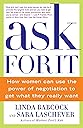
Ask for It: How Women Can Use the Power of Negotiation to Get What They Really Want
Product ID: 65949419
📈4-phase proven negotiation system
📚Backed by years of research
🤝Collaborative, win-win approach
Desertcart purchases this item on your behalf and handles shipping, customs, and support to Japan.
💪 Own Your Worth, Negotiate Your Future
Ask for It is a groundbreaking negotiation guide designed specifically for women, offering a four-phase, research-backed program that empowers readers to confidently negotiate raises, promotions, and more. Combining practical strategies with a collaborative approach, this book helps women unlock their full potential both professionally and personally.

| Best Sellers Rank | 356,613 in Books ( See Top 100 in Books ) 3,871 in Popular Psychology 10,759 in Practical & Motivational Self Help |
| Customer Reviews | 4.6 out of 5 stars 327 Reviews |
E**P
Just excellent
I normally hate self-help books but this one hit the nail on the head. Practical and clear without being condescending, it's already helped me negotiate for dozens of things I never thought I'd have the guts to ask for and achieve excellent results. If you're a woman who struggles with negotiating I can't recommend it highly enough. I've also found the process of learning to negotiate fun and that's something I never thought I'd say. Thanks to the authors for writing such a useful book.
P**A
Great book and a must read for every young girl ...
Great book and a must read for every young girl and a woman. Teaches women to understand their value beyond what society dictates they "should" do and "should "be. Explains ideas and negotian strategies.
E**O
Splendid Read...and very helpful too
I got this book for a female friend who expressed a need for help in becoming more assertive. She is using the 'power of negotiation' already and feeling much more positive about herself.
P**E
None of us have done enough asking- do it today
I read a review of this book in The Sunday times. I was interested in it even though obviously not a woman. In my experience people are very poor at negotiating. The only ones they do are for houses and cars and like driving everyone think they are good at it. Most people make an offer or counter offer then when that isn't accepted they threaten to withdraw or issue an ultimatum. This is the end of their skills. This works if you do not have to deal with these people again. This book is about how you negotiate with people and still retain a relationship. In my experience it is a good idea to put our feelers in a negotiation because you may learn something very early on.such as you will never get promoted or a decent pay rise because of so e even that you have forgotten about or that you did not know about. Also a lot of bosses and colleagues will tell you something that you were not aware of and you were labouring under a a misapprehension that you can either resolve or move on. This book is an attempt to teach people the skills of negotiation. the book is divided into various phases broken into four phases. It sets out why you need to ask. We spend our lives thinking that if we do a good job then good things will come our way. Unfortunately this is not the case. It starts with everything is negotiable. The example of the male students asking for teaching practice than getting in then the female students complaining that all the teaching practice had gone to the men. she answer was they asked. The men as a result got better jobs because their CVs looked a lot better. Recently an educationalist said that they should reintroduce single sex school as girls do better on their own. Boys put their hands up more to answer questions and as a result dominate the class. Men negotiate four times as much as women even a small increase on basic salary at the beginning of a career means that over whole lifetime they have earn a massive amount of money more. If I have a criticism of the book it is that there is far too much guff that is page filling examples of the blindingly obvious. All you need to do is think Have I asked for it? If not why not. None of us have aksed for enough on enough occasions. I used the example and made a lot prgoress. I am now getting lot more of what I want as a result of reading this book and I am a bloke. what do you have to lose? If you are not assertive you are looked upon as being a bit weak and soft in the head. There is a fine line between being assertive and a pain in the butt. Most of us however are far too soft. A musat read for the all the sofites in this world and that is most of us. In my expierence the underserving get most of the rewards because they are so pig headed and keep asking whereas the rest of us think we are being reasonable by not rocking the boat. Where has it got us ?
N**R
Highly recommended
Unputdownable -so glad I got this book. Shows how women from all backgrounds & stages of their lives lose out because girls aren't expected to 'go' for the things they want and need. Demonstrates with real life examples the benefits of 'asking & negotiating' skills. Gives tips on how to recognise opportunities & even on how to create them. Shows how and when to walk away too. Has a practical exercise section at the back. Already I'm implementing many of its principles & seeing the results including increased self esteem. I've recommended this book to two girlfriends
A**.
so good
I loved the book! Now I know that I'm not alone and I could even explain my boyfriend why I can't easily ask for more money from my boss. Great book.
Q**T
Hmmmmm
Just found that it was all other people's examples. I wanted more ideas and exercises to do.
A**S
Too much Text for morning
This book has got too much true cases.The letters are really small and it's far too much talking about peoples lives.I'm throwing it in the bin.the cover is unappealing.I was hoping for something with more content in less words.
L**N
A Life-Changing Tool for Women
The male of our species seems to spring from the womb ready to negotiate everything. This tendency not only increases the wage and pension gap between men and women by the end of life, but it also adds to men's sense of empowerment and control in their world. Women don't ask, and as a direct result they get less. Exponentially less. Why do we fail to ask? Because we have this little voice inside of us, clucking and frowning. According to Linda Babcock and Sara Laschever, who wrote Ask for It, we need to ignore that voice because: "The little voice inside telling you not to do it (don't rock the boat, don't get pushy, why can't you be happy with what you have?) isn't your voice. It's the voice of a society that's still trying to tell women how to behave. It's a voice whose message is conveyed, often unwittingly, by our parents, teachers, colleagues, and friends - and then repeated and amplified by the media and popular culture." The authors present numerous examples of the unintentional, unconscious, and overwhelming bias society applies to women. Like this: Female musicians applying for a job with an orchestra were 250% more likely to be selected if they auditioned behind a screen. I know what you're thinking. "I'm fine," you say. "I don't deny that it exists. It's just that I personally have never suffered from discrimination." However, again quoting from Ask For It: "Social psychologist Faye Crosby calls this `the denial of personal disadvantage' in which members of a particular group recognize that other members of the group have suffered but believe that they themselves have escaped it." This bias without malice starts early. In a study, school children were asked to perform a small task and then pay themselves what they thought they deserved. (First graders were asked to award themselves Hershey's Kisses.) Here's the heartbreaking result: In first, fourth, seventh and tenth grades, girls consistently paid themselves 30% - 78% less than boys. It adds up - or I should say down. According to the latest US Census, women still earn less than men in every category. But there's a simple way to overcome this ingrained self-doubt, self-effacement, and self-denigration: ASK. Simply pause before you agree to anything, and ask for something to sweeten the deal. Why not? What are we afraid of? All they can say is no, and then you're where you were before the ask. However, you might be pleasantly surprised. I bought some furniture a couple days ago. The salesman tallied up the price, ending with "and delivery is $149." I looked at him and said, "Do you have any flexibility on that?" Without hesitation he knocked it down to $100. I saved fifty bucks with seven words! Men do this all the time. Per study after study, women don't. The authors found "clear and consistent evidence that men initiate negotiations to advance their own interests about four times as often as women do." If you're unhappy with something in your life, assume it can be changed. How many of us assume the opposite, sigh, and keep plugging? This book includes many, many practical tools for learning to ask (as well as tons of examples and anecdotes, which made it fun reading.) In Chapter 10, for example, the authors describe "cooperative" bargaining (It's also called collaborative, or interest based, or win/win bargaining). It is more effective and comfortable than the traditional stony-eyed, fist-pounding version you might envision. Also - bonus! - this strategy is more natural to women. In fact, you probably use it every day with your kids, partner, and coworkers. Now, here are some great tips taken from the book: *Women specialize in waiting until they can't take it anymore and then blow up. Better to "assemble documentation, showing how you've increased the value, identify the best time to approach the boss, and make your case in a calm and businesslike way." *Doing it sooner rather than later makes a negotiation easier. "The brain imposes costs when we worry about something, and the longer we worry, the higher the cost. The sooner you ask for something you want, the better the negotiation itself will feel." As soon as my granddaughters are old enough to understand this book, I'm going to make sure they read it. Life is too precious to go through it with a self-imposed disadvantage.
J**G
Love it!
Great book, with practical exercises and many ideas for improving the way we work and communicate.
S**N
Brilliant, practical a window into how we live and how to negotiate change
Excelent book that discusses not only the disparity in how women and men are treated in the business and cultural world, but identifies the root of this difference. More importantly, it does so from an analytic, sensical and proactive perspective that eschews fingerpointing in favour of positive action in negotiating change both in our personal and social lives. Written by two notable ( and personnable) scholars, this book is Practical, empowering and a must read for men and women, parents and industry leaders, it is a must read,
V**R
A great read for women
A must read for women. The authors have shared so many stories of women in different professions, the challenges they live with until they learn that they can negotiate. Very useful insights and tips on how to negotiate at home and at work.
L**S
Useful information about why you should negotiate, and guides to doing so
This book is an excellent read, with helpful tips illustrated by lots of stories and studies. It is aimed primarily at women, but any person who wants to learn to negotiate better, in work or other parts of life, could benefit from it. It's especially good for people who don't know how to negotiate, or who think they shouldn't/don't need to ask for things. I love the section where the authors provide concrete exercises to help the reader go from non-negotiator to someone who is confident and practiced at asking for (and getting) things. I took detailed notes from the book to refer to in the future. Here are a few examples of tips from the book that apply to everyone: * Never ask if something is negotiable. It implies you're okay with it if not. Always assume yes. * Ask for what you want when your bargaining power is high -- e.g., due to recent personal successes, or after a bunch of people leave the company and they're in a tight spot if they lose you. * Each side can end up benefiting more by working collaboratively. Negotiation is often not zero-sum. You may think outside the original set of options to find something that meets everyone's needs better by discussing needs in detail and brainstorming. This is explored in a lot more detail in the book, and is one of the most valuable chapters. * Whether or not to make the first offer depends on how much information you have. If you know the other side's bottom line but they don't know yours, go first. Set the anchor at a beneficial place to you. But if you have no idea what they'll pay, try to let them start the negotiation. Here are a few examples of tips from the book aimed primarily at women -- because aggressive bargaining is often seen as positive coming from men, but negative coming from women: * Avoid tentative language. "I'm not sure this is a good idea..." "Stop me if I'm wasting your time..." "I'm no expert, but..." * Frame proposals and comments positively. Don't soften what you want; just frame it as a positive for both you and other side. * Be relentlessly pleasant. Choose your words carefully, use a nonthreatening voice, and seem nice and friendly in all your actions. Express polite concern at the beginning that everyone is comfortable and has everything they need -- but don't fetch the coffee.
Trustpilot
2 months ago
1 month ago