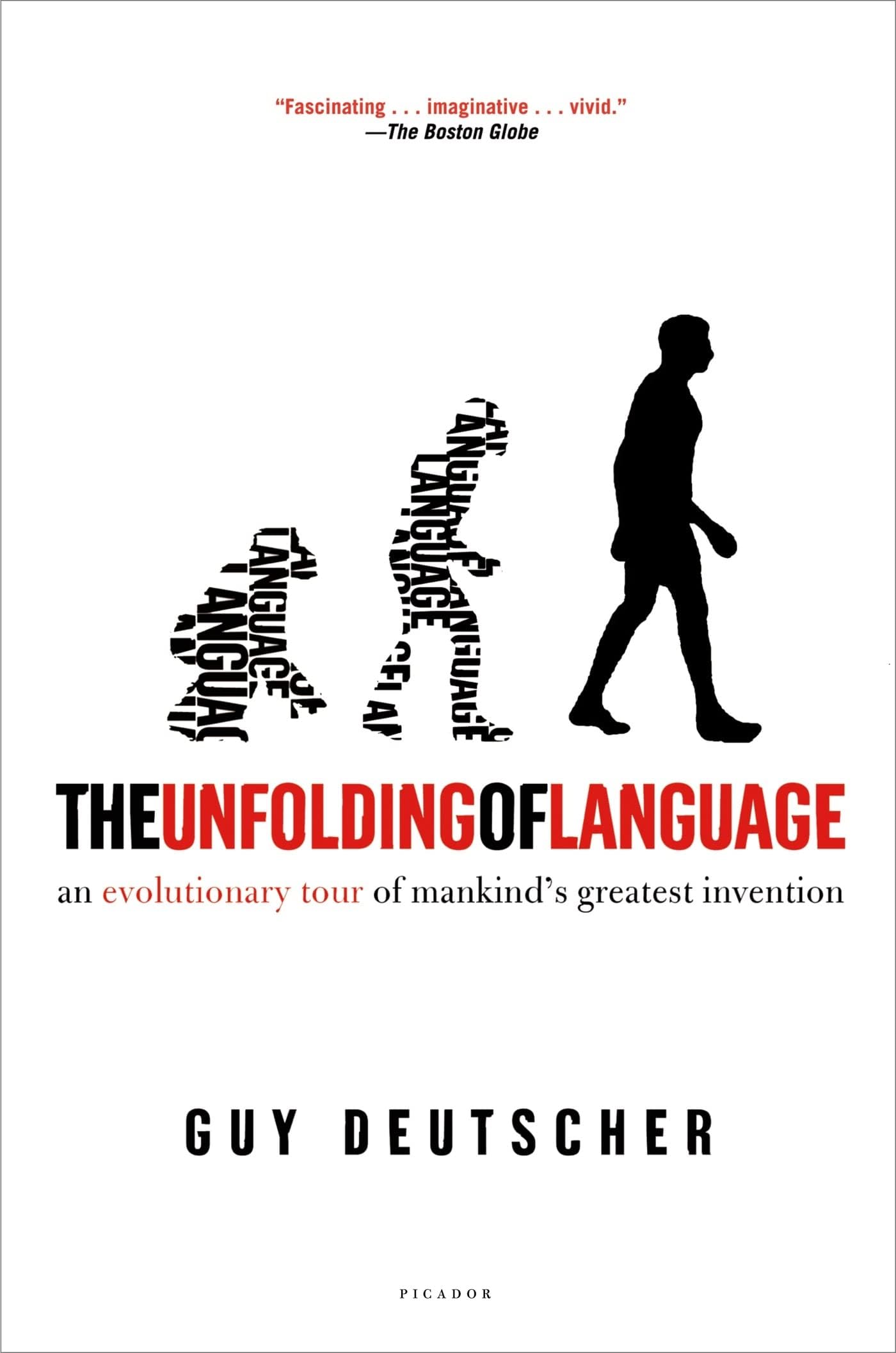
The Unfolding of Language: An Evolutionary Tour of Mankind's Greatest Invention
Product ID: 6379438
Desertcart purchases this item on your behalf and handles shipping, customs, and support to Japan.
Susanne K. Langer Award Winner Named One of A.S. Byatt’s Favorite Books of the Year in The Guardian “A lively and thought-provoking exploration of why language change appears to be haphazard yet is fundamentally orderly. Exciting, witty, and a masterpiece of contemporary scholarship.”―Elizabeth Closs Traugott, Professor Emeritus of Linguistics and English, Stanford University Blending the spirit of Eats, Shoots & Leaves with the science of The Language Instinct , an original inquiry into the development of that most essential ― and mysterious ― of human creations: language. Language is mankind's greatest invention-except, of course, that it was never invented." So begins linguist Guy Deutscher's enthralling investigation into the genesis and evolution of language. If we started off with rudimentary utterances on the level of "man throw spear," how did we end up with sophisticated grammars, enormous vocabularies, and intricately nuanced degrees of meaning? Drawing on recent groundbreaking discoveries in modern linguistics, Deutscher exposes the elusive forces of creation at work in human communication, giving us fresh insight into how language emerges, evolves, and decays. He traces the evolution of linguistic complexity from an early "Me Tarzan" stage to such elaborate single-word constructions as the Turkish sehirlilestiremediklerimizdensiniz ("you are one of those whom we couldn't turn into a town dweller"). Arguing that destruction and creation in language are intimately entwined, Deutscher shows how these processes are continuously in operation, generating new words, new structures, and new meanings. As entertaining as it is erudite, The Unfolding of Language moves nimbly from ancient Babylonian to American idiom, from the central role of metaphor to the staggering triumph of design that is the Semitic verb, to tell the dramatic story and explain the genius behind a uniquely human faculty. Review: Bursting with new ideas - I've read a goodly amount of material on linguistics, so I expect each new book to go over much the same ground as previous books, but this one took me by surprise -- it's chock full of new and interesting ideas. Other reviewers have already explained the basic structure of the book; allow me to offer some of the tidbits that stuck to my mind: 1. The concept of erosion. People always shorten words, cut off consonants, simplify vowels. His working example, and an excellent one it is, is "gonna", an eroded form of "going to". Erosion wears down words to the point that they start to lose expressiveness, at which point people tack on something else to clarify their meaning. He presents one case of a French word; I can't recall the details but here's an analogy: suppose that "gonna" someday gets eroded to 'gon' and later to 'g'. At some point, people will need to flesh it out, so perhaps they'll tack 'will' onto it to get 'gwill', which in turn might get eroded down to 'gill'. And so on and on and on. Many of the words in our language are eroded, compressed, multi-layer fossils of much longer original expressions. 2. Complementing erosion is back-formation, a process by which people extend patterns in the language to other words. One example might be the child who says, "I goed with mommy." The trick is, there are lots of patterns scattered all through the language, and ofttimes a pattern can be recruited to a word when that word has been dangerously eroded. This is especially likely when two words are similar in pronunciation. "sing sang sung" leads to "ring rang rung" -- but should past tense of the fairly new verb "wing" be "winged" or "wang" or "wung"? With so many patterns to choose from, there's always grist for language change. 3. He starts off with a delightful point on the common plaint that English is going to hell, that people nowadays don't know how to use it properly, how just 30 years ago the language was so much more pristine. He presents a modern quote to this effect; then another quote from 30 years ago saying the same thing; then another quote from 30 years before that saying the same thing; and so on all the way back to 1620. The more things change, the more they stay the same. 4. I was particularly impressed by his explanation of how the weird Semitic word system (every word has a root of three consonants, and the vowels that are filled in specify its gender, case, number, and so forth.) He starts by pointing out that this system is too intricate, too well-ordered, to have simply arisen by chance. Or is it? He proceeds to demonstrate just how it could have happened using erosion and back-formation. 5. Vowel coloring. This is another concept that I had seen mentioned but never explained. Some vowels can affect vowels near them in a word. The example he gives is the Germanic "gest", whose plural was "gestiz". [I'm probably screwing up the spelling here.] The 'i' in the plural form "colored" the 'e' and caused it to shift into an 'a'. Later on, the 'iz' was eroded down to a schwa (spelled as an 'e', but pronounced as a short "uh"). Thus, the singular is "Gest" but the plural is "Gaste". All in all, a surprising and fascinating book. This guy is definitely on my list of authors to watch. Review: Creative destruction in philology--brilliantly elaborated - A brilliant solution to the conundrum: why does language so often proceed from more to less complex structure, as one sees in comparing Sanskrit, ancient Greek, or Latin to the derived modern languages? Filled with fascinating and informative examples of the continual and ongoing "degeneration" of language, the author is quite versed in changes in English back to the Anglo-Saxon era, as well as other Indo-European languages. I wish I had known his explanation for the origin of the system of declensions and conjugations when I was studying Latin in high school. My fascination with this question, when I later studied, French, Spanish, and German in college, is what led me to a life-long interest in philology. The author is also a native speaker of modern Hebrew and quite knowledgable in ancient Semitic languages. His explanation of the evolution of the 3-consonant root characteristic of Semitic languages is informative as well as fascinating. The only shortcoming I find is that the thesis is presented without reference to who discovered it. If it is entirely the work of the author, this should be stated; or the contributions of others should be acknowledged. It is not so much a matter of who gets the credit, as to understand the evolution of the concepts. The view he puts forth is undoubtedly quite controversial in academic circles, and one suspects that this is the reason for his omitting this aspect of the subject. Perhaps he drew the lesson from the reception given Merritt Ruhlen, who is often criticized for being overly polemical in his advocacy of Greenberg's work pointing to monogenesis. The reactionary nature of academia when confronted with a new paradigm is well-known, and as bad, or worse, in the field of philology as in any other. The author's work rates 5 stars in my view. I have reduced my review of the product review to 4 stars because of a production defect in two successive copies I received from desertcart. I returned one copy but received a replacement with the same defect-- a small pucker in all the central pages, probably caused by the fingers of the stitcher grasping too tightly. One expects a perfect copy when buying a new book. Although a minor annoyance, it did not affect the readability of the type, and is not noticeable from the outside.
| Best Sellers Rank | #120,350 in Books ( See Top 100 in Books ) #79 in General Anthropology #80 in Linguistics Reference #344 in Evolution (Books) |
| Customer Reviews | 4.5 out of 5 stars 921 Reviews |
C**D
Bursting with new ideas
I've read a goodly amount of material on linguistics, so I expect each new book to go over much the same ground as previous books, but this one took me by surprise -- it's chock full of new and interesting ideas. Other reviewers have already explained the basic structure of the book; allow me to offer some of the tidbits that stuck to my mind: 1. The concept of erosion. People always shorten words, cut off consonants, simplify vowels. His working example, and an excellent one it is, is "gonna", an eroded form of "going to". Erosion wears down words to the point that they start to lose expressiveness, at which point people tack on something else to clarify their meaning. He presents one case of a French word; I can't recall the details but here's an analogy: suppose that "gonna" someday gets eroded to 'gon' and later to 'g'. At some point, people will need to flesh it out, so perhaps they'll tack 'will' onto it to get 'gwill', which in turn might get eroded down to 'gill'. And so on and on and on. Many of the words in our language are eroded, compressed, multi-layer fossils of much longer original expressions. 2. Complementing erosion is back-formation, a process by which people extend patterns in the language to other words. One example might be the child who says, "I goed with mommy." The trick is, there are lots of patterns scattered all through the language, and ofttimes a pattern can be recruited to a word when that word has been dangerously eroded. This is especially likely when two words are similar in pronunciation. "sing sang sung" leads to "ring rang rung" -- but should past tense of the fairly new verb "wing" be "winged" or "wang" or "wung"? With so many patterns to choose from, there's always grist for language change. 3. He starts off with a delightful point on the common plaint that English is going to hell, that people nowadays don't know how to use it properly, how just 30 years ago the language was so much more pristine. He presents a modern quote to this effect; then another quote from 30 years ago saying the same thing; then another quote from 30 years before that saying the same thing; and so on all the way back to 1620. The more things change, the more they stay the same. 4. I was particularly impressed by his explanation of how the weird Semitic word system (every word has a root of three consonants, and the vowels that are filled in specify its gender, case, number, and so forth.) He starts by pointing out that this system is too intricate, too well-ordered, to have simply arisen by chance. Or is it? He proceeds to demonstrate just how it could have happened using erosion and back-formation. 5. Vowel coloring. This is another concept that I had seen mentioned but never explained. Some vowels can affect vowels near them in a word. The example he gives is the Germanic "gest", whose plural was "gestiz". [I'm probably screwing up the spelling here.] The 'i' in the plural form "colored" the 'e' and caused it to shift into an 'a'. Later on, the 'iz' was eroded down to a schwa (spelled as an 'e', but pronounced as a short "uh"). Thus, the singular is "Gest" but the plural is "Gaste". All in all, a surprising and fascinating book. This guy is definitely on my list of authors to watch.
S**R
Creative destruction in philology--brilliantly elaborated
A brilliant solution to the conundrum: why does language so often proceed from more to less complex structure, as one sees in comparing Sanskrit, ancient Greek, or Latin to the derived modern languages? Filled with fascinating and informative examples of the continual and ongoing "degeneration" of language, the author is quite versed in changes in English back to the Anglo-Saxon era, as well as other Indo-European languages. I wish I had known his explanation for the origin of the system of declensions and conjugations when I was studying Latin in high school. My fascination with this question, when I later studied, French, Spanish, and German in college, is what led me to a life-long interest in philology. The author is also a native speaker of modern Hebrew and quite knowledgable in ancient Semitic languages. His explanation of the evolution of the 3-consonant root characteristic of Semitic languages is informative as well as fascinating. The only shortcoming I find is that the thesis is presented without reference to who discovered it. If it is entirely the work of the author, this should be stated; or the contributions of others should be acknowledged. It is not so much a matter of who gets the credit, as to understand the evolution of the concepts. The view he puts forth is undoubtedly quite controversial in academic circles, and one suspects that this is the reason for his omitting this aspect of the subject. Perhaps he drew the lesson from the reception given Merritt Ruhlen, who is often criticized for being overly polemical in his advocacy of Greenberg's work pointing to monogenesis. The reactionary nature of academia when confronted with a new paradigm is well-known, and as bad, or worse, in the field of philology as in any other. The author's work rates 5 stars in my view. I have reduced my review of the product review to 4 stars because of a production defect in two successive copies I received from Amazon. I returned one copy but received a replacement with the same defect-- a small pucker in all the central pages, probably caused by the fingers of the stitcher grasping too tightly. One expects a perfect copy when buying a new book. Although a minor annoyance, it did not affect the readability of the type, and is not noticeable from the outside.
S**T
Why language is not degenerating
A great book, well-written, humorous, knowledgeable. The main accomplishment of this book,for me, was to explain why, over the centuries of written language, prominent commentators have bemoaned the decline of their language by fellow citizens, grousing over how nobody speaks correctly any more, and citing examples of poor usage, ungrammatical forms, distortions of original meanings of words, etc. It apparently happens in every generation. And no commentator of language has ever (to my knowledge) claimed that language usage is improving in his generation. But if things have only gone down hill forever, how then did any langauge ever start out in "good" condition? The author explains that languages change as people find quicker and shorter ways to say things (from "going to" to "gonna"), add or change words to make things clearer, and generalize from one example to parallels. The net effect of all these changes is the evolution of a language, eventually to the point where it seems like a different language. The old guard cites Latin, with its declensions (suffixes to words indicating a word's grammatical role in a sentence), as an example of a "perfect" language. Language descendants of Latin (and for English, descendant of Old German) have tended to drop these suffixes and use word order and other markers to indicate the part of speech a word fills in a sentence. What the grousers don't know is that the classic Latin endings were once probably separate words that indicated the grammatical function of the previous word, but that those separate words were eventually shortened and attached to the previous word, until they remained only as a one or two or three letter ending. So classical Latin is an example of "degeneration" from its earlier form. I'm not trained in linguistics or languages, but I found the book fascinating and fun to read.
A**O
from grunts to latin in 3 easy moves :)
It didn't quite go down like this, I know, but if I had to summarize what I remember of the history and classic languages that I learned back in school, mankind was grunting and depicting animals in a cave one day, only to be speaking greek and latin one day later! How did man go from guttural sounds to the complex grammar we find in classical latin? Some steps are obviously missing and school was never really bothered to tell us about them. Well, this book (which will probably be boring to 99% of common people) is a marvel for the 1% who care about understanding one thing or two about the mechanics of languages. I skipped the part about the Semitic languages (with the author's explicit approval LOL) because I only have 24 hours in my day, but that was not essential. I finished the book with a much deeper understanding of what human languages really are. I feel much more confident now. One word of caution: if you are a grammar Nazi, steer clear of this book. Discovering that you are a despicable human being might be depressing for you :)
A**A
Is language being created and destroyed in a constant cycle?
Understandable, readable, but best of all, enjoyable explanation of the destructive and creative forces acting upon language. This book will convey you a "big picture" of how our present languages could have evolved into their present state and is mainly aimed at the interested layperson or at beginner students of linguistics, not for specialists (or maybe for those specialists that would like to read an overview of their science field from a humorful perspective). The destruction of language structures, as well as the creation of new ones is explained with very illustrative examples taken fom a wide variety of languages and from different historic periods. (Other reviewers have already explained the involved forces). Most 20th/21st century linguists believe that the same forces that acted on prehistoric languages should be the same forces at play now, so by observing present (or at least more or less recent) language changes we should be able to understand the forces that shaped our current languages. Creative changes are harder to observe than destructive ones, since it is easier to observe a present irregularity and look for its origin in the past (the action of a destructive force) than to look at something that looks regular now and imagine that sometime in the past it was irregular. Therefore, the only way to observe such creative processes is by noting an irregularity in some old text, which has somehow become regular in the present. This difficulty gave rise to the widespread idea among 19th century experts that language was only decaying. Although linguists have finally managed to observe some creative phenomena, these are not enough to compensate for the erosion that is evident in languages. Maybe written language and the existence of formal "grammar" and "ortography" are hindering or at least slowing down the creative processes. Linguists still do not know if this situation will lead us to a frightening erosion of meaning and structure in language (for example almost all noun cases existing in Proto-Indo-European, Latin and some Germanic languages are disappearing). Personally, I do not believe language will deteriorate to that point, since the very function of language (communicating meanings between individuals) would be threatened. Therefore, maybe we will reach some critical point and afterwards there will be a Cambric explosion of meaning and structure, it's a pity we will probably not witness this.
D**S
Helpful to my understanding of English
At times, reading this book, it almost put me to sleep, so to speak! Hahahaha!!! But there are parts in this book that explain things about the English Language which I have never read anywhere else. Every Language seems to BORROW and change the spelling and/or the pronunciation of many words in its useage by us English speakers. G. Deutscher has made me understand where many of our words came from and how, especially through the changing or evolving pronunciation of certain letters, in Germanic, words like "HAVE" which apparently derived from root or original words or meanings of Grasp or Sieze, which are often easier to understand the link in Latin (from which we also borrowed many words) of a similar meaning, such as "Catch", "Capture", "Occupy". Deutscher spends a lot of words or chapters showing Language as Metaphor, which makes a great deal of sense, but I rarely thought about or focused on, until I studied my first "foreign" language. But this book is probably only going to appeal to those who really, actually find WORDS, their meanings and origins, INTERESTING. For what it is worth, I was terribly disinterested in and got poor grades in Elementary through High School, English and Grammar! In fact, I really never understood English until I took a course in High School on FRENCH! I didn't understand what conjugations of verbs, idioms, word genders and spelling and all of that until FRENCH! Many words we obviously borrowed from French or Latin, or "Romance" languages make sence when you learn the vocabulary, words in a foreign language; Our word: TRAVEL, comes from TRAVAILLE, whicn means "WORK, TOIL" in French. In the days of getting around only by foot or horse or even carriage, let alone by car, train or Jet today, is WORK and quite often very Tiring! And guess what the French word for FISH is? It is the same as our English word for POISON, it's just pronouced differently! And if you have ever eaten Bad Fish or Shell fish, you know you have eaten POISON and you got sick.
J**T
Dancing With Destruction
Guy Deutscher will be your new favourite linguist. His sincerity and wide-ranging admiration for linguistic achievement win one over. As a bonus, Deutscher is truly funny, no smart-ass élitist like Steven Pinker or John McWhorter. An eccentric feature of Unfolding is its incorporating fictional dialogues among two non-professional linguists and a linguistics professor. Not the character in the dialogue Deutscher hovers nearest to but only by his sufferance present in the dialogue at all is a representative of the (also fictional) “Royal Society for the Protection of English.” Elsewhere, in a similar vein, Deutcher recalls the great 19C romantic-linguist August Schleicher with qualified approval. Compare such allowances to the up-front hostility of Bas Aart’s Modern Grammar: “Readers hoping to find confirmation [here] that the so-called split infinitive is odious…will be disappointed” (Preface). Deutscher’s relative openmindedness in these regards bodes well for our opinion of the book as a whole. The thesis of Unfolding is that changes in language are the work of opposing cyclical forces. The Gothic word for “guest” was “gast,” and the plural of “gast” was “gastiz.” The “a” and “i” of “gastiz” requiring different mouth positions in quick succession, “gastiz” underwent what is known as a-mutation: the colouring of an “a” by a subsequent “i” that makes the “a” easier to pronounce (120). After a-mutation, which made {a} into {eh}, the singular-plural pair became gast/gestiz. Emphasis being on the first syllable of “gestiz” and the pair already being distinguishable from each other by this vowel-shift, the terminal “z” wore off leaving only “i,” which was soon even further eroded to “ə” (schwa). The mid-word a/e feature caught on as a paradigm—as students of modern German know, or wish they knew, all too well. Thus did one “blind change” (194), which destroyed part of German word structure, prompt analogical extension and lead, ultimately, to the shining new edifice of nominal German umlaut. Deutscher’s is a brilliant model of language change, but I have a few questions for him. One involves the fact that some blind changes seem to have lead to permanent destruction. According to Benjamin Forston III, a barrage of syncope and apocope “[devastated]” Old Irish verbs and especially verbs compounded with one or more preverbs (323); as a result, the absolute and conjunct forms even of relatively simple verbs can look entirely and preposterously unalike (324). What but confusion did such erosion bring for the Insular Celts and the students of the Celtic language thereafter? Shouldn’t they have fought (negative) change off insofar as they could? And regarding the possibility of fighting off change, isn’t Sanskrit, whose very name means “[carefully] assembled,” an instance of a language consciously defying erosion? And isn’t conservative Senatorial Latin another instance? Deutcher needs standards of positive and negative change.
J**O
for those interested in linguistics and language evolution
Deutscher is a scholar, educated at Cambridge. He is knowledgeable in a wide range of languages from different language groups, e.g, from Niger-Congo to Medieval Chinese, from Cushitic (Somalia) to Berber and Semitic languages. This book is well-written, not in a ponderous style, but it is loaded with material and hence is more challenging than a relaxing mystery novel. But for those interested in the development of languages, it is well worth it. As he says, “make yourself a strong cup of coffee, and read on.” Pros: * He does not make assertions without evidence. He clearly distinguishes what is knowable, what is not. * He provides the viewpoints of other scholars. Estimates for language origins range from 40kya years ago to as much as 1.4mya. * We do not know when language began. His focus is on how language could have began and on how languages continue to change. * Some examples: the change in word consonants, first systemized by one of the Brothers Grimm. And why the spelling of words differs from how words are pronounced today. I have read a number of books on the evolution of language, and this is by far the best one I have come across.
C**E
Fascinating and insightful
I have really enjoyed the Unfolding of Language as it is a well written and stimulating book. It is easy to read and uses simple examples to advance the author's ideas. I was familiar with some of the concepts in the book beforehand which was what intrigued me to buy it, however there were still many fascinating examples and theories that I was unfamiliar with, which made it a rewarding read. As a fan of languages I found the book a wealth of information on the bizarre methods languages use to convey their meanings and how these might have come about originally. I was however surprised by some obvious omission from the book, which left me feeling that Guy was searching for answers in the distant past when examples in living language were far more revealing. A case in point is the change of p to f and f to h for which he uses the example of German "vater" compared to the Latin "pater". However far more frequent and varied changes occur in Welsh (and other celtic languages) as part of the everyday language. Welsh has a well developed system of mutations, namely soft, nasal and aspirant. The mutations may be sumarised as normal->soft->aspirant p->b->ph t->d->th c->g->ch b->f->b f->dd->d g->w->g etc. Where "dd" is pronounced as "th" in the english word "them" and "f" is pronounced as the english sound "v". This is a good example of Guy's softening of consonants. So for the Welsh speaker the concept of Grimm's Law is enshrined in their language. As such I think it makes a better example then the Latin-German example and is a curious omission form the book. In a later section of the book, Guy talks about the principle of erosion where consonants are removed over time to make the words easier to speak. Here again he makes a rather obvious omission. Scottish Gaelic has a peculiar spelling orthography which retains the old consonants long after their pronunciation has been lost. Take for example the word "leabhar" which means "book" and is similar in orthography to the Latin "liber" However the Gaelic pronunciation is "lyower", the "b" sound having been eroded by the surrounding vowels. Medial "bh" sounds are silent in Gaelic". This is not an isolated example in the language either. Examples include "adhaircean" [arkun] ="horns" ; "mathair" [ma-er] = mother. The list is endless. Finally when talking about creating grammar from changes in pronunciation, again an obvious example in Scots Gaelic springs to mind. The past tense was formed using the particle "do" as is "do buail mi" ="I struck". The "b" of "buail" was eroded because it was stuck between two vowels and so became "bh" [v]. "do bhuail mi". Eventually speakers stopped saying the "do" because the aspiration of the "b" to "bh" was sufficient to mark the past tense and in modern Gaelic "bhuail mi " is the past tense. However when the verb starts with a vowel (which can't be aspirated) the "do" remains. However the general rule of aspiration is still applied but in this case it is the "do" that aspirates to "dh" and the past tense of a verb beginning with a vowel is "dh'innis me" = "tell me". Again these are examples from a living language where these changes occur dynamically on a daily basis. It seems strange that he does not mention these important examples and chooses to search in long dead languages for proof of the theories. Having said all that I am still going to buy his other book on why language looks different to speakers of different languages. He really is an inspiring writer!
R**A
Good read
The book is excellent. It gives verisimilitude to the existence of an Indo-European language. It is not a very easy read, but the effort is worthwhile. It is a pity that on the paperback edition the cover illustration, printed on a film, ends up unglued from the paper cover curling up unsightly.
R**Y
great book but bad kindle
This is an EXCELLENT book, extremely well-written and informed, BUT I agree 100% with what another customer said in his review: "I cannot understand how Amazon can release Kindle versions of books where some portions of the text are POSITIVELY UNREADABLE. The font is microscopic, causing the reader to have to skip some of the text. In my view this is quite inexcusable, as the technology is there to avoid the problem. This reflects at best a sense of carelessness from the people in charge of formatting the Kindle text, at worst a complete contempt toward the customer. A book SHOULD NOT BE KINDLE-RELEASED if it is not 100% readable." The biggest problem is that the font is microscopic when the author gives examples to illustrate his point--which is very often. It is literally impossible to read. DO NOT buy this otherwise excellent book in the Kindle format!!
D**P
Linguistik (auch) für die Linguistische Künstliche Intelligenz
Für mich ist dieses das wichtigste Linguistik-Buch zumindest in diesem Jahrtausend. Das vor allem als KI-Entwickler, was ich wohl erklären muß. Die derzeitige Künstliche Intelligenz leidet darunter, daß die Programme nicht wirklich und effizient Wissen erwerben können. OK, die Lernenden Algorithmen "lernen" durch Versuch und Irrtum - aber nicht so wie intelligente Menschen: durch Gespräche mit uns und durch Lesen von Büchern und anderen Texten. Einfach weil sie natürliche Sprache nicht verstehen, sondern bestenfalls so tun. Zwar versuchen wir, den Intelligenten Digitalen Objekten Sprache beizubringen. Aber das ist verdammt schwer. Jetzt wird es anders. Deutscher erklärt, wie sich Sprache entwickelt hat. Dazu verwendet er ein (geniales) linguistisches Modell. Denn die ältesten Sprachen, die wir kennen und verstehen können, Akkadisch und das alte Hebräisch, sind etwa 5000 Jahre alt. Und sie waren damals schon ziemlich fertig entwickelt - denn keiner weiß, wann und wie die ersten Menschen "die Sprache erfanden"; die zeitlichen Schätzungen dafür liegen zwischen 40 und mehr als 100 Tausend Jahre zurück. Um das für unsere Digitalen KI-Geschöpfe nachzuvollziehen, müssen wir Software-Programmierer es nacherfinden und nachprogrammieren - verdammt schwer für Amateur-Linguisten. Aber jetzt hat uns endlich ein professioneller Linguist erklärt, wie es zumindest gehen kann. Und in einer Form, daß wir es direkt in Software umsetzen können, zum Beispiel den raffinierten Mechanismus, mit dem die Hebräer ihre Verben konstruierten. Das habe ich gerade probiert, und es funktioniert sogar für ein ganz anderes linguistisches Wortschöpfungs-Problem perfekt. Auch falls Sie nicht Software entwickeln sondern einfach nur so an Sprache interessiert sind: lesen Sie das Buch trotzdem. Deutscher schreibt sehr unterhaltsam und sehr kreativ. Deshalb macht die Lektüre - wie bei seinen anderen Büchern - auch sehr viel Spaß.
B**E
Great book
This book on linguistics is written for the educated non-specialist, like me. It is clear, entertaining, and stimulating. As Deutscher says, "Language is mankind's greatest invention, except... it was never invented." It just grew, and mostly shrank, because we are lazy. Despite this, languages continue to evolve, and are capable of expressing intricate nuances and sophisticated ideas. This is a beautiful book about the process of language evolution. Highly recommended.
Trustpilot
2 months ago
2 months ago