
Buy anything from 5,000+ international stores. One checkout price. No surprise fees. Join 2M+ shoppers on Desertcart.
Desertcart purchases this item on your behalf and handles shipping, customs, and support to Japan.
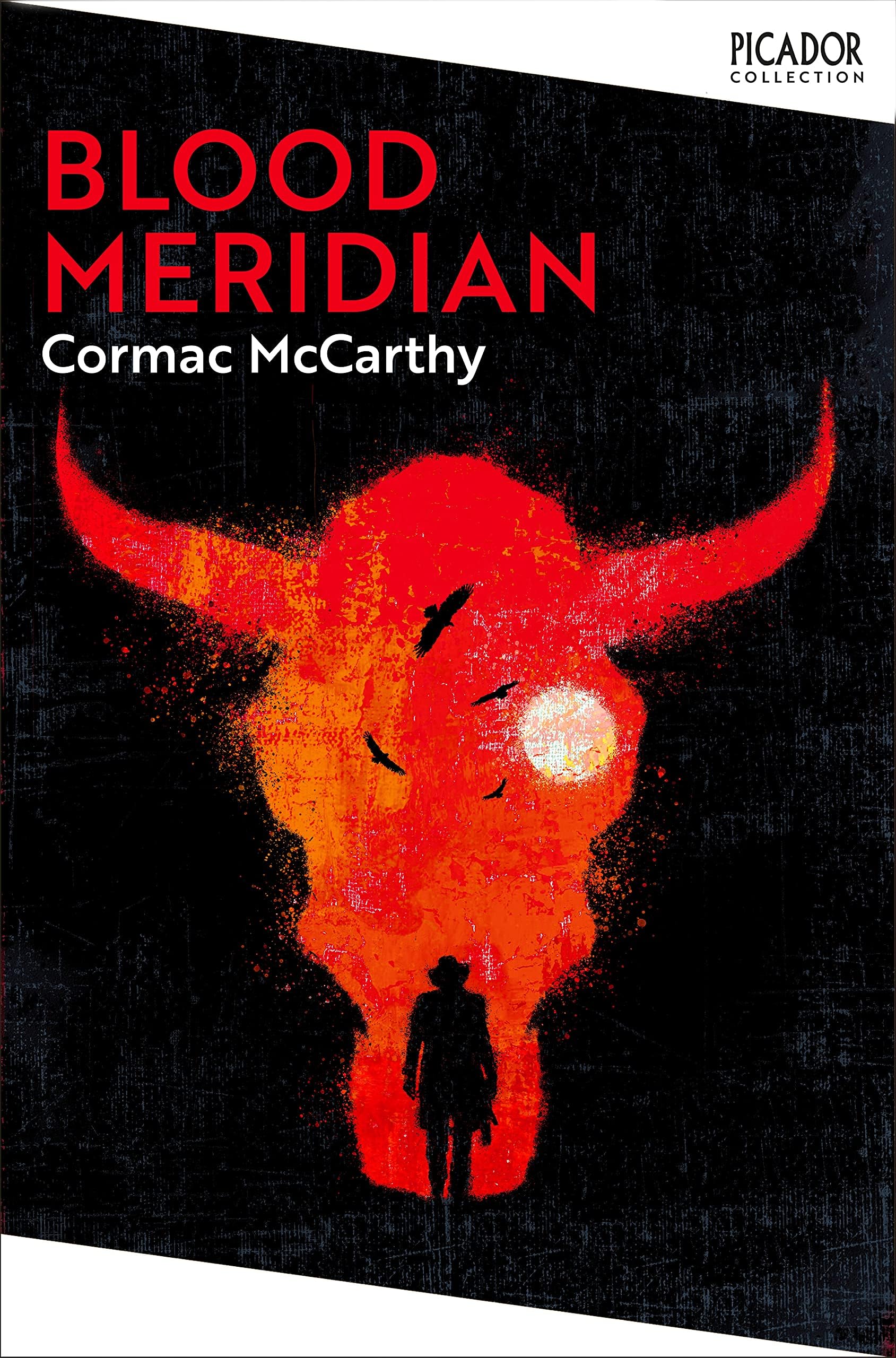
Celebrating Fifty Years of Picador Books The wrath of God lies sleeping. It was hid a million years before men were and only men have power to wake it. Hell aint half full. Set in the anarchic world opened up by America’s westward expansion, Blood Meridian by Cormac McCarthy is an epic and potent account of the barbarous violence that man visits upon man. Through the hostile landscape of the Texas–Mexico border wanders the Kid, a fourteen year-old Tennessean who is quickly swept up in the relentless tide of blood. But the apparent chaos is not without its order: while Americans hunt Indians – collecting scalps as their bloody trophies – they too are stalked as prey. Since its first publication in 1985, Blood Meridian has been read as both a brilliant subversion of the Western novel and a blazing example of that form. Powerful, mesmerizing and savagely beautiful, it is established as one of the most important works in American fiction of the last century. Part of the Picador Collection, a series showcasing the best of modern literature. Review: Comparisons to Faulkner and Melville valid, but a laborious read - Let’s start with the most common complaint about this book. Yes, almost all the characters are violent, but that word doesn’t convey the sheer cruelty inflicted in this story. Certainly all the main characters are violent including the protaganist, “the kid”. The few minor characters who are not are generally brutalized. I quit reading for a few month less than halfway through. When I picked it back up I finished the last two hundred pages in a long day. I guess I was better prepared for the violence and the lack of morality in all the characters, but I also felt I was becoming densensitized during my second attempt. If you read the backcover or a critical summary you should be aware violence is at the core of Blood Meridian, it shouldn’t be a suprise. But the depth of it might. Now this is the type of read that for the average reader, like myself, can be laborious. I do not have the skill to be a book critic and struggled as an English major to understand the intracacies of some masterful writers, compared to my professors and some fellow students who quickly identified subtext and points of style. McCarthy is one of those writers, certainly Blood Meridian is one of those works. This novel is often compared to Moby Dick or Faulkner’s top writing, and the comparison is spot on for me. I struggled to understand the subtext of what is being said, re-reading McCarthy’s frequent long descriptive sentences which are amazing to behold. They can be longer than a typical paragraph but are smooth and flow perfectly. I could never pull that off, it would either be a disjointed run-on sentence or it would take me ten maybe twenty sentences to convey what McCarthy does in one. What is amazing is these are common throughout the book, every page is filled with them. I can only imagine how much work went into each page, this is clearly the result of many years of focused effort. Similarly, I hear complaints from others or see complaints in reveiws regarding McCarthy not using quotation marks to highlight dialogue. This is a hallmark of his work, and he is not the first nor last to choose such a style. I think too much is made of this by people who really just didn’t want to put in the effort to read the book. Which is fine, this is not a traditional Western in any way, its not a tradtional mindless entertaining story. That’s one reason I am just reading this at age fifty and I am a fan of McCarthy. I have had the book for ten years and just read it. I knew going in it was the type of book you need to prepare for. But I don’t believe most people who claimed they couldn’t tell when a character was speaking are being honest. More likely they are just annoyed as it takes more effort to follow who is speaking, to re-read to understand, and if you want to skip the long descriptive sections to jump to the next scene of dialogue it is hard to do without quotation marks. This is just not an issue. Is it a gimick by McCarthy and those who pull it off? Maybe, I don’t know what they have said about the style but I suspect its more about flow and keeping the text clean. The pages do look beautiful and that affects your mood when reading. Also, quotation marks and other punctuation does in fact effect the cadence of you reading. Regardless of all that, I don’t believe it will effect most readers and is a weak complaint. As I mentioned, there are many long descriptive sentences. Sometimes there are pages of this with minimal action occuring, but you tend not to notice unless you are really analyzing the style. Very vivid, I could visualize almost every scene, and appreciated McCarthy’s ability to be so descritpive while simultaneously leaving specifics of how we visualize up to us individually. I suspect how I see each character is different than everyone else, but we all enjoy vivid scenes. For this reason I hope they don’t make a film version of this. For one, I think it would be a failure, especially in today’s hypersensitive PC climate, and two, I just think it would be impossible and an antithesis to what McCarthy’s writing accomplished. I did struggle with the last twenty pages, because, as I’ve said this is not a book where the story is solely at the heart of things. Symbolism and style are equally as important. And the judge as a character is the most complex. The final encounter and how things were left was at first baffling to me, but after re-reading the last few pages I loved it. Won’t ruin things but there is of course room for interpretation. Sometimes I hate that, sometimes it works. For me at least, this time it worked. The epilogue was however completely unnecesary and a distraction. I get what its saying but its like hitting me over the head. I almost feel like ripping that page out it seems so out of place, like a teacher told him, now put this in so it will all be tied together and the stupid people will “get it”. I might be one of those stupid people and I just found it annoying. Overall, I enjoyed the novel once I came to accept the inclusion of so much violence, and am glad I set aside mental space to read it and time to chew on what it was saying. If you want to read a real western, stick with Zane Grey, Elmore Leonard, even Louis L’Amour if you want the heart of the genre. If you want a taste of the true history of the west in the mid 19th century, framed with an exploration on man’s capacity for violence and cruelty, pick up a copy of Blood Meridian. Just allow more time for the read and you’ll likely get more out of it. Review: Western Expansion Told By A Master - Considered one of the great American novels, Blood Meridian tells the story of the Old West, not the one of John Wayne fame, but the one of hard men and bloody battles, of little sentiment and the willingness to kill men for little or no reason. It is set in the deserts and small towns of the American southwest and northern Mexico in the time period 1849 and 1850, after the American-Mexican War. The reader follows the life and growing up of 'The Kid' who is fourteen when the story starts. An orphan, he does whatever he can to stay alive and falls in with the Captain Glanton gang. This gang roams the area, killing and scalping both Native Americans and Mexicans for the bounty on their heads. They are an especially brutal gang in a land of brutality and blood lust. The Kid is a sharpshooter and willing to kill to defend himself but he doesn't have the blood thirst of the rest of the gang, just the desire to have a purpose and food and shelter. The villain of the book is The Judge. He is described as an almost supernatural being, seven feet tall, bald, a man who has vast knowledge but no mercy. When he and The Kid fall out, The Judge tracks him across miles and miles of desert but never manages to kill him. The Judge adopts a man who had been displayed in sideshows as a brute but who was in reality someone who was mentally challenged. The Judge regards him as a possession rather than another human being. This was a reread for me and I anticipate reading it again. This novel is considered an American classic and shows the opposite side of the Western expansion, that of the brutality and bloodlust of those who wrenched the land away from earlier inhabitants. It sets aside the concept of Manifest Destiny and shows what really took place in the American desire to capture all land between the oceans. Cormac McCarthy was an American author who many consider one of the best American novelists to come along. In addition to this novel, he wrote the Border Trilogy books, No Country For Old Men and The Road which won the Pulitzer Prize. I love his writing although it is bleak and violent and not for everyone. This book is recommended for historical and literary fiction readers.
| Best Sellers Rank | #768,326 in Books ( See Top 100 in Books ) #3 in Westerns (Books) #38 in Literary Fiction (Books) #6,417 in Contemporary Literature & Fiction |
| Customer Reviews | 4.4 out of 5 stars 20,582 Reviews |
C**S
Comparisons to Faulkner and Melville valid, but a laborious read
Let’s start with the most common complaint about this book. Yes, almost all the characters are violent, but that word doesn’t convey the sheer cruelty inflicted in this story. Certainly all the main characters are violent including the protaganist, “the kid”. The few minor characters who are not are generally brutalized. I quit reading for a few month less than halfway through. When I picked it back up I finished the last two hundred pages in a long day. I guess I was better prepared for the violence and the lack of morality in all the characters, but I also felt I was becoming densensitized during my second attempt. If you read the backcover or a critical summary you should be aware violence is at the core of Blood Meridian, it shouldn’t be a suprise. But the depth of it might. Now this is the type of read that for the average reader, like myself, can be laborious. I do not have the skill to be a book critic and struggled as an English major to understand the intracacies of some masterful writers, compared to my professors and some fellow students who quickly identified subtext and points of style. McCarthy is one of those writers, certainly Blood Meridian is one of those works. This novel is often compared to Moby Dick or Faulkner’s top writing, and the comparison is spot on for me. I struggled to understand the subtext of what is being said, re-reading McCarthy’s frequent long descriptive sentences which are amazing to behold. They can be longer than a typical paragraph but are smooth and flow perfectly. I could never pull that off, it would either be a disjointed run-on sentence or it would take me ten maybe twenty sentences to convey what McCarthy does in one. What is amazing is these are common throughout the book, every page is filled with them. I can only imagine how much work went into each page, this is clearly the result of many years of focused effort. Similarly, I hear complaints from others or see complaints in reveiws regarding McCarthy not using quotation marks to highlight dialogue. This is a hallmark of his work, and he is not the first nor last to choose such a style. I think too much is made of this by people who really just didn’t want to put in the effort to read the book. Which is fine, this is not a traditional Western in any way, its not a tradtional mindless entertaining story. That’s one reason I am just reading this at age fifty and I am a fan of McCarthy. I have had the book for ten years and just read it. I knew going in it was the type of book you need to prepare for. But I don’t believe most people who claimed they couldn’t tell when a character was speaking are being honest. More likely they are just annoyed as it takes more effort to follow who is speaking, to re-read to understand, and if you want to skip the long descriptive sections to jump to the next scene of dialogue it is hard to do without quotation marks. This is just not an issue. Is it a gimick by McCarthy and those who pull it off? Maybe, I don’t know what they have said about the style but I suspect its more about flow and keeping the text clean. The pages do look beautiful and that affects your mood when reading. Also, quotation marks and other punctuation does in fact effect the cadence of you reading. Regardless of all that, I don’t believe it will effect most readers and is a weak complaint. As I mentioned, there are many long descriptive sentences. Sometimes there are pages of this with minimal action occuring, but you tend not to notice unless you are really analyzing the style. Very vivid, I could visualize almost every scene, and appreciated McCarthy’s ability to be so descritpive while simultaneously leaving specifics of how we visualize up to us individually. I suspect how I see each character is different than everyone else, but we all enjoy vivid scenes. For this reason I hope they don’t make a film version of this. For one, I think it would be a failure, especially in today’s hypersensitive PC climate, and two, I just think it would be impossible and an antithesis to what McCarthy’s writing accomplished. I did struggle with the last twenty pages, because, as I’ve said this is not a book where the story is solely at the heart of things. Symbolism and style are equally as important. And the judge as a character is the most complex. The final encounter and how things were left was at first baffling to me, but after re-reading the last few pages I loved it. Won’t ruin things but there is of course room for interpretation. Sometimes I hate that, sometimes it works. For me at least, this time it worked. The epilogue was however completely unnecesary and a distraction. I get what its saying but its like hitting me over the head. I almost feel like ripping that page out it seems so out of place, like a teacher told him, now put this in so it will all be tied together and the stupid people will “get it”. I might be one of those stupid people and I just found it annoying. Overall, I enjoyed the novel once I came to accept the inclusion of so much violence, and am glad I set aside mental space to read it and time to chew on what it was saying. If you want to read a real western, stick with Zane Grey, Elmore Leonard, even Louis L’Amour if you want the heart of the genre. If you want a taste of the true history of the west in the mid 19th century, framed with an exploration on man’s capacity for violence and cruelty, pick up a copy of Blood Meridian. Just allow more time for the read and you’ll likely get more out of it.
S**D
Western Expansion Told By A Master
Considered one of the great American novels, Blood Meridian tells the story of the Old West, not the one of John Wayne fame, but the one of hard men and bloody battles, of little sentiment and the willingness to kill men for little or no reason. It is set in the deserts and small towns of the American southwest and northern Mexico in the time period 1849 and 1850, after the American-Mexican War. The reader follows the life and growing up of 'The Kid' who is fourteen when the story starts. An orphan, he does whatever he can to stay alive and falls in with the Captain Glanton gang. This gang roams the area, killing and scalping both Native Americans and Mexicans for the bounty on their heads. They are an especially brutal gang in a land of brutality and blood lust. The Kid is a sharpshooter and willing to kill to defend himself but he doesn't have the blood thirst of the rest of the gang, just the desire to have a purpose and food and shelter. The villain of the book is The Judge. He is described as an almost supernatural being, seven feet tall, bald, a man who has vast knowledge but no mercy. When he and The Kid fall out, The Judge tracks him across miles and miles of desert but never manages to kill him. The Judge adopts a man who had been displayed in sideshows as a brute but who was in reality someone who was mentally challenged. The Judge regards him as a possession rather than another human being. This was a reread for me and I anticipate reading it again. This novel is considered an American classic and shows the opposite side of the Western expansion, that of the brutality and bloodlust of those who wrenched the land away from earlier inhabitants. It sets aside the concept of Manifest Destiny and shows what really took place in the American desire to capture all land between the oceans. Cormac McCarthy was an American author who many consider one of the best American novelists to come along. In addition to this novel, he wrote the Border Trilogy books, No Country For Old Men and The Road which won the Pulitzer Prize. I love his writing although it is bleak and violent and not for everyone. This book is recommended for historical and literary fiction readers.
J**N
Blood Meridian- The poetic violence
Blood Meridian by Cormac McCarthy is about violence, violence, and more violence. It revolves around The Kid, who runs away from home to commit violent acts across the southwest untied states/Mexico. He meets other violent hungry characters around the desert, who burns house, kills children, and throws puppies off a bridge. Based on this description, you can guess that this book is detached from feelings. No one in this book is really portrayed as good; Everyone tries to pick a fight with each other, and when they aren’t fighting, they take advantage of each other for their own benefit. The tone itself depicts these actions as no big deal, showing that the people in the story have no regard for the horrific acts they commit. There are a lot of great things in this book. The Kid himself is an interesting character to look at; While he commits horrific crimes for the fun of it, he also shows a little of bit of humanity in him when he shows loyalty to his comrades by not leaving them behind or killing them when ordered. The Judge is also another character of importance. His personality and actions are pretty mysterious, and there’s a lot of symbolism that you can find in character. While some may be turned away, I loved the abundance of violence that is presented in this book. McCarthy does not shy away from the harshness of killing, and the regeneration through violence you feel is not commonly found in other books, thus, making it stand out. He doesn’t use violence just for the sake of having violence, he depicts the violence as the bad side of humanity that just thrive for blood, making it the central theme of the book. I thought the other themes of the book worked great as well. Racism appears throughout the book, and it’s portrayed brilliantly: the people that constantly put down the minorities (African Americans, Indians, Mexicans) are portrayed as narrow-minded killers, while the minorities are shown as nice and helpful. It’s great commentary on how these kinds of people were back then, almost mocking them in a way. This book is not without flaws. As mentioned, everyone in the story is portrayed as bad people, so it’s hard to care about most of them when they get killed off. Besides the kid, no one in the story receives any kind of remarkable character development: they are all static to their personality. McCarthy’s writing style is hit and miss for me. The choice to not use quotes when characters are talking was hard to get used to; often, I would have to reread a page up to three times before realizing that the characters were interacting with each other. While most of the time he keeps his sentences short and straight to the point, there are times where the sentences are really long, up to a full page, and these could be a chore to get through. Also, without giving anything away, I was really underwhelmed by the ending. From a symbolic perspective, it does its job well, but reading it as appears in the story, it was anticlimactic, especially coming from this intense, action book. A good book’s ending should work in the context of story, as well as add a layer of symbolism to it, but the ending here only does half of that. Final analysis: This book is not going to be for everyone. The evil of humanity, with the countless killings and ruthless behavior, might drive people. Even the people who find no problem in excessive violence might take issue with the writing style and underwhelmed by the lack of character development. The way McCarthy displays how the story goes and the symbolic meanings of the character’s personality and choices is a must read for anyone who likes to read books at a deeper level. There’s a lot to analysis, and I will definitely re-read the book several times through different perspectives to get the most out of it. The problems I listed will get in the way, but the story still stands out as a unique outlook on human error.
D**9
A challenging and worthwhile read
Rarely, okay, never have I read a book which is so simultaneously abhorrent and appealing. Blood Meridian is a book that treats violence as a commonplace occurrence, and offers little respite in its continual assault on all (or anything, please anything) that is good in the world. The prose is stark, direct, and often undefinable (perhaps somewhere, but I often found words for which no definition can be found). The novel immerses you in a world of evil and violence far more terrifying than any post-apocalyptic book can create. And this, indeed, is how I came to this “masterwork” by Cormac McCarthy (bio). I’ve read a few of his novels, and consider “The Road” (blogged about here) one of my all time favorite novels. This novel centers around “the kid” in the 1850s as he travels from his home state of Tennessee and joins up with the Glanton Gang, a real-life group of killers (there are probably more appropriate terms, but I’m calling them what they are) led by John Joel Glanton. Hired by the Mexican government to fight off attacking Native Americans, they killed any Native American they could since they were paid by the scalp. Women, children, unarmed men — it makes no difference. Even non-Native Americans were not exempt for their depravity as all of humanity appears to be at their disposal. What makes McCarthy’s descriptions so unnerving is the calmness and detachment used in describing the killings. You can almost read through some of them before the horror of what is happening dawns on you. I’m reminded of Tim O’Brien’s writing about the My Lai massacre during the American war in Vietnam. In the Lake of the Woods is a novel about a politician later found to have been involved in the massacre. But the most disturbing part of the book is not the fiction, but a chapter of excerpts from the actual court-martial records. What you see is this same dispassionate account of brutal abuse and killing. As if the event itself is not horrific enough, the presenting of it as a normal occurrence makes it even worse. McCarthy’s prose is powerful. It can edge on the dramatic, and at times tips into the over-dramatic category, but its power is clear. "Under a gibbous moon horse and rider spanceled to their shadows on the snowblue ground and in each flare of lightning as the storm advanced those selfsame forms rearing with a terrible redundancy behind them like some third aspect of their presence hammered out black and wild upon the naked grounds. They rode on." The phrase, “they rode on,” is the perfect balance to that long, intricate preceding sentence. Language like his can be hard to follow in our quick read society, but a slow and thoughtful read pays off. Plus, he reminds you of the beauty of words (and perhaps I just tipped into the over-dramatic category). While “the kid” is the anti-hero of this anti-western, it is the Judge who stands out as the most memorable character. A large, hairless, white man, he is often naked and always calm. He appears to be waiting for others as they come to him, and his intellect puts him ahead of both enemies and his fellow travelers. He makes observations in his notebook in order to understand and thus control the world, and is given to long, fascinating discourses on a variety of topics. He is both God-like and devil-like, omniscient and monstrous, and terrifying in his outreach. Toward the end of the book “the kid” faces off with judge, the culmination of a relationship in which they dance around one another throughout the book. "The judge smiled. He spoke softly into the dim mud cubicle. You came forward, he said, to take part in a work. But you were a witness against yourself. You sat in judgement on your own deeds. You put your own allowances before the judgments of history and you broke with the body of which you were pledge a part and poisoned it in all its enterprise. Hear me, man. I spoke in the desert for you and you only and you turned a deaf ear to me. If war is not holy man is nothing but antic clay." It is as if “the kid” recognizes his role in evil, and by the recognition (for there is no repentance) he has broken the fabric of their community. He recognizes the judge as the one behind the evil, but he cannot separate himself. As the judge says, “What joins men together is not the sharing of bread but sharing of enemies.” Clearly, this is a disturbing novel. The fact that McCarthy bases this on historical occurrences does not allow us to write this off as some post-apocalyptic fantasy. Instead, we have to face the judge and his comments about our own culpability in human affairs. "You can find meanness in the least of creatures, but when God made man the devil was at his elbow".
S**N
A Great Writer Unfortunately Defined by What He Left Out
McCarthy is not for everyone. The violence of Blood Meridien is graphic and pervasive, but is also cold and emotionless, and it dehumanizes many of the characters. I found no dark humor here, only darkness, but not evil. Of course there are evil acts perpetrated by nearly everyone McCarthy chose to include as a character and those who don't are either killed before they have a chance, or shown as fools to juxtapose the reality of western expansion of the United States. So the question that arises is "why?" McCarthy based this book on real events, the participation of the eradication of the indigenous population of North America by scalp hunters paid by the Mexican government to track down and kill Indians, the scalps serving as receipts to prove that Indians had been killed. When caught by Indians, the scalphunters suffered the same fate and worse at the hands of their intended prey, which left a river of blood in the wake of these marauding bands. McCarthy's point here is to destroy the romanticism of how the West was won that has supplanted the reality of genocide and ruthless destruction. The West was won by an almost unimaginable amount of killing, Indian and buffalo alike, by our ancestors, and McCarthy wanted to write a book about how and why people ended up doing this, and wipe out the hideous mythology of sentimental and delusional western hacks like Louis L'Amour. At this he succeeds brilliantly. No one who reads this book should ever think of the American West of the 19th Century in the same way again. Part of what drives the book and its characters is the love of war by some, and the acceptance of war by others. The relevance to our current foreign policy situation is even more startling than when McCarthy wrote the book in the 80s. McCarthy's wordcraft is everything it's hyped to be. There aren't many writers working today who can craft descriptions of the landscape with as much compelling wonder and detail. One section early in the book, a long, unpunctuated description of a band of men attacked by Commanches, stands as far as I'm concerned with some of the greatest literary achievements in history, Hamlet's soliloquy, the last few pages of One Hundred Years of Solitude, the opening scenes of The Sound and the Fury, the death of Joe Christmas in Light in August, chapter 4 of V, Joyce's The Dead, just to name a few off the top of my head. Yet there was something missing from this book that weakened it for me. It is a great book, but not a perfect book, and that is because McCarthy has no use for women. Even in scenes with women, they are tossed aside as unimportant. This is a book about men, he leaves no doubt, but he never even for a moment speaks of sensuality, need, and desire, and despite his wilingness to describe violence in lurid detail, his view of the human experince remains myopic. He barely mentions sex, and refuses to detail it despite his chances to. Graphic violence is everywhere, these are men passionate about their killing, yet their sex lives are so glossed over or ignored they stop seeming like men. One could imagine a band of robots sitting in for the men in this book because it is bereft of the most human of desires. This huge absence left me sad because I wanted to really love this book, and love this writer, but he is so ensconced in masculinity and unable to even approach the female side of his male characters, let alone the females characters, and the mens' needs for them, that ultimately I was put off. Blood Meridien could have stood as an example of the great American novel, but instead it stands as a brilliant near-miss, a great book that missed its chance to be the greatest, letting itself be defined by this failure. As an example of being able to encompass violence and sensuality, I feel I know what I'm talking about, thusly: Mad God
L**R
Resist this Narrative
With all books, there is a difference between author and narrator. Sometimes the difference is slight, sometimes great. Omniscient narrators tend to reflect the author's stance about the story more than, say, first-person narrators, which often strike poses very unlike the authors', excepting the case of confessional "fiction" (which is not actually fictional). At first I thought Blood Meridian's narrator spoke without irony, without distance being injected between his voice and the author's feelings about the story. As I read on, I felt more and more an ironic distance between McCarthy and the narrator. I felt as if McCarthy were telling me to resist this narrative for its excesses, its hyperbole and its superstition and fatalism. Omniscient narrators are not usually unreliable. This one certainly speaks with an authority we are invited initially to believe. The narrator knows the landscape and how it regards the people trudging through it, like pawns in a game ruled by its unalterable ends. We can say that the landscape is the most revealed character in the novel, as Harold Bloom has noted. The narrator seems to speak with unquestioned insight about the world, which he animates. We glimpse the landscape's recalcitrant and indifferent interiority in the poses it strikes, that is, in its eerie lightening, meteor showers, ominous clouds, threatening mountains, and its hellish surfaces that stretch for miles. It is god-like and uncaring, harsh and without mercy. But the Judge also speaks with authority, and we do not believe him: his actions are clearly manipulative, and so must be his words. The judge shares the narrator's King-James-inspired dialect, though the judge uses that rhetoric to a much greater extent, consciously, with the intent to manipulate and gain authority. Whenever a dialect is assumed in a narrative this automatically distinguishes the personalities of author and narrator. Once I had this present in my mind, when I was about three quarters of the way into the book, I began to look for signs of slight parody, by which I mean, not humor, but notable and critical repetition. I found them immediately, everywhere. I began to note some formulas being used in the narration. An object or person in the landscape is frequently described as "like some" fearful object, monster or god from ancient times, mythology or religion. Things are often described as "like some" ominous or meaningful thing. Sometimes there are as many as four of these formulaic constructions per page. On page 251 of the Modern Library edition, for instance, the lakebed of lava is "like a pan of dried blood, threading those badland of dark amber glass like the remnants of some dim legion scrabbling up out of a land accursed..." while the character called "the idiot" is "clinging to the bars and calling hoarsely after the sun like some queer unruly god abducted from a race of degenerates..." and there lay a ridge "sand or gypsum, like the back of some pale seabest surface among the dark archipelagos." On 282, judge and idiot are "Like things whose very portent renders them ambiguous. Like things so charged with meaning that their forms are dimmed. ...." and the judge pale pink is "like something newly born, lurching ... across the pan at the very extremes of exile like some scurrilous king stripped of his vestiture..." and who "was bedraped with meat like some medieval penitent." There is at least one "like some" construction every few pages in the last quarter of the book where I started counting. Another common formula, which also appears in the quote above, is "the very" whatever of such and such. Formulaic writing is bad writing in the hands of an amateur and good parody in the hands of a master. I think McCarthy is a master, therefore I think it's an indication that we should understand it as having a critical distance. "Seems" may be an operative word thorough the book. The foreboding landscape that says over and over again, You are doomed to your fate, only seems to say so. Things are like this and that; and things behave as if they were this or that. Simile is almost always used over metaphor. While metaphor actually changes one thing into another, and speaks with more objectivity, simile makes fragile comparisons that are always subjective. I met McCarthy in 2001 or so. We both had offices at the Santa Fe Institute, a center for complexity science (I doing research, he writing fiction). We had a few conversations, mostly about postmodernism, for which he expressed great disdain, disdain for the view of science as "just another narrative." As far as I know he still writes at SFI. I presume that he continues to enjoy the intellectual atmosphere of that place. The prevailing philosophy there typically involves the belief that nature, as complex, is inherently unpredictable. Without being critical of science an enterprise that seeks to know and therefore to posses the world -as does the judge, who is the evil scientist character, clearly--complexity workers tend to be aware of the limits of human control. At the same time, however, the inherent complexity of the world offers new possibilities for imagining a new kind of human agency and creative freedom. Agency, free will, destiny, fate, one could say, is the theme of Blood Meridian. War, gore and brutality are also themes, but war is justified or not depending on whether or not its inevitable or due to fate (or so the judge argues) and whether or not we can make choices in our lives. My analysis of fate would be deeper in a longer writing. Suffice it here to say that the notion of fate espoused by the (unreliable?) narrator feels very ancient to me and akin to that of epic narrative. Blood Meridian, many have noted, is an epic. It shares many characteristic of that genre, including the absence (relative to modern literature beginning, say, with Hamlet) of individual interiority. We do not know what members of the Galton gang think. Modern literature conventionally shows thought in asides, soliloquies, in stream of consciousness, internal monologues, none of which we have in Blood Meridian. Whereas in modern literature a man is often shown to be in a constant state of becoming, in epic, a man is equal to his actions and his fate is inextricably linked to his innate character. Does Blood Meridian uphold this epic view of character and fate or does its over-the-top narration belie it? I think ultimately McCarthy invites us to resist a narrative that describes, in too much gory detail, two columns of blood gushing out of a decapitated trunk of a man, whose head was struck off, unbelievably, in one stroke with a knife. Blood Meridian is a pre-modern narrative of fate, strangely devoid of notions of honor that justified the gore in the Iliad and that goaded poor Hamlet on in a time when such notions were fading. I believe that probably there still exist Galtons in this time and age. But they are otherworldly. They don't belong in our psyche. They belong to a rhetoric we cannot help but doubt.
D**M
Brutal and unflinching as it is beautiful and thought provoking in the most morbid of ways
Blood Meridian remains to be one of the most beautifully horrific things I have ever read. I'm not sure what I can tackle that hasn't already been said. McCarthy's detailed writing helps paint some of the most vivid imagery in the reader's head, whether than be gorgeous sweeping landscapes or acts of utmost brutality and savagery. His use of the characters, despite all of them being degenerates, makes for some genuinely thought provoking and philosophical ideas, even if in the most morbid of ways. And of course Judge Holden is one of the most fantastically written and horrifically vile villains in literary history. This is not a story for the feint of heart, but for those who posses the stomach for the subjects depicted and discussed in the book, it is a must read.
B**L
An astonishing story about brutally bad people.
Brutal but good. A nightmarish story with a sophisticated vocabulary and style that is both astonishing in imagery and overwhelmingly dense at the same time. There is no speck of kindness in this book, but it is worthy of the accolades.
M**S
A literary masterpiece.
A relentless and merciless metaphorical portrayal of the lives of mercenaries during the clashes between the Native Americans, Mexicans and the newly arriving populations on the shifting frontiers of the US and Mexico. It is not an easy book to read, as it lacks the strong narrative thread of ‘No Country for Old Men, ’ but is well worth the effort. It is a powerful counterpoint to the vacuous individualism that has developed in our society. A magnificent work of art.
C**D
Reçu en temps et en heure.
Reçu en temps et en heure. Colis en excellent état. Bravo et merci.
B**N
Simply amazing
One of the most interesting books I’ve ever read. I think it’ll haunt me for a long time.
A**P
Edizione ben fatta, libro senza eguali.
Niente a che vedere con le edizioni economiche picador. Questa è un'edizione di classe, con una formattazione impeccabile, ben impaginata e rilegata. Sulla qualità del libro non mi esprimo, dato che si tratta di uno dei più grandi capolavori della letteratura americana. Vale davvero la pena di spendere qualche soldo in più e prendere questa versione, perché è destinata a durare nel tempo ed esser tramandata alle generazioni che verranno. Anche la carta è piacevole al tatto, con una porosità calda e raffinata. Diciamoci la verità: alcuni libri meritano una rilegatura all'altezza, come in questo caso. In america è possibile trovare delle edizioni molto più prestigiose, ma questo è quanto di meglio sia possibile reperire in Italia. Sono entusiasta, ed il servizio amazon è stato impeccabile. Fatti questo regalo. Valuterò solo l'edizione e non il contenuto del testo, che è INGIUDICABILE tanta è la sua grandezza. Rilegatura: 8/10 Carta: 9/10 Impaginazione: 9/10 (c'è lo spazio per scrivere appunti) Dimensioni del testo: 9/10 (non affatica la lettura) Copertina rigida: 8/10 Sovra-copertina: 5/10 (brutta, ma il suo scopo è solo protettivo).
A**K
Classic
a must have in any personal library
Trustpilot
1 month ago
3 weeks ago