


Desertcart purchases this item on your behalf and handles shipping, customs, and support to Japan.
❄️ Stay cool, dry, and quiet—because your space deserves the best.
The Whynter ARC-131GD is a high-performance 13,000 BTU dual-hose portable air conditioner designed for rooms up to 420 sq ft. It features a patented auto drain dehumidifier with a 91-pint daily capacity, operates quietly at 52.5 dBA, and offers four operational modes with full thermostat control. Equipped with activated carbon and washable pre-filters, it ensures cleaner air while its portable design with caster wheels and a storage bag provides easy mobility and storage.
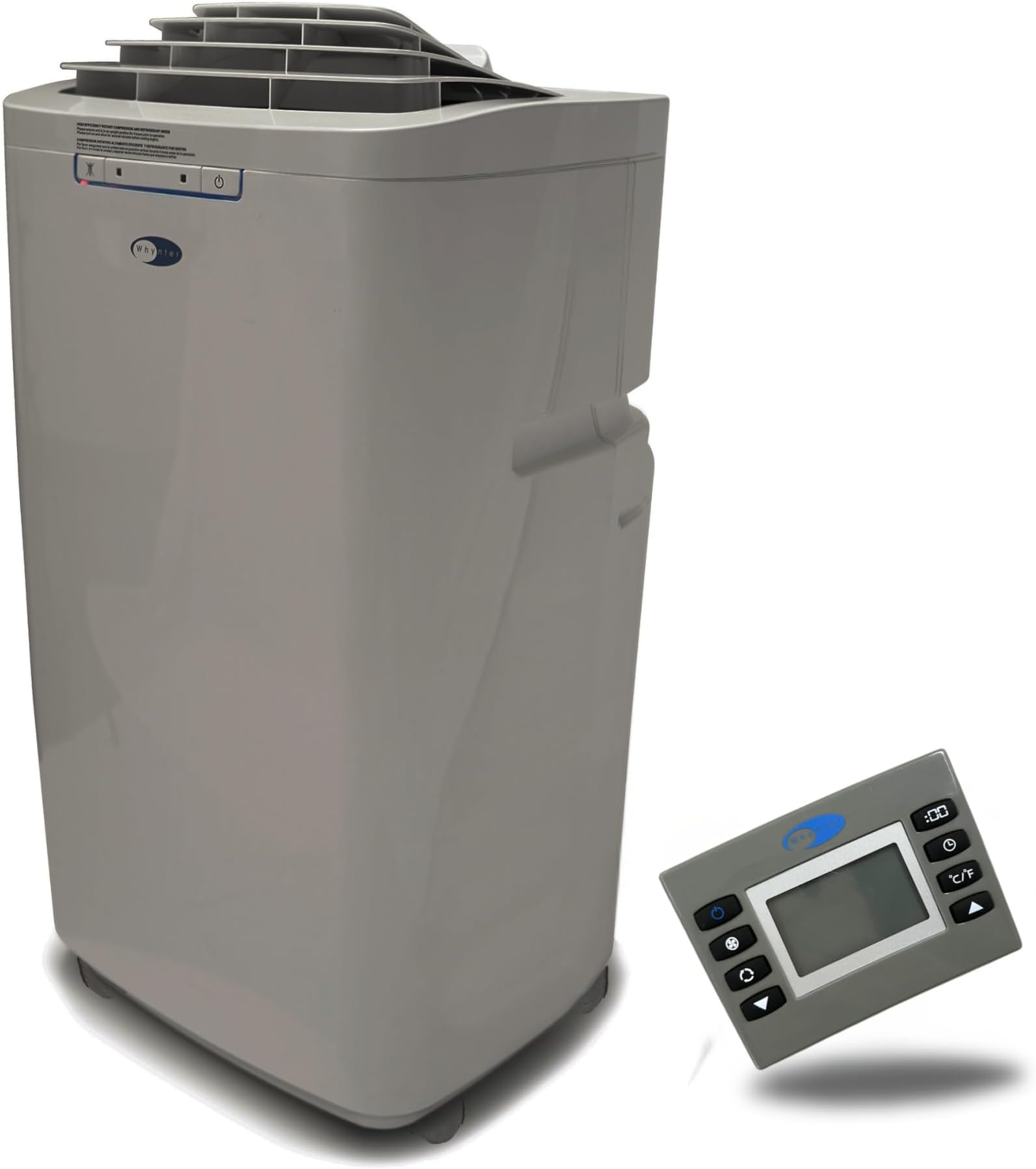







| Additional Features | Patented auto drain function fully exhausts all condensate automatically in most environments, with upper gravity and lower drain ports for continuous operation |
| Annual Energy Consumption | 1150 watts |
| Brand | Whynter |
| Capacity | 91 pints |
| Color | Gray |
| Efficiency | 5.88 |
| Item Dimensions D x W x H | 17.3"D x 30.5"W x 15.4"H |
| Item Weight | 68 pounds |
| Noise | 52.5 db |
| Power Source | Corded Electric |
| Product Dimensions | 17.3"D x 30.5"W x 15.4"H |
| Seasonal Energy Efficiency Ratio (SEER) | 5.88 |
| Special Feature | Patented auto drain function fully exhausts all condensate automatically in most environments, with upper gravity and lower drain ports for continuous operation Special Feature Patented auto drain function fully exhausts all condensate automatically in most environments, with upper gravity and lower drain ports for continuous operation See more |
| Start year | 2020 |
| Voltage | 115 volts |
| Wattage | 1150 watts |
| Window Opening Maximum Width | 6.5 inches |
N**E
Why didn’t I do this sooner???
After years of sweating I finally purchased this for my 450 sq ft living room which has huge picture windows that don’t open so window AC wasn’t an option .. it’s seperate from the the rest of the house so all the fans in the world only lowered it a degree or two. I’m in love. I ended up getting a scratch and dent one from amazon for $229 (I’m cheap) I vent it out my screen door. It has a crack in the plastic on the side. Oh well... sooooooo much quieter than the window units. It also keeps the room at a consistent temperature unlike my window units in other rooms. Where it goes way up and then freezing.. then sweating, then freezing ... Checking my thermostat on the wall it’s generally super close to if not at the same temp I have the ac at really far away from it .. again unlike the window units I have to set wayyyyy below what I actually want my room at. It’s big... don’t care. It was super easy to install. It’s actually not that ugly. Far superior to my window units I don’t know why I didn’t do this a million years ago. I will be replacing all my window units with these. I have the room curtained off but no doubt it’s powerful enough to cool a lot more Space if I wanted to. Also my breakers are known to trip .. hasn’t once so it can’t be pulling as much power as the window units that trip it all the time. I’ve had this unit for several years now. Still works great. I got my money’s worth when it finally dies and I have to replace it. My energy bills have been very reasonable.
M**T
Be very skeptical of these units
I bought 3 from Amazon and all 3 have gone back. I didn't even open one of them as I was so frustrated with the other 2. I bought the units for my 3 bedrooms, two of which are about 150sq ft, the last which is about 250 sq ft. All 3 rooms are well under the size of what the units are rated for. I bought the larger size unit with the expectation that I could move them to other rooms if need be to keep them cool. Setup: The setup of the units was not a problem. Even though the shipping weight is 86 pounds, I found them to be relatively easy to move. As another reviewer commented, they are very easy to unbox by just cutting the 4 straps and lifting the box up. Once out of the box and in the rooms that I was putting them in, I had an extra setup step due to my windows being casement/crank-outs. To get the unit to work I have to put a piece of plywood or plexiglass in each window and cut the holes for the exhaust pipes. I've done this with other portable units that I have used in the past so I find it easiest to cut the plywood to the size of the screen for the window. Once the unit was all setup, I was ready to go! Cooling: I am well aware of the limitations of portable air conditioners. If you do not have to install a portable unit (you have regular double or single hung windows) buy a standard air conditioner. They work incredibly well. Portable units are not the answer unless you absolutely have to use them. With that being said, I have an old unit (Icy Breeze or Arctic Breeze or something along those lines) that works perfectly in the large master bedroom. Regardless of what the temperature is outside, it will do a good job of keeping the temperature consistently cooler. That is a single hose unit and is at least 10-15 years old. These new units would not keep the rooms cool at all. I tried using these units in both hot and moderate weather. There were days when it was 90-94 and there were days where it was 75-85. I have a thermostat in the master bedroom to control one of the zones for my boiler and even with this Whynter unit running for 10-12 hours, the coldest the room ever got on a hot day was 80. Even on the moderate days, it would not drop the temperature below 72. What is the point in an air conditioner that doesn't work when it is hot out? Draining: On the days where it was hot 90-94, I had to drain the units about 4 times during the night. It probably got down to about 74 or 75 at night and still I would drain the unit at 6pm, 12am, 4am, 6am. It was unbearable. For whatever reason, as it got cooler out at night and into the morning, the unit would actually build up more condensation. Draining wasn't too difficult, I used a plastic ziplock bag that I put underneath the lower drain and let it fill up. The upper drain I used the ziplock bag as well. But this unit needs a larger tank to be able to not have to be drained 4 times during the night. Mind you that each time that you drain the unit, the unit has shut off so it takes another 10 minutes for the compressor to kick on. Due to the simple fact that these units could not cool a room that was well within the specs of what they should be able to handle, I returned them. Next year, I will just put in new windows and use regular window air conditioners as they always work as expected.
M**E
ARC-131GD comparison to ARC-12SD
I have been using this for about 2 weeks. I bought this for my master bedroom which is about 23x16 (368 square feet) and has vaulted ceilings. It was to replace a Whynter ARC-12SD which was working great but was going to be moved to my wife's office. Not to make this a review about the ARC-12SD but comparing it to the ARC-131GD reveals the latter's pros and cons. The ARC-12SD has been in use for about 1.5 years and has performed great. It had two downsides. Its first downside may not be a downside depending on the room you place it in. It has a bright blue led display and several other led indicators that could not be turned off. At night, in a bedroom, the led's are quite bright. We taped a credit card over the main display. The card blocked most of the light at night and we could flip it up if we wanted to see it if we wanted. The ARC-131GD has a remote control that contains the display rather than having it on the air conditioner itself. My wife and I both like that. There is a spot on the unit to store the remote but my wife keeps it on the nightstand. The ARC-131GD does have a blue led on the front of the unit but you can turn it off. Again, depending on the room you are putting this in, either may work for you. We only realized the ARC-12SD's second downside when we started to use the ARC-131GD, The ARC-131GD is quieter than the ARC-12SD. The compressor seems to quietly engage in the ARC131GD whereas the compressor on the ARC-12SD seems to be more abrupt and noisier. Although I do remember hearing the ARC-12SD cycling at times (I guess it woke me up), I have not noticed the ARC-131GD cycling at night (I guess it does not wake me up). On paper, the ARC-131GD is ever so slightly better suited for a larger room. The ARC-12SD is rated for 400 square feet while the ARC-131GD is rated for 420 square feet. After reading a few reviews it seemed like the ARC-131GD was slightly more efficient than the ARC-12SD. Believing that the ARC-131GD was more powerful and more efficient lead me to consider the ARC-131GD rather than just getting another ARC-12SD. Price wise, it seems that the ARC131-DG is generally available at a lower price than the ARC-12SD. When the ARC-131GD dropped to a particularly low price, I jumped on it. The first night with the ARC-131GD revealed just how quite it is. Of course you can hear the fan, similar to, but slightly quieter than the ARC-12SD's fan. From a cooling perspective, the ARC-12SD cooled the room faster. Not sure why this is but...every night the ARC-131GD is slower to cool then the ARC-12SD. Both were set to maximum fan speed. During the night, both cooled the room fine. Neither my wife nor I have been uncomfortable. We both notice the room cooling slower with the ARC-131GD as compared to the ARC-12SD. The ARC-12SD does have adjustable vents while the ARC-131GD does not. We used to point the vents on the ARC-12SD as high as they would go, almost vertical. Since hot air rises, it seemed like a good idea to push the cold air towards the ceiling. The ARC-131GD pushes the air out at a more horizontal angle. Maybe if it could push the cold air towards the ceiling, it would do an better job at cooling the overall room faster. This may only be an issue with a room with a vaulted ceiling. Would I buy another ARC-131GD? Based on the price I got it for (much less than the ARC-12SD) I would say yes. How much am I saving in electricity using the ARC-131GD in comparison to the ARC-12SD? If your requirements are for the room to be cooled a bit more quickly than the ARC-12SD may be better choice. If you have to run the ARC-131GD 20 minutes longer a day to get the room to a specific temperature, does its slightly better efficiency pay off? If the ARC-131GD is priced the same as the ARC-12SD, I would get the ARC-12SD. If the ARC-131GD is at an all time low price-wise, I would get the ARC-131GD again. It has its pluses and minus's (both of which depend on where it will be located and your personal preferences). A couple of additional points. The ARC-12SD has an intake and exhaust hose. Both are the same diameter. The ARC-131GD intake hose is the standard size. The exhaust hose is smaller. The connectors are standard as far as connecting to the air conditioner or window vent but the tube connections are different sizes to match the hoses. The tube lengths on the ARC-131GD are about 8 inches shorter than the ARC-12SD. Whereas I could maneuver the ARC-12SD away from the window and point it an any direction I wanted, the limited hose length on the ARC-131SD did not allow for this. I had to place the air conditioner as close to the wall as I could. Although I had standard replacement hoses which were longer, I could not utilize them because of the non-standard exhaust hose connector of the ARC-131GD. My solution, buy 2 more standard connectors. I live in FL. My back yard, which is where the air conditioner cooling intake pulls air in from, is basically a jungle. The air being pulled in is extremely humid. When I hooked up the new air conditioner, I replaced both the intake and exhaust tubes. The intake hose I was replacing was full of a very light coating of mildew. Yuck! Even given those conditions, I never had a problem with the ARC-12SD filling up with water. I have read other reviews of the ARC-131GD and some have reported problems with the unit filling with water. So far (2 weeks) I have not had a problem with the unit filling with water even with the very high humidity.
M**F
A/C is adequate, but don't buy this for use as a fan; window mount needs improvements
I'll start my review by stating that I've never owned another air conditioning unit, whether a "portable" one like this model or something else. I did a fair amount of research before buying this unit, though, and decided on this model because of the dual hoses and because the BTU rating seemed appropriate for my living area. Here are the pluses of this unit as I see it: Easy to follow installation instructions until it gets to the window plate. (More on that under the cons.) Okay looking for what it is. Has remote control. Puts out cold air when set to a/c, as promised. Not too loud. (I'm not sure whether other people who've commented on the loudness just got defective units or have different expectations.) Here are the cons/minuses: 1. Window plate. Who designed this thing? I anticipated, based on the manufacturer's description, that I would simply be able to slide out a panel or two and lock the panel in place somehow since my window is in the size range this is supposed to fit. Well, when I used the small plate in conjunction with the one that the hoses go into, it was too small to cover the entire vertical space. When I used the long one, it was too big to put into the window. I had to cut the larger one down to size, and given that I don't have a saw (don't have much use for tools, generally speaking) it was quite a task to cut through the thing with a pair of scissors! The other issue I don't quite understand with the wall plates is why aren't designed to simply be more accommodating to different lengths. I'm not sure how to describe what I was expecting, but I used to have a dual window fan with slide-out accordian panels and I expected something a little more easy like that. 2. Fan mode. One of the reasons I bought this model was the dual hoses, and I thought this would not only be useful when the unit was in a/c mode (exhausting hot air outside while drawing in new air to be cooled so as not to create a negative air pressure issue) but also in fan mode. Well, the unit does not draw air in from outside while in fan mode; it simply circulates the air that's already in the room. This makes sense when the unit is set in "auto" mode because you certainly wouldn't want it to draw in hot air from outside in between the a/c compressor's cycles. But when the outside temperature is actually cooler than it is inside, not being able to simply use this unit as a fan to draw in cool air is a MAJOR design flaw. Had I known this about this unit, I surely would not have purchased it. My need for this unit was actually more that I have difficulty getting an exchange of air from outside my condo with what's inside due to the builder's poor decision to install only one operating window. I figured that instead of simply getting a dual window fan like I had before that was really only effective in the area immediately adjacent to the fan due to a lack of power that I would get something like this that would surely be more effective at drawing in outside air while exhausting existing inside air. I figured that I'd really only need the a/c a few times per year when it's extremely hot outside where I live. When the evening air is 60 degrees but the inside of my condo is in the upper 70s, I can cool it down just as fast with a fan in the window as I can using this unit in a/c mode, using only about 20% of the energy. So I guess I'll be happy when it is actually hot outside and I have something that will actually provide cool air, but that only happens where I live on rare occasions. My other major beef about this unit is the designer's decision to have the a/c unit deliberately miscalibrated by 5 degrees. Want your room cooled down to 73 degrees? You must set the a/c to cool down to 68 degrees. If you set it to 73 degrees and it's currently under 78 degrees inside, the a/c unit won't even turn on. I understand the manufacturer's logic that this will save energy, but that's only true if the unit is being used by someone stupid. It's the equivalent of deliberately setting one's clock to the wrong time in order to trick one into getting up on time. I don't know about you, but if I know the clock is set 10 minutes fast then I'll simply compensate for that in my mind; I won't be fooled into thinking that 6:00 am is really 6:10 am. In a way, I feel like my star rating is overly generous since I actually do regret this purchase. To give it less than 3 stars when it basically does what it's supposed to do, though, doesn't seem fair. It's just the case that the product doesn't suit my needs very well and I probably would have been just as well served buying a new dual window fan for 10% of the cost of this unit.
S**8
A COMPLICATED FIVE-STAR RATING.
To those who justifiably complain in their reviews about modern-day PORTABLE air conditioners being noisy, did you know that a quiet, much more efficient design call the PORTABLE-SPLIT AC is available in Europe and other parts of the world with a 50 HZ electric supply but is NO LONGER available for the USA's 60 HZ market? Way back in the 1990s, we purchased a PORTABLE-SPLIT AC that is no longer available in the USA but technologically advanced versions of it are sold in Europe. Our model was a two-piece, 11K BTU, DeLonghi PAC GSR/MU "Pinguino" (aptly named penguin) with its fan and electronics housed within its ultra-quiet interior unit. Its small compressor unit, which is the piece that makes the noise, was outside where it could drip condensate unimpeded instead of flooding the house or shutting down the AC if emptying was required. The compressor was permanently attached to the interior unit by a connector line comprised of a pair of small refrigerant-filled copper tubes housed in an unobtrusive, slim (1.5" x 3"), 6-foot-long plastic sleeve. (One can search for this Pinguino model number on the internet to see its configuration.) Our dependable PORTABLE-SPLIT Pinguino provided over fifteen years of outstanding, trouble-free service to a house with difficult-to-vent casement windows and sliding glass doors. We placed its thin connector line at the bottom of a two-inch opening in one sliding glass door and inserted a barely-visible, narrow foam insulating strip to block off the remainder of the 2" vertical opening. (Exiting the connector line out a double-hung window would be even easier.) Security-wise, our sliding glass doors came with an accessory that prevented the door from sliding open any further. Comparatively speaking, one was barely aware that the portable was there when it was operating except for the floor space that its interior unit occupied. The basic principle behind the superior efficiency of a "split" AC, with its inside and outside components connected by refrigerant-filled tubing, is that no outside air contaminates the conditioned air in the living space. By contrast, the air-to-air portables currently available to the American public not only have their noisy compressors housed in the one-piece interior unit, they also have truly ugly, highly inefficient, single or dual five-inch-diameter air-exchange hoses that are impossible to conceal, troublesome to vent, and problematic because both single and dual hose models create some degree of negative-air-pressure that draws the hot, humid outside air back into our living spaces to contaminate the conditioned air and condense on our cooled interior surfaces. What's currently available to us is a giant step backwards in air conditioning technology. Though no longer available as a portable in America, the quiet, efficient, two-piece "SPLIT" AC design is now exclusively the lucrative product of big-name-brand Ductless Mini-Split manufacturers. Trouble is that, compared to portables, Ductless Mini-Split air conditioners are very expensive and require (a) professional installation to retain warranty and (b) putting a hole in an exterior wall. Installation of our portable Pinquino was just the opposite; we seasonally set up and removed the Pinquino twice a year for the fifteen-plus years that we enjoyed it; it took only minutes and required no expensive professional assistance. We tucked the two-piecer in a closet for the winter and didn't have to deal with a hole in an outside wall or a drafty window kit when the temperatures were below zero outside. For those of us (apartment dwellers OR homeowners) who either can't or don't want to drill a hole in an outside wall but live in areas with hot, humid summers, we no longer have that quiet, efficient PORTABLE-SPLIT option. (There is an unwieldy SPLIT AC hybrid with a 20 to 25 ft. connection line with a "Quick-Connect" feature that's designed to exit either through a window OR a hole in the outside wall but, since the interior unit is secured to the wall like a Ductless Mini-Split, it may be movable with considerable effort but hardly qualifies as "portable".) Unfortunately by 2011, I felt that either the Pinquino was starting to show its age or the summers were getting hotter so, since I couldn't buy a PORTABLE-SPLIT AC in the USA anymore, I decided to replace it with newer and, I hoped, better technology. Trying to fill the PORTABLE-SPLIT AC void, I bought (a) a single hose air-to-air portable in 2011, (b) a dual-hose air-to-air portable in 2012, and (c) a very expensive Ductless Mini-Split AC whose professional installation required a hole in my wall in 2013. Both of the noisy portables, single AND dual hose, caused a negative-air-pressure that made my living space mold-inducingly humid. Over the course of its first month in the summer of 2013, the Ductless Mini-Split system failed. The HVAC installer was unresponsive to my complaints and never revealed whether a faulty installation or defective compressor caused the refrigerant leak not discovered until September, so I returned it. The Ductless Mini-Split was great for the brief time that it worked and I do not think that all HVAC professionals are as incompetent or unresponsive to their customers or that all Ductless Mini-Split ACs are defective, but last summer's stressful, expensive experience was one that I'm in no hurry to repeat. This spring, I bought a dual-hose Whynter ARC-131GD from Amazon as an interim solution and have used it in May...but May is not the hottest, most humid month in the Northeast by any stretch so it hasn't been challenged. However, it is a solid, well-built unit. Even its electric cord is a substantial gauge. Its fan easily disperses cold air through the fixed, tiered opening on the top of the unit with sufficient strength to condition my 425 square-foot room. The ARC-131GD's "EXHAUST" hose is smaller that the "INTAKE" hose, and I personally think that this diameter difference might contribute to minimizing the negative air pressure in my tightly constructed house. I base this opinion on the fact that I cannot feel any perceptible air being drawn by the ARC-131GD into the house through the stove and bathroom exhaust fans as I could with the other two air-to-air portable ACs. I really like its unusual medium gray color because it visually disappears in our dark room instead of standing out like white or other bright color. In fact, I wish the hoses were the same color so they would "disappear"! No surprise, the (compressor-housed) Whynter ARC-131GD is considerably noisier that a "split" system, either portable or ductless, both of which have outside compressors. The ARC-131GD's noise is noticeable but tolerable, although I'd classify it as more than "white noise" to me. However, I only paid $400 for the 131GD versus a whopping $3500 for that troublesome, hole-in-the-wall Ductless Mini-Split, so I rationalize that I can tolerate some noise for the $-difference. Would I trade this Whynter for a PORTABLE-SPLIT of the same quality and longevity as my quiet, dependable Pinguino PORTABLE-SPLIT? In a nano-second! However, the ARC-131GD is, for the reasons mentioned above, satisfactory so far and I have expectations that it will remain satisfactory throughout the summer's increasing heat and humidity because it has demonstrated that it has considerable reserve power to make my room uncomfortably cold in short order when cranked up to top fan speed while set at the lowest temperature. I gave the ARC-131GD five stars because, so far, it does the job for which it is designed, but it is what it is. Air-to-air technology is inherently noisy and inefficient. I'm still looking for another ultra-quiet, efficient, unobtrusive portable-split AC and wonder why I no longer have access to such a product in America. Conservatively speaking, I've read at least a thousand justifiably negative portable reviews over the past 3-1/2 years since the passing of the Pinquino. Perhaps it's time for a PORTABLE-SPLIT AC rebirth for those of us who can utilize this two-piece SPLIT design. To that end, I still hope that manufacturers of PORTABLE-SPLITS realize that there is a market for this product here and convert a current 50 HZ model (with inverter technology, "quick-connect" lines, and other technological advances) to 60 HZ to give Americans this option again. Better yet, manufacture this option in America.
R**N
Honest Review of Whynter's ARC-131GD Dual Hose Portable Air Conditioner
This is my review of Whynter’s ARC-131GD 13,000 BTU Portable Air Conditioner. I have owned several portable air conditioners in the past, and was looking for one to replace my failing LG unit. After extensive research, I decided to go with Whynter’s dual hose design over the single hose units I have had in the past. The first unit arrived very quickly with no damage shown on the box. When I first turned the air conditioner on, it started right up and was fairly quiet. Once the compressor kicked on, it sounded like a diesel engine was running. The entire room started to vibrate and actually vibrated the ceiling light on the room below. I called Amazon right away and told them what was going on. They were extremely apologetic, and agreed to have a replacement sent out right away. Getting this air conditioner back in the box was almost impossible considering it weighs 86 pounds. The replacement unit arrived the next day via FedEx Express, and UPS picked up the defective unit. This is where my full review begins. I purchased this portable air conditioner to cool my office which is 330 sq ft, well below the 420 sq ft it is meant to cool. Setup: This portable air conditioner weighs a ton just like most of the units on the market. If you plan on carrying it up the steps, it will most likely take more than one person considering it weighs 86 pounds. Getting the air conditioner out of the box is fairly simple, and requires you to cut 4 plastic straps and lift the outer cardboard shell/box straight up. Inside you will find the unit itself, 2 hoses, a plastic window slider, screws, caps, and a few other miscellaneous things. Setting everything up was straight forward just like all the other portable air conditioners I have owned in the past. If this is your first portable air conditioner, I would strongly suggest reading the manual to see how the hoses attach to the window. Remote Control: This portable air conditioner comes with a decent controller that has 8 buttons and a small LCD display. The remote has buttons to control the operating modes, fan speed, temperature, clock, timer, and Celsius/Fahrenheit. There are two major things to note about the remote. The first is the remote is the only way to change the temperature, modes, etc. The second is for the remote to work, it must be pointed directly at the unit, and the command is confirmed with a quiet beep. There are only 2 buttons located on the portable air conditioner itself (A power button and a button to turn the lights on the unit on/off) If you lose the remote, there is no way to change the temp, modes, etc. Cooling Power: This portable air conditioner is rated at 13,000 BTU/420 sq ft. It takes approximately 10 minutes for cool air to start coming out of the unit, which is typical for portable air conditioners. As I stated before, the area I was trying to cool was aprox. 330 sq ft. I did several tests to see how long it would take to get the room which normally is 78 degrees down to the lowest temperature of 61 degrees. During the first hour of operation the room dropped to 76 degrees. The unit ran for the next 12 hours, and could only lower the temperature down to 68-69 degrees. I was extremely disappointed in the cooling power of this portable air conditioner. The air exiting the cooling vent was only between 58-58 degrees. All of the other portable air conditioners I have owned could easily blow air out between 40-45 degrees. Noise Level: First off, portable air conditioners are not as quiet as normal window air conditioners so you cannot base the noise level off that. The replacement unit that Amazon sent me operated much quieter than the previous one. On the lowest fan setting you can carry on a conversation and hear the tv. Once you raise the fan level up, it becomes quite loud. What annoyed me the most is when the outer case of the portable air conditioner started to rattle/vibrate from the compressor. Overall, when the unit was not rattling it operated at a comparable noise level to other units I have owned. After having tested two of these portable air conditioners, I ended up returning the replacement because it did not operate like it was supposed to. It lacked cooling power, and the constant rattling really drove me crazy. It seems there are major quality problems with this portable air conditioner since I had similar problems with both units. Due to all these issues, I would not purchase another Whynter portable air conditioner until all these issues are addressed.
T**N
Problems with this Unit...
I regret buying this unit and will not buy another floor standing AC unit again. Nor a Whynter product either. Here's why: 1. You have to regularly drain the unit. There's a plug in back to do this but it is so low to the ground that you'll be using a very shallow basin to do this manually every day or two or three depending upon the temperature and how much you use it. 2. So the solution is to elevate the unit and let it drain into a large basin. Ok, just try that and see how it works! The problem is that it has casters so it doesn't want to stay on top of anything. So if you build a small wooden platform to elevate it...It will slide off. Ok, so take the casters off. And then you find that the housing which reaches beyond the bottom of the unit prevents this. Ok, so get some bricks and put them down to elevate the unit so the housing clears the platform you just built. Ok, so now get some plastic tubing to channel the drain water into the basin...And you find that it is some weird thread so you have to take the screw on plug to Home Depot or Lowes and try to match it. I finally did find a usable fitting and screwed it on. Had to buy 25 feet of tubing to match the fitting, only used about 10 inches. Ok, so now I have it sitting up on a platform, on bricks, with a drain fitting and tube to drain the water into a catch basin. I bought a medium sized storage container for this so it was deep enough yet small enough in the other dimensions. Turn it on during the summer heat. Find water dripping from the top of the platform...Ok, the fitting is apparently not exact or something. But it's the only one that they had. Buy a kitchen drain pan and put it under the unit and channel the leaking water in to my improvised catch basin. A little over 1 day later, the catch basin is overflowing! Ok, drain that and clean it up. Move unit and catch basin so that I can actually SEE it daily and drain it daily. What a pain!!! A window unit does NOT have ANY of these problems or extra needs! 3. The unit is BIG. And noisy! Remote doesn't work all that well because the transmit/receive range and cone is small. Had to move some things to get it all to fit. 4. Unit over time apparently leaks Freon and its cooling capacity reduces steadily. No provision to recharge it. Rather an expensive unit for it not to last. 5. Fan self-destructs. Makes a heck of a noise! Shut the unit down. Tear it apart...That's a big challenge/problem in itself. Yes, the fan is made is made of inferior light weight plastic and the blades came apart and destroyed the rest of the fan. No, the fan cannot be repaired. No, I don't have the money for a new unit. Yes, of course, the unit is out of warranty. How convenient for the Whynter company with its self-destructing fans! Find a replacement unit on the web. Get it bought and delivered. Oh, boy! Replacing it is quite a pain! Now I know why these units cannot really be repaired and it is advised to just through them out. How wasteful! And expensive! I get the fan replaced and somehow get it all re-assembled. Works for a while... 6. Notice it is not cooling as well as it did originally. Must be a Freon loss/leak. Funny, but I bought another one of these types of floor standing units from Whynter and it has the exact same problem! But it lost its cooling even faster! Ok, so now knowing my sad and tortuous and expensive story you may want to just buy a window unit. I did! And I'm very, very glad that I did! ZERO floor space used! Much quieter! I bought a GE unit with a quiet mode and it works really well! So think twice or thrice before getting a floor standing unit and in particular this unit. - Grant
D**.
Good Portable (With some effort) AC Unit
This AC unit was purchased to cool a 400 square foot room in our Florida house. The rest of the house has central AC. Its our first portable AC unit. I have been using it for maybe three weeks. My preliminary opinion is positive. The unit cools the room at least 10 degrees below the outside air temperature which is all we have asked it to do so far. Florida is often humid. So, it has been necessary to put a bucket behind the machine and to attach a short section of garden hose to the upper drain outlet on the rear of the unit. Otherwise, the unit will shut off and wait to be drained after it uses up its internal water storage capacity. The unit is somewhat noisy when the compressor it working during its first one or two cooling cycles. It seems to quiet down somewhat after it has "warmed up"....not quiet but definitely tolerable. The compressor cycles on and off in AC mode but the fan always stays on. In the fan only mode I just hear a moderate humming background noise. There is a dehumidifying setting on the unit. I called rep at Whynter about it. She said there is no built in humidity gauge. The unit just cycles between the compressor and fan intermittently when it is in its dehumidifying mode. She suggested just using AC mode but disconnecting the exhaust hose so the warm exhaust air doesn't leave the room when I want to remove excess moisture but not cool the room down. She thinks that will be more effective for my Florida climate. In demhumidifying mode it is also necessary to disconnect the exhaust hose. I suspect we will just turn the AC mode on and off periodically when we mostly just want to get moisture out of the air as it is a hassle fussing with the hoses. All in all we are pleased with the unit.
R**D
Bon choix
Je suis très satisfait de mon achat. Livraison gratuite ,arriver en 5 jours, aucun dommage et acheter a petit prix (334.00$ neuf en spécial). Elle refroidit bien mon salon et ma cuisine ce qui donne approximativement 500 pied carré (Il me reste a confirmer ce que sa donne au milieu de l'été a des +35 degré Celsius) , mais pour l'instant tout est parfait.
J**N
Four Stars
the unit is preforming well, amazon.ca overcharged me.my fault should have shopped around more.
S**E
Would not buy this again
Not pleased with the hose attachment. Mine broke trying to get hose off window...hoses are very short.
D**G
So far so good!
So far it seems to work well! The summer will be the real test though? As far as removing the hoses as one person complained about, I found all you have to do is firmly grip and rotate the hose coupler and that will push the tabs back, then wiggle it out! Very easy! I don't know why that is not in the instructions? As far as delivery, UPS did a great job, no damage to box at all!!! Update: I stand corrected, it does say in the manual to twist connectors to remove at the bottom of page 15 of the manual! A little hard to find though?
M**R
Satisfied customer
Excellent purchase. Would not choose otherwise.
Trustpilot
3 weeks ago
3 days ago