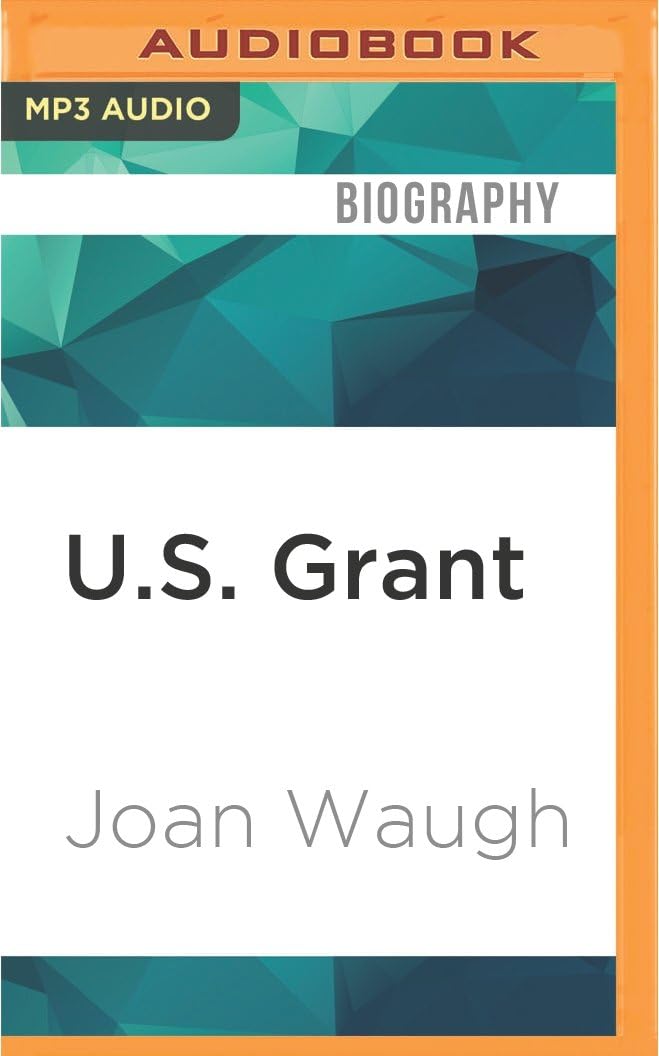
U.S. Grant: American Hero, American Myth
Product ID: 563256795
⏳In-depth cultural memory analysis
🎧Immersive audiobook format
📚Comprehensive historical biography
Desertcart purchases this item on your behalf and handles shipping, customs, and support to Japan.
🎙️ Unlock the untold story of America’s forgotten hero—don’t miss the history everyone’s rethinking!
U.S. Grant: American Hero, American Myth is a meticulously researched audiobook by Joan Waugh, produced by Audible Studios. It offers a nuanced exploration of Ulysses S. Grant’s life, military career, presidency, and the fluctuating public memory of his legacy. Combining biography with cultural history, it reveals how Grant’s reputation evolved from revered Union savior to a misunderstood figure, challenging prevailing historical narratives and inviting listeners to reconsider his true impact on American history.
| Customer Reviews | 4.6 out of 5 stars 63 Reviews |
M**R
US Grant Savior of the Union
Joan Waugh has written a very important book that explores many of the myths that have surrounded US Grant for a very long time. Most importantly she investigates how it was possible for Grant to go from being so overwhelmingly loved, respected and admired, in the US and internationally, to being listed near the bottom of presidential rankings. At his death he had been ranked with Washington and Lincoln today he is lucky to be listed near the middle of the pack. She explores his fall in the eyes of historians and how their influence tarnished his memory. The entire nation mourned Grant at his funeral in thousands of memorial services across the country yet it took 5 years for his mausoleum to begin construction. Its location in New York City was wildly controversial since it would not just be his final resting place but a national memorial to the great man. It was thought that a national memorial should be in the nation’s capital. It would take 7 more years for the mausoleum to be completed and over a million people attended the massive parade and dedication ceremony. Yet only 90,000 people contributed money to the construction of the memorial and most of those were New Yorkers. Ms Waugh explores all of this in detail and how, by the second decade of the 20th century, US Grant had faded in public memory and his esteem had fallen dramatically. But this book is about much more than that. It covers his childhood, education at West Point, military career before the Civil War, his movement into civilian life, military career during the Civil War, his post war activities, his time as president, the often overlooked struggle for reconstruction and the writing of his classic autobiography. It examines the many myths surrounding him such as: Was he a drunk? Was he a failure at everything he did in civilian life before the war? Was he a butcher who threw away lives needlessly during the Civil War? Was he a corrupt president? The author covers all of this and does it in a very readable and entertaining way. It is remarkable to me how poorly Ulysses Grant had been viewed by historians in the 20th century and that continues into the 21st century. In the Siena Institute ranking he moved from 35 in the 2002 survey to 26 in 2010. Still too low in my estimation but it shows that current historians, political scientists and presidential historians are being influenced by modern scholarship. However, in 2010 they listed Polk, Jackson, Cleveland, Van Buren and Arthur above him. That is way too high for those presidents and Grant should be rated much higher. Of all the surveys that are done to rate presidents Siena seems to survey the most credible sources but I still feel those sources are incorrect in their evaluations of many of the presidents. When historians are not focusing on Grant and reconstruction they overlook the tremendous effort Grant put into attempting to secure true freedom and unobstructed suffrage for the freedmen. This quote from Joseph Ellis’ “His Excellency George Washington” struck me. When discussing the extraordinary difficulty Washington faced when he first entered office Ellis writes, “Looking back over two hundred years of the American presidency, it seems safe to say that no one entered the office with more personal prestige than Washington, and only two presidents- Abraham Lincoln and Franklin Roosevelt- faced comparable crises.” Well that overlooks the enormous personal prestige Grant enjoyed as the savior of the Union and the crises of reconstruction. I am so glad that Joan Waugh covers both of those topics in some detail. Ulysses S Grant is in my top ten list of presidents and I think Professor Waugh does an excellent job of illustrating why that should be so. I would recommend this book to anyone interested in Ulysses S Grant.
M**S
Excellent book
Very good book. Doesn't just concentrate on his military career but his upbringing, political career and why he went from hero to almost forgotten. I went to his mausoleum in New York and there was nobody else there. A good read for those who want an overview of his life and his importance in the years after.
R**A
Great man gone...
This quasi-bio is especially valuable in breaking down the reasons for Grant's puzzling departure from American historical fame and fanfare to revisionist obscurity. Fortunately author Waugh is amongst the wave of "re"revisionist biographers reinforcing the implications of "why" set forth by others like Smith and Simpson. The book is somewhat fragmented, not caring to be a sprawling biography but rather a treatise on certain issues, principles and events. In particular, Grant's death and subsequent funeral, and, the history of Grant's Tomb are greatly detailed and alone make the book worth reading for devotees and doubters alike. richard guida
B**.
Refreshing, Poignant, and Timely-the most insightful book yet on U.S. Grant
Ulysses S. Grant remains most of the most enigmatic figures in American history as the amount of biographies written on his career as both a General and President are extremely plentiful. And I have read many of these great biographies by esteemed historians that detail Grant's life. Yet, Professor Joan Waugh's account of Grant is unique and in my opinion, sorely needed; Waugh addresses the important question of why Grant's legacy, one of the most famous living Americans ever, toils in mediocrity. Through an incredible account of historical sources mixed with page-turning prose, Waugh's analysis is refreshing and enlightening, illustrating the historiography of Grant's legacy and frankly, how much Grant did for America both as General AND as President. As many other reviewers have mentioned, this book is not a strict biography of his life--Waugh clearly explains that and does not try to re-hash what has been extensively written about Grant by historians such as Brooks Simpson and Jean Edward Smith, to name a few. It is because Waugh looks at the historiography of Grant in a way that, almost surprisingly, has not been done that makes her account exciting and as I put it, timely. In addition, many other reviewers also have commented on Waugh's writing style; in addition to the exciting premise and dynamic scholarship, this is one of the most readable (with great pictures) page-turning history novels I have ever read. All in all, as a graduate student studying American History, I've read many books on the Reconstruction time period and on Grant, and this is by far my favorite book on Grant and one of my favorite history books, period. For those who criticize the books favorable account on Grant, it is important to understand that this is so because of the historical truth--Grant was far from perfect, something that Waugh clearly states and that Grant states himself, but history verifies his good intentions and great actions in what he thought was best for America (and his under-appreciated advancement of civil rights) during an unprecedented time period. Overall, pick this book up and enjoy this stimulating account on one of the most interesting figures in history!
L**S
Brilliant and original biography of U.S. Grant
U.S. Grant is routinely seen today as a disastrous president and only a competent, at best, general. Yet in the 19th and early 20th century, U.S. Grant was third in line of greatness, following only Washington and Lincoln. Joan Waugh's superb biography is not aimed so much at telling Grant's story, though she does that, too. Instead, she explores how Grant went from being an international hero to a negative stereotype, mainly as the result of a concerted effort to redefine the Civil War in pro-Southern terms of "states rights" and downplay the role of slavery, civil rights, and the rights of free workers. Waugh is working against some powerful modern myths. "Gone With the Wind" features happy slaves, debonair aristocrats, and gentle people of refinement thrown into the brutality of war by those evil Union scum. The book, the movie, and popular culture all latched on to the notion of an ideal world made brutal through the "war of Northern aggression." One major target of this re-imagining of the Civil War was U.S. Grant. The general that conquered the South had to be diminished and demonized, and Waugh shows, in splendid fashion, how this process unfolded. Robert E. Lee, who lost all battles fought outside of his native Virginia, was lionized as the perfect general; Grant, who won in every theater of the war, was cast as a drunken bumbler that was lucky to have numbers on his side. Very readable yet scholarly, "U.S. Grant: American Hero, American Myth" is exactly what the title suggests: an examination of a major American figure in life, death and myth. Highly recommended.
Trustpilot
1 month ago
1 month ago