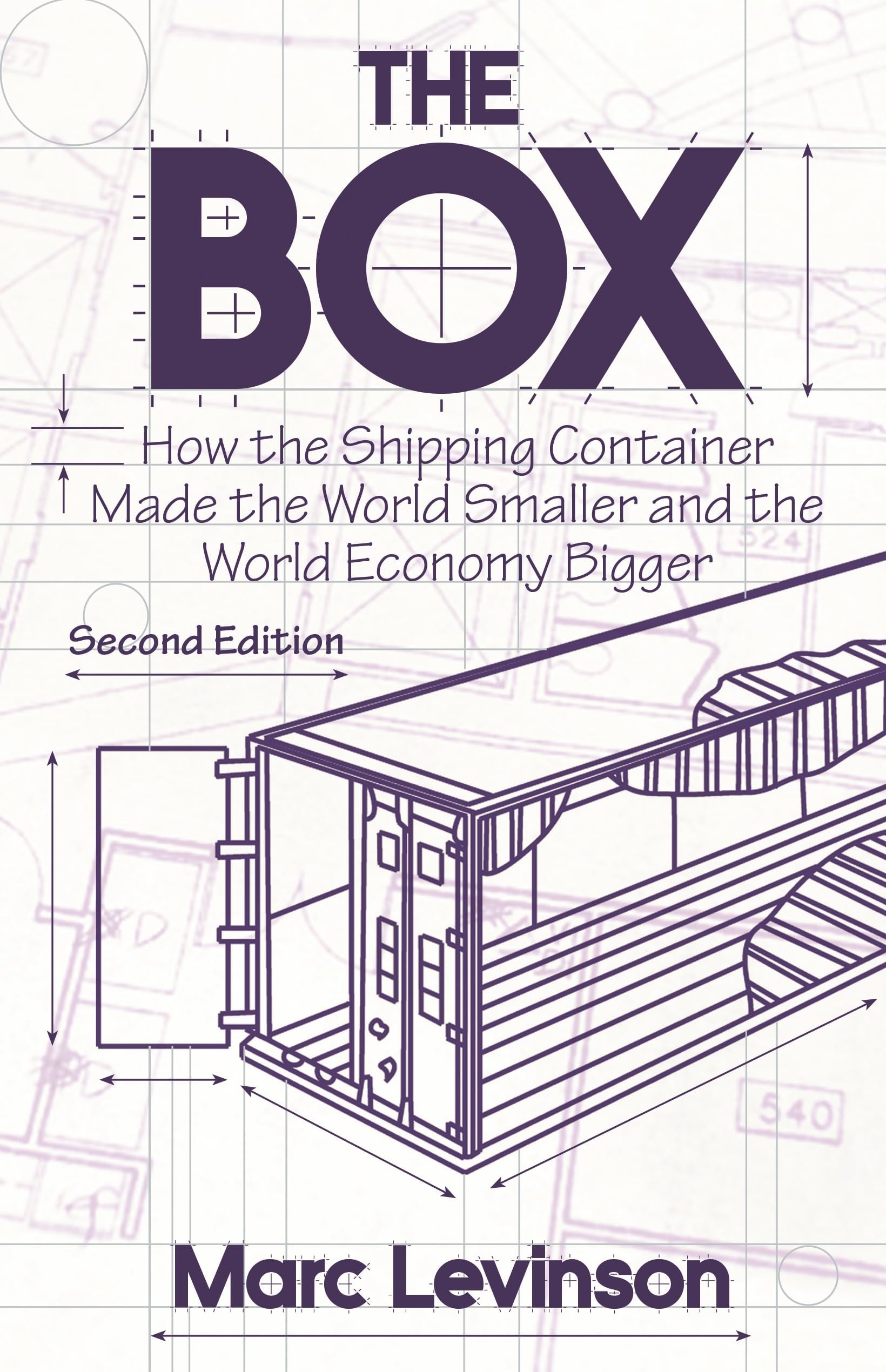

The Box: How the Shipping Container Made the World Smaller and the World Economy Bigger, Second Edition with a new chapter by the author : Levinson, Marc: desertcart.co.uk: Books Review: Fascinating coverage of the container! - Really interesting book on the history of the outwardly humble shipping container, and how it transformed shipping and the global economy with interesting comparisons throughout to traditional breakbulk shipping. Review: Box clever - This book makes a good case for the fundamental changes that containerisation has made to world shipping and trade. Before the introduction of containers international trade was a mess of legislation and restrictive practises by dock workers, and middle men accompanied labyrinthine bureaucracy, the description of which beggars belief. Although the writer gives a comprehensive history of the transport industry there are some sections which are a little hard to wade through because there is an overwhelming level of detail and one wonders whether the reader needs to know the blow by blow hammer of the history of labour relations of US dockside affairs.


| Best Sellers Rank | 166,506 in Books ( See Top 100 in Books ) 108 in Marine & Nautical Technology 192 in History of Engineering & Technology 864 in Business & Economic History |
| Customer reviews | 4.4 4.4 out of 5 stars (1,111) |
| Dimensions | 13.97 x 3.81 x 20.32 cm |
| Edition | Second Edition with a new chapter by the author |
| ISBN-10 | 0691170819 |
| ISBN-13 | 978-0691170817 |
| Item weight | 482 g |
| Language | English |
| Print length | 544 pages |
| Publication date | 5 April 2016 |
| Publisher | Princeton University Press |
R**H
Fascinating coverage of the container!
Really interesting book on the history of the outwardly humble shipping container, and how it transformed shipping and the global economy with interesting comparisons throughout to traditional breakbulk shipping.
B**E
Box clever
This book makes a good case for the fundamental changes that containerisation has made to world shipping and trade. Before the introduction of containers international trade was a mess of legislation and restrictive practises by dock workers, and middle men accompanied labyrinthine bureaucracy, the description of which beggars belief. Although the writer gives a comprehensive history of the transport industry there are some sections which are a little hard to wade through because there is an overwhelming level of detail and one wonders whether the reader needs to know the blow by blow hammer of the history of labour relations of US dockside affairs.
I**N
Gripping!
With no real prior interest in container shipping (apart from Season 2 of The Wire), I came across this book and was curious enough to read it. The story is really compelling and Levinson's fascination with the topic is contagious. If you're like me, you will be scouring youtube for video footage of container ports.... It's a fascinating portrait of how innovation happens and why it's often a long and messy process with failure along the way. Rightly cited at length in Matt Ridley's latest book on innovation
M**K
A wonderful work of economic history
This slightly disjointed book explains just how the idea of shipping goods in truck-sized boxes rather than loose proceeded to change the world: how docks and unions and in the end the whole planetary economy and the very idea of local production changed.
L**R
Excellent book on the development which led to your t-shirts being made in Asia
Who knew the development of the shipping container was so interesting and so important? The author spins a great story of the evolution of shipping. In days gone by, boats would come into harbour with all sorts of stuff randomly placed on board. Unloading took days. Many workers were employed unloading items. This offered both advantages (everyone could see what exactly was onboard reducing the chance of illegal goods) and disadvantages (everyone could see what was onboard so people often stole valuable items). The development of the shipping container was excellent for reducing shipping costs and times. It was a primary driver on why your t-shirts and sweaters are now made in Asia rather than closer to home. The shipping costs went from dollars to a few cents. Not only have jobs been lost in the country but also in the harbour. Men are no longer needed to do the tough work down the docks. Unions were formed to try and stop the wave of efficiencies but to little effect. All the unloading of containers is now done by robotic cranes. With the faster increase in offloading comes more and more containers of which only around 10% can be screened. The container has made the smuggling, of goods, drugs and even people more likely. The book is incredibly well researched and indeed well written. Its possibly a bit longer than one would want to spend reading about shipping containers but it has clearly been a really important development worthy of such a decent book.
M**N
Shipping containers
A very interesting read however it is really a history of the American container revolution. There is very little mentioned about world operators -other than how the relate to America. I think the word Maersk is mentioned only once in the whole book!
C**.
A great book about the influence of the container on shipping
The Box is a great book regarding the influence of the container on the modern economy and gives a detailed understanding of the world before the container, the transition and the consequences. It is a good read, but requires that you are interested in shipping since it can be a heavy in certain chapters. I would recommend this book to anyone wanting to understand global trade and globalization.
C**A
Love it!
I bought this book for my partner who has a haulage company. He could not put it down, he loved it. He has now taken it to his father to read.
A**R
Levinson's "The Box" is the most comprehensive, reader-friendly book not only on the usage of the shipping container but the shipping and transportation industry itself. The style, a linear, narrative type, gives both the proper historical context of breakbulk shipping preceding containerized freight to the union battles of the 60's, ending with the explosion of Asian container ports in the second decade of the 21st century. Levinson's detailed narrative is great for both readers with experience in this industry and the general audience. However, on occasion, Levinson will mention very specific terminology that can confuse a reader not familiar with logistics and shipping. Everyone reading this review probably knows what a container looks like, but not the specifics, such as the locking mechanisms and the sides to support the weight of multiple containers. It would have been nice to have more photos to illustrate these parts. For the most part, any figures are tables relating to data; useful, but the space should have been used for pictures. Thankfully, Google is a useful ally. With the book being around 500 pages (the last ~100 are references and citations), The Box approaches the border of being too lengthy, but not verbose. If you are looking for a quick, brief understanding of containerized freight, I would suggest another book or a YouTube video. However, if you'd like to learn the history of shipping, containers, transportation, and its affects, both political and economic, then this book is a must.
P**A
Una bella storia sui container. E di come hanno cambiato la storia (e pure la geografia)
L**.
He loved it.
A**O
Interesante para aquellos que nos dedicamos a Comercio Exterior. Una fuente que te ayuda a entender mejor cómo una "simple" caja nos ha permitido vivir en un mundo globalizado.
K**H
Good book
Trustpilot
1 month ago
4 days ago