
DOWNLOAD THE APP


Customer Services
Copyright © 2025 Desertcart Holdings Limited
DOWNLOAD THE APP
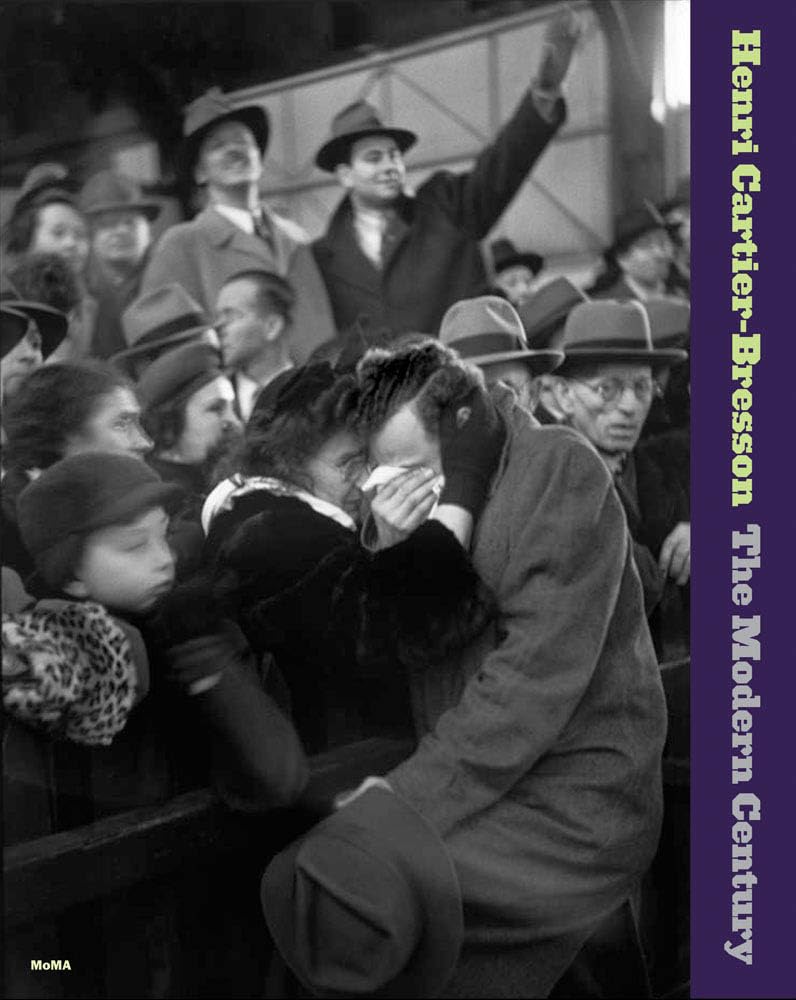
📸 Capture the essence of modern photography’s golden era with Henri Cartier-Bresson’s iconic legacy!
Henri Cartier-Bresson: The Modern Century is a highly regarded photography monograph featuring the seminal works of the Magnum co-founder. With a 4.8-star rating from 128 reviewers, this used book in good condition offers deep insights into surrealism and existentialism through the lens of one of photography’s greatest masters.
| Best Sellers Rank | 2,978,744 in Books ( See Top 100 in Books ) 2,148 in Individual Photographer Monographs 7,975 in Photography Collections & Exhibitions 18,816 in Individual Artists |
| Customer Reviews | 4.8 out of 5 stars 128 Reviews |
W**P
One of the greats of photography.
HCB is one of the great seminal photographers associated with the Magnum foundation. To understand the essence of photography his work has to be delicately viewed and reviewed. Simply, he was the best. I bought this book to source valuable information and references for my dissertation which focussed on surrealism and existentialism.
L**L
Great book
Excellent book ...
T**N
excellent
Quick delivery, excellent product
M**O
The best selection
Just to be short, I am not a big fan of Cartier-Bresson. In my eyes, he is the Picasso of photography, good, but a little bit dated. But if you want to have a good idea of his work, this is probably the best selection ever made. Besides, the printing is brilliant.
S**R
First impressions
First impressions are important, although they can be misleading. The dustjacket of this book is a graphic design disaster. The eye is first assaulted by a combination of plum red and intense egg-yolk yellow. Once the senses have become acclimatized to this almost nausea inducing juxtaposition of colours, once notices the ugly typeface of the title; it bears a distinct similarity to the one that was used for Wild West "wanted" posters. The eyes now take in the text of the title, "Henri Cartier-Bresson" (obviously nothing wrong with that) "the Modern Century" - the what? Have I missed something? Is this now the accepted "name" for the 20th Century? No, it isn't. Each century is, or was "modern" at some stage. I think it would be fair to say the 21st Century is and is likely to remain for some time, modern. The title is silly. Lastly one notices a small picture imbedded in the text; a photograph taken by H.C-B, but a poor choice of image for the cover. It's a pity that MOMA didn't employ the splendid German publishers Schirmer & Mosel, not only to design the book/catalogue, but also to give the exhibition and catalogue a better title. The German edition of this tome has an attractive and appropriately black and white dustjacket and is entitled "Henri Cartier-Bresson, his 20th Century" ("Henri Cartier-Bresson, sein 20. Jahrhundert") However - of course this is all of less consequence than the content of the book, which is indeed good. There are several photographs here one has either not seen for a long time, or not at all. The images are beautifully printed on satisfyingly thick paper. True, many are on rather a small scale, but this was presumably the only solution if so many illustrations were to be included and the book was not to become unmanageably large and prohibitively expensive. Doubtless, this was also the reason for omitting the black borders one associates with Cartier-Bresson's photographs. Naturally the choice of photographs and the decision, which ones were to be printed large, which small was subjective, but on the whole the selection is a good one. The text is, as you'd expect with a retrospective exhibition, exhaustive and informative; even the most obsessive Cartier-Bresson enthusiast is likely to find something there they didn't know. Unfortunately, the author Peter Galassi, occasionally descends into "intellectualese", which slightly mars ones enjoyment, as it serves no purpose other than to obfuscate what he's presumably trying to communicate. He also indulges in criticism of previous publications on Cartier-Bresson which, in view of his own publication's deficiencies, is an urge he should perhaps have resisted. I have one other, minor gripe and this is the anachronistic use of place names; Beijing for Peking, Mumbai for Bombay, St. Petersburg for Leningrad etc. For example, in 1958 no one, certainly not outside China, used the name Beijing; to alter Cartier-Bresson's original text to suit contemporary American "taste", is a travesty. This is arguably not the best book on Cartier-Bresson, but it is undoubtedly one of the best. It's a volume that has, with the exception of the dustjacket, grown on me. If you have an interest in the work of the late, great Henri Cartier-Bresson, or good photography, you should acquire it. On the other hand, if you're fluent in German I recommend you buy their edition; it will look better on your bookshelves and the content is, apart from the obvious difference, identical. Except that the Germans, I'm glad to say, have stuck with "Peking".
A**N
The most generous collection...but possibly not the best
This collection has probably the most generous inclusion of previously unpublished or little published work, but although I return to it frequently I remain unsure that it is necessarily the best. I think I prefer the Thames & Hudson collections. The print sizes in the T&H titles are usually larger and generally the printing is better. The other slightly strange thing is that I realise how used I have become to seeing HC-B's pictures with the black key-lines (the negative edges) he insisted on as an indication that the image was uncropped and seen as he intended. THE MODERN CENTURY does away with the black edges and to me this makes the prints look a little naked on the page. Most will not be bothered by this. There is remarkable work in this new collection, of course -- but possibly too much of it. The placing of multiple pictures on the page reduces rather than increases their impact, and introduces a tendency in the reader to skim in a way that I don't think you do when the publication has one picture per page. I'll give an example. On p.203 there is an extraordinary photograph -- but it isn't immediately evident just how extraordinary it is. It isn't terribly sharp and it isn't terribly well printed. It shows young women dancing as apart of the parade during the celebrations of the People's Republic of China's ninth anniversary. I had turned the page before I realised that every figure as far as the eye can see in the photograph ha both feet simultaneously off the ground. What in other hands would have been a rather workaday journalism assignment in HC-B's hands becomes a little miracle of timing (and editing). But somehow, this present collection seems to require harder work than any other HC-B title I have to mine out the marvels. They are there. But I'm still not quite sure that the presentation and printing do them full justice.
Trustpilot
2 days ago
1 month ago
4 days ago
2 days ago