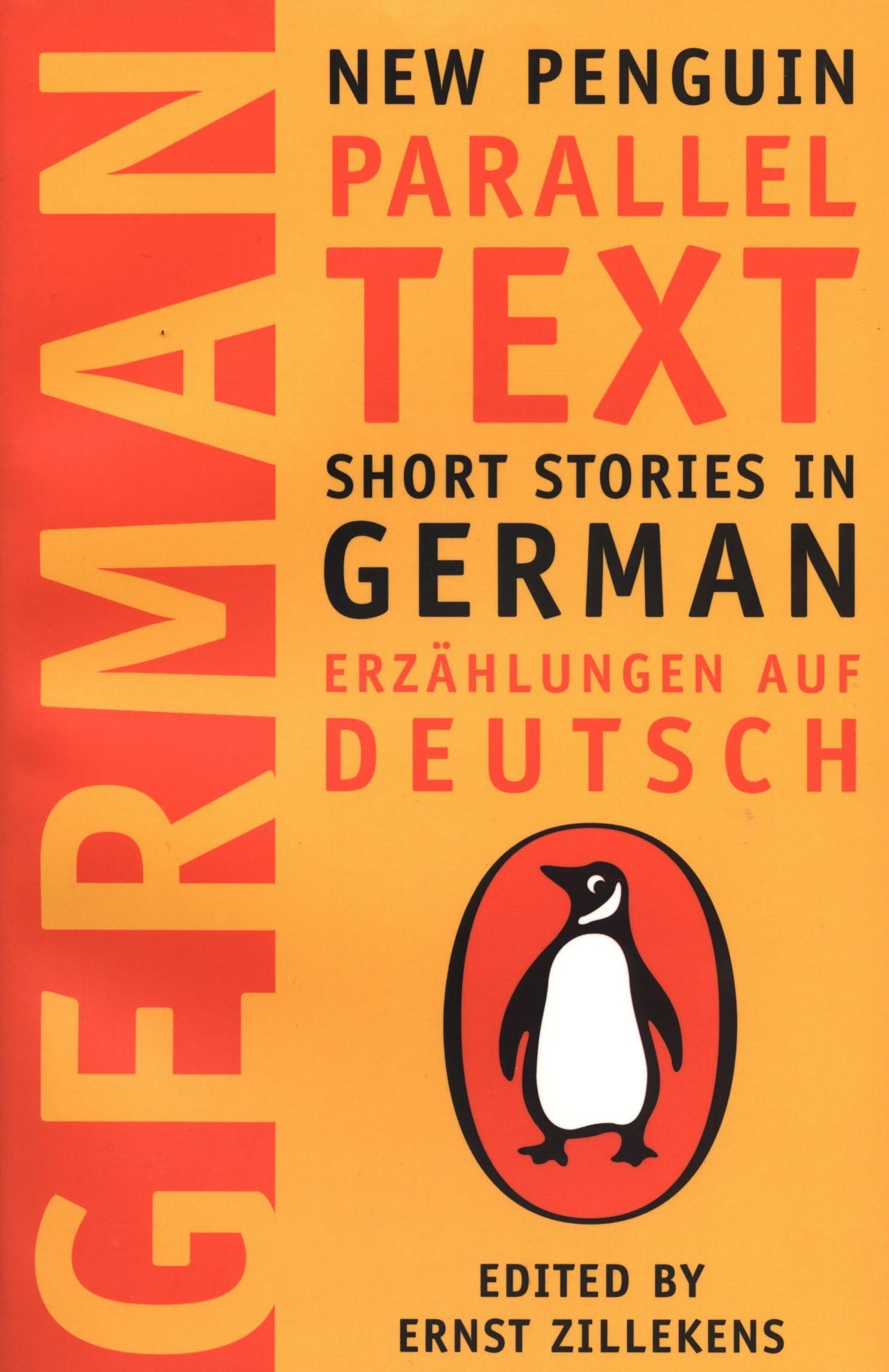
German Short Stories: Deutsche Kurzgeshichten (New Penguin Parallel Texts Series)
Product ID: 48667617
📚8 contemporary German short stories
🔄Parallel German-English text for seamless learning
🕒Same-day dispatch if ordered before noon
Desertcart purchases this item on your behalf and handles shipping, customs, and support to Japan.
📖 Unlock German fluency with stories that speak your language—and yours too!
German Short Stories: Deutsche Kurzgeschichten offers eight contemporary tales with parallel German-English texts, ideal for intermediate learners seeking authentic literary immersion. Featuring detailed notes and reliable same-day dispatch, this Penguin series volume combines cultural insight with practical language learning tools.
| Best Sellers Rank | 109,528 in Books ( See Top 100 in Books ) 116 in Language Readers Reference 792 in Fiction Anthologies (Books) 3,879 in Short Stories (Books) |
| Customer Reviews | 4.3 out of 5 stars 243 Reviews |
R**L
Good selection
Good selection of short stories, also good translations and footnotes, recommended for intermediate language level. Good insight into post war stories.
C**H
An Exception to the Penguin Parallel Series
This book is a collection of short stories in German with the fairly literal English translation on the other page. The main points of this are that you can get a 'dictionary definition' (it is not a complete description, it is often best in the long run to look up words that may not be exactly the same as the English) that does not require putting down the book and much more importantly you can analyze and compare the differences in the way the two languages prefer to communicate the information from the level of the particle (if you are good at grammar) to the sentence, the paragraph and the story as a whole. I feel this is the main strength of a parallel text which the 'quick look-up' only serves to augment. Normally Penguin Parallel texts feature quite dull texts (I should know, I have all of the new series in each available language and the 1st of the old Penguin Parallel series which believe it or not even had a now unavailable 'Soviet Stories') that are as a rule boring. However I found some of the stories in this text genuinely interesting; Lascia for instance features a humorous car journey with a rather crazy Romanian taxi driver around Sicily and the collection is capped off with two simple but involving stories about Communist East Germany. Not much occurs, but the description I found interesting. Personally I found the 48 page long story, which is only second after a truly bizarre first story "The Listener, or a Description of a Route with a Hidden Motive," 'Waiting for Guests' unbearably boring about an anxious woman interminably ruminating over her feelings about her divorce. Still, short of being immersed in oral conversation with Germans, reading is the next best thing and with a parallel translation to look over I find I absorb much more of the important structure of thinking (& grammar). This volume, as with written German in general, is difficult to run through having long sentences only being completed at the end, but it is worth it; especially after time spent investigating the roots of the German language, which then enables one to 'build' the German language yourself.
P**T
Parallel reading
It is a long, long time ago since I studied German, nor have I had the opportunity of speaking the language...but I found the book not downright easy, but not difficult either. The parallel definition is good. I am refreshing German mainly as a challenge - using it just like a crossword to stimulate my brain. I am treating the text as I was taught - studying the German concentrating on it , memorizing it as best I can then turning to the English and translating that. It does the trick. If I have a word I just can`t make head nor tail of, I look it up in a dictionary rather than look at the text. That way the word is explained in full. I don`t think it is too difficult for students - I did Buddenbrooks (Thomas Mann) this way - I first read the book in German when I was a student - years later I did it by parallel.. - I couldn`t put it down. Maybe it is better to read something like it, something you like - If this book is too challenging, don`t give up
T**N
Like the proverbial parson's egg: good in parts
I'm British. I've lived and worked for more than 7 years in Germany in Austria, I'm now working as a part-time translator (German to English). I've been intensively investigating and buying "dual-language / parallel text" books for months now, to help me with my translation skills. The many books I've bought are not only from British publishers but also from German publishers. Of all the books that I've bought, this one is the most unusual. Firstly, the choice of stories. I liked the fact that they are quite modern stories. Learning a foreign language is doubly difficult if you have to struggle with archaic terms. Another positive point is that a couple of the stories were quite origina: the first one, with its "story within a story", and the one about Chicago. However, some of the others were, well, a bit underwhelming. For example, the extremely long story about the lady who is waiting for her dinner guests to arrive. Another reviewer here was less kind, and described that particular story as "interminable". Secondly, the translation. According to Penguin Books, Ernst Zillekens was the editor and translator, he chose the stories, translated them, and wrote the useful notes at the back. Apparently he was born and brought up in Germany, and after spells at universities in Germany and the UK, he now teaches German at Charterhouse School. Therefore, one would imagine that he is eminently suitable as a translator, and I'm sure that he's a good one. However, I am skeptical about the claim by Penguin Books that Zillekens translated these stories. The translation seems very wooden and literal, and there are some absolutely elementary mistakes that are absolutely baffling in this context. For example, in the story near the end about the grandfather, there are two references to the grandfather's habit of eating a fried egg on a slice of fried bread as a "second breakfast". There is no difficulty in translation there. It's not some overly abstract concept, it doesn't deal with an obscure metaphor or some cryptic, high-flown metaphysical theory. Yet, at two different points in the story, the eggs are described as "poached eggs". You may be thinking: "what does it matter, poached, fried, who cares?" But it does matter. The original text says "Spiegelei" and "Bratei". Both are incontrovertibly "fried egg", "Bratei" even had the prefix "Brat-" which denotes "fried". A poached egg is "ein pochiertes Ei". I hope this has not been an "interminable" explanation, my point is that someone of Zilleken's background would not make such an elementary mistake. So who did the translation, then? Another reviewer, D.S. Hall, presumably feels similar because he/she writes, "I struggled with the way this was translated so I loaned it to a native Berliner who works as a translator for the government, she was less than impressed and suggested the translation was poor and that some compound German words were either not used or do not exist. I buy parallel text books from German bookshops now." A final point: in my experience, "dual-language / parallel text" books from German publishers are not necessarily any better, neither in choice of story nor in the quality of the translations.
A**R
Good book to enhance learning and is fun at same ...
Good book to enhance learning and is fun at same time. I study German at university and decided to buy this myself to help.
M**N
inspiring
Good selection of stories. Inspired me to buy more German books.
O**N
Could have been better.
Just the sort of thing I was looking for but the remoteness of the English version is a disadvantage. I have several Bible translations which are arranged helpfully together verse-by-verse, so why could this not have been the same?
C**R
Great Bilingual Reads
So nice to have a bilingual book as a source of language study. There should be many more products like this on the market.
R**J
Getting to know some great writers
The ability to read top writers without always wanting to go to a dictionary for fear of missing a critical aspect of the story is great. Being short stories means not having to get bogged down in long and involved plots.
G**S
Frustrada
Não veio o que eu esperava. Letras miúdas e sem figuras. Difícil compreensão
K**Y
Gets the job done!!
Great selection of short stories.
R**S
Contento con el libro
Muy buen libro, viene en edición bilingüe así puedes a la vez mejorar también tu inglés, aunque si diría que no es un libro para gente muy principiante el nivel de Alemán de este libro ya es intermedio.
A**E
Almanca ve ingilizce aynı anda
İki dilli de aynı anda geliştirmek için aldım iyi ki de almışım.
Trustpilot
2 weeks ago
2 months ago