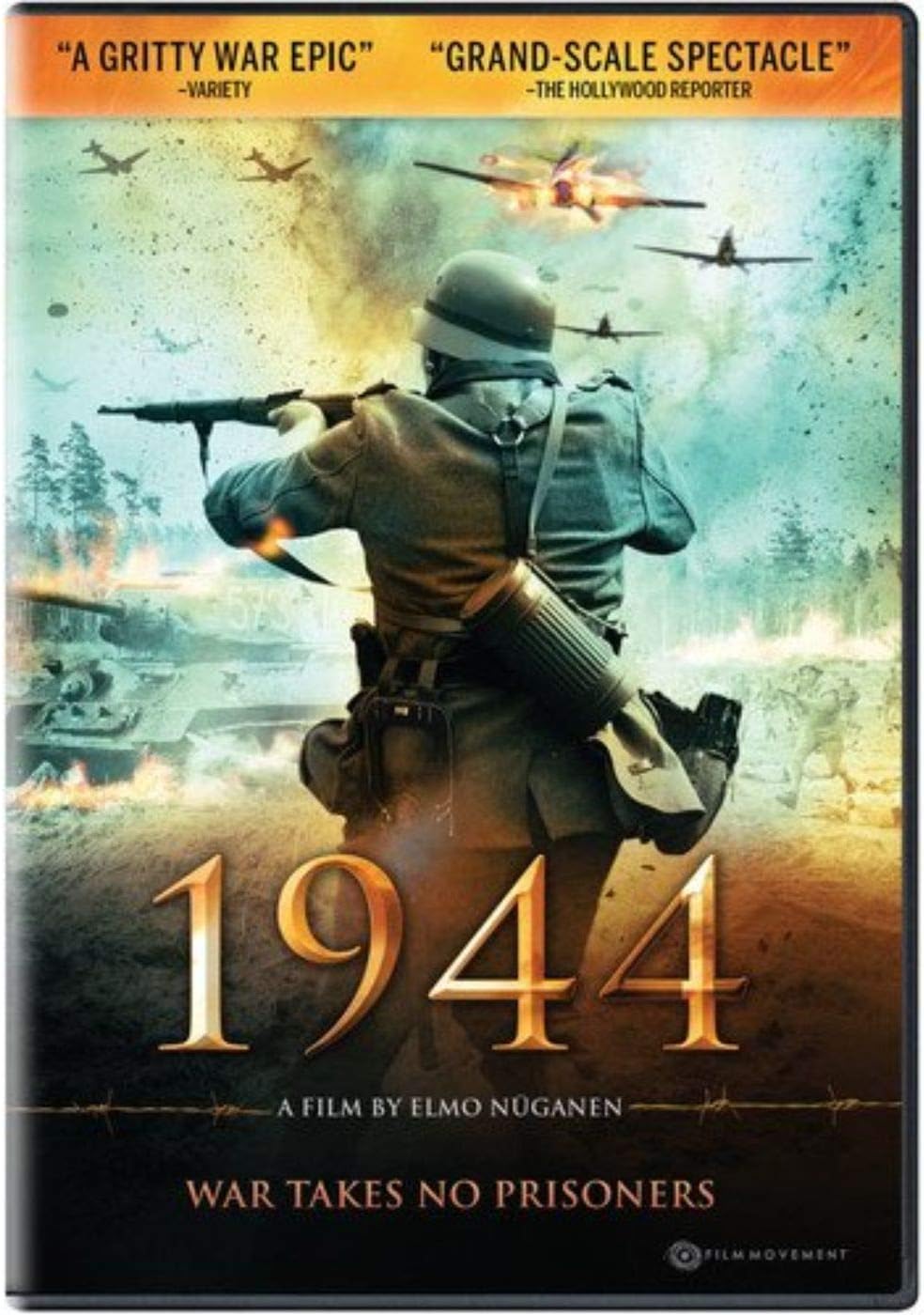
1944
Product ID: 47734779
**ESTONIA'S SUBMISSION TO THE 2017 ACADEMY AWARDS FOR BEST FOREIGN LANGUAGE FILM** In World War II, the Russian Army and Nazi forces invaded Estonia tearing families apart and forcing locals to battle one-another beside these vicious armies. This Oscar submission is the true tale of a nation ravaged by war. From director Elmo Nüganen one of the stars of the Academy Award nominated Tangerines 1944 is a thrilling and emotional war story that shows the hopes, aims and drama of the Estonian men caught between two forces as objectively as possible. Bonus feature includes short film Les Deux Vies de Nate Hill . Package includes: Directors' statement, Why-We-Selected statement, and chapter breaks. OFFICIAL SELECTION - Berlin Int'l Film Festival OFFICIAL SELECTION - Palm Springs Int'l Film Festival OFFICIAL SELECTION - Camerimage International Film Festival OFFICIAL SELECTION - European Union Film Festival Toronto OFFICIAL SELECTION - Trondheim Kosmorama International Film Festival OFFICIAL SELECTION - Central and Eastern European Film Festival --- Ranking as Estonia's biggest domestic box office success, Elmo Nuganen's gritty war epic, 1944, provides a harsh perspective on the country's painful 20th-century history. --Alissa Simon, Variety Breaking box office records back home, Estonia's official Academy Awards entry in the Best Foreign Language Film race is a handsome World War II drama. Director Elmo Nuganen...shows a flair for grand-scale spectacle in his polished second feature. --Stephen Dalton, The Hollywood Reporter Review: “The innocent feel guilt, the guilty feel nothing…” - This is the first Estonian movie I have seen. It was directed by Elmo Nuganen and released in 2017. A bit of context is needed. Estonia, along with Latvia and Lithuania, constitute what is traditionally called the Baltic Republics, just across the Baltic Sea from Finland and Sweden. All three Baltic Republics were once part of the Soviet Union, following the Second World War. Today, Estonia is an independent country. It joined the European Union in 2003 and as of 2011, the Euro is its currency. Russia remains its dominant neighbor. Most remarkably, it has a population of only 1.33 million. Timothy Snyder would call the area the “bloodlands” in his seminal history of the peoples caught between Hitler and Stalin, from 1933 to 1945. Snyder estimated that 14 million civilians died in this area during those years. He has an impressive technique of concentrating on the “1,” and not using a round number. Estonia was part of this area, though not directly covered by Snyder, hence the value of this movie. 1944, as the title says, is the changing of the guard, or more precisely, the occupiers. The movie starts with two factoids that dominated the entire movie: in 1940 the Soviet Union annexed Estonia, mobilizing 55,000 Estonians into the Red Army; in 1941 Germany occupied Estonia, mobilizing 72,000 Estonians into their army. Thus, the year 1944, in particular, would see Estonian fighting Estonian. And the Estonians on the German side were in the Waffen SS! I’d always considered those units to be composed of the more fanatically bent Germans. Not so, per this movie. It was only Germans who could be in the Wehrmacht. All other nationalities were thrown into the Waffen SS (which did also contain Germans). And many an Estonian willingly joined the Germans, seeing them as liberators from Stalin. One soldier mentioned how his father had fought in the Russian White Army during the Civil War and he was executed by the Red Army upon the invasion in 1940. Others had relatives deported to Siberia. There were also Danes in the Waffen SS unit. I felt the combat scenes, of which there are ample, were realistic. Tanks and infantry. Mainly it was country boys and city boys caught up in a fight they would have preferred to avoid, along with a sprinkling of fanatics who live for the killing. On the Soviet side, there is the big bad ruthless commissar, the enforcer of correct political thinking. There is the propaganda over the loudspeaker about changing sides. And there is the moving scene of “the man I killed,” who happened to be a fellow Estonian, and having to go see the sister. Stalin had decreed that the Estonian capital, Tallinn, would be taken by September 19th of the title year, and it was. Naturally the civilians turned out to welcome (again) their liberators. The German army pulled out of its last defensive line in Estonia on November 19th, with Estonians again trying to switch sides or flee across the Baltic to Sweden. The E11. This movie is very good in its own right and filled in some lacunae in my historical knowledge. But I also had an ulterior motive for watching it since it was filmed entirely in Estonia. It is the E11, the recently completed European long-distance hiking trail that traverses the lowlands of northern Europe, 4700 km, from the Hague in the Netherlands to Tallinn. No, I am not crazy enough to believe I have enough days or stamina left to walk the whole thing, but, COVID-willing, I hope soon to sample a bit of the far eastern end, in Latvia and Estonia. The views in the movie of the “bocage,” that French word that denotes a cared for mixture of woodlands and open fields was inspiring, and thus I will add a personal “plus” to my 5-star rating. Review: At least Dubbed allows you to keep your eye on the action - This is an excellent film, and shows two sides of the war. It almost reminded me of our Civil War, with brother against brother. The war shows the Russian and German influences on this Estonia country. Some Citizens were forced to join the Russian soldiers and others forced into the German army. The people in the middle were being killed by both sides. It gave me a fresh perspective about WW2. The fact that a dub feature was there, I like much better, because by the time you read subtitles, the action or acting is over. If you like war films, you will definitely like this one. There is plenty of action, except a brief time off the front. Recommended

| Customer Reviews | 4.3 out of 5 stars 1,379 Reviews |
J**I
“The innocent feel guilt, the guilty feel nothing…”
This is the first Estonian movie I have seen. It was directed by Elmo Nuganen and released in 2017. A bit of context is needed. Estonia, along with Latvia and Lithuania, constitute what is traditionally called the Baltic Republics, just across the Baltic Sea from Finland and Sweden. All three Baltic Republics were once part of the Soviet Union, following the Second World War. Today, Estonia is an independent country. It joined the European Union in 2003 and as of 2011, the Euro is its currency. Russia remains its dominant neighbor. Most remarkably, it has a population of only 1.33 million. Timothy Snyder would call the area the “bloodlands” in his seminal history of the peoples caught between Hitler and Stalin, from 1933 to 1945. Snyder estimated that 14 million civilians died in this area during those years. He has an impressive technique of concentrating on the “1,” and not using a round number. Estonia was part of this area, though not directly covered by Snyder, hence the value of this movie. 1944, as the title says, is the changing of the guard, or more precisely, the occupiers. The movie starts with two factoids that dominated the entire movie: in 1940 the Soviet Union annexed Estonia, mobilizing 55,000 Estonians into the Red Army; in 1941 Germany occupied Estonia, mobilizing 72,000 Estonians into their army. Thus, the year 1944, in particular, would see Estonian fighting Estonian. And the Estonians on the German side were in the Waffen SS! I’d always considered those units to be composed of the more fanatically bent Germans. Not so, per this movie. It was only Germans who could be in the Wehrmacht. All other nationalities were thrown into the Waffen SS (which did also contain Germans). And many an Estonian willingly joined the Germans, seeing them as liberators from Stalin. One soldier mentioned how his father had fought in the Russian White Army during the Civil War and he was executed by the Red Army upon the invasion in 1940. Others had relatives deported to Siberia. There were also Danes in the Waffen SS unit. I felt the combat scenes, of which there are ample, were realistic. Tanks and infantry. Mainly it was country boys and city boys caught up in a fight they would have preferred to avoid, along with a sprinkling of fanatics who live for the killing. On the Soviet side, there is the big bad ruthless commissar, the enforcer of correct political thinking. There is the propaganda over the loudspeaker about changing sides. And there is the moving scene of “the man I killed,” who happened to be a fellow Estonian, and having to go see the sister. Stalin had decreed that the Estonian capital, Tallinn, would be taken by September 19th of the title year, and it was. Naturally the civilians turned out to welcome (again) their liberators. The German army pulled out of its last defensive line in Estonia on November 19th, with Estonians again trying to switch sides or flee across the Baltic to Sweden. The E11. This movie is very good in its own right and filled in some lacunae in my historical knowledge. But I also had an ulterior motive for watching it since it was filmed entirely in Estonia. It is the E11, the recently completed European long-distance hiking trail that traverses the lowlands of northern Europe, 4700 km, from the Hague in the Netherlands to Tallinn. No, I am not crazy enough to believe I have enough days or stamina left to walk the whole thing, but, COVID-willing, I hope soon to sample a bit of the far eastern end, in Latvia and Estonia. The views in the movie of the “bocage,” that French word that denotes a cared for mixture of woodlands and open fields was inspiring, and thus I will add a personal “plus” to my 5-star rating.
A**R
At least Dubbed allows you to keep your eye on the action
This is an excellent film, and shows two sides of the war. It almost reminded me of our Civil War, with brother against brother. The war shows the Russian and German influences on this Estonia country. Some Citizens were forced to join the Russian soldiers and others forced into the German army. The people in the middle were being killed by both sides. It gave me a fresh perspective about WW2. The fact that a dub feature was there, I like much better, because by the time you read subtitles, the action or acting is over. If you like war films, you will definitely like this one. There is plenty of action, except a brief time off the front. Recommended
S**E
Looks like a good movie, but defaulted to Estonian 5.1
Looks like a good movie, but defaulted to Estonian 5.1, however I changed to English Stereo. There is no option for English 5.1 which is a big downgrade for my 7.2 Surround system. Otherwise, seems like a good movie. I deducted 1 star due to now English 5.1. Also for some reason, the movie did not start at the very beginning, but more like a Minute and a half in... I was able to get it to start over in English 5.1 however. The Movie does appear to be of good quality and based on real facts. Deducted 1 Star due to menu issues. I may re-evaluate this later on after it is reloaded at some point. My player is a Sony BlueRay that is very high end and almost new. Latest technology!
J**E
This film is EVERYTHING.
Apart from being a very, very well done "war film", this movie is so, so, so, so much more. I anticipated only a really well done war and action experience, and believe me it was absolutely that; however, the story and the message transcended my expectations several times over. This film is a number of stories wrapped up into one, and done so in such a captivating and enthralling way that I am left in such awe after watching this. No other war film that I've seen in recent years -- save perhaps Saving Private Ryan -- comes as close. I cannot recommend this highly enough.
M**9
A Small Country Caught in the Middle
Not a bad movie, but undermined by poor dubbing into English. I would prefer subtitles. Subtitles give you a flavor for the interaction of the characters and a feeling for the situation as opposed to the canned studio dubbing which drains the life from the dialogue. In "1944" there were action scenes that sounded as if the characters were talking across a kitchen table over a vodka bottle.
P**E
Great war movie with action drama and a reflection of real history
What a mess Estonia was. The Finnish Russian war and then the Germans recruiting Estonians to fight Russians and then the Russians recruiting Estonians to fight Germans and other Estonians and at times everybody was killing everybody. Meanwhile big battles were taking place as the Russians were pushing West like an unstoppable tidal wave and German was going to collapse. These poor soldiers were supposed to choose for or against their own homeland and many had suffered from either side as their families had been moved, evacuated, or sent to Siberia. This is the mess in which the drama of this movie takes place and it is good. I recommend this movie.
D**I
Incredible Movie from Eastern European Perspecitve
I come from Central-Eastern Europe, and the "1944" film really touched my heart to the core since it represents tragic struggles of nations that were squeezed between two totalitarian systems Nazism and Communism and also what a "Soviet liberation" of Estonia meant for Estonians. The film is very well filmed, has a unique, somewhat peaceful atmosphere and also incredible combat scene. I gave this movie 5 stars and let me take this opportunity to thank for showing us WWII history from Estonian, Eastern European perspective. We need more stories and movies like "1944 ".
P**K
Good movie
Only if you like war movies...
Trustpilot
2 days ago
3 weeks ago