
Buy anything from 5,000+ international stores. One checkout price. No surprise fees. Join 2M+ shoppers on Desertcart.
Desertcart purchases this item on your behalf and handles shipping, customs, and support to Japan.
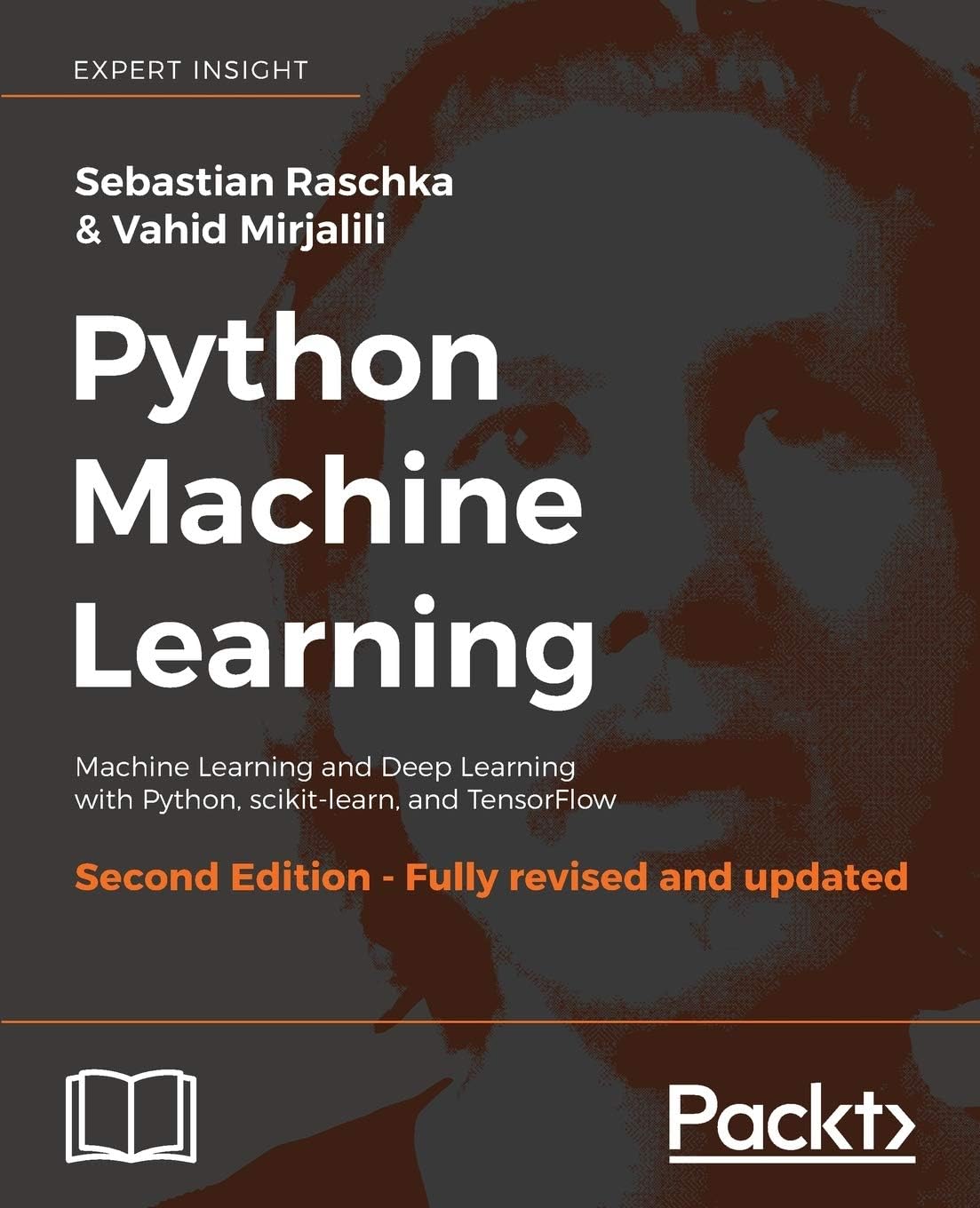
Unlock modern machine learning and deep learning techniques with Python by using the latest cutting-edge open source Python libraries. Key Features Second edition of the bestselling book on Machine Learning A practical approach to key frameworks in data science, machine learning, and deep learning Use the most powerful Python libraries to implement machine learning and deep learning Get to know the best practices to improve and optimize your machine learning systems and algorithms Book Description . Publisher's Note: This edition from 2017 is outdated and is not compatible with TensorFlow 2 or any of the most recent updates to Python libraries. A new third edition, updated for 2020 and featuring TensorFlow 2 and the latest in scikit-learn, reinforcement learning, and GANs, has now been published. Machine learning is eating the software world, and now deep learning is extending machine learning. Understand and work at the cutting edge of machine learning, neural networks, and deep learning with this second edition of Sebastian Raschka’s bestselling book, Python Machine Learning. Using Python's open source libraries, this book offers the practical knowledge and techniques you need to create and contribute to machine learning, deep learning, and modern data analysis. Fully extended and modernized, Python Machine Learning Second Edition now includes the popular TensorFlow 1.x deep learning library. The scikit-learn code has also been fully updated to v0.18.1 to include improvements and additions to this versatile machine learning library. Sebastian Raschka and Vahid Mirjalili’s unique insight and expertise introduce you to machine learning and deep learning algorithms from scratch, and show you how to apply them to practical industry challenges using realistic and interesting examples. By the end of the book, you’ll be ready to meet the new data analysis opportunities. If you’ve read the first edition of this book, you’ll be delighted to find a balance of classical ideas and modern insights into machine learning. Every chapter has been critically updated, and there are new chapters on key technologies. You’ll be able to learn and work with TensorFlow 1.x more deeply than ever before, and get essential coverage of the Keras neural network library, along with updates to scikit-learn 0.18.1. What You Will Learn Understand the key frameworks in data science, machine learning, and deep learning Harness the power of the latest Python open source libraries in machine learning Explore machine learning techniques using challenging real-world data Master deep neural network implementation using the TensorFlow 1.x library Learn the mechanics of classification algorithms to implement the best tool for the job Predict continuous target outcomes using regression analysis Uncover hidden patterns and structures in data with clustering Delve deeper into textual and social media data using sentiment analysis Who this book is for If you know some Python and you want to use machine learning and deep learning, pick up this book. Whether you want to start from scratch or extend your machine learning knowledge, this is an essential and unmissable resource. Written for developers and data scientists who want to create practical machine learning and deep learning code, this book is ideal for developers and data scientists who want to teach computers how to learn from data. Review: Good balance of theory and code. Excellent for people who already have intermediate stats/ML knowledge. - This book is excellent for the following demographic: People who already have a decent level of skill and experience in statistics who want to: - 1) Elevate their understanding of ML techniques without absolutely breaking their skull on dense theory - 2) Learn how to implement the algorithms in Python and gain moderate proficiency in sci-kit learn I would say it's not a beginner's book, but more for intermediates. I am half-way through and find it a little challenging, but definitely attainable. This balance I consider to be putting me right in the sweet spot for learning. To judge whether you're a good candidate for this book, you can compare your experience and skill to me : I started this book after earning a PhD in the social sciences, which basically gave me good coverage in inferential and applied statistics (T, F distributions, p-values, confidence intervals, linear regression, one-way and factorial ANOVA, PCA, etc.). I also took a machine learning graduate course at my university and a few online courses in introductory ML for R. All of this background gave me solid grounding in statistics. With all this I still find this book somewhat challenging, but definitely not too hard. I'd say without my background I would find this book hard to get through. There is linear algebra, concepts like minimizing cost functions, bias/variance tradeoff, learning from errors, etc. So, if you are just starting out or reading the previous sentence and don't know what I'm talking about, I would recommend learning more stats fundamentals before starting this. After you gain some proficiency in stats, come learn this book and elevate your understanding of the algorithms, add nuance to them, integrate them into your mental conceptual structures more fully (e.g. you'll know more nuances of ML, e.g. which subsets of algorithms are preferred for controlling more of the bias, variance, how random forest is basically bagging with a twist, how adaboost's treatment of classification errors has kind of an element of perceptron implementation, and many more). Review: Excellent explanations, excellent visualizations, excellent mathematical proofs; incredible book! - This book will stay on your reference shelf for years to come! The authors clearly have taught these materials many times before, and their significant mathematical and technical prowess is delivered using a very approachable style. This book seems best suited for someone who wants to sit down and begin to apply Python Machine Learning to a problem that they already know they have. It's not particularly an "intro course to M.L.", but it contains enough details that you could easily follow along and learn how to use the various tools and techniques of the field if you've never seen or heard of them before. The copious notes scattered throughout this book are pure gold, mined from the obvious experiences of the authors while working in the field. If there ever is a Machine Learning equivalent to the venerable "Forrest M. Mims Engineering Notebook" for electronics, I feel these two authors could write it! Once you use this book to work on your current M.L. problem in Python, you will find yourself returning to it as a reference for other problems in the M.L. space. Its lucid explanations will help reinforce the topics presented, and cement your understanding of the materials. This book will get you writing Python Machine Learning code to work your current M.L. problem in no time flat!


| Best Sellers Rank | #1,161,391 in Books ( See Top 100 in Books ) #247 in Business Intelligence Tools #453 in Data Processing #979 in Python Programming |
| Customer Reviews | 4.5 out of 5 stars 301 Reviews |
S**W
Good balance of theory and code. Excellent for people who already have intermediate stats/ML knowledge.
This book is excellent for the following demographic: People who already have a decent level of skill and experience in statistics who want to: - 1) Elevate their understanding of ML techniques without absolutely breaking their skull on dense theory - 2) Learn how to implement the algorithms in Python and gain moderate proficiency in sci-kit learn I would say it's not a beginner's book, but more for intermediates. I am half-way through and find it a little challenging, but definitely attainable. This balance I consider to be putting me right in the sweet spot for learning. To judge whether you're a good candidate for this book, you can compare your experience and skill to me : I started this book after earning a PhD in the social sciences, which basically gave me good coverage in inferential and applied statistics (T, F distributions, p-values, confidence intervals, linear regression, one-way and factorial ANOVA, PCA, etc.). I also took a machine learning graduate course at my university and a few online courses in introductory ML for R. All of this background gave me solid grounding in statistics. With all this I still find this book somewhat challenging, but definitely not too hard. I'd say without my background I would find this book hard to get through. There is linear algebra, concepts like minimizing cost functions, bias/variance tradeoff, learning from errors, etc. So, if you are just starting out or reading the previous sentence and don't know what I'm talking about, I would recommend learning more stats fundamentals before starting this. After you gain some proficiency in stats, come learn this book and elevate your understanding of the algorithms, add nuance to them, integrate them into your mental conceptual structures more fully (e.g. you'll know more nuances of ML, e.g. which subsets of algorithms are preferred for controlling more of the bias, variance, how random forest is basically bagging with a twist, how adaboost's treatment of classification errors has kind of an element of perceptron implementation, and many more).
S**Y
Excellent explanations, excellent visualizations, excellent mathematical proofs; incredible book!
This book will stay on your reference shelf for years to come! The authors clearly have taught these materials many times before, and their significant mathematical and technical prowess is delivered using a very approachable style. This book seems best suited for someone who wants to sit down and begin to apply Python Machine Learning to a problem that they already know they have. It's not particularly an "intro course to M.L.", but it contains enough details that you could easily follow along and learn how to use the various tools and techniques of the field if you've never seen or heard of them before. The copious notes scattered throughout this book are pure gold, mined from the obvious experiences of the authors while working in the field. If there ever is a Machine Learning equivalent to the venerable "Forrest M. Mims Engineering Notebook" for electronics, I feel these two authors could write it! Once you use this book to work on your current M.L. problem in Python, you will find yourself returning to it as a reference for other problems in the M.L. space. Its lucid explanations will help reinforce the topics presented, and cement your understanding of the materials. This book will get you writing Python Machine Learning code to work your current M.L. problem in no time flat!
E**N
Good book for starters in Neural Networks
Book gives a good overview of how to tackle a learning problem. Preparing learning data and evaluation of learning model. Witch python libraries to use and a lot of examples. Was very useful l for me Thanks guys
G**T
Excellent, concept-math-code end to end for software engineers
(I own the 1st edition, and was given early access to a pre-release PDF of the 2nd ed. My paperback copy just arrived.) This is the best book I've seen for professional software engineers to bootstrap themselves into Data Science, Machine Learning and (with the 2nd ed) Deep Learning. It makes heavy use of the scikit-learn library; and the latter chapters give an excellent high-level overview of TensorFlow. Books in this space can often feel either too basic or too academic. Not this one -- for me it hits the sweet spot of explaining and doing. What I love about Raschka's writing is how he builds up from theory to practical code. It lays out the concepts, math, and code together which helps comprehension. So, if you happen to be rusty in math, like me, you can look to the code to help explain what the equations actually do. The chapters of the book build up from each other; so many of the examples feel like they can be used as recipes for building your own custom models.
U**N
Very useful overview!
I found this book to be very clearly written and also very informative since in addition to providing code examples it tried to illustrate the basics of theory behind what makes machine learning work. The explanations were mainly done by showing examples of data on a x-y plot and how the different techniques separate the data to make a decision. This is a nice way to reduce the complexity of explanation and getting lost in the details of the mathematics and programming syntax etc and to get at the heart of where different algorithms have strengths. This is review is from the perspective of someone who knows a little python and had little knowledge of machine learning, but has kind of seen neural nets and regressions used in different applications over the years. Part of its usefulness to me is that it gives me a nice way to explain machine learning to non-scientists.
J**O
Hard to read
Very steep learning curve. I almost gave up in chapter two at perceptron but since that algorithm is the foundation of all I spent a whole week to understand it. The code the author uses is pretty much optimized and it was not in sync with the mathematical introduction. But the first 30 pages are absolutely neccessary to read and understand deeply in order to move on. After page 30 it became a little faster to proceed with the book since topics from page 30 - 107 are mostly the extension of the perceptron. At page 107- 160 I am already accustomedto the authors style and to the books logic so it is now quite effective to read and digest the models. And that is where I am at the moment. I gave this book 5 stars since I wanted a high quality ML and python book which leads me through the models in a step-by-step way no matter how hard it is mathematically or programmtechnically. And I got this. negative: The pdf version has color pictures which is nice especially for multiline charts ( like page 212) where the b&w book just visually flat and some chart elements cannot be identified.
R**G
Although there are web pages that can do this it is nice to have it al together
It is helping me learn TensorFlow (with Keras too). Although there are web pages that can do this it is nice to have it al together. Like all Packet books down loading the errata and sample code was not as easy as they make it sound.
K**R
This is very tough but very worth it
I am a relatively new at python, and have never been associated with some of the libraries in the book. The coding was almost immediatly over my head but was realatively easy to figure out. Just going throught the coding and analyzing what was going on has taught me a great deal (much more than I every thought that I could) about python and the machine learning/math libraries. If you truly want to learn, and are not afraid to put in some extra homework, I highly recommend this book.
P**H
It is a great book
It is a great book. Read it and enjoy the ideas.
J**R
Bon équilibre mathématique / informatique
Le livre trouve un bon équilibre entre l'application du machine learning en python et les raisonnements mathématiques derrière les algorithmes. Il est très complet et je le conseille pour ceux qui souhaitent explorer le sujet en profondeur. Le code est mis a disposition pour téléchargement ce qui permet de tester directement ce qui est expliqué.
S**N
An excellent beginner's book
This is one of the best beginner's books out there. If anyone wants to start ML they have to go through this book, although the DL part of the book uses TF version 1 which is not used anymore. You will also learn a lot of numpy, pandas and matplotlib features
ま**め
CourseraのMachineLearningコースと併用がおすすめ
内容が近く、おすすめです。早く購入すればよかった。
X**N
Nice book for implementation
Nice book that constructs a bridge between theory and implementation. It doesnt include detailed theory. But it mentions many methods that can help one know the knowledge framework that can facilitate future study.
Trustpilot
1 month ago
2 weeks ago