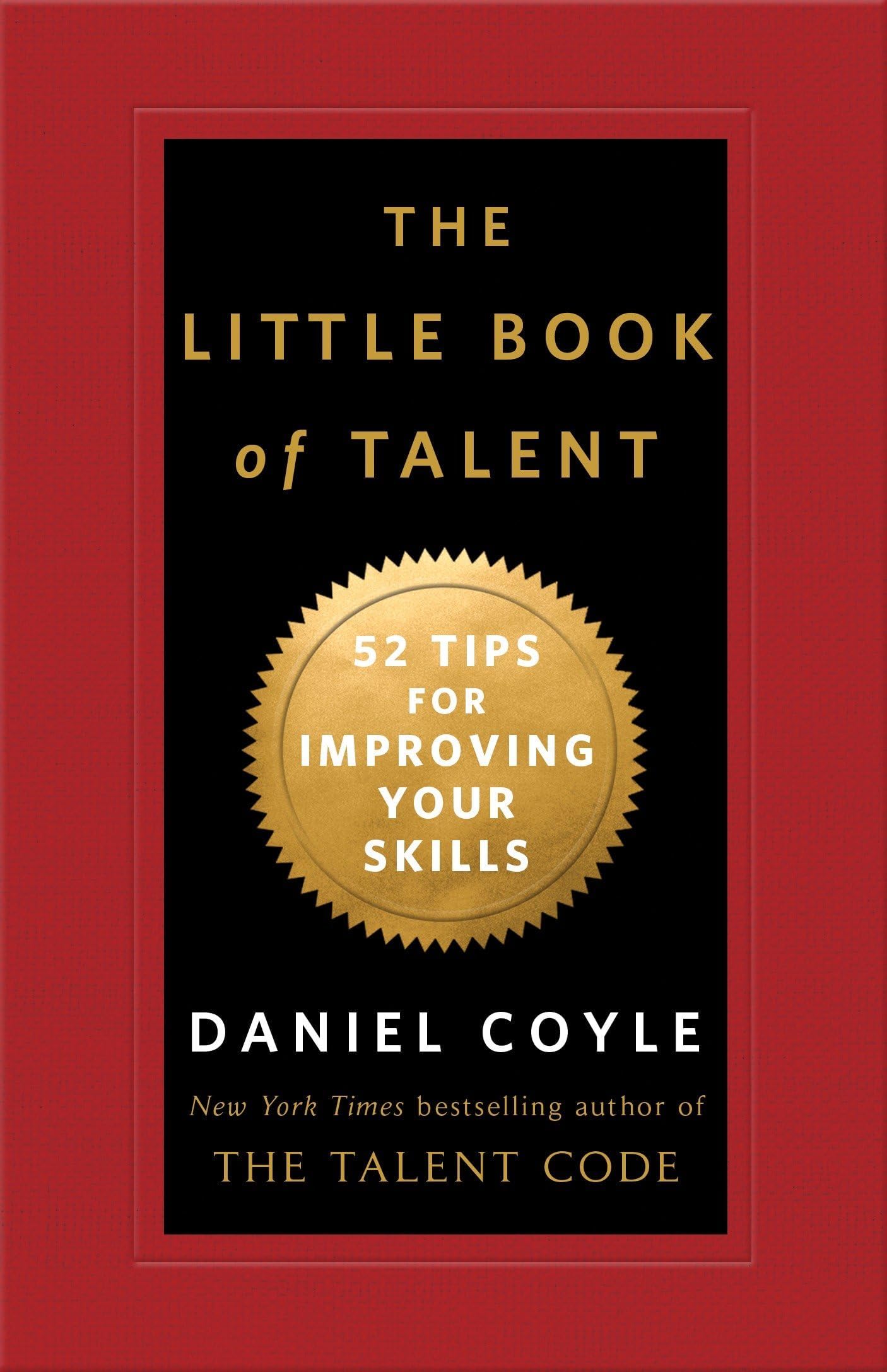
The Little Book of Talent: 52 Tips for Improving Your Skills
Product ID: 4641133
Desertcart purchases this item on your behalf and handles shipping, customs, and support to Japan.
Build a faster brain and a better you with this invaluable handbook from the New York Times bestselling author of The Culture Code and The Talent Code. “ The Little Book of Talent should be given to every graduate at commencement, every new parent in a delivery room, every executive on the first day of work. It is a guidebook—beautiful in its simplicity and backed by hard science—for nurturing excellence.”—Charles Duhigg, #1 New York Times bestselling author of The Power of Habit Whatever talent you set out to build, from golfing to learning a new language to playing guitar to managing a startup, be assured of one thing: You are born with the machinery to transform beginners’ clumsiness into fast, fluent action. That machinery is not controlled by genes, it’s controlled by you. The Little Book of Talent is an easy-to-use handbook of scientifically proven, field-tested methods to improve skills—your skills, your kids’ skills, your organization’s skills—in sports, music, art, math, and business. The product of five years of reporting from the world’s greatest talent hotbeds and interviews with successful master coaches, it distills the daunting complexity of skill development into 52 clear, concise directives. Whether you’re age 10 or 100, whether you’re on the sports field or the stage, in the classroom or the corner office, this is an essential guide for anyone who ever asked, “How do I get better?” Review: Practical Follow-Up to The Talent Code–Short, Useful Tips After Reading It Twice - Having recently finished reading Daniel Coyle’s The Talent Code for the second time, I picked up his follow-up, The Little Book of Talent: 52 Tips for Improving Your Skills. It’s a short, fast, easy-to-read book packed with practical tips that you can actually use to get better at anything. Unlike The Talent Code, which builds its ideas through longer stories and context, this one skips the narrative and just delivers the helpful information straight. It’s not deep or revolutionary, but it’s useful and to the point—exactly what I wanted for quick application. Review: Great book!! - This book was short and too the point. So much great knowledge in such a little package is rare these days. I have read some reviews on here saying that its "a good book but not a system". I guess that's true to an extent, but I like the book better as it is. Right now you can pick out of the 52 tips to make your own system if that's what you want. I mean really how hard can it be? If the author tried to put the tips into a system I don't feel it would be applicable to such a wide variety of talents. Anyway the tips for improvement are well researched, simple, and I have found them to be very effective. Not only that but reading the book gives you so many things to try, you cant help being left motivated and hopeful to improve at whatever you wish.

| Best Sellers Rank | #77,638 in Books ( See Top 100 in Books ) #64 in Rugby (Books) #169 in Sports Coaching (Books) #786 in Behavioral Sciences (Books) |
| Customer Reviews | 4.6 out of 5 stars 2,129 Reviews |
K**K
Practical Follow-Up to The Talent Code–Short, Useful Tips After Reading It Twice
Having recently finished reading Daniel Coyle’s The Talent Code for the second time, I picked up his follow-up, The Little Book of Talent: 52 Tips for Improving Your Skills. It’s a short, fast, easy-to-read book packed with practical tips that you can actually use to get better at anything. Unlike The Talent Code, which builds its ideas through longer stories and context, this one skips the narrative and just delivers the helpful information straight. It’s not deep or revolutionary, but it’s useful and to the point—exactly what I wanted for quick application.
C**S
Great book!!
This book was short and too the point. So much great knowledge in such a little package is rare these days. I have read some reviews on here saying that its "a good book but not a system". I guess that's true to an extent, but I like the book better as it is. Right now you can pick out of the 52 tips to make your own system if that's what you want. I mean really how hard can it be? If the author tried to put the tips into a system I don't feel it would be applicable to such a wide variety of talents. Anyway the tips for improvement are well researched, simple, and I have found them to be very effective. Not only that but reading the book gives you so many things to try, you cant help being left motivated and hopeful to improve at whatever you wish.
M**L
This book is like an actionable summary of the talent code
This book is like an actionable summary of the talent code. The talent code contains much of the latest research and case studies on how to learn things very well and to learn them quickly. It is hard to put it all together after reading that book. I feel like this book is the bookshelf companion with little reminders, whereas the other book(talent code) is best read on a kindle cover to cover. I enjoyed this book, it was quick and easy as well.
J**R
Learn the Human SuperPower
Humans lack any major physical attributes to face the physical world except the power to mentally adapt by developing skills. Skills are developed in humans by a process called myelinezation that allows the brain to develop incredible skill, speed, and adaptability of the skill to new situations. The Little Book of Talent teaches you how to develop skills in the fastest and most reliable way by studying the teaching methodologies of the best "talent hotbeds" or world class schools. You can develop nearly superhuman skills like pro athletes, musicians, etc. by learning these techniques. This book is even better than the first book, The Talent Code, because this books tells you the actual practical techniques to adopt to gain impressive skills in any area you choose. This book is a definite must read.
H**H
Really Useful
There are hundreds, no thousands, of new self-help books out there, but most are either notional (based on one person's experience or thoughts that may or may not translate to anyone else), or a complex rendering of a research project (lots of data with a conclusion). This is something different. Each "Tip" is short and sweet, no more than a paragraph or two, with concrete images that help you understand it. But each tip is the result of intense study on a specific (narrow) topic. The tips are organized in a way that makes it easy to see the progression in building a skill. It is basically written in a style that builds on the performance skills being taught here. Each of these tips really resonate. Looking at my own life, I recognize techniques used by the best of my teachers over the years. Well researched, well organized, and well written. Highly recommended.
S**H
Highly recommended
This is a great book, after reading it in a book store I promptly ordered it, online, where the prices are better. Anyway, I loved it and I lent it to my dad who also thought it was a great book. Often times journalists write in a way that I just don't like very much, on account of them trying to give you the information in a story. The problem is I really don't care about what the person you interviewed looked like or what restaurant you went to for the interview and what it was like and other useless details. I will never benefit from knowing how deep so and so's voice is or what it was like outside when you did the interview. Luckily, this book only uses stories when they are real life stories that are concise and directly relevant to the point being made. Otherwise it's listing out the information itself. So if you like that type of writing as much as I do then this book is perfect for you. It's a quick read and a great book.
P**H
How This Book Came About - Good, Almost Great
It will help the potential buyer or reader to understand how a self-help book of this type comes about. The author is a known professional, which means he will give you your money's worth whatever he writes about. You may also bet he will pick a topic in his 'little book' that offers solutions to a concern of millions. Having the talent and goal, he then finds a path to action. Finally, he packages the answers into a tidy 'little book' to make it universally palatable. His next stop will be speaking tours, but that doesn't concern us here. This is what has happened to 'The Little Book of Talent'. On that basis, I recommend any self-striving reader to inhale it. In one evening you may change the rest of your life. There is nothing in it that someone who grew up on the farm and school of hard knocks doesn't know, but not everyone was so lucky to get these lessons for ten bucks.
T**J
Little book, standard price
This book can be read in one hour. Despite its small size, it carries the usual Kindlle book price of $9.99, "set by the publisher." The book describes the characteristics shared by "talent hotbeds" where great athletes, musicians, and other performance masters are developed around the world. The author provides an intentionally concise set of tips for improving your performance at any endeavor, drawing techniques used in the talent hotbeds. The tips can be used to coach yourself, your children, or anyone else. The three stars I gave this book is mainly for the price. It makes some interesting points about how skills can be developed in anyone, and in that sense it has an inspiring message. The book could make you a better coach. However, the "little book" format does leave you feeling that the examples cited by the author are somewhat anecdotal. Worth reading, though.
L**R
Facilidad
Super facil de tener acceso a la lectura
A**L
Espectacular!!!
A brilliant manner of bringing down to earth many myths of talent identification and talent development. A Must-read for any teacher, coach or parent!!!!
D**O
you want to develepp youself? this book is for you
A short book but that's not mean it is oversimple so we can easily understand the message of the author throught the book and we all can use these tips in life. If you are too busy? start with 1 tips a day. If you have more time? read it all in the weekend and note which tips are suit for you in this moment. - Enjoy-
K**A
Kurze, knackige Tipps zum Üben
Für dieses Buch hat der Autor viele Tipps zusammengetragen von Weltklassetrainern im Sprot und z.B. auch Musiklehrern. "The little book of talent" gibt insgesamt 52 Tipps, wie man sein Talent weiter entwickeln kann. Natürlich sind nicht alle Tipps gleich wertvoll, aber einige sehr gute sind schon dabei. Ich lerne gerade Gitarre zu spielen, und z.B. der Tipp, neue Musikstücke in kleinste Mosaiksteinchen zu zerlegen, die isoliert geübt und dann zum Ganzen zusammengefügt werden, ist schon allein das Geld wert. Und natürlich: Dranbleiben. Unregelmäßiges Üben bringt nichts oder nur wenig. Also unbedingt lesen und einige Tipps umsetzen, dann hat man schon viel gewonnen.
P**R
interesting book
Full of good ideas. After reading it, I passed on to my niece's husband to read. Excellent ideas to apply when you have young kids.
Trustpilot
2 weeks ago
1 week ago