Desertcart purchases this item on your behalf and handles shipping, customs, and support to Japan.
โก Charge smarter, test deeper, power further โ never run out of juice again!
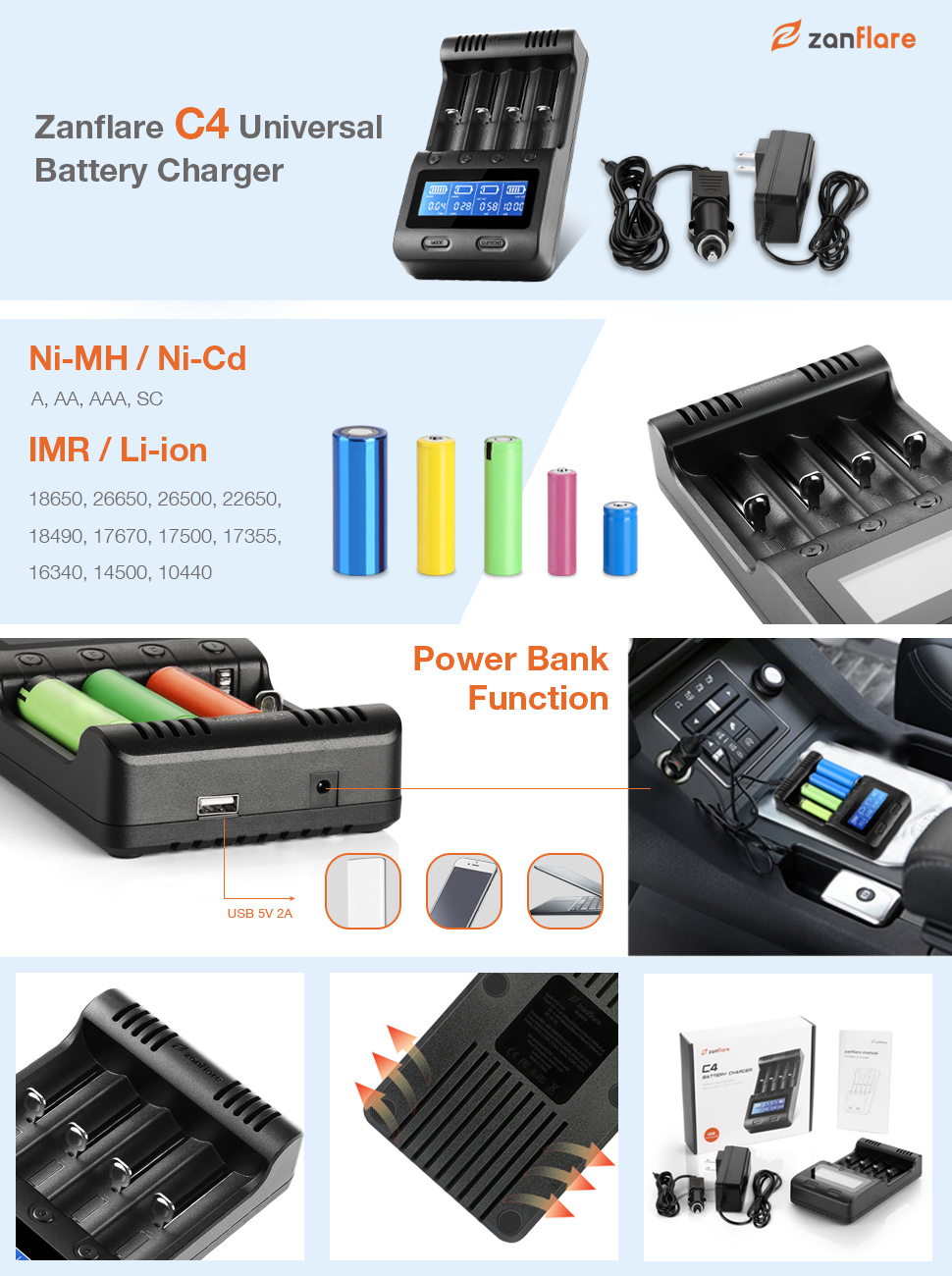
The Zanflare C4 is a versatile smart battery charger and analyzer featuring 4 independent slots compatible with AA, AAA, 18650, NiMH, and Li-ion batteries. Its integrated LCD provides detailed real-time data including voltage, current, capacity, and internal resistance per battery. With selectable charge currents up to 2A and multiple test modes, it ensures optimal battery maintenance and performance. Certified for safety and built with flame-retardant materials, it also doubles as a power bank via USB output, making it an essential tool for professionals who demand reliable, intelligent battery management.


| ASIN | B07428G1G2 |
| Amperage | 2 A |
| Brand | Zanflare |
| Color | Black |
| Current Rating | 2 A |
| Customer Reviews | 4.5 out of 5 stars 2,287 Reviews |
| Global Trade Identification Number | 00191438006457 |
| Input Voltage | 12 volts |
| Item Dimensions D x W x H | 7.09"D x 3.94"W x 1.57"H |
| Item Weight | 9.6 ounces |
| Manufacturer | Zanflare |
| Mfr Part Number | C4 |
| Model Number | C4 |
| Number of Items | 1 |
| Number of Ports | 4 |
| Output Voltage | 5 volts |
| Product Dimensions | 7.09"D x 3.94"W x 1.57"H |
| Specification Met | rohs,ul |
| UPC | 191438006457 |
| Unit Count | 1 Count |
C**G
Excellent quality product with many easy to use features
Great charger. This works better than I thought it would and has features typically only available on more expensive chargers. The charger is easy to use and provides more information than a typical user would need. Excellent product for maintaining, charging, and seeing how much life you have left in your rechargeable batteries. Overall excellent quality product.
J**M
This Smart Charger / Analyzer keeps up with the big boys.
What can I say about the Zanflare C4 Smart Charger / Analyzer? I had mediocre hopes for the C4, assuming it wouldn't live up to its featured hype. But I am happy to say that it has thus far exceeded my expectations. I have lots of NiMh and LiIon batteries. LOTS, over 300. I also have 5 different smart chargers, and a slew of others. So my perspective comes from a comparison of things I already possess and use. My favorite Smart Charger / Analyzer up to this point was the Opus BT-C3400. So most of my perspective is related to that one. The ease of use and setting individual slot configurations is even nicer than the C3400. Additionally, like the C3400 you can set / reset the configuration of each individual slot "on-the-fly" with immediate response. The only feature the C4 doesn't have where the C3400 does is an automated REFRESH mode. Instead, you either manually use the Fast Test (discharge / charge [measure mAh on charge cycle]) or Normal Test (charge / discharge / charge [measure mAh on discharge cycle]) and simply do it manually 3 times to get the same process the Opus performs with its Discharge Refresh program. Sometimes it might be a hassle, other times it is nice to check the value between each cycle to see what kind of results you get at each point. What I've found is that when I need to refresh some old batteries, or ones that have not been used in awhile, where they seem to have lost some of their capacity, I can use the C3400 refresh and then "set it and forget it" until it is done. On the other hand, when I purchase new batteries, I find that if I use the C4 Fast Test manually, I might not need to do a full 3 cycle test to break them in. If the capacity is within 10% of the battery's rating, I then do the Normal test which provides the capacity from the "discharge" perspective (more accurate in my opinion), record my info and move on to the next set of batteries. The C4's display uses a white on blue background so is slightly less appealing than the C3400's LCD display, but is by no means difficult to read. In fact the C4 has a "virtual" battery that is always visible for each slot giving a nice and easy visual status without having to try and "read" something and without having to cycle through the "modes". Though you can cycle the modes just like the C3400 to indicate Voltage, mA charge rate, mAh capacity rate, Internal Resistance, etc. But that visual battery indicating a visual status is also always there, so you know "visually" about how close it is to being done with the discharge or charge state. Effect: I can look at it from across the room and just "know". The C4 appears to have good ventilation much like the C3400. It is a couple inches longer than the C3400, but it really doesn't require much more desk space as in either case you would want to have a bit of ventilation room anyway. I've used the unit on the major battery types (AAA, AA, 14500, 18650, 26650) and used the various current settings (even up to 1A * 4 slots) and the unit itself doesn't over heat or get any warmer than any other charger I own. So the "physical" characteristics are pretty similar. The exception is probably in the slots themselves. Rather than have a multi-tiered slot design like the C3400 has, they chose to simply make the slot "half circle" diameter the size needed for its largest battery support. This tends to make the smaller (AA, AAA) batteries "rock and roll" a bit when trying to place them. It takes more effort in other words. Not a lot more, but enough to certainly realize that it does. The C3400's two tiered system favors AA batteries for the smaller tier as they fit *almost* snug in that bottom tier. The wider batteries fit into the 2nd (upper) tier pretty nicely. So the C4 is not quite as nice as the C3400 in that respect. Additionally, the metal sliders are a little "bendy" (read as weak) so you may have to occasionally bend them to a straight vertical position for proper contact with the negative pole on the battery. Not a major problem, but something they should look at fixing in the future. So that I don't write a novel, I'll simply summarize here with possibly adding comments in the future as they become necessary: The Zanflare C4, much like the Opus BT-C3400, appears to be a solid Smart Charger / Analyzer and performs well. Could there be improvements? Maybe. But nothing major here is needed. I'm thoroughly pleased so far with the Zanflare C4, and the fact it is less expensive than my C3400 is simply icing on the cake.
K**S
Simple intelligent charger
One thing I didn't notice another reviews is one annoying thing no one explained is that during the first 10 seconds when you're allowed to change the mode it's actually in the mode that it shows so if it shows charging it is charging. If it shows fast test it is discharging even though it's still flashing. this is frustrating because when you want to check the batteries voltage it is skewed by the fact that it is currently charging or discharging. so although it may not be a good battery voltage checker it does everything else quite well. It charges My AA's properly and even when I put a 18650 that was at 1.2 volts it knew it was lithium and charged it up a properly to 4.2v. when it reports the resistance reading sometimes it will report 200 and then when it's done charging it will say the resistance is 150. And next time I charge that particular cell it'll say 250. So the resistance reading is just a wild ball park. But I have noticed that the cells that are older and abused and far less capacity than they're supposed to generally will always show a higher resistance like up near 400. I like knowing that I can put some lithium cells in this charger and use it as a power bank to charge my phone. It's milliamp hour readings I've always been very accurate. There's no fan to wear out and go bad. When it discharges your cell it can only do a Max of 500 milliamp hours and does get quite warm so I generally use the 300 milliamp hour setting which is kind of annoying because then it uses only 300 milliamp hours to charge as well and takes forever when you're charging a larger cell. sometimes when I noticed that it's done discharging I'll restart at the 1amp hour charge rate to save time. I got a universal flat battery mount and attached wires to it and ran them over to this charger now I can charge all of my flat lithium's with this charger as well. All in all I'm really happy with this charger and now I've got all of my cell phone, camera and cylindrical batteries tested and labeled with their true milliamp hour abilities. There's so many mislabeled fake aftermarket batteries out there and we all need a charger like this to keep sellers accountable for selling mislabeled cells to us all the time.
S**Y
Amazing Charger/Analyzer
I'd been wanting a proper battery charger for quite a while. I had been using a re-branded Tenergy 4-bay universal charger that only did Nicad and NiMH batts. It worked, but took forever to charge batteries (overnight). I discovered these 'smart' chargers that could do all kinds of things and monitor the batteries like my LiPo charger did, and charge all battery chemistries (including LiFe) and looked at a few and found out they weren't expensive for what you get. I looked at the Opus BT-C3100, Nitecore SC4, Miboxer C4 and C4-12, Nitecore D4, and this one, the Zanflare C4. I didn't want to spend $50 for the Miboxer and Nitecore SC4, the D4 didn't have fast charging, the C4 didn't have a 1 amp charge mode, and I couldn't find the Opus for under $45 without having to wait a month or more for it to come from China. So, I got this. $32 shipped to my door in 1 day. Amazing. Ordered Wednesday AM, at my door when I got home from work Thursday PM. Nice. So I like this charger. I'm an electronics and gadgets junkie, so all the functions are awesome. You get all the standard safety stuff like overvoltage, undervoltage, overcharge, overdischarge, reverse polarity protection, etc. I got the charger, wall adapter/power supply, and a 12V car adapter for the charger. It's a 12V 1.5A adapter with a non-standard size jack, so finding a replacement would be hard. On the back is the 12V input and a 5V USB port for plugging in a USB cable to charge things with (Phone, tablet, etc.). They say it's rated for up to 2A. There are 4 slots or bays, and this charger will take every cylinder style battery out there: Nicads, NiMH, Lithium ion in every conceivable size from the tiny up to the big 26650's. Downside is no LiFe chemistry, and you can only use two of those 26650 cells at a time and on bays 1 and 4 only. Otherwise, 4 18650's fit fine. For the features, up front there's that display. Has a really nice deep blue backlight, and shows a battery symbol with horizontal bars showing charge status. Below is the battery stats, mode setting, and the values. Nice. The only gripe is the text is tiny and the viewing angles are horrible. It completely washes out at like 50 degrees. I do like how the backlight always stays on. It's dim until you touch a button, then it goes to full brightness. There's 6 physical buttons, with mode and current up front, and one for each slot that you use to cycle through stats and select slots for current adjustment. it has 3 modes: charge, norm test (I think they mean normal), and fast test. Normal test charges the battery, discharges it, and then re charges it and shows the estimated capacity. That can take a long time for high capacity cells. Fast test does a charge-discharge cycle only. Charge mode gives you 4 current settings available in all 4 bays at the same time: 300mAh, 500mAh, 700mAh, and 1000mAh. There are 4 display functions that display during charging as well: volts (real-time), charge time (hh:mm- no seconds), accumulated capacity in mAh, current setting (not real time), and mR or internal resistance in milliohms. It measures the internal resistance of the cell. That's really helpful in figuring out how healthy your batteries are. High internal resistance indicates a battery that's worn out or low quality, but the best way is doing the charge discharge cycle tests. Discharge currents are 300 and 500mAh. How's it work? Really good! I charged some AA, AAA high capacity NiMH, NiCad, and lithium ion 18650 cells I had lying around, which is going to be its primary role. The charger feels quality and sturdy. The slots have metal sliders that hold the batteries, and they ride in metal slots, not plastic, and the springs are strong which is important for getting a good reading for volts, current, and resistance. The buttons also feel good and solid. Operation is simple. Plug the charger in. Insert the battery and the display flashes with the battery symbol and the current shows as 500mAh, which is default. The charger detects the battery type automatically, but It doesn't show you what it is like some other chargers in this class, which might be handy for a mystery battery with no markings. Push the current button to cycle through the current settings, and use the mode button to cycle through the modes. It gives you a little time to choose the current and mode before it locks in. However, you can change the current setting by long-pressing the slot button and pushing the current button. I really liked that about it since you don't have to take the battery out to change it. You do have to take it out to change the mode though. Pressing the slot button lets you cycle through the information, volts, current, accumulated charge, and resistance. I love how fast the batteries charged. On the old charger it would take all night. On this one it took 1.5 hours for the really high capacity AA's and AAA's at 700mA for the AA's and 500mA for the AAA. At the 700mA setting, the AA's did get a little warm, so I wouldn't recommend that current setting for any battery under 2100mAh capacity. I ran the normal test on some old AAA NiCad and some salvaged 18650 batteries and found that the results were in line with my lipo charger. It takes a long time (6 hours), but really shows how healthy your batteries are. NiCads and NiMH charged to end voltages of around 1.45 and the lithium cells to 4.20. I checked these with my multimeter and t NiMH were 1.4 to 1.5, and the lithium ions were 4.17, well within spec for a charger like this. I tried reviving a dead Lithium ion cell, and it did it just fine. You can use the charger as a "power bank" but NOT when it's plugged in. You can only use it when it has batteries in it, and it takes minimum 2 Lithium ion cells to get the 2A current rating. Pros: Sturdy and well-made Easy to use Handles all cylindrical batteries and chemistries Shows important battery information Has resistance measuring capability 4 charge currents up to 1A for all slots Independently controllable slots Display backlight stays on all the time and dims when idle Revives dead batteries 2A USB port Came with car charger Cons: No discharge mode Display has poor viewing angles No support for LiFe PO4 cells This is an amazing charger for $30 with its capabilities. You pay $15 extra to get the Opus, and $20+ extra to get the Miboxer C4-12 or Nitecore SC4 with largely the same capabilities (minus discharge mode). Great buy. Highly recommended if you charge lots of batteries.
B**E
Very Good
I have now changed over 30 batteries with a mix of 18650โs, AA, AAA and it works well. At first I found that none of my batteries were not even close to the mAh rating, I was thinking the charger was bad, every 18650 I had would only charge to a capacity of around 600 mAh, the batteries were rating anywhere from 2500mAh to 6000mAh. The same on the AA batteries, should be 2400 got 1000 mAh. What I found was ALL my batteries just were not very good, so I bought some Samsung and Duracell and they charge up to the rating. Why I bought this unit over the others: It will measure the internal resistance on all 4 slots, not just one slot. You can control the changing current up to 1000ma (other only go to 800) It can also be a USB battery pack if you put 18650โs in the unit (no other unit had that) The overall unit seems to be build well, and if you are charging 4 18650โs at 1000mAh it does get very warm, but you can pick it up without burning yourself. Every other setting 300/500/700 there were no temperature issues. For a charger with a lot of features it is very simple to use. If you want to just charge a battery, just put it in and walk away, it will by default auto select battery type and set the charging current to 500mA, it will then flash END when it is down. The advance features require you to press the mode and current buttons within the first 10 seconds of inserting a battery to set the current and charge type (Charge, Normal test, Fast test). After 10 seconds the slot button rotates between, Volts, Charging current, Internal resistance, Time and capacity (mAh). The only thing I would change to make this unit better is a lager โENDโ message and show more than one item on the screen at a time, I would like to see Volts and mAh at the same time. It was nice to get a car power adapter and A/C adapter, other units did not include ether.
A**E
Awesome charger does everything!!
The Zanflare C4 is Zanflare's entry into the Battery Charger market. The C4 is a 4 bay multi-functional smart charger which can charge and analyze NiMH, NiCd and Li-Ion batteries. The C4 is great for anyone looking to upgrade from their non-analyzing chargers. User Interface and Modes Each slot can operate completely independently (for example, slot 1 can be set to charge, slot 2 can be set to Fast Test and slot 3 can be set to Normal Test). In order to set different modes for each slot, you have to insert each battery one-at-a-time, set the mode and then wait a few seconds before inserting the next battery. Each slot can also have separate a current setting. The mode and current is set within 10 seconds of a battery being inserted. Operation: * When battery is inserted, press MODE within 10 seconds to rotate through the modes (Charge, Fast Test and Normal Test). * When battery is inserted, press CURRENT within 10 seconds to rotate through the current options (300/500/700/1000mA for Charge and 300/500mA for Test). 500mA is default. * Once charging/analysis has started, press the individual buttons (1, 2, 3 and 4) to rotate through the display for each slot. Modes: * CHARGE - Basic battery charge mode (300/500/700/1000mA) * FAST TEST - Discharge then re-charge and measure capacity (300/500mA) * NORMAL TEST - Charge, discharge than re-charge and measure capacity (300/500mA) Display: Each also has it's own individual display and can display: * mA - Charge/Discharge Current (Shows the setting, it does not fluctuate in real-time) * V - Voltage * mAh - Cumulative charge * mR - Internal Resistance * Time - Cumulative charge/analysis time Summary and Conclusion The C4 is a nice analyzing charger both in terms of function and appearance. It supports up to 4 18650s simultaneously and can charge up to 2 26650s simultaneously (non-adjacent slots). It can also support charging NiMH and NiCd so this makes it a good universal/family charger. It can also fit protected cells up to about 72mm in length although longer and wider cells like GAs feel cramped and tight. It does not support LiFePo or C/D cells. I like the charge and discharge current options (300/500/700/1000mA for Charge and 300/500mA for Test). I know that some people prefer chargers that can support more than 2A+ for charging or 1A for discharging. However, I prefer charging/discharging my cells at lower speeds for better longevity and less heat. I normally charge my 18650s at 500mA regardless of charger used. The 300mA charging option is also great for people charging smaller cells like 14500s. The charger has good size and ventilation and does not need a built-in fan. When charging 4 cells at 500mA, the charger gets warm. When charging 4 cells at 1A, the charger gets very warm (but not overly hot). If someone wanted to add cooling for heavy use, you could set this until on top of a cheap laptop fan since there are a lot of vents on the bottom. I like the display options and the ability to view actual voltage on top of accumulated charge. I also like that there is individual information for each cell so that I can monitor voltage for all 4 cells at the same time. However, I would prefer if the unit/interface was not "upside down" (design preference). I like that the unit is powered with a proper wall/car plug and not USB-powered. The sliders move well (not too stiff or too sloppy). The power bank functionality works well and charges my phone pretty quickly even on one cell (1A charge). Using cells as a power bank is also a good way to discharge cells (either for storage or testing) without "wasting" energy. My unit terminates charge around 4.16V and the voltage accuracy is within 0.3V when removing cells and measuring them with a voltmeter. Packaging and Contents 1 x Battery Charger 1 x Power Adapter 1 x Car Charger 1 x Manual I highly recommend buying this charger for all your needs!!
T**.
Great charger!
Exactly what I was looking for charges diff types. Very useful.
E**S
Ok for charging, for testing not so much.
Iโm kinda disappointed in this charger. It looked good from the features and reviews but it has some problems. I got it specifically because it can charge cells individually, whereas my old charger always charged them in pairs, which is bad if the batteries arenโt well matched in capacity. First, it doesnโt seem to be able to test NiMH cells reliably. Iโve been trying to test the capacity of some cells but after I put them in test mode, and then come back a while later, the display says it is done, but the mAh display is still all dashes. Sometimes it works, but usually it doesnโt, and not sure why. And no, these cells are not dead, they work just fine in flashlights and other tools. The next issue is that it seems to charge pretty slowly, or just tries to charge batteries too far. It seems to charge cells most of the way pretty fast, but getting them all the way until the charger says theyโre done seems to take a long time, even though they were already full or nearly so, and even though the charge current is supposed to be high. So not a fast charger if you want full cells. The next issue is that there is no indication on the display what part of the cycle the charger is in. You canโt tell if itโs charging or discharging unless you sit and wait to see if the mAh display is increasing. Thatโs pretty annoying. The internal resistance measure seems very unreliable. I will get readings that vary a LOT on the exact same cell if I just take it out and put it back in again several times. With that much variability, the resistance test is useless. And yes, Iโve checked and cleaned the connections and battery terminals. The next problem is that the display only shows one measurement type at a time. And although I knew this when I bought it, it has turned out to be much more of an annoyance than I thought it would, because every time you put in a cell it defaults back to the least useful display, which is the current setting. It should stay on the same display you already had set for that slot, even if you change cells. And the metrics I find most useful are usually several button pushes away from that. There is no display of instantaneous current input/draw. The only current display is what setting the charger is on. Would have been nice to see what the current current is in addition to voltage. The last issue is that the capacity test is not that useful because it only measures mAh rather than Watt-hours. And two batteries with the exact same mAh test value can perform dramatically differently if they have a different voltage profile. So the good is it seems to work mostly ok as just a charger if you donโt care if itโs slow. But if you actually want it for itโs testing features, itโs not very useful, or at least could be much better if they took the time to improve the software.
S**4
Glad I Bought This
Awesome Units When I clicked Buy I thought I was Only Getting 1 unit But it was for 2 .. I have am using this to test/check 18650 Batteries and it works Well .. took a while to figure out the menu .. press buttons .. done .. Very Easy to Figure out..
A**N
USB does not work with NiMh batteries. Far from a universal charger.
Very dissapointed. For a universal charger, it does not charge D type or 9 vrechargebale batteries. and the USB ouput does not work with NiMh batteries. If you're hoping to use this in conjunction with high capacity 2800mAh NiMh batteries to charge your mobile device, look elsewhere. Overall, unless you want to specially charge lithium ion batteries, this is not the best option.
J**N
Reliable battery tester and charger
Excellent battery charges and testers. These are invaluable tools for use in cell harvesting and testing large quantity of batteries. NiCad, Nimh, Li-ion.
Y**S
Charge facile
Facil pour la prise en main .3 charge 300ma 500ma 1A et 2 fonction de testeur normal et rapide je ne pouvais pas donne plus de cinq etoile
R**B
like it, but prefer another model
too big, lcd display need to be better
Trustpilot
3 weeks ago
3 weeks ago