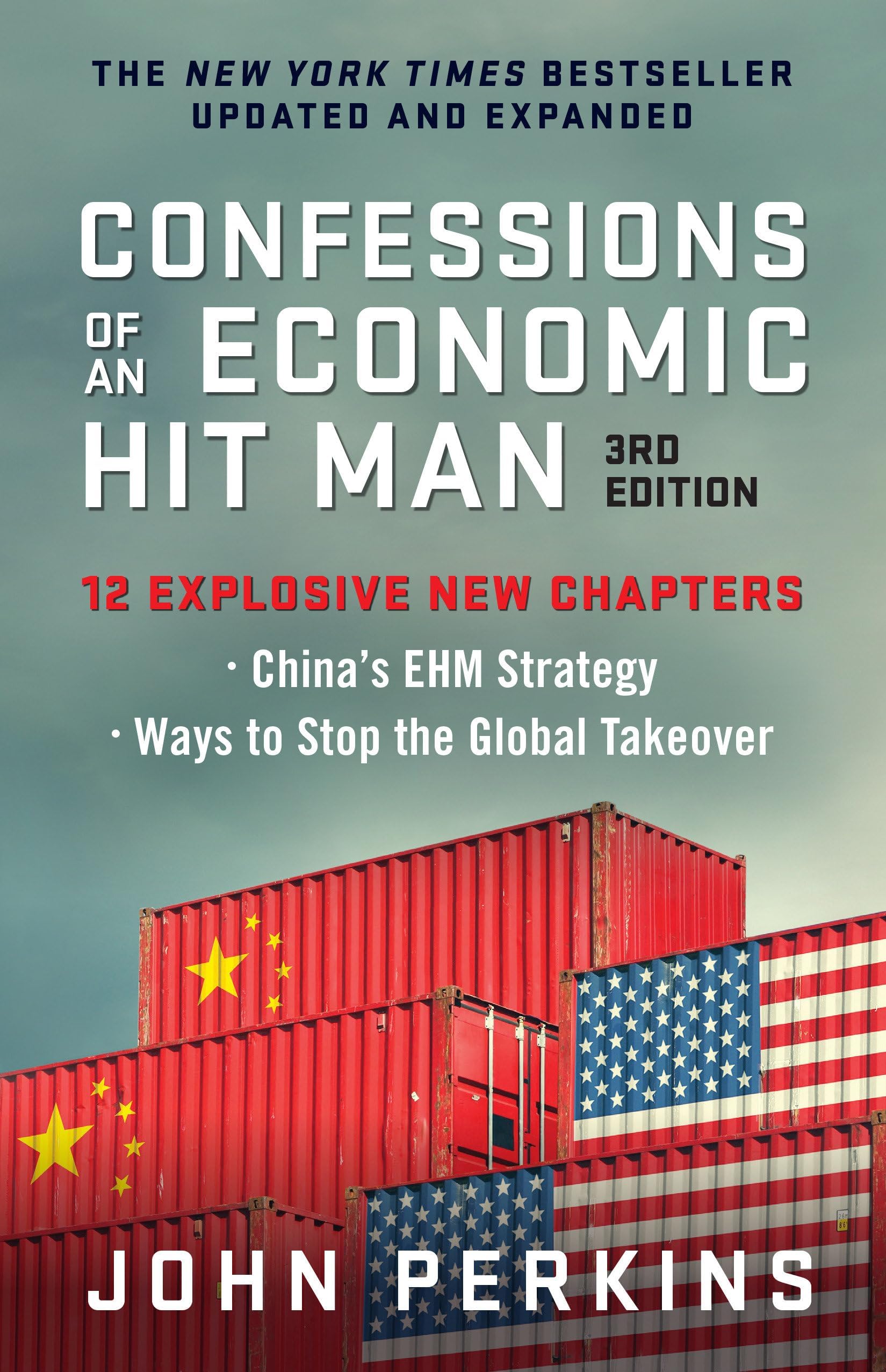
Confessions of an Economic Hit Man, 3rd Edition
Product ID: 440356940
Desertcart purchases this item on your behalf and handles shipping, customs, and support to Japan.
Los Angeles Times Bestseller How do we stop the unrelenting evolution of the economic hit man strategy and China’s takeover? The riveting third edition of this New York Times bestseller blows the whistle on China’s economic hit man (EHM) strategy, exposes corruption on an international scale, and offers much-needed solutions for curing the degenerative Death Economy. In this shocking exposé, former EHM John Perkins gives an insider view into the corrupt system that cheats and strong-arms countries around the globe out of trillions of dollars and ultimately causes staggering income inequality and ecological devastation. EHMs are highly paid professionals who use development loans to saddle countries with huge debts and force them to serve US interests. Now, a new EHM wave is infecting the world, and at the peak of the devastation sits China, a newly dominant economic power, with its own insidious version of the US EHM blueprint. Twelve explosive new chapters detail the allure, exploitation, and wreckage of China’s EHM strategy in Latin America, Asia, Africa, the Middle East, and Europe. If allowed to continue its rampage, the EHM strategy—whether executed by the United States or China—will destroy life as we know it. However, all is not lost. Perkins offers a plan for transforming this system that places profits above all into a Life Economy that restores the earth. He inspires readers to take actions toward a new era of global cooperation that will end the United States’s and China’s EHM strategies for good. Review: Fascinating book - Fascinating book. You get a blend of history, geopolitics, economics, and the personal journey of an economic hit man. Very well written. Easy to follow. Full of information for those of us that love true history (not the whitewashed garbage the Department of Education has been feeding the public for so long). Enjoyed this book thoroughly and I can see why it’s been such a bestseller for so long Review: Great Education on Geopolitics - A great book, well written, and it was an eye opener as to how geopolitics is intertwined with industry. Very educational.


| Best Sellers Rank | #9,732 in Books ( See Top 100 in Books ) #3 in Government & Business #7 in Economic Policy & Development (Books) #35 in Biographies of Business & Industrial Professionals |
| Customer Reviews | 4.6 out of 5 stars 788 Reviews |
K**E
Fascinating book
Fascinating book. You get a blend of history, geopolitics, economics, and the personal journey of an economic hit man. Very well written. Easy to follow. Full of information for those of us that love true history (not the whitewashed garbage the Department of Education has been feeding the public for so long). Enjoyed this book thoroughly and I can see why it’s been such a bestseller for so long
A**.
Great Education on Geopolitics
A great book, well written, and it was an eye opener as to how geopolitics is intertwined with industry. Very educational.
E**N
John Wick of Economy
I’ve had this book sitting on my iPhone for a while, and finally I pushed myself to read it. For that I’m glad, for it’s a very good book. It’s an important book. Confessions of an Economic Hit Man by John Perkins share many similarities with the books of F. William Engdahl, especially Myths, Lies, and Oil Wars, but there are also differences. I’ll get back to where the two men disagree. Both are history books. They explain why and how the world turned into what it is today, the political landscape, the war about resources, all the money-grabbing schemes, the problem with the money system of today, and why the rich are getting richer while the poor are turning into slaves. Just like the spice merchants of old, the oil companies have a lot of power. Enough money and power to shape the world around them. Perkins talks about «corporatocracy». How the megacorporations rule the world. They choose the politicians, not the other way around. They control the narrative, and they trick the people to think they have democracy. They send out their hit men, the EHMs, they own the banks, the government. They decide what kind of money system we are forced to use. Go against them, and you risk ending up having an «accident». Originally I was going to rate the book five stars, but there are inconsistencies, factual errors, and spelling errors. Where Engdahl is clear about the origins of oil and gas, Perkins for some reason uses Big Oil’s own term Fossil Fuels. That term, alongside Peak Oil, was coined by Rockefeller, to create an illusion of scarcity, while in reality oil and gas will keep bubbling up from the deep as long as the Earth has a liquid metal core. I also wonder if Perkins is aware that mankind always has, and probably always will, exist within the Quaternary ice age? Ice ages last for millions of years, and while we’re lucky to live within an interglacial, the Quaternary isn’t likely to end anytime during the next hundred million years. He talks about CO2 and climate change, and it’s really confusing. Doesn’t he know who stood behind the Neo-Malthusian Club of Rome? A warm and green world is the best we can hope for, but scared people are always easier to rule. Perkins calls them Death and Life economies, but isn’t it really about Keynesian and the Austrian Economics? One creates hyper-inflation and regularly crashing markets, making the rich richer and the poor poorer, while the other is stable and fair, with no need for a money monopoly. While less important, there are also a few spelling errors. Sometimes our planet is called «earth» and at other times «Earth». Name of planets shall of course have a capital first letter. «Flammable» should be «inflammable» (see the writer’s bible «Elements of Style»). When talking about percentages one should choose between the forms «five percent» and «5 %». Don’t mix them. There are many more, but I’ll stop there. If you’ve read this book, don’t stop there. I also recommend Engdahl’s Myths, Lies, and Oil Wars, and Fraudcoin by Rune Østgård. These books are telling you what’s really going on.
P**T
Required reading!
This book should be required reading in every government economics class. Every American citizen should read this book to better understand how our government operates behind the scenes. It is shocking to say the least. A must read!
S**S
Playbook for current events
GREAT F💥‼️KING BOOK! History may not repeat itself but It definitely rhymes.
J**N
Very Informative
Good book to make sense of all the economic activities of IMF and the World Bank, etc.
A**E
How the World Really Works: Know the Meaning Behind the Headlines
I was fortunate to meet John Perkins in 2011 when he spoke at a Maui event hosted by my employer. As the event emcee, I worked with him backstage to prepare his introduction. I mention this before getting to the book, because it goes to his authenticity. Although he's a top-tier speaker, he's not about sensationalism - he's about connection, clarity, and truth and I was delighted to find that he's the same quality of person onstage and off. What was most helpful to me in the pages of Confessions of an Economic Hit Man 3rd Edition was the way Mr. Perkins blended his early history as an "EHM" with current events playing out on the global stage. The new chapters promoted on the cover really do add new value and relevance to this work, from the "where are they now?" updates covering his formative work in places like the Middle East and Latin America to his illuminating insights on today's EHM activity related to China and the New Silk Road. Mr. Perkins takes complex world events (many of which he personally participated in) and provides fresh perspectives that make them accessible. This is important, because he goes on to explain how "ordinary" people like myself (without a background in international politics, business, or economics) can understand these events and find grassroots ways to make a difference. In many ways it reads like some of my favorite classic spy stories, but it's all true, all rigorously documented, and ultimately, a hopeful call to positive action. I hope many will read and share this important writing.
P**L
Book Review: Confessions of an Economic Hit Man
Originally published in 2004, Confessions of an Economic Hit Man is John Perkins’s astonishing autobiographical “true story” of his time working as an economist with US contractors in developing countries. Moving mostly chronologically from the 1960s through 2023 in the third edition, Perkins reveals the pattern of control exerted by the US and China over the developing nations. This pattern, identified through three distinct waves, repeatedly involves “the four pillars of the EHM strategy: Fear, Debt, Anxiety, Divide and Conquer.” In his introduction, Economic Hit Men are described as “highly paid professionals who cheat countries around the globe out of trillions of dollars.” These EHMs work to channel funds from the World Bank, USAID, and other foreign aid organizations into developing nations through large loans for power grids, dams, infrastructure, manufacturing, etc. Economic forecasts and other statistics for “aid projects” in these nations are manipulated, and often wildly exaggerated, in order to induce countries to accept loans from either the Washington Consensus and to employ US firms to supply the manpower and materials for the needed projects; or in the Chinese EHM strategy, with the China International Development Cooperation Agency (CIDCA) and using Chinese companies and materials. This strategy funnels the “aid” funds back to the US or China and the contracting companies make record profits on the projects. As the economic projections almost inevitably fail to materialize, these nations are left with vast amounts of debt, leaving the creditor to negotiate control over the country’s natural resources and often their political goals and alliances as well as their social policies. The book reads much like a spy novel, with Perkins relating the exciting details of the cloak and dagger meetings that resulted in him working for Chas T. Main, Inc. (MAIN) in countries like Panama, Ecuador, Colombia, Saudi Arabia, Iran, Indonesia, and Egypt. He describes his relationship with various national leaders, such as the Ecuadorian presidents Rafael Correa and Jaime Roldos, the Chilean president Salvador Allende, and Panama’s Omar Torrijos. All of these, Perkins asserts, were killed for standing against Big Oil and other industry giants. Throughout this shocking book, the EHM strategy is described in such a way that specifics may be questioned but not the existence of the overall strategy itself, which becomes clearly evident. Perkins assures the readers that the EHM strategy amounts to slavery and results in a “Death Economy.” A key characteristic of this type of economy is the belief, advanced by Nobel-prize winning economist Milton Friedman in the late 1970s, that a corporation exists to maximize short-term profits and no heed should be paid to long-term or collateral damage. Other characteristics of a death economy include: the vilification of taxation; the undemocratic control of citizens by corporations; the exploitation of entire countries and their populations; places higher value on nonproductive jobs; keeps billions of people in poverty. (p.323) Contrary to this is what Perkins terms a “Life Economy,” which aims at the goal of serving the public interest democratically through non-monopolistic competition, sustainable products, valuing life and spiritually enhancing activities above materialistic ones; placing an emphasis upon education, health care, and the arts; cleaning pollution and regenerating devastated environments; one that is driven by compassion and debt avoidance. Overall, the book serves as a much-needed wakeup call for citizens not only in the West but throughout the entire world. As a former insider with a well-developed and well-deserved guilt complex, Perkins here exposes the EHM strategy but stops short of supporting the view that it is a conspiracy led by a few with nefarious intent. Nevertheless, he makes the uncomfortable assertion that the EHM strategies only work because we-the-people make them work; we authorize them through the decisions we make every day. In order to combat the four pillars of the EHM strategy, Perkins suggests using social media to share knowledge of the EHM strategy with other people; writing to CEOs; remaining debt-free; recognizing attempts to create anxiety through “othering” and materialism; denouncing propaganda; and by glorifying “cooperation, compassion and peace instead of conquest.”
A**R
Good read
Great book to learn about empires
D**K
Confessions of an Economic Hit Man 3rd Edition
This is an excellent read. John Perkins has a style which includes us, his readers, in intimate conversations with men and women of huge power and influence. He shares with us his intimate knowledge of the international power brokers who dictated the course of history. John Perkins was a part of that brokerage and in this third edition of his confessions, he speaks to us, and shares with us an unparalleled insight and knowledge into what can be described as conspiracy fact enacted on a global scale. John concludes his book with many ideas on how we, the readers can help ourselves and our friends to combat feelings of impotency in the face of the economic structures which are killing our planet. I give John hearty thanks for his courage, honesty and tenacity in the writing of this brilliantly written book. Thank you John.
C**C
À good Read
Very interesting ! Good reading . It givre a great example of how we nickel and dime these different countries and finally end up bankrupting them into submission.
K**D
A must read book
An exceptional book. A must read
M**G
Great book
Where do I begin… if you are interested in learning how corporations and the US government make things happen around the world, read this. It’s an essential read.
Trustpilot
3 weeks ago
3 weeks ago