
Buy anything from 5,000+ international stores. One checkout price. No surprise fees. Join 2M+ shoppers on Desertcart.
Desertcart purchases this item on your behalf and handles shipping, customs, and support to Japan.
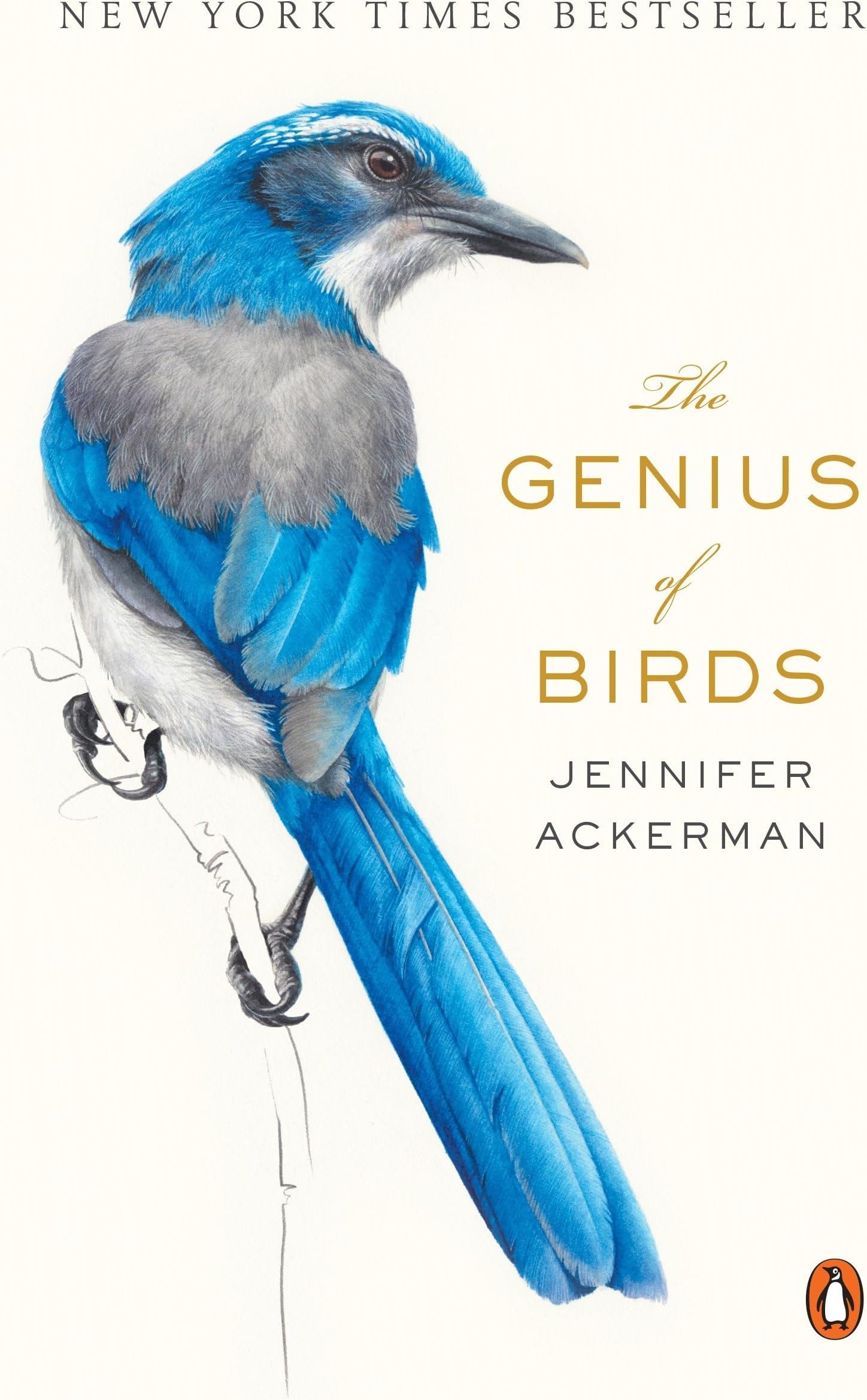
“Lovely, celebratory. For all the belittling of ‘bird brains,’ [Ackerman] shows them to be uniquely impressive machines . . .” — New York Times Book Review “A lyrical testimony to the wonders of avian intelligence.” — Scientific American An award-winning science writer tours the globe to reveal what makes birds capable of such extraordinary feats of mental prowess Birds are astonishingly intelligent creatures. According to revolutionary new research, some birds rival primates and even humans in their remarkable forms of intelligence. In The Genius of Birds , acclaimed author Jennifer Ackerman explores their newly discovered brilliance and how it came about. As she travels around the world to the most cutting-edge frontiers of research, Ackerman not only tells the story of the recently uncovered genius of birds but also delves deeply into the latest findings about the bird brain itself that are shifting our view of what it means to be intelligent. At once personal yet scientific, richly informative and beautifully written, The Genius of Birds celebrates the triumphs of these surprising and fiercely intelligent creatures. Ackerman is also the author of Birds by the Shore: Observing the Natural Life of the Atlantic Coast. Review: Scientific writing at its best - I have been a birdwatcher for a couple of decades, and have done research on human behavior in evolutionary and comparative context. But I was positively awed by what I learned from this book; Ackerman went way beyond the demonstration that crows are clever, she dug deeply into how and why different bird species are intelligent in different ways, and showed the connections between controversies about human intelligence and animal intelligence (without ever getting boring-/ perhaps an advantage of being a scientifically literate English major and journalist rather than a scientist whose writing skills have been dulled by writing jargon-filled prose for research journals). The book inspired me to want to dust off my binoculars and to schedule a trip to Costa Rica see some of these brilliant creatures in the wild. I will likely read it again. Review: Man Knows Nothing - Birds are as common as grass but most humans give them no more consideration than the grass under their feet! Man always puts his species at the top of the heap when it comes to intelligence but few ever stop to think that a lot of species evolved on parallel paths with humans. When I was about ten years old, I visited some my grand mothers relatives, in a fairly remote area, near Jackson, Tennessee. One of grannies sisters had a crow. This crow was very special in that it was stealing her eggs. She knew the crow was stealing the eggs but could never catch it red handed. One day shortly before we arrived, the sister heard a hen start cackling had looked out the window just in time to see the grow carrying an egg shell out of the hen house. She watched it carry the shell around the hen house but could not determine where the crow deposited the egg shell. Finally she found an old wash tub turned upside down with a hole in the bottom. She turned the tub over and found dozens of egg shells! The crow was dropping the shells in the hole in the tub. She was going to dispatch the crow but my brother and I talked her into giving the crow to us. We returned to North Little Rock, Arkansas with the crow. We kept it in a rabbit hutch for a few years and really enjoyed it. The crow took a bath every day year round rain or shine and cold or hot. I saw the feathers on the crow frozen together several times. We feed it wieners, black berries, and table scraps. My dad decided that his boys might do better on a farm. He bought fifty acres near Cabot and started raising strawberries and about fives acres of cotton. My dad had a "real job" working for Delta Airlines in Little Rock and commuted daily from the farm. We took the crow with us to the farm and finally let him loose but he never really left! He would sit in the top of a large tree in the back yard and always seemed to be near. On day the neighbor "across the road" came over and told my dad that if he didn't keep that damned crow at home he was going to shoot it. About two weeks later the crow came up missing! We didn't have chickens at that time but the crow remembered "after several years" what a cackling chicken meant! I would have had a hard time time believing some of the things described in this book about the Genius Of Birds had I not had this personal experience with our crow. I found the book fascinating, enlightening, and very timely. Our world is racing toward who knows "what" and all of the earths creatures will have difficulty adapting to the "progress" of such rapid changes in their environment! I am almost seventy five now and birds have always been a fascination of mine.


| Best Sellers Rank | #38,553 in Books ( See Top 100 in Books ) #22 in Environmentalist & Naturalist Biographies #48 in Bird Watching (Books) #75 in Biology (Books) |
| Customer Reviews | 4.6 out of 5 stars 2,981 Reviews |
D**K
Scientific writing at its best
I have been a birdwatcher for a couple of decades, and have done research on human behavior in evolutionary and comparative context. But I was positively awed by what I learned from this book; Ackerman went way beyond the demonstration that crows are clever, she dug deeply into how and why different bird species are intelligent in different ways, and showed the connections between controversies about human intelligence and animal intelligence (without ever getting boring-/ perhaps an advantage of being a scientifically literate English major and journalist rather than a scientist whose writing skills have been dulled by writing jargon-filled prose for research journals). The book inspired me to want to dust off my binoculars and to schedule a trip to Costa Rica see some of these brilliant creatures in the wild. I will likely read it again.
P**R
Man Knows Nothing
Birds are as common as grass but most humans give them no more consideration than the grass under their feet! Man always puts his species at the top of the heap when it comes to intelligence but few ever stop to think that a lot of species evolved on parallel paths with humans. When I was about ten years old, I visited some my grand mothers relatives, in a fairly remote area, near Jackson, Tennessee. One of grannies sisters had a crow. This crow was very special in that it was stealing her eggs. She knew the crow was stealing the eggs but could never catch it red handed. One day shortly before we arrived, the sister heard a hen start cackling had looked out the window just in time to see the grow carrying an egg shell out of the hen house. She watched it carry the shell around the hen house but could not determine where the crow deposited the egg shell. Finally she found an old wash tub turned upside down with a hole in the bottom. She turned the tub over and found dozens of egg shells! The crow was dropping the shells in the hole in the tub. She was going to dispatch the crow but my brother and I talked her into giving the crow to us. We returned to North Little Rock, Arkansas with the crow. We kept it in a rabbit hutch for a few years and really enjoyed it. The crow took a bath every day year round rain or shine and cold or hot. I saw the feathers on the crow frozen together several times. We feed it wieners, black berries, and table scraps. My dad decided that his boys might do better on a farm. He bought fifty acres near Cabot and started raising strawberries and about fives acres of cotton. My dad had a "real job" working for Delta Airlines in Little Rock and commuted daily from the farm. We took the crow with us to the farm and finally let him loose but he never really left! He would sit in the top of a large tree in the back yard and always seemed to be near. On day the neighbor "across the road" came over and told my dad that if he didn't keep that damned crow at home he was going to shoot it. About two weeks later the crow came up missing! We didn't have chickens at that time but the crow remembered "after several years" what a cackling chicken meant! I would have had a hard time time believing some of the things described in this book about the Genius Of Birds had I not had this personal experience with our crow. I found the book fascinating, enlightening, and very timely. Our world is racing toward who knows "what" and all of the earths creatures will have difficulty adapting to the "progress" of such rapid changes in their environment! I am almost seventy five now and birds have always been a fascination of mine.
C**R
“Birdbrain” should no longer be considered an insult!
Both the book’s catchy title and the actual text go a long way in challenging a long-standing paradigm and assumptions about birds’ supposed lack on intelligence. Regarding that paradigm, I remember back when I was a wee-bitty kid in the early 1980s, I had a set of World Book Encyclopaedias from circa 1947, and of the articles therein ranked The 10 Most Intelligent Animals in the World. The chimpanzee topped the list, followed by several other primates, the cat and dog, the pig, the elephant, and the horse rounding out the bottom of the list. Regarding “talking” birds like parrots, cockatoos, mynahs, etc, the article stated that that while these speaking abilities may seem at first to indicate intelligence, the author(s) went on to dismiss this avian skill as mere mimicry, asserting that “their intelligence is far less than [the mammals listed in the Top 10].” Hmmm, I wonder what the author(s) of that World Book article would say about “The Genius of Birds” if they were still alive today. This book is chockfull of fascinating facts, figures, anecdotes, and hypotheses. Indeed, one of the reasons it took me so goshdarn long to finally finish reading it was that I could hardly go 1 or 2 pages without feeling compelled to highlight an eye-opening passage and add Comments for my Goodreads Notes & Highlights. As much as I liked this book, I felt compelled to downgrade it from a perfect 5 stars down to 4 when, in the final chapter, the author just had to go on a political gloom & doom soapbox about global warming/climate change. Oh well, still a very good read overall.
K**E
All you need to know about our fantastic feathered friends
There are a number of books I read over and again when I need to connect with the physical world beyond the office, laptop, automobile, cell phone, a 767 en route to Beijing, and more. I have read Bob Berman's "The Sun's Heartbeat" three times and look forward to reading it again soon. Peter Wohlleben's "The Hidden Life of Trees" is another favorite. I've read Thomas Seeley's "Honey Bee Democracy," and have placed it in the pile of books to read again by Christmas. I read the first edition of "Written in Stone," by Chet Raymo and his daughter Maureen, when it first came out in 1991. I wonder whether I should look at the most updated edition, because we know a lot more about geology today than forty years ago, but the original was so engaging I don't want to experience possible disappointment with an adulterated work. There are at least a half dozen other favorite s. I am adding "The Genius of Birds" to this list. It is well-written with plenty of humorous insights. It truly covers all you need to know about birds, starting with their dinosaur origins up through the latest findings that demonstrate that many species possess astonishing, though focused, intelligence. It highlights the role of evolution in putting some families -- e.g., corvids, parrots and sparows -- at the top of the pile of survivors because they use their brains to adjust to environmental challenges almost immediately. Sadly, other smaller-brained birds are doomed to extinction because after a million years of living in a stable environment, they are unable to adjust to even the smallest changes. A good book, worth at least two or three re-reads!
J**R
More Than You Ever Dreamed About Birds
Birds are not the little feathered automatons we once believed, says this fascinating book. Their brains may be small, and they are built differently from mammalian brains, but they can still execute prodigious feats of intellect--tool-making, map-making, memory, and the creation of beauty. The study of bird intelligence is more complex than you might think. Even the definition of intelligence is a daunting task, with much room for controversy. Most fascinating to this reviewer was the question of whether intellect correlates to the survival of an individual or a species. Perhaps the answer is 'it depends.' Author Jennifer Ackerman writes in a somewhat dry manner, but she makes the extensive research on bird intelligence accessible and leaves the reader wanting more. How do birds carry out those vast migrations, how do they find their way home, why do male birds pour their hearts out in song and why do female birds choose their mates by these efforts? These and many other questions are explored, with no final answers, but the raising of more questions. Why does the bower-bird build elaborate, artistic structures to impress potential mates? Do birds appreciate beauty itself? Well, you can't stop reading. The book is extensively referenced for readers who want to pursue the topic in more depth. I only wish the author had included some illustrations--the basic anatomy of the avian brain would have been helpful. Or, some of the tools birds make. Or those incredible "bowers" that bower-birds build for their music and dance performances. Still, this is an outstanding book and I recommend it highly. Reviewed by Louis N. Gruber.
E**L
Fascinating and accessible review of research on avian intelligence
The Genius of Birds may not be for everyone, but for this bird lover and biology major, it was absolutely marvelous. The author—a bird lover herself—is a journalist who traveled the world to observe the work of researchers studying avian intelligence. She relates amazing stories of many species of birds—the New Caledonian crows, the bowerbirds of Australia, the tits of Great Britain, mimic birds and migratory birds—whose intelligence, as measured by fascinating and well-constructed experiments, is far greater than previously thought. In some cases, these birds rival primates and even humans in their intricate behaviors. From complex song patterns to the construction and use of tools, to impressive social behavior (e.g., deception, manipulation, gift-giving, consoling, alerting to danger), Ackerman gives us an inside look at almost unbelievable avian characteristics, elegant experiments, and fascinating conclusions. This research is not without issues—birds must sometimes be captured, operated on, and killed to be studied. The studies themselves can alter their behavior. But the work she describes is furthering our knowledge and understanding of intelligence—not just avian, but also all animal intelligence. I was fortunate to hear the author, who lives in the Charlottesville area of Virginia, speak at our state arboretum, Blandy Farm. Her commitment to learning and her passion for discovery were as evident in person as in her book. One thing for sure: the next time I call someone a birdbrain, it will be a sincere compliment.
J**R
Great for any birder or someone interested in birds in general!
I've only recently got into birding, putting up some feeders and learning about the species I can see near my home. It has been a rewarding experience learning their behaviors and songs. This book is a nice supplement and look into bird behavior. The majority of the book does not focus on birds you see in the backyard, but a decent bit is there to be learned about those birds as well. You do learn a lot about corvids (blue jays, mag pies, crows, ravens etc) and sparrows get their time in here as well. I really enjoyed the part about the mockingbird. Did you know Thomas Jefferson kept one as a pet? Focus goes on other species not native to North America but it was still a great read. You can learn a lot about birds from this book. It is very easy to digest in sections (most of this I would read on my breaks at work). Obviously the book is based off scientific research, but the author does a decent job presenting the material. I was never bored with it. In fact I am trying to find another book about birds.
H**A
Book that deals with intelligence of birds explained by debatable theories and personal observations.
The writer of this book, Ms. Jennifer Ackerman, accepts the evolution of the species and, as such, affirms that the mental capacity of birds is similar to that of humans, but with a lower degree of expression. Throughout this work she discusses topics as varied as cognition, learning, problem solving, individual and collective behavior, memory, communication through singing, tool making and use, nesting, sexual activity, vision, smelling, adaptation, and migration, among others. In doing so she embraces the language of health professionals dealing with personality traits of man. Since a scientific explanation has not been established and accepted for most of the issues proposed here, Ms. Ackerman utilizes a full range of speculative theories and anecdotes in an attempt to validate the concepts she is writing about. The analyzed topics correspond to functions of the brain that may be partially explained by some factors the author includes, such as, size or weight of the brain, hormones or substances produced by its principal cell or neuron, and the genetic material present in certain regions. After an in-depth discussion on the role the size or weight of the brain may play, she states that these characteristics are irrelevant. However, in the final chapters of her book, she admits the importance of a large or small brain as paramount in the activities of many birds. This repeatedly annoy the reader. The description of the region of the brain related to singing and the organ necessary to produce a sound, called syrinx, is reported in detail, but she does not explain the connection between them through one of the twelve cranial nerves, called hypoglossus, and the relationship of such nerve with the muscles responsible for moving parts of the syrinx in order to make the fine musical notes. She agrees with others that the surface of a bird’s brain is smooth and its cells are compiled in groups, but falls short describing the cellular organization of such gatherings. In the human brain, the neurons of the cortex are layout in layers and columns, an arrangement necessary for the proper functioning. Apart from the description of some interesting features about the smartness of birds, I find this book superficial, sometimes boring, and extensive for pleasant reading. There is ambiguity and repetition in many of the ideas discussed. It shows lack of some effort to scientifically explain most of the issues addressed. Not everything should be the subject of personal and anecdotal observations and speculative theories.
C**Ã
The genius of the birds
It’s amazing to see how birds may be responsible to the emotional needs of others, like the example of the ravens that console others that had been in a fight. Some kind of birds are known to have empathy. They have social structures, they can imagine another bird’s point of view to make strategics for pilfering or caching food. Some birds are artists, like the bowerbird. They just do it to impressive females. It’s impressive to know how they can remember the place of thousands of seeds they buried, they have mental maps that helps them do remember this places and to travel long distances with so much accuracy. The Nicole Blaser experiment (home loft and food loft, page 215) was astonishing. She showed that pigeons are capable of making choices between targets according to motivation, a cognitive ability, and they have a genuine cognitive map in their heads. It was amazing to read the study that suggests their ability to perceive a hurricane so far away, due to their capability to sense strong low frequency infrasound. The book is very easy to read, even if you are not specialist. The author brings a lot of scientific material. Great read.
N**N
I love this book.
I loved every single page I read from this book. Lots and lots of information about research efforts to better understand how intelligent birds really are. And oh boy, are they really smart feather creatures! I particularly liked the chapter where quantum biology tries to explain how some migratory birds like the European Robin finds its way. A must read for any serious bird lover.
G**O
Bouquin très intéressant
Ce livre explique plusieurs aspects intéressants concernant la vie des oiseaux.
S**A
Content is very good. Book of different taste
Nice book. Loved it
C**S
A fascinating account of birds
The Genius of Birds, now translated into a German version under the title "Genies der Lüfte" finally does away with the prevalent view of birds as pretty, colourful automatons who are prurely instinct-driven and have no capacity for problem-solving or innovation. It has become common knowledge that corvids and psittacines are on the level of a four-year-old human child, but passerines are usually underestimated as to their abilities. In a lively, never technical account which is accessible to all readers, Mrs Ackermann describes birds' actions by species, presenting convincing reactions and actions that demonstrate that, under all those feathers, there is far more to be discovered than we could have imagined. For anyone who is interested in birds and their behaviour, or for people who have taken a bird or birds into their home, here is the proof that the behaviour of these beings has far more behind it than instinct alone.
Trustpilot
3 weeks ago
1 month ago