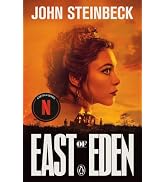
The masterpiece of Steinbeckโs later years, East of Eden is a sprawling epic in which Steinbeck created his most mesmerizing characters and explored his most enduring themes: the mystery of identity, the inexplicability of love, and the murderous consequences of loveโs absence. Review: Casting the Widest Net Into the Human Sea - When Iโm considering watching a movie I first check the running time. If itโs more than 120 minutes I think twice. Between the screenwriter, the director, and the editor most stories can be told in less than two hours. A significantly longer running time indicates someone who doesnโt know what he or she is doing, or someone in love with his or her own work. There are exceptions, of course, such as biopics or sweeping historic accounts. The same is true for books. Especially in non-fiction many 600-page books could be edited down to 300 pages. But even in fiction the 300-page metric (or so) tends to hold. There are exceptions, of course, such as "East of Eden." I did not mind this bookโs 600 pages at all. The first word of the second paragraph tells the reader the story will be told in first person. Along the way that fact needs remembering. "I" as a pronoun, indicating the author, appears just a handful of times. Mostly the narrative seems omniscient. Clearly Steinbeck chose first person as a means to deliver his personal philosophies, present to a notable degree. This deliverance would likely have been awkward in third person. The story tells about the Hamiltons and the Trasks. Adam Trask leaves New England for California. Samuel Hamilton sails from Ireland, only to make his further way clear across the continent. Adam Trask has inherited money, enough to buy a fine ranch. Samuel Hamilton has nothing. His dusty spread, gained by government allotment, is, even in the better years, only marginal. The basic story is simply one of good and evil, but Steinbeck went on for 600 pages because a parable cannot illustrate the fluidity of both good and evil that flows back and forth through human lives. In this fluidity evil inadvertently oozes out of good people and goodness sometimes escapes from an evil life into that very life. Both despite their struggles and because of them, the Hamilton clan possesses a human wealth beyond purchase. Still, illustrating the oozing, Tom Hamilton, son of Samuel, is, genetically, a brooder. His outlook is of his nature, largely unchecked by his nurture, as perhaps it might have been. He never leaves home, which eventually finds a population of one, himself. He is one of those who constantly loses today because heโs always pursuing yesterday โ to simply reclaim it, or to hold it static in order to fix the past. When, from outside his own life, yesterday presents itself he destroys it. His destruction is completely inadvertent, and yet a blindness he has that allows the destruction is one of neglect in his nurture. As further example, Cal (Caleb) and Aron Trask (he disliked Aaron) are Adamโs twin sons by a woman who lacks a certain human dimension, which, by that omission, emphasizes her abilities to manipulate and control others, both for her own specific gain and simply because she can. She abandons her sons days after theyโre born. Cal wrestles with the omission, which he has inherited to a degree. Eventually his internal give-and-take delivers him to a battered state of understanding. Aron is unclouded by the omission, is a paragon of goodness, and so becomes a victim of unbalance. Steinbeck grew up in Salinas and the Salinas Valley, the setting of the story. His early life mirrors the time of the story. His paternal grandfather did the emigrating from Germany, so there would have been talk of the old country. He was a war correspondent for the Herald Tribune and worked with the OSS. From his experiences we can infer his acknowledgement of the ability in America to throw off ancient ways, also acknowledging that the farther west one travelled the more one could outpace the tentacles of Puritanism that continued to exist in the East. The clichรฉ and reality of California, which continues today, was an even more utterly contrasted state two centuries back, and even one century back. So, I read the last fifty pages of "East of Eden" in the leafy parking lot of a suburban library branch. The building is new and modern, in a well done mid-century way, leaving me to wonder how the plans ever survived the city council, in these days of varying degrees of neoclassicism. It is attached to what was originally a three-story grade school from the early 1940s that is now the city hall and police HQ of this suburban town. Around in all directions are Cape Cod-y homes, both pre- and immediately post-war. These houses are attractive, well proportioned and well builtโ somewhat humble contrasts to the Barbie castles. Many are barely larger than the master bedroom suites in those ostentatious, multi-gabled clown shows, and yet were coveted by returning G.I.s eager to find normality again. Early fall is at hand right now, with enough leaves on the ground and beginning colors in canopies to confirm the season. Hurricane Delta made landfall yesterday evening on the Louisiana coast. The system has already moved up the Mississippi Valley and will soon turn into the Ohio Valley to deliver a fair amount of rain tomorrow, and so today, a Saturday, has increasingly become overcast. I point out the day of the week, and the season, because itโs the sort of day I lived for as a kid โ open ended, unstructured, free, with a certain contemplation implicit to cooler weather and indirect sunlight. As my wife says, the geography of childhood. And, hell, I still live for these days, days extraordinary simply because they are so ordinary, which is to say "Jesus! Iโm a sentient being walking around on the surface of a planet!" And thatโs what Steinbeck was after in "East of Eden," and that is just what he achievedโbasically a Cheever short story x 500. Steinbeck needed six hundred pages to establish for the reader the pace and canter of daily life โ i.e., life โ in this California valley, and in one of its small towns. He needed that many words to let us into the life and minds and dreams and nightmares of a dozen or so human beings. That many words to expose the tumult behind the face of conformity, a template that makes it easier for you and me to connect on a same frequency. A hallmark of great writing is an implicit prescience, a story as true today as it was during the time of its creation. "East of Eden" was published in 1952, so we can assume Steinbeck was writing the story in the post-war years of the late 1940s and very early 1950s. In the story evil wins when the truly good are ambivalent, unwilling to spend time and effort to stand up to, or even acknowledge, the calculations of connivers. There could hardly be a better description of our present time. Review: One of the best books ever written! - "East of Eden" covers the time from the Civil War to World War I. The period between these two big wars offered a perfect slate for examining the human condition which becomes clear by showing the personalities, deeds and actions of two families, the Hamiltons and the Trasks. Yet this book is not simply a study of good vs evil but rather an ode to how conflicted and complicated human beings can be. And it is a story of how each action will bring on a reaction and then the consequences of such actions and individual decisions. There are three sets of characters covered in the book: the Hamiltons, a relatively poor but loving family headed up by Sam, the family patriarch, whose dreams and deeds were so often in the clouds though he had great personal strength and integrity. The Hamilton children are each covered individually. Secondly, there are the Trasks, a family led by a father who preaches duty over all else including love. He had two sons, Charles and Adam. The third character is the land itself, both back East (of California) where Charles lives and farms his rocky acres and especially in Salinas Valley, California. Steinbeck himself grew up in Salinas Valley and he must have greatly loved it for his descriptions are so vivid as to put the reader there with a gentle breeze ruffling tree leaves while scents of blossoms fill the air and one's fingers can feel the richness of the earth. Much has been made of the Cain/Abel comparison to the story in the Bible and with good reason. The two Trask sons, Charles and Adam are opposites and often at odds with one another. Charles never married while Adam's two sons, Cal (Caleb) and Aron (he did not like two A's in his name) are also of opposite personalities. So the age old question once again arises of whether humans are shaped by nature or nurture since both sets of boys lived with the same father under the same conditions. But how much consideration should be given to the fact the fathers favored one son over the other while the unfavored son knew of it and felt it? So clever of Steinbeck to build such strong characters for we, the readers, to ponder such questions! As each character is introduced the nature vs nurture question arises several times. For instance was Cathy Ames born with an evil mind which continued to develop and guide her throughout her life because she learned from an early age that she could manipulate people? No one stopped her or called her out on her negative manipulations and carefully crafted lies. No one asked her to be nice instead so she saw no reason to behave any other way. Cathy (who later called herself Kate) was very petite, extremely pretty and very clever making it difficult for those around her to look for negatives and, if any were found, they were disregarded. So was she (and most other people) born blank slates while the environment/nurture shapes the person? Or in the final analysis is it a combination of both nature and nurture? However, even Cathy/Kate had a few positives such as wounding her husband, Adam Trask, rather than killing him which she later admitted she aimed the wounding shot. As long as those around her completed their tasks to her satisfaction, she paid them what she agreed to with no effort to cheat them even though she was so powerful in her position that she could have done so and gotten away with it. Small things to be sure yet out of character for her overall since she had no scruples against cleverly murdering those who had something she wanted. And once meeting both sons at high school age, why did she favor the nicer one over the one who was more like her? Would the one who was more like her overcome his negatives as he matured? Although Steinbeck did an excellent job of developing and showing the personalities of each character perhaps one of the most pronounced was Lee, the Trask's live-in caretaker. Not only was Lee a learned and intelligent man, he had the inner strength to keep Adam and his two sons, Cal and Aron, reasonably functioning while dealing with his own nuances. There is the old adage: 'like likes like' and so it was with Lee and Sam Hamilton. They enjoyed sparing intellectually and respected each other greatly even though their lives otherwise varied significantly. It is through the development of each very different personality that Steinbeck really shines. Each person has his or her own weaknesses and strengths and his or her own individualism. There was also focus on how all the Hamilton children matured into such different individuals. Did those children differ that much from the Trask children and if so how and why? How each character from both families behaved based on their own personality is so realistic as to give the reader pause at times to stop reading and consider how it could be so. "East of Eden" is a book to be savored, to be absorbed and considered and remembered long after one reads the last page. I read modern love stories and mysteries for pleasure while also over the years having read many of the 100 best books of all time (also a pleasure!). Many of those books are 500 pages or more (East of Eden is 600) which gives the author space to develop characters while letting the reader sort through the angst and/or happiness to draw their own conclusions. Such as that cannot be rushed. It is my opinion that Steinbeck, within his characters, covered the majority of personality strengths and weaknesses found among humankind and he is to be commended for that accomplishment. "East of Eden" is highly recommended for those who like personality driven stories. The 600 pages will disappear before you know it and there you will sit strongly disappointed that the story ended while wishing it to continue. Steinbeck is a great story teller, one so deserving of the Nobel Prize for literature. What an honor that he left behind novels like this one for readers to savor for generations to come. This is true apparently due to his understanding of human nature and his eloquent and expressive use of language, also outstanding. The book could not have ended any other way in my opinion. It is after all up to each individual to choose their own path. A review should not give away too much about a story so know that this book is complex and full of showing to build each character through their deeds and many actions toward one another and to others. I loved this book so much that while I had already read "Grapes of Wrath" I will now read his other books and doubtless re-read this book as well, something I rarely ever do. After all, one remembers the good books while the others are easily forgotten. It will be a very long time before John Steinbeck is forgotten. His literary life will parallel that of Dickens and all those other long-lived writers we love so much centuries after their demise!


F**S
Casting the Widest Net Into the Human Sea
When Iโm considering watching a movie I first check the running time. If itโs more than 120 minutes I think twice. Between the screenwriter, the director, and the editor most stories can be told in less than two hours. A significantly longer running time indicates someone who doesnโt know what he or she is doing, or someone in love with his or her own work. There are exceptions, of course, such as biopics or sweeping historic accounts. The same is true for books. Especially in non-fiction many 600-page books could be edited down to 300 pages. But even in fiction the 300-page metric (or so) tends to hold. There are exceptions, of course, such as "East of Eden." I did not mind this bookโs 600 pages at all. The first word of the second paragraph tells the reader the story will be told in first person. Along the way that fact needs remembering. "I" as a pronoun, indicating the author, appears just a handful of times. Mostly the narrative seems omniscient. Clearly Steinbeck chose first person as a means to deliver his personal philosophies, present to a notable degree. This deliverance would likely have been awkward in third person. The story tells about the Hamiltons and the Trasks. Adam Trask leaves New England for California. Samuel Hamilton sails from Ireland, only to make his further way clear across the continent. Adam Trask has inherited money, enough to buy a fine ranch. Samuel Hamilton has nothing. His dusty spread, gained by government allotment, is, even in the better years, only marginal. The basic story is simply one of good and evil, but Steinbeck went on for 600 pages because a parable cannot illustrate the fluidity of both good and evil that flows back and forth through human lives. In this fluidity evil inadvertently oozes out of good people and goodness sometimes escapes from an evil life into that very life. Both despite their struggles and because of them, the Hamilton clan possesses a human wealth beyond purchase. Still, illustrating the oozing, Tom Hamilton, son of Samuel, is, genetically, a brooder. His outlook is of his nature, largely unchecked by his nurture, as perhaps it might have been. He never leaves home, which eventually finds a population of one, himself. He is one of those who constantly loses today because heโs always pursuing yesterday โ to simply reclaim it, or to hold it static in order to fix the past. When, from outside his own life, yesterday presents itself he destroys it. His destruction is completely inadvertent, and yet a blindness he has that allows the destruction is one of neglect in his nurture. As further example, Cal (Caleb) and Aron Trask (he disliked Aaron) are Adamโs twin sons by a woman who lacks a certain human dimension, which, by that omission, emphasizes her abilities to manipulate and control others, both for her own specific gain and simply because she can. She abandons her sons days after theyโre born. Cal wrestles with the omission, which he has inherited to a degree. Eventually his internal give-and-take delivers him to a battered state of understanding. Aron is unclouded by the omission, is a paragon of goodness, and so becomes a victim of unbalance. Steinbeck grew up in Salinas and the Salinas Valley, the setting of the story. His early life mirrors the time of the story. His paternal grandfather did the emigrating from Germany, so there would have been talk of the old country. He was a war correspondent for the Herald Tribune and worked with the OSS. From his experiences we can infer his acknowledgement of the ability in America to throw off ancient ways, also acknowledging that the farther west one travelled the more one could outpace the tentacles of Puritanism that continued to exist in the East. The clichรฉ and reality of California, which continues today, was an even more utterly contrasted state two centuries back, and even one century back. So, I read the last fifty pages of "East of Eden" in the leafy parking lot of a suburban library branch. The building is new and modern, in a well done mid-century way, leaving me to wonder how the plans ever survived the city council, in these days of varying degrees of neoclassicism. It is attached to what was originally a three-story grade school from the early 1940s that is now the city hall and police HQ of this suburban town. Around in all directions are Cape Cod-y homes, both pre- and immediately post-war. These houses are attractive, well proportioned and well builtโ somewhat humble contrasts to the Barbie castles. Many are barely larger than the master bedroom suites in those ostentatious, multi-gabled clown shows, and yet were coveted by returning G.I.s eager to find normality again. Early fall is at hand right now, with enough leaves on the ground and beginning colors in canopies to confirm the season. Hurricane Delta made landfall yesterday evening on the Louisiana coast. The system has already moved up the Mississippi Valley and will soon turn into the Ohio Valley to deliver a fair amount of rain tomorrow, and so today, a Saturday, has increasingly become overcast. I point out the day of the week, and the season, because itโs the sort of day I lived for as a kid โ open ended, unstructured, free, with a certain contemplation implicit to cooler weather and indirect sunlight. As my wife says, the geography of childhood. And, hell, I still live for these days, days extraordinary simply because they are so ordinary, which is to say "Jesus! Iโm a sentient being walking around on the surface of a planet!" And thatโs what Steinbeck was after in "East of Eden," and that is just what he achievedโbasically a Cheever short story x 500. Steinbeck needed six hundred pages to establish for the reader the pace and canter of daily life โ i.e., life โ in this California valley, and in one of its small towns. He needed that many words to let us into the life and minds and dreams and nightmares of a dozen or so human beings. That many words to expose the tumult behind the face of conformity, a template that makes it easier for you and me to connect on a same frequency. A hallmark of great writing is an implicit prescience, a story as true today as it was during the time of its creation. "East of Eden" was published in 1952, so we can assume Steinbeck was writing the story in the post-war years of the late 1940s and very early 1950s. In the story evil wins when the truly good are ambivalent, unwilling to spend time and effort to stand up to, or even acknowledge, the calculations of connivers. There could hardly be a better description of our present time.
C**S
One of the best books ever written!
"East of Eden" covers the time from the Civil War to World War I. The period between these two big wars offered a perfect slate for examining the human condition which becomes clear by showing the personalities, deeds and actions of two families, the Hamiltons and the Trasks. Yet this book is not simply a study of good vs evil but rather an ode to how conflicted and complicated human beings can be. And it is a story of how each action will bring on a reaction and then the consequences of such actions and individual decisions. There are three sets of characters covered in the book: the Hamiltons, a relatively poor but loving family headed up by Sam, the family patriarch, whose dreams and deeds were so often in the clouds though he had great personal strength and integrity. The Hamilton children are each covered individually. Secondly, there are the Trasks, a family led by a father who preaches duty over all else including love. He had two sons, Charles and Adam. The third character is the land itself, both back East (of California) where Charles lives and farms his rocky acres and especially in Salinas Valley, California. Steinbeck himself grew up in Salinas Valley and he must have greatly loved it for his descriptions are so vivid as to put the reader there with a gentle breeze ruffling tree leaves while scents of blossoms fill the air and one's fingers can feel the richness of the earth. Much has been made of the Cain/Abel comparison to the story in the Bible and with good reason. The two Trask sons, Charles and Adam are opposites and often at odds with one another. Charles never married while Adam's two sons, Cal (Caleb) and Aron (he did not like two A's in his name) are also of opposite personalities. So the age old question once again arises of whether humans are shaped by nature or nurture since both sets of boys lived with the same father under the same conditions. But how much consideration should be given to the fact the fathers favored one son over the other while the unfavored son knew of it and felt it? So clever of Steinbeck to build such strong characters for we, the readers, to ponder such questions! As each character is introduced the nature vs nurture question arises several times. For instance was Cathy Ames born with an evil mind which continued to develop and guide her throughout her life because she learned from an early age that she could manipulate people? No one stopped her or called her out on her negative manipulations and carefully crafted lies. No one asked her to be nice instead so she saw no reason to behave any other way. Cathy (who later called herself Kate) was very petite, extremely pretty and very clever making it difficult for those around her to look for negatives and, if any were found, they were disregarded. So was she (and most other people) born blank slates while the environment/nurture shapes the person? Or in the final analysis is it a combination of both nature and nurture? However, even Cathy/Kate had a few positives such as wounding her husband, Adam Trask, rather than killing him which she later admitted she aimed the wounding shot. As long as those around her completed their tasks to her satisfaction, she paid them what she agreed to with no effort to cheat them even though she was so powerful in her position that she could have done so and gotten away with it. Small things to be sure yet out of character for her overall since she had no scruples against cleverly murdering those who had something she wanted. And once meeting both sons at high school age, why did she favor the nicer one over the one who was more like her? Would the one who was more like her overcome his negatives as he matured? Although Steinbeck did an excellent job of developing and showing the personalities of each character perhaps one of the most pronounced was Lee, the Trask's live-in caretaker. Not only was Lee a learned and intelligent man, he had the inner strength to keep Adam and his two sons, Cal and Aron, reasonably functioning while dealing with his own nuances. There is the old adage: 'like likes like' and so it was with Lee and Sam Hamilton. They enjoyed sparing intellectually and respected each other greatly even though their lives otherwise varied significantly. It is through the development of each very different personality that Steinbeck really shines. Each person has his or her own weaknesses and strengths and his or her own individualism. There was also focus on how all the Hamilton children matured into such different individuals. Did those children differ that much from the Trask children and if so how and why? How each character from both families behaved based on their own personality is so realistic as to give the reader pause at times to stop reading and consider how it could be so. "East of Eden" is a book to be savored, to be absorbed and considered and remembered long after one reads the last page. I read modern love stories and mysteries for pleasure while also over the years having read many of the 100 best books of all time (also a pleasure!). Many of those books are 500 pages or more (East of Eden is 600) which gives the author space to develop characters while letting the reader sort through the angst and/or happiness to draw their own conclusions. Such as that cannot be rushed. It is my opinion that Steinbeck, within his characters, covered the majority of personality strengths and weaknesses found among humankind and he is to be commended for that accomplishment. "East of Eden" is highly recommended for those who like personality driven stories. The 600 pages will disappear before you know it and there you will sit strongly disappointed that the story ended while wishing it to continue. Steinbeck is a great story teller, one so deserving of the Nobel Prize for literature. What an honor that he left behind novels like this one for readers to savor for generations to come. This is true apparently due to his understanding of human nature and his eloquent and expressive use of language, also outstanding. The book could not have ended any other way in my opinion. It is after all up to each individual to choose their own path. A review should not give away too much about a story so know that this book is complex and full of showing to build each character through their deeds and many actions toward one another and to others. I loved this book so much that while I had already read "Grapes of Wrath" I will now read his other books and doubtless re-read this book as well, something I rarely ever do. After all, one remembers the good books while the others are easily forgotten. It will be a very long time before John Steinbeck is forgotten. His literary life will parallel that of Dickens and all those other long-lived writers we love so much centuries after their demise!
L**N
An Exploration of Life's Most Important Themes
Although centered around the lives of just two families, John Steinbeck's East of Eden can be described as a novel of truly epic scope. Set in the period from the United States Civil War until the end of World War I, the story follows the lives of three generations of the Trask family, from Connecticut, and their contact with the Hamilton family on the opposite side of the country in the Salinas Valley in California. For those who have not read the novel, I will give a brief evaluation before getting into more detail for those who have. ***Spoilers are included in the โIn Detailโ section,*** so you may not want to read past the quick evaluation if you have not read the book already! Quick Evaluation for those Who Have not Read It Starting from the opening chapter, Steinbeck's style is exceptionally vivid. You feel you are right there in all the beauty of the Salinas Valley. At the other extreme, when Steinbeck delves into sordid subjects, you also feel right there. The novel includes some of the most intensely developed characters in all of literature. Their interactions are complex and full of genuine dilemmas. You feel the character's happiness and their sorrow. You cannot help but root for some, hope for a demise that cannot come soon enough for others, and have no idea how things will turn out for the remainder. The themes covered are the most important possible: family, love, good and evil, happiness, sorrow, and the relationship or lack of it between these things and money and success. If these sound like themes of interest, and you are not queasy about a considerable percentage of the book delving into dark themes, then this book is highly recommended and will be hard to point down through most parts. Although, from the description on the cover, I worried that the book might become too overtly and excessively religious, this was not the case. Also, although the book is said to describe something distinctive about American culture, this seems like a stretch since nearly all themes have universal applicability. The only real weaknesses of the book are that, ultimately, some things that happen or fail to happen are rather unbelievable, and some things seem exaggerated compared to real life. These, however, are only minor dings on the overall brilliance of the story. In Detail [Spoilers Begin] Key Themes The key theme of the novel is family. Specifically, what a strong family makes possible and the destructiveness that absence of familial strength, or complete absence of family, can have. This is where the juxtaposition between the Hamilton's and the Trask's is most pronounced. We see that although the Hamilton family is not immune from tragedy, they are generally happy. For me, Samuel's humor and the Hamilton familyโs gentle teasing of each other best demonstrate this, along with the scene where Samuelโs daughter Olive courageously takes to flying at an early airshow. Although Samuel has both had bad luck and never seriously set his mind to becoming wealthy, it seems safe to say that because of his devotion to his family, he is the richest man in the novel. With the Trask's, by contrast, there is general unhappiness, struggle, and uneven and even dubious love throughout. It is fascinating to ponder how this may have affected Adam's attraction to Cathy and Charles's repulsion from her. This is in addition to the more obvious replay of the Cain and Abel story through Caleb and Aron. Another central theme is the relationship between family and good and evil. The question of how much someone should worry about inheriting traits, especially undesirable or even evil ones, from their parents is particularly prominent. This, of course, is best exemplified by Caleb. He is already prone to worry that he is not good, and he begins to worry even more after finding out who his mother, Cathy, really is. (Although it is not mentioned in the book, the fact that he worries about this at all tells the reader that he is something much different from her and can avoid her course.) At the same time, although some children inherit traits considerably from their parents, others seem quite different. Caleb's difference from Aron shows this in the positive direction, while Cathy's difference from her parents shows an extreme in the other direction. Deeply Developed Characters Beyond the resonance of the themes, the book's other great strength is the depth of characters. As in real life, there are some very good people, like Samuel and Lee, one very bad one, Cathy, and many such as Adam, Charles, Caleb, and Aron, somewhere in between. All characters are completely three-dimensional. Samuel and Lee have had darkness in their backgrounds but emerge above it and become sources of love and light to those around them. Cathy, by contrast, seems to be a pure psychopath (meaning probably due mainly to genetics versus environment) or, at best, only a hair's width away from it. Despite this, Steinbeck is able to get readers inside her head convincingly. Cathy sees herself as stronger and smarter than others, something she realized very early on. Projecting, she can only see evil in others and their attempts to control her. In her mind, any attempt to control her warrants nearly any retribution, including murder. As she gets older, we even see glimmers of conscience in Cathy in the events leading up to and including her suicide. For instance, she worries that her arthritis is punishment for accepting the inheritance from Charles. Additionally, the reader wonders: did she leave Aron rather than Caleb her money because she ultimately realizes she is missing something Aron has? Nonetheless, even these glimmers of conscience do not prevent her from taking out Joe Valery with her last actions since he foolishly thought he could out-manipulate and harm her. Indeed, whether her decision to give everything to Aron was partly motivated by a desire to stir conflict among the twins is unclear. One even wonders if part of her motivation in committing suicide is because she realizes how weak she is becoming, both mentally and physically, compared to her youth. She can no longer be as competently evil as she once was. All these themes are woven together in a sick intensity in her suicide scene, which competes with the opening chapter for the most vivid in the novel. Some Minor Blemishes on a Great Novel Despite the novel's strengths: the depth of its characters, and the power and universality of its themes, some things in the book are blemishes on its greatness. For example, some things stretch the limits of believability. For instance, it stretches credibility that Adam could have such schizoid traits that learning from Cathy that Charles may be the twins' father does not lead to conflict with him. Similarly, given that Charles does not like Cathy, why would he leave half his money to her instead of giving it all to Adam or leaving it held in trust for the twins? Also stretching the limits of believability, why would Cathy, who seems all about vengeance, not get even with Edwards, who beats her within an inch of her life and leaves her for dead? Finally, although stories exploring good and evil on such a grand scale may inevitably have to take some liberties versus just recounting ordinary people's mundane day-to-day lives, the book overplays some things. One is just how prominent in American life brothels were. Was nearly everyone, married, unmarried, from laborer up to politician and lawyer, really visiting them regularly? To such an extent that nobody gets upset in the slightest upon learning that someone else has. Overall, there is quite a bit of somber reading to get through here. Nevertheless, the strength of the Hamilton family and the rise of Caleb and Abra into adulthood make the story, ultimately, a hopeful one.
J**L
Cat in The Hat: but the cat's meow!
From the outset, the narrator, the I, seems to be the author, and the family his own. Iindeed much is autobiographical. The book opens with a beautiful description of Steinbeck's beloved Salinas Valley. Throughout the narrative he self adoringly interrupts, as if to say like The Cat in The Hat... Look at me, look at me now! Chapter 7 is a Steinbeck lecture on Time; Chapter 8 is his sermon on evil. Usually Steinbeck doesn't show, he tells, translating for the reader. Chapters 11 and 12 begin with lecures, and they pop up throughout; in fact most chapters begin that in a 'Cat in the Hat' way. It is said Steinbeck considered this his greatest novel, written from the summit a long life. He simply has to let the reader know that in these first person soliliquies. As always, the characters and the scenes are carefully, richly drawn, and believable. I find the most recurring themes are: 1) the relationship between fathers and sons 2) between sons, one an uncaring favorite, and the other who adores his father but is rejected: in other words, the story of Genesis, and of Abraham, Abel and Cain. As in Genesis it mainly feature men, but includes a rebellious Eve, or Cathy, who contributes to the brother's conflict, or the conflict between father and son, God and Adam. Even if Eve/Cathy is a strong and bad woman, like the whore house madam, the story is centered on men, fathers, sons, brothers, and male sibling rivalry, despite sincere brotherly love. 3) The good, innocent but dumb and weak brother vs the intelligent bad strong one. ( a typical depiction of the intelligent angry rebellious progressive as contrasted with the dumb gullible traditionalist that is seen and heard here and now!) In Chapter 13 the narrator is revealed to be the child of Olive, possibly Steinbeck himself whose mother was Olive. Then the story begins to take control of the novel, setting the characters free from the author's editorial interruptions. Lee, the cook who habitually speaks in 'chinee' to avoid attention, revels he is a fully competent , highly educated and literate English speaker, a native Californian. Moreover he provides the order, intellectual guidance affection, and tough love that helps the sons survive. Adam's own adored pater familias, Samuel, speaks of the biblical reference to Cain's murder of Abel, with his subsequent banishment East of Eden. Samuel reads Genesis 4:6-7, from the King James Bible, this, originally written in Hebrew.: "And the Lord said unto Cain, "Why art thou wroth? And why is they countenance fallen? If thou doest well, shalt thou not be accepted? And if thou doest not well, sin lieth at the door. And unto thee shall be his desire, and thou shalt rule over him." But Lee points out that the Hebrew word is timshel... means thou mayest. not thou shalt. Of course Steinbeck can't totally yield to the story; he injects typical Steinbeckianisms like: 'their shadows slid under them on the bright earth.' But who would not forgive that sin! The story and the characters are now in control. In the end Cal, yet another son, hopes for a blessing from his dying neglectful father, another Adam. Lee, the acting good parent and cook, urges Adam to bless Cal: "Give him him a chance. It's not inevitable that (your family) keep producing fathers who pick favorites and siblings who want to kill each other.โ He urges Adam to just say Cal's name, as a blessing; but Adam says "Timshel!", implying: 'Thou mayest decide whether or not to continue the curse, regardless of my blessing. Your choice. '
S**S
Maybe the best American novel ever
This is the pinnacle of writing by the greatest American author ever. There is a discussion in the book about the meaning of the Bible expressions, you will, and you shall. It is the single best description of biblical verse ever. The conclusion is that people do not understand what the Bible said. God did not mean to say you will do this and you shall not do this. The people in this book understand that god meant โthou mayestโ!! That phrase explains everything there is to know about biblical proscriptions. The storytelling is every bit as excellent as you would come to expect from John Steinbeck. Reading this book will enrich you and give you understanding that you may not have had the time to work through on your own.. I would give this book 10 stars if I could.
L**S
A True American Epic
John Steinbeck's American epic, East of Eden, is a complex analysis of good and evil in society. The book follows two families over three generations (from the end of the Civil War to the beginning of World War I) as their lives intertwine and the characters are faced with a series of tough moral decisions. Reading this book is like being caught in a giant moral dilemma; Steinbeck provides the reader with enough information to form opinions on the morality of the characters in the book. This forces the reader to make tough decisions about who is good and who is evil, while Steinbeck never ceases to shock the reader with the actions of his characters. Steinbeck's novel is held together by the complex and highly developed characters he features as the focus of the book. There are several important characters that can all be defined by a very distinct set of qualities. There is the extremely wise Samuel Hamilton, the intelligent, but naive Adam Trask, and the notoriously evil Cathy Ames. Steinbeck spends a great deal of time developing these characters and the reward is a satisfying representation of America in a period of dishevelment as industrialization and west ward expansion are the focus of society. The plethora of characters created by Steinbeck creates a complex and intricate balance in the novel; the actions of one character will undoubtedly affect all of the characters in either a positive or adverse way. These characters are what truly makes this novel an American classic; Steinbeck's ability to create a memorable cast drive the rest of the story. One of these characters, Cathy Ames, may be the most evil, twisted character ever created in all of American literature. The reader is introduced to Ames as she murders her parents by lighting their house on fire. From this point on, it is clear that Ames is the embodiment of evil in the novel. As Ames becomes ingratiated into the main plot, more evil actions ensue, including the attempted murder of her husband and the murder of a madam in charge of a brothel. These actions occur before Ames becomes truly evil by the end of the novel. Another of the more memorable characters in East of Eden is Lee, the Trask family's loyal Asian servant. Lee is meant to play the stereotypical Asian role in the novel, but Steinbeck attempts to break race barriers by incorporating Lee into the main plot of the novel. Lee is extremely intelligent and very wise. He puts up a facade of a stereotypical Asian servant around ignorant and arrogant Americans. However, around people he trusts, such as Samuel Hamilton and Adam Trask, he reveals his intelligence. Lee is very complex and Steinbeck ensures that he plays an important role in the novel. The novel lacks a clearly defined plot; it follows two families over several generations as they struggle to establish themselves in the Salinas Valley in California. However, the novel does act as an allegory to the Biblical story of Cain and Abel. There are several obvious references to the book of Genesis throughout the novel (East of Eden, Adam Trask, and the twins Caleb and Aaron, meant to represent Cain and Abel), creating an interesting outlet for Steinbeck to analyze religious and social issues prominent in society during this era of American history. There are times when Steinbeck's commentary is somewhat subtle and there are times when his commentary is blatantly obvious as the narrator provides insight into the state of society during this time. However, unlike other fictitious novels that attempt to tackle heavy topics such as religion, Steinbeck is able to provide this commentary without sounding too pretentious; he doesn't claim to know the answers to some of the more controversial issues regarding religion. This adds depth to Steinbeck's already complex and layered novel, contributing to the intricacy of this intelligently written novel. East of Eden, like all of Steinbeck's novels, is full of descriptive passages that are essential in establishing the setting for the novel. The novel also takes place in the Salinas Valley of California, the same place that Steinbeck grew up in as a child. Steinbeck's knowledge of the region enables him to provide deep, descriptive details of the setting for the story. The setting is almost as important as the characters, as the distinct environment of the Salinas Valley shapes their behavior throughout the novel. In fact, the Salinas Valley is a metaphor for the lives of the Hamiltons and the Trasks. The valley appears to be heavenly and fertile, but as one digs into the soil unexpected layers of clay, dirt, and rock are revealed. The Hamiltons and the Trasks also appear to have it all together, but as the reader is familiarized with these characters, it becomes clear that they struggle with a great deal of internal conflict. Steinbeck's emphasis on setting also adds to the complexity of the novel, creating a memorable multilayered epic that has become an American classic. In writing this novel, Steinbeck took on a nearly impossible challenge; he attempted to write a novel that would encompass ideas about morality, religion, and politics, while remaining intelligible to his audience. Steinbeck deserves to be commended for accomplishing this feat. Reading this book should be a requirement for everyone as it successfully touches the reader emotionally, logically, and ethically. The highly complex, but relatable characters will surely find a way to sneak into one's heart and become a conscious reminder of ethical behavior. This novel will truly change lives and this is what has kept it moderately relevant in today's society. Reading this novel will not disappoint.
J**N
A brilliant classic which sucks you in completely and enjoyably!
I enjoyed the perspective of the challenges humans faced back then, although they closely mirror today's struggles at their core. This leads me to the conclusion that humans have deep rooted characteristics regardless of the hundreds of years that separate them. A great novel that places you right in the center of the environment visually and emotionally.
A**E
Steinbeck meets Dostoevsky in "East of Eden"
Is is possible that Netflix may boost literacy? I just did a Netflix mini-retrospective look at James Dean's films: "Rebel Without a Cause," "Giant" and "East of Eden." Watching the complex story of "East of Eden," reminded me that I had never read the Steinbeck novel from which the film was adapted. This came as a surprise to me, since I am a huge fan of Steinbeck's writings and have long considered "The Grapes of Wrath" among my favorite novels. So, I embarked on reading the novel. I was expecting it to be good; I was unprepared for the depth of the writing and the brilliant insight into human nature that marked Steinbeck's writing at this stage of his career. In my opinion, if he had never written another novel besides "East of Eden," he would have been worthy of the Nobel Prize that he won in 1962. The story is a complex and very moving modern setting of the Cain and Abel story told at multiple levels through several generations of the Trask family. Adam and Charles Trask lay the groundwork for the narrative by vying for the affection of their father, an ersatz Civil War hero who carved out a reputation and a fortune by misrepresenting the role that he played in key battles of the War Between the States. The saga continues into its main section with Adam's two sons - Cal and Aron - struggling to please him. Adam is raising them as a single father - with the not inconsiderable help from Lee, the live-in Chinese cook - after his wife abandoned the family shortly after giving birth to the twins. The most profound musings that stand as the intellectual and spiritual center of the novel are found exactly halfway through the narrative. The setting is that Lee, the Chinese cook, is having a theological discussion with a neighbor, Samuel. The crux of the discussion bears on varying translations of Genesis 4:7, in which God addresses Cain and implores him to overcome the temptation to sin. Lee describes the result of two years' of study by elders in the Chinese community who had undertaken to understand the issue in all of its subtleties: "After two years we felt we could approach your sixteen verses of the fourth chapter of Genesis. My old gentlemen felt that these words were very important too - 'Thou shalt not' and 'Do thou.' And this was the gold from our mining: 'Thou mayest.' 'Thou mayest rule over sin.' The old gentlemen smiled and nodded and felt the years were well spent. It brought them out of their Chinese shells, too, and right now they are studying Greek. Samuel said: 'It is a fantastic story. And I've tried to follow and maybe I've missed somewhere. Why is this word so important?' Lee's hand shook as he filled the delicate cups. He drank his down in one gulp. 'Don't you see?' he cried. 'The American Standard translation orders men to triumph over sin, and you can call sin ignorance. The King James translation makes a promise in "Thou shalt not." meaning that men will surely triumph over sin. But the Hebrew word, the word timshel -"Thou mayest" - that gives a choice. It might be the most important word in the world. That says the way is open. That throws it right back on a man. For if "Thou mayest" it is also true that "Thou mayest not." "Yes, I see. I do see. But you do not believe this is divine law. Why do you feel its importance?" "Ah!" said Lee. "I've wanted to tell you this for a long time. I even anticipated your questions and am well prepared. Any writing which has influenced the thinking and the lives of innumerable people is important. Now, there are many millions in their sects and churches who feel the order 'Do thou,' and throw their weight into obedience. And there are millions more who feel predestination in 'Thou shalt.' Nothing they may do can interfere with what will be. But 'Thou mayest'! Why, that makes a man great, then gives him stature with the gods, for in his weakness and his filth and his murder of his brother he still has the great choice. He can choose his course and fight it through and win." Lee's voice was a chant of triumph. Adam said, "Do you believe that, Lee?" "Yes, I do. Yes, I do. It is easy out of laziness, out of weakness, to throw oneself into the lap of deity, saying, 'I couldn't help it; the way was set.' But think of the glory of the choice! That makes a man a man. A cat has no choice, a bee must make honey. There's no godliness there. And do you know, those old gentlemen who were sliding gently down to death are too interested to die now?" (Pages 301-2) Steinbeck's argument reminded me of the exquisite Grand Inquisitor passage in Dostoevsky's magnum opus, "The Brothers Karamazov." The Inquisitor confronts a Christ who has returned to earth during the Spanish Inquisition and excoriates him for having condemned mankind to freedom of choice. Both Steinbeck and Dostoevsky are delving into levels that represent the quantum physics of the soul. This is great literature - writing that combines story telling as an art form with profound examination of the human condition. Even in the age of Netflix and Grand Theft Auto IV, there is still room for great writing - and great reading. Enjoy! Al
A**R
Great
Very long book but amazing
L**A
book
good
L**Y
Beautiful Edition that came in near mint condition
Very pretty book with a beautiful deckeled edge. Only flaw it came with is a slightly smashed corner on the top left - barely noticeable. It is a bit smaller than I was expecting but the size doesn't take away the beauty of this edition.
R**S
Excelente
Estou amando a leitura
A**U
Severek okudum
Gรผzel bir kitap..tavsiye ederim
Trustpilot
2 months ago
1 month ago