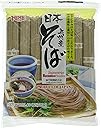
🍽️ Savor the Tradition, Share the Love!
The Twin Pack Hime Dried Buckwheat Soba Noodles offers a generous 25.40 ounces in each bag, made from premium buckwheat sourced from Japan. This family-sized pack is perfect for those who appreciate authentic flavors and healthy eating, making it a versatile addition to any kitchen.
| ASIN | B01F15K6IO |
| Best Sellers Rank | #36,924 in Grocery & Gourmet Food ( See Top 100 in Grocery & Gourmet Food ) #10 in Soba Noodles |
| Customer Reviews | 4.5 4.5 out of 5 stars (1,721) |
| Is Discontinued By Manufacturer | No |
| Package Dimensions | 8.98 x 8.66 x 1.77 inches; 3.17 Pounds |
| UPC | 011152085074 |
| Units | 1.00 Count |
A**R
YUM!
I love these noodles! The taste and quality is very good. I like the fact that they are gluten free. They are quick and easy to cook and are so versatile. I can enjoy them in my diet without the guilt of eating regular pasta. YUM! I feel they are a great value for the money. We use them regularly. Try them! You'll like them!
W**D
Tasty and convenient
Maybe buckwheat is an acquired taste - well, I've acquired it. These versatile noodle show up on my table in a range of different ways. They're perfect in noodle soups, in place of ramen or udon. Served cold with soy, sesame oil, and scallion, they're a flavorful side dish. When they star in a dish of sesame noodles served warm (I like mine spicy), they add a deep note that other noodles can't equal. The fact that their protein is more complete than that of wheat or rice doesn't hurt either. Years ago, a Japanese grocer I favored had a wide range of soba noodles available. They're pretty much always a mix of wheat flour and buckwheat, and they pretty much always gave percentages. More buckwheat give more flavor, but also more tendency to crumble. I found that 60-70% buckwheat gave the balance I preferred of flavor and mechanical strength. But that was back when they printed the percentages on the packages. Alas for the days of my youth. BTW, I make no claims about authenticity of my cooking outside the WASP/Euro cuisines, and even not them a lot. I use the world's flavors as my imagination and palate direct me. It's not "cultural appropriation." I'm just coloring with every crayon in the box, and in every box I can lay hands on - sometimes to the surprise of of people whose crayons I took home to play with. -- wiredweird
J**N
Best brain. I've tasted definitely 5 stars.
These are some of the best buckwheat noodles I have tasted.They have great flavor and cook up nicely. They're a great dry food product
K**.
Good value soba if both packs arrive.
solid soba noodles but the first time only one packet came, however I got a replacement with the right amount with minimal hassle and time lost. The soba is also a decent value for the price.
I**H
Buckwheat Soba
Great quality product at a good price. I've been buying it for years.
A**E
Top flavor of Amazon sobas, heavy on the salt, not from China.
I have sampled every soba offered on Amazon. This was the last and for flavor and eating pleasure, it is by far the best. Much thinner that the others, cooks cleaner(nothing left in the pan but water), does not stick together, and it is a product of Japan. King Soba and Organic Planet are manufactured in China, and Habubahu is from Australia. The latter two list wheat as the main ingredient, buckwheat second. In my opinion that makes them more spaghetti than soba. Both are equal in flavor and texture. I add a tablespoon of olive oil and 1/4 tsp of smoked peprika. Tasting the first bundle of Hime, I thought ‘Wow’! For flavor nothing else was close. Thinking the oil and paprika may have created the flavor, I cooked another bundle. Same great flavor. After more label reading I discovered why. Hime has 1490 mg of salt, Organic Planet 160mg, King Soba has 5mg, and Habubaku has “0”. If salt is not your friend, Hime is probably not for you. If salt were not my friend, Habubaku would be my choice, Even though it’s more spaghetti than soba, it cooks in six minutes and tastes fine.
C**R
The real thing. The best Japanese soba noodle there is. Go ahead and buy it.
Of all the Japanese foods, cold soba in dipping sauce is my most favorite. This is my top choice of all the buckwheat soba noodles. It contains both buckwheat and wheat flours like almost all of the soba noodles, but my only regret is I wish they increase the buckwheat proportion highers. Higher buckwheat means more flavor, more fiber, and more comfortable stomach. But more buckwheat also means less chewy. But you can make it a bit chewy, by cooking it real al dente (by reducing the boiling time by 30 sec ~ 1 min), then cool it in ice water immediately. It will be chewy like it should be. Another secret is using highest quality Wasabi you can find, the real hot stuff, in the sauce with good quality nori.
I**R
Good flavor...
....but a little coarse. Soba are not an easy food for some Westerners. Buckwheat is associated with hard times, like buckwheat pancakes. But buckwheat is very nutritious. It isn't a grain so it is gluten-free, and it hs a low glycemic index, allowing diabetics to enjoy it with less worry. In Brittany, buckwheat flour is made into crepes both sweet and savory, while Russian blini are the perfect pillow for caviar. Soba might be an aquired taste, but one you might want to aquire not only for health reasons but because the Japanese have the best way to serve soba: cold with dipping sauce. Japanese summers are blisteringly hot with high humidity. In days before cooling devices, one way to dissapate body heat was by eating soba dipped in cold tsuyu, a soup base made from preserved bonito flakes, kombu seaweed, soy sauce and other flavorings. The mode is this: soba noodles are cooked to al dente, shocked with and then washed in cold water (sometimes containing ice), drained and served on a bamboo tray alongside cold tsuyu and little bowls of finely sliced green onion, shredded nori seaweed, flaked sea salt, and freshly grated wasabi and daikon radish. The flavor combinations are very refreshing, and the dish doesn't uncomfortably fill one up during hot weather. These particular soba are a little more coarse than I usually like, but that makes them perfectly rustic. They are chewy and hearty and best of all, not stale like some soba can be if they were made too long ago. This is cheap, nutritious, cultural food at its best.
Trustpilot
1 day ago
4 days ago