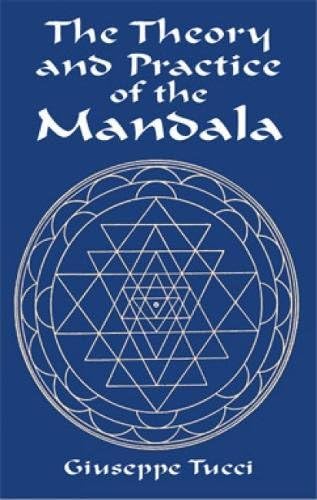

The Theory and Practice of the Mandala
Product ID: 32941617
Desertcart purchases this item on your behalf and handles shipping, customs, and support to Japan.
Mandalas are complex arrangements of patterns or pictures used in Hindu and Buddhist Tantrism to represent the cosmos (or "wholeness") and to give expression to the infinite possibilities of the human subconscious. Though mandala means "circle" in Sanskrit, mandalas are more often squares or rectangles, filled with images and geometric figures that symbolize forces of the individual and collective psyche and the flow of energy to and from a central point. Believers use this powerful figure as a focus of ritual and a support for meditations — through its use gaining possession of the energies signified by its images or symbols. This intriguing, thought-provoking study by one of the world's leading authorities on the subject examines the basic doctrine behind the theory and practice of the mandala in India and Tibet, by both Hindus and Buddhists. "As a whole," as the author says in his preface, "the spiritual background is the same: … the yearning to find out a way from time to eternity, to help the primeval consciousness … to recovery of its integrity." Individual chapters consider the doctrinal basis of the mandala, the mandala and its various parts, the liturgy of the mandala, and the mandala in the human body. Of special interest to students of Eastern philosophy and art, this volume will also fascinate New Agers and anyone interested in the symbols and psychology of Asian cultures. Review: A great resource - A classic. It helps if you have some background in the eastern religions and the spiritual literature of India. Review: Fascinating Reading - Not for the beginner but a fascinating journey for anyone willing to engage.
| Best Sellers Rank | #5,282,402 in Books ( See Top 100 in Books ) #2,140 in Comparative Religion (Books) #7,191 in Eastern Philosophy (Books) |
| Customer Reviews | 4.3 out of 5 stars 64 Reviews |
A**R
A great resource
A classic. It helps if you have some background in the eastern religions and the spiritual literature of India.
A**R
Fascinating Reading
Not for the beginner but a fascinating journey for anyone willing to engage.
A**R
Five Stars
Wonderful book
A**N
Not if you are looking for details on Shree Yantra
Well, I was expecting much more from the book and specially going by the author. Little disappointed with the information. Try some other if you are looking for in depth info on Shree Yantra. The language isn't the best to grasp quickly.
R**I
Good and important book
Definitely, Tucci is an expert. I didn't do a thorough study but only a short glance makes an impression of potent material. This book is relatively easy in style but still deep. Something like Eliade. Though you must have some preliminary knowledge of indic terms like maya, karma etc. Tucci also uses specific terms in his own fashion; like for exaple intellect for him is robust monster of modern age in its dissociatin with soul. Mandala for Tucci is "...psycho-cosmagrammata which may lead the neophyte, by revealing to him the secret play of the forces which operate in the universe and in us...the way to the reintegration of consciousness." What stroke me was also next quote about Vijnanavadins concept of "store-consciousness". "No act or thought is ever lost but is deposited in that universal psyche which, therefore, and implicitly, is not an immobile entity but an "experience" continually being enriched. In it, past and present live together, form a fruitful and inexhaustible soil in which grows the plant of the individual, so that when it dies it lets fall into this soil the seeds which perpetuate the life-cycle" Seems so similar to Castaneda's "Eagle". Also recommended: Yoga : Immortality and Freedom , The Myths and Gods of India: The Classic Work on Hindu Polytheism from the Princeton Bollingen Series ...
C**S
Expected some pic
Expected some pics, examples, none. Disappointed that no were given. I think I can get more info by looking at youtube
M**A
Classical text on mandala interpretation
This book was first pubblished in 1949, when Giuseppe Tucci had been regularly visiting Tibet and India. The dominating cultural ideas in psychology in that period were jungian and since Jung had envisaged in mandalas the practical application of his archetype theory and orientalism was at one of its reiterating climaxes, Tucci pubblished his "Theory and Practice of Mandala" in the Italian series of Astrolabio Psychanalytical books. A brief phrase accompanies the title "with particular regard to modern psychology of the deep". Presently jungian theories on mandalas have been discussed and modern scholars think jungian theories have done to oriental thought what Hollywood has done to the Tibetan cause. However, independently from the very few sentences in Tucci's book referring to the psychology of the deep, this text still is maybe the first and most authoritive illustration of the mandala theory written for western readers. Like all Tucci's texts I've read up to now it is objective and does not convey the authors opinions. The book is divided in five short chapters that start from the doctrinal bases of the mandala and lead to the mandala inside one's body. The history of this interesting form of meditation is not limited to the Tibetan lamaism, but is illustrated also in Hindu religion, from where it started, with particular attention to Kashmir Schivaism. Mandala symbolims is well described, even if there are no practical descriptions or examples, differently from what would be expected from a modern book. The most interesting chapter is the last on the similarities and identities of Yoga practice and mandalas. A book for scholars of this age-old meditation practice even if dated.
M**N
this text is dense and not easily read for the novice
this text is dense and not easily read for the novice. the run-on sentences and lack of outlines, structure and illustrations of what tucci was describing make it difficult for the uninitiated to grasp. this might be a good resource for those familiar with sanskrit terms, hindu and buddhist theory, but i don't recommend it as a first text.
M**S
Ein wichtiges Buch
Ein kompetentes, wichtiges Buch für Leute, die sich für diese Materie interessieren. Essentiell. Eine Hilfe, Energiebilder zu interpretieren und verinnerlichen.
D**L
Best book on mandalas, if you are serious
This is by far the best explanation on exactly what mandalas are, the are so much more than most people think.. He explains the spiritualism aspect of mandalas , it explains just how mandalas come together, that I have never know. This is an imported book if you want to get serious about making mandala..
D**H
Giuseppe tucci is a good author
It's a good book . Recommended
D**A
Very Interesting!
This book is a bit of a one off. It is one of the few books on Mandalas that actually gives you the purpose behind, what some may see as, a pretty picture. Mandalas are almost mystical due to the lack of info about them. Yes you could browse the internet and get a wealth of info but unfotunately you cant tell if you are just reading somone's interpretation and not the true theory. So I recommend this book for those who are interested in the healing and meditative aspects of the Mandala and would like to take their knowledge a little further
L**E
Five Stars
Good
Trustpilot
2 months ago
3 weeks ago