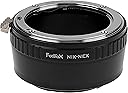
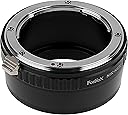
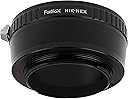
🔗 Bridge the old and new — vintage Nikon lenses meet Sony innovation!
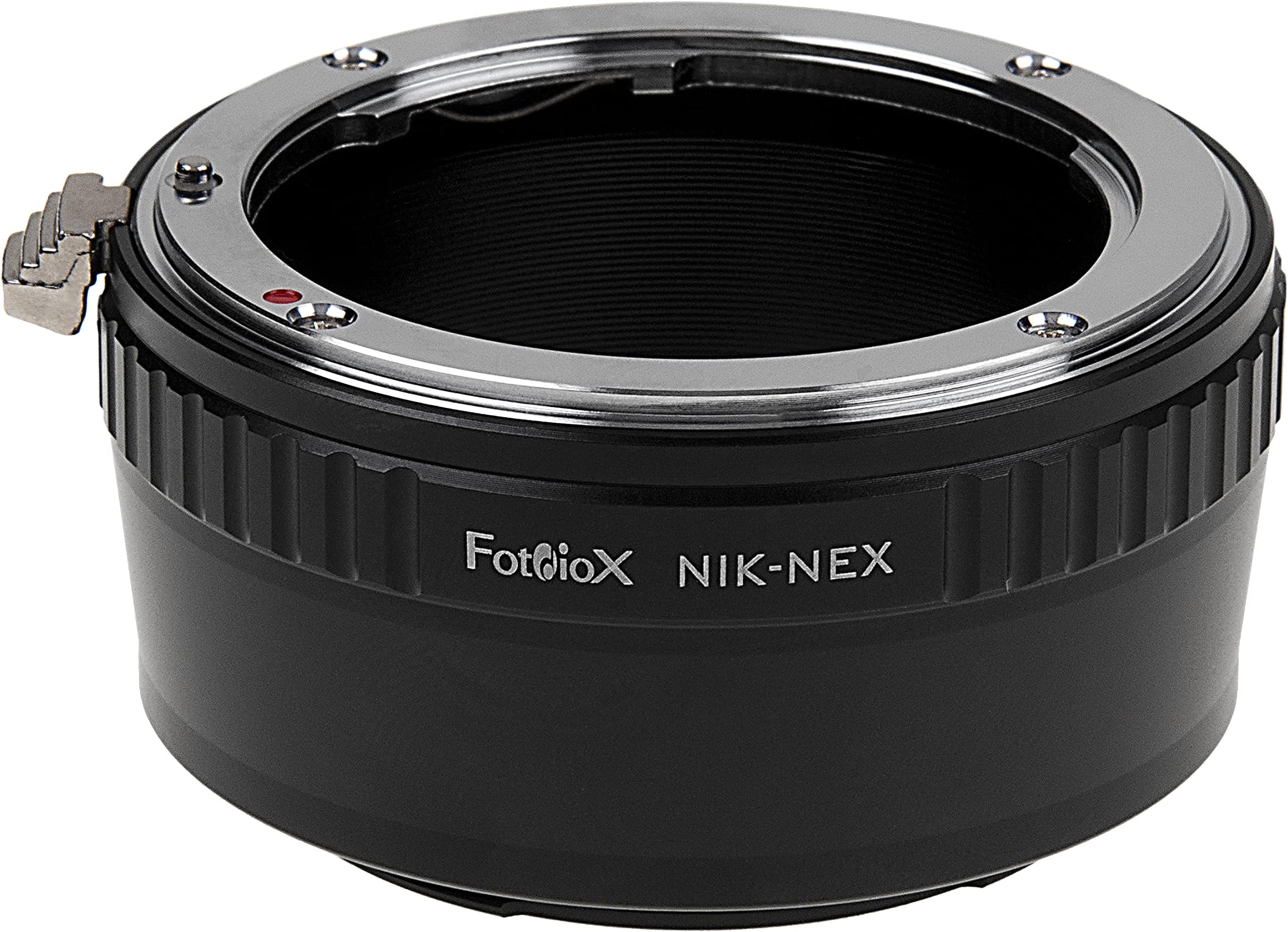
The Fotodiox Lens Mount Adapter enables seamless use of Nikon F-mount lenses on Sony E-mount mirrorless cameras. Constructed from durable anodized aluminum, it supports infinity focus and manual aperture control, making it ideal for photographers who value manual precision and want to extend their lens collection affordably. Compatible with a wide range of Sony E-mount models, this adapter offers a sturdy, cost-effective solution to blend classic optics with modern camera technology.


| ASIN | B005ODKCH4 |
| Best Sellers Rank | #31 in Camera Lens Adapters & Converters |
| Brand | Fotodiox |
| Built-In Media | Fotodiox Lens Adapter |
| Camera Lens | 7 |
| Camera Lens Description | 7 |
| Color | gray |
| Compatible Camera Models | Sony E-mount mirrorless cameras |
| Compatible Camera Mount | Sony E |
| Compatible Mountings | Sony E |
| Customer Reviews | 4.3 out of 5 stars 1,986 Reviews |
| EU Spare Part Availability Duration | 2 years |
| Exposure Control Type | Manual |
| Focal Length Description | 50 millimeters |
| Focus Type | Auto Focus, Manual Focus |
| Global Trade Identification Number | 00847372006991 |
| Image stabilization | No image stabilization |
| Lens | interchangeable |
| Lens Coating Description | Nano Crystal Coating, Super Integrated Coating |
| Lens Design | Fixed |
| Lens Fixed Focal Length | 35 millimeters |
| Lens Mount | Sony E |
| Lens Type | interchangeable |
| Manufacturer | Fotodiox Inc. |
| Manufacturer Part Number | Nikon-NEX-none-G |
| Maximum Focal Length | 0.01 |
| Maximum Shutter Speed | 30 seconds |
| Model Name | Nikon F SLR Lens to Sony Alpha E-Mount Camera Body Adapter |
| Model Number | NikF-SnyE |
| Number of Items | 1 |
| Number of Packs | 1 |
| Shooting Modes | Manual, Aperture Priority |
| UPC | 847372006991 |
| Unit Count | 1 Count |
| Viewfinder Type | Electronic viewfinder |
| Warranty Description | All products purchased as new carry a 2 Year/24 month Limited Warranty from Fotodiox from date of purchase. Our limited warranty provides coverage for defects in manufacturing only. Our limited warranty expressly excludes coverage for excessive wear and tear and/or physical/accidental abuse, loss or theft. The limited warranty is not applicable on consumable items, items marked as used or clearanc… |
| Water Resistance Level | Not Water Resistant |
| Zoom Ratio | 1:1 |
J**D
You get what you pay for
I bought 3 different adapters for canon FD-NEX. The ones I tested were the Fotodiox, the Neewer, and the Fogta. First, I shall reiterate what others have said, that these are manual focus and aperture adapters, and they do not use lens elements that reduce image quality. You set your NEX to allow lens release, and it has no communication with the lens. You do it all by hand, just like in the olden days, which is why I love using these so much! The Fotodiox was the most expensive, and, after some consideration, the best. At first, I did not like the fact that the Fotodiox is set a little past infinity. The fact is that I rarely focus straight to infinity on the lenses I am using--I am doing macro, portrait, and long telephoto lenses with these adapters, it's more likely to be a wide angle landscape lens that you send straight to infinity when you shoot, and I have that in my NEX kit lens (which strangely seems to lack a specific infinity point, but that's another story). I also now appreciate that this extra sliver of focus makes sure that you should be able to safely hit infinity on every lens, which was a concern with the other adapters. What I like most about the Fotodiox adapter is that it really fits the camera and lenses snugly with no play, unlike the cheaper adapters. So I tend to use this adapter on my long telephoto to make sure that it's extra secure. I'm buying one more adapter, and this will be the one, despite that it costs twice what the others cost. The cheaper Neewer and Fogta appear to be set at infinity, but each of them has a little bit of play in the mount--they're not completely snug. I later noticed that the Neewer sometimes seemed to hit infinity just right, and then sometimes, it couldn't reach infinity! Huh? It may have been temperature induced (had trouble hitting infinity in hotter weather), but I think it's more because of the play in the mount. Hitting infinity focus requires very tight tolerances. Since the adapter is a little loose, if it's not in complete contact with the camera, it will never reach infinity. I had to wiggle the lens and adapter while pulling it tight against my camera, and then it popped back to infinity. So it's a cheap mount, what do you expect? I'd rather have an adapter that's just a hair shorter, having that safety factor of going slightly beyond infinity. The apeture lock on the Neewer adapter is very smooth and buttery, so I appreciate that. I have not experienced the problem of not reaching infinity on the Fogta adapter; it does seem to be set on infinity, but knowing what a small tolerance that is, It wouldn't surprise me if there's a chance it might not always hit it on certain lenses since there's no room for error. My only complaint about the Fogta adapter is that the aperture lock ring is loose feeling. It's a little harder to snap into place, and then it kind of wiggles after you set it. I don't think that actually matters for its function, but it makes it feel cheaper. Also, the Fotodiox and Neewer shipped very quickly, and the Fogta took a few weeks to ship from China. I use the Fogta and Neewer adapters on my portrait and macro lenses, where I rarely need to think about infinity, and a little wiggle in the mount doesn't bother these smaller lenses.
A**M
Great value. simple solution to get great images with an NEX body from a microscope or telescope.
This adapter is well made. All threading was perfect. It's a simple plate, really. I have an NEX-6 body that I wanted to connect to a few different microscope systems at work. The C-mount and T-mount are most common. The standard mounts used to connect Carl Zeiss Axiocams is a C-mount. I threaded this onto the microscope port first, then carefully mounted the NEX body onto the adapter plate. Without any tinkering, the camera produced exceptional results... in my situation at low power objectives, the resulting images were sharper than with the $12000 Axio HRc camera. They were more true to what you actually see through the eye pieces. This mount also worked very well with an Olympus IX50/IX70 base platform for a custom laser dissection system we have. Again, minimal tinkering, just mount plate to scope port, mount camera, set 100ISO and adjust metering using the camera... the NEX takes care of the rest. Really brilliant setup. A couple things to note if you're in a similar situation w/telescope or microscope: 1. mount the plate to the C-mount port first. The threading on the 25mm C-mount is thin and could be awkward when mounted to the NEX first. I found mounting the body to the adapter was very solid and easy to do. Just line up the dots. 2. Vignette... it's big. You're basically just getting a circle within the frame of the NEX's field of view. This is totally normal for directly mounting a C-mount setup to NEX (or any APS-C or larger sensor). For a $16 solution just crop it. If you'd like to fill up the sensor more, you would need a 2x adapter between the microscope port and the camera body. If you contact Zeiss for the mounting hardware for an NEX, they'll sell you T-mount stuff, but include a very expensive 2x optic to magnify the image onto the comparatively larger APS-C sensor. A FF sensor on a camera like a 5D or a new Alpha 7 mirrorless will require a 2.5x adapter. These exist on Amazon as well (but not with high quality glass). I bought one for $100 and will test it soon. Summary: It's a $16 solution to get incredibly sharp images right away off of a C-mount port without the need for anything else. It's a fantastic bargain and I highly recommend it.
T**B
Small and functional
Delivery, packaging: I received the adapter promptly via USPS Priority Mail. It wasn't packed properly, but it did not appear delicate. There were no instructions included. I guess the key instruction must be the red alignment dots. Adapter/lens mating: Very snug fit. No Play. I tried this adapter on a Contax G 45mm f/2 lens. I thought I had mounted it correctly, lining up the dot, inserting, twisting to a click, etc. I was wrong. I could turn the focus knob but no focus. The aperture ring on my lens seemed off, starting from 5.6 and going past the highest setting. I thought this was a lens issue (received lens the same day), but it turns out I had mounted it wrong. The release tab has no feel, and barely moves. It also feels like it could break. When I removed and carefully remounted the lens (I was plenty careful the first time!), the aperture ring issue was fixed and it worked fine. The focus ring is narrow, Well knurled (I counted fifty notches), probably aluminum. The focus throw on my lens with the adapter is about 151 degrees (21 out of the 50 indents in the ring). It seemed smooth at first. Later on, when focusing, it would catch and refuse to rotate. Then it resolved itself and has been pretty smooth again without issues. (I've taken at least a hundred photos so far with no recurrence of this problem) I was please to find there was no wobble of the lens in the adapter. It is a tight fit. There is a very small amount of purely rotational play with my lens/adapter combination which should be of no account. My sense is that unmounting and remounting lenses on this adapter may be unwise for three reasons: 1. the tab which seems both fragile and without a 'feel'--it is very hard to unmount the lens 2. mounting the lens correctly is not easy, and I am concerned it was possible to mount it incorrectly at all. In fact it's hard to figure out how I could have mounted it wrong, there is nowhere for the focus driving screw to go other than the right place, and lining up the red dot is pretty basic, and 3. the tight fit of the lens may not be guaranteed if switching lenses with this mount. (UPDATE: part of my issue is user error. I now have the hang of mounting and unmounting Contax G lenses. Had there been instructions for the adapter it would have helped. If I had a Contax G manual, it probably also would have made a difference!) Adapter/Camera mating: While there is an alignment dot on the back bottom of the adapter, it was the Nex-5 itself that gave me no indication of the correct orientation for screwing it in. It goes on the bottom. Give it a twist, click and...perfect! You are going to want to buy more than one of these adapters if you have more than one Contax G lens. Given that this is the surest way to use the adapter, it would have been nice if the adapter came with it's own 'lens' cap. This might be true even if you buy a more expensive adapter like Metabones or Kipon. Focusing: Fortunately, manual focus with the focus magnifier and the focus peaking feature is very easy! Occasionally the focus ring will stick, as I stated, so you might miss a shot here and there, but it sorts itself out again. (BTW, if you intend to rely on focus peaking, it may not help you for wide-open shooting with critical depth of field on faces, since they have lower contrast. You might get an eyelash, but you will still want the magnification). Results: I don't have scientific equipment to test the results. They look good to me. You can focus a bit past infinity which isn't unusual for any adapter, it sacrifices slightly against the closest focus distance to make sure that infinity is reachable. It just means that you can't throw the focus to one end, and assume infinity is in focus. (I have read this might be improved with a paper shim.) Conclusion: I haven't tried other adapters, and believe that I am satisfied with saving the money. I have another Contax G lens coming and am debating whether I should try a different one for comparison sake, or just save the money. I might spring for a Metabones adapter for my 90mm lens, regarded by many as the best, though it impinges on the fingers of the right hand gripping the camera. If it is better I will want the best focus feel for the longer focal length. If I do get another adapter, I will update the review to put in comparison info.
B**B
Works Great
Contents of the box was the adapter only; wrapped in a small plastic bag. No pouch and no end caps for the adapter openings. I can use the rear lens cap that came with one of my Sony lenses and a body cap from one of my Nikons. Perhaps they envisioned users doing this and saved a few pennies by not providing them with the adapter itself but I would like to have been provided a set with the adapter. Likewise, there were no instructions. (I did not think these two things were worth taking a star away from something that does what it is supposed to do and does it well.) The adapter feels substantial and well-made when you pick it up. It is a simple device – as we know – no electrical connections are made between lens and camera body. It provides a superb and reassuring fit between camera/adapter/lens. Attachment was just as you would want it to be – secure, stable, no wobble in any lateral direction while some slight rotational movement was noted but nothing in excess of what a typical lens-to-body attachment would exhibit. I have tried it with 200 mm macro “D” lens (aperture ring/control on lens barrel) and 14-24 mm zoom “G” lens (no aperture control). Both worked well. “Aperture” control on the adapter had much less travel than I expected but I realized the travel is limited by the travel available within the body of the lens when engaging the aperture control within the lens itself (in the case of the D lenses). I think I was expecting something like focus ring travel but of course it would not be that much. I just hadn’t thought about it before using the adapter. Focus peaking together with Zebra allowed good control of exposure and focus. (I am really loving this focus-peaking thing with my Sony a7ii.) Buttery smooth removal from lens and from the camera body. No trouble as some have reported with attaching or removing the adapter to/from lenses. NOTE: The Release button is NOT a “button” at all; it is actually a lever that you push away from the lens to release the adapter and allow it to be rotated and removed from the lens. I have read comments from several reviewers stating that “no matter how hard they pushed the button” it was exceedingly difficult to remove the adapter from the lens. They just were not doing it correctly. Instructions they SHOULD have provided - When using with a Nikon D-series lens (aperture control ring on the lens itself): • Find the small slide switch ON THE LENS BARREL and make sure it is in the unlocked position (usually toward to the front of the lens) and verify that the aperture ring on the lens can be rotated • Rotate the aperture ring ON THE ADAPTER fully CW when viewed as looking through the camera (might consider using a bit of gaffer’s tape to be sure it doesn't move) • Make your exposure adjustments using the aperture ring ON THE LENS as necessary • If you are using a D-series lens but want to use the aperture adjustment on the adapter then rotate the aperture ring ON THE LENS to its smallest aperture (typically 32 or similar) and slide the lock switch to the locked position. • Make aperture adjustments on the control ring OF THE ADAPTER. When using a Nikon G-series (no manual aperture adjustment control on the lens): • This is easy because the only control you have is the ring on the adapter • Rotate the adapter control ring as needed provide the exposure you want based up other settings you have made • The control ring does NOT move much at all from full open down to smallest aperture With either type of lens, make your exposure adjustments while looking through the viewfinder or on the monitor. Use of focus-peaking is very helpful for optimizing the focus which, of course, is manually adjusted when using one of these adapters with Nikon lenses. Turning on the Zebra function (first setting under the “gear wheel” in the Menus) is also VERY helpful to control exposure.
A**N
An excellent mount for your Sony Alpha Nex
I bought this adapter because I needed more versatility out of my Alpha Nex 5, as I only had the 16mm lens. I didn't want to drop $300 for the 18-55 lens, especially with the amount of barrel distortion it has. So with already having a couple FD lenses, I was keen on buying this adapter. I must say, it was an excellent purchase! I was warned that it might degrade image quality if I use a mount, but my pictures look better than ever. This is everything you could ever want out of a mount, it's small, allows for breach and bayonet mounting (I have both, and have tested both to work incredibly), and even aperture control (make sure to mount the lens correctly though otherwise you will not have this feature)! This adapter specifically is incredible because of the price you can get FD lenses. I have a Vivitar 28-200 macro, a Vivitar 500mm Mirror lens, a Canon 50mm prime, and a Canon 70-150mm zoom lens (picked them up for about a total of $45, look around Goodwill and garage sales for incredible deals on these lenses). The types of pictures I can now take are incredibly diverse, and all at the cost of $95. Definitely beats buying the Sony E mount lenses, especially in image quality. Before you could tell that this was not a DSLR camera, but now my pictures look incredible, and have no loss of detail even while zooming in fully. However there are two things to note when you use this adapter. You have to use manual focus, and the weight of the lenses makes some shooting difficult without a tripod. The manual focus for these works great (even better than with the E mount lenses as they don't rotate forever), and the shoot tips button becomes a MF assist, allowing you to zoom in 7 or 14 times to check your focus. The infinity is slightly off on my canon lenses, and I have to twist it a little shy of infinity in order to focus correctly, but not a huge issue. Just learn how your lens works with the camera, it might be different but certainly didn't lose any of its quality or features. The second part is a much bigger problem with these, as you will be using much larger lenses on the camera, making the weight balance be entirely in the lens. With my prime lens it's not a problem, but with my telephoto I have to keep the shutter at least on 1/150 in order to not get blurry pictures. The E mount lenses have built in image stability, which is not present here. For photos this isn't particularly difficult to work around, but for videos they get extremely shaky. Definitely use a tripod to film video with this, but the video will look incredible if you do. The only other complaint is that the tripod mount is attached by TINY screws, I haven't found a screwdriver to take it off yet, but not a huge inconvenience. Simply put, if you have a couple FD lenses lying around, there's no reason you should not get this adapter. For a fairly cheap price, you'll turn have professional shooting capabilities, and this is definitely the cheapest way to get a diverse set of lenses under your belt.
H**A
1st try was a dud... trying again for better luck 2nd time
I ordered this to use with a Contax G 90 lens and my Nex7. Was excited to use the lens on the Nex. Upon first inspection, the Fotodiox adapter seems well made with good finish. There was a little bit of oil residue visible on the adapter, which I suppose is necessary for lubrication and smooth rotation. Attaching the adapter on the lens, was pretty straightforward -- which justifies no instructions with the adapter. So far so good. Then, I attached the adapter with lens on to the Nex7. Turned on the camera and put it in the right mode and setting. Ready for my first shot -- of course needed focus assist/peaking. Now the problem -- it was very difficult to turn the focus ring on the adapter. It would get stuck in many positions in both directions. Practically un-usable. I struggled and managed to take one shot before the thought that I had attached the lens to adapter incorrectly crossed my mind. I detached, and tried again many times with no better success. I had rated it 3 stars hoping to upgrade the rating to 4 or 5, but unfortunately I can not recommend this adapter after having two duds. Is it the FotoDiox adapter or my lens that's the problem?? To find out, I separated the adapter from the lens, and looked at the lens itself. Using a small flat-head screwdiver on the focus mechanism of the lens, it was very easy to turn to make the lens extend and protract (for focus). Then with just adapter in hand, I attempted to rotate the focus ring, and in one direction it was fairly smooth. In the opposite direction, it locked up in many places. Kept rotating the ring hoping it would lubricate and eventually smooth out, but no such luck. In fact, I was getting intermittent locks in both directions now. I concluded that I received a bad/defective adapter. Promptly called Amazon to arrange a return. I've ordered another with overnight shipping since I'm leaving for a trip in two days. Hoping that the 2nd order will be better. If not, the Contax G lens won't make the trip, and I'll have to find a different adapter to use this lens. Btw, while the lens/adapter was on the Nex 7, I managed to take 1 shot after struggling to get focus and the lens appears to be a keeper. Please, oh please new adapter be good! Cheers! --------- The 2nd adapter arrived, and sad to say that it didn't do much better. I found that, in order to not have it lock and grind on manual focusing, I had to pull the focus ring toward the camera as I turned it. That and gripping it a certain way made it easier, but if I didn't remember to do this then it definitely would lock up. There are times even when the focus ring moves, but the lens doesn't move with it which suggests that the adapter's design isn't deep enough where it contacts with the focus mechanism of the ring. I'm going to see if I can find a used Kipon or Metabones adapter as I've read elsewhere that these focus rings are smooth.
A**R
Fotodiox Canon FD to Sony NEX mount adapter
Sometimes you can go home again. With this adapter I am using my breech mount Canon FD lenses, purchased in the 1970s, with my Sony A7, purchased in 2014. This adapter is well made and the Canon lenses work well with it on the A7. Just make sure to rotate the collar on the adapter from "Open" to "Lock" to manually adjust the aperture blades. Set the camera's menu to "release without lens", and set the camera's top control dial to "A" (aperture), and you are good to go. It is actually fairly easy to manually focus using focus peaking. In addition, as you will be viewing off of the sensor, the image in the viewfinder does not dim as the lens is stopped down, an additional assist to manual focusing. You can also see the effect that the aperture has on the depth of field, and the histogram in the viewfinder will allow you to assure that the exposure is correct. The adapter is well made. There is no play in the mount, and the adapter fit perfectly to the lens and to the camera. The only "problem" is that the camera's logo says "Sony", and the lens cap says "Canon". This adapter allows great legacy lenses to be used on modern digital cameras. Highly recommended.
A**R
but were fine with telephoto lenses
Bought this adapter for use on an A7mkII with wide angle lenses. Flange distance is critical with wide angle lenses as they have very shallow depth of field behind the lens. I'm trying to switch over completely to FD glass and I want an adapter on each lens so that it's easier to change lenses. I bought 4 Chinese adapters off ebay to begin with. They would not focus to infinity with anything under a 50mm lens, but were fine with telephoto lenses. So that's what they ended up on. This adapter just barely fails to reach infinity with a 28mm lens. If the lens (An FD 28/2.8) is stopped down to f4 then it makes it, barely. With a 20mm lens it doesn't make it until stopped down to f8. So if you're buying this for use on a 35mm lens or above, it's fine. Below that, I'd find something else. Of course all this applies to full frame. I gave it 3 stars because it is well built and would work great on longer lenses.
J**T
Five Stars
Have a few of these mounts always excellent
W**B
Excellent piece of kit, works a treat.
Use this on a Sony A7S and A6000 with my Olympus 28mm, 50mm and 135mm lenses. It works a treat and focus peaking makes it easy to nail the shots 9 times out of 10. Made of tough plastic, doesn't seem as tough as say Metabones but it's a fraction of the price and works fine. Best used in Aperture prioritybor full manual mode, you have to set the camera to "release without lens" and the camera gives no aperture reading, just "F_ _" but you set the aperture on the lens and the camera changes shutter speed accordingly in Aperture and you can change it up yourself in Manual to get the right exposure.
N**P
Thanks for reviving my D Type Nikon lens
It fits my D type Nikon lens well. Easy to put and remove.
A**S
Perfecto para mi sony a6000
La calidad es excelente, llego antes de la fecha estimada y en perfectas condiciones. Ajusto perfecto en mi Sony a600 para adaptar mi lente 50mm Nikon (Manual) ! Cambie de nikon a sony y no queria perder mi 50 mm ya que es mi lente favorito. Muy contenta de encontrar este articulo a un precio super accesible !
M**T
Decepcionante que fotodiox falle...pero es cierto!
Tengo hace muchos años un Tele Soligor de 300 mm, con montura OM. Con éste adaptador no logro que encastre, y suene click. ¡No se traba! Quiere ésto decir que cuando giro el objetivo para enfocar, ocasionalmente se desengancha del adaptador. La consecuencia: Caida al suelo y rotura del filtro B+W de 72 mm. No es culpa del objetivo. ¿Quien me paga éste caro filtro? He comprado HAOGE Y FUNCIONA PERFECTAMENTE. Ref. X000NTVMD5 OM-NEX. Si los d eFotodiox leen ésto, hagan revisar la linea de producción de ese concreto adaptador. No digo que los demas sean malos, pero ésta unidad, es defectuosa.
Trustpilot
4 days ago
1 month ago