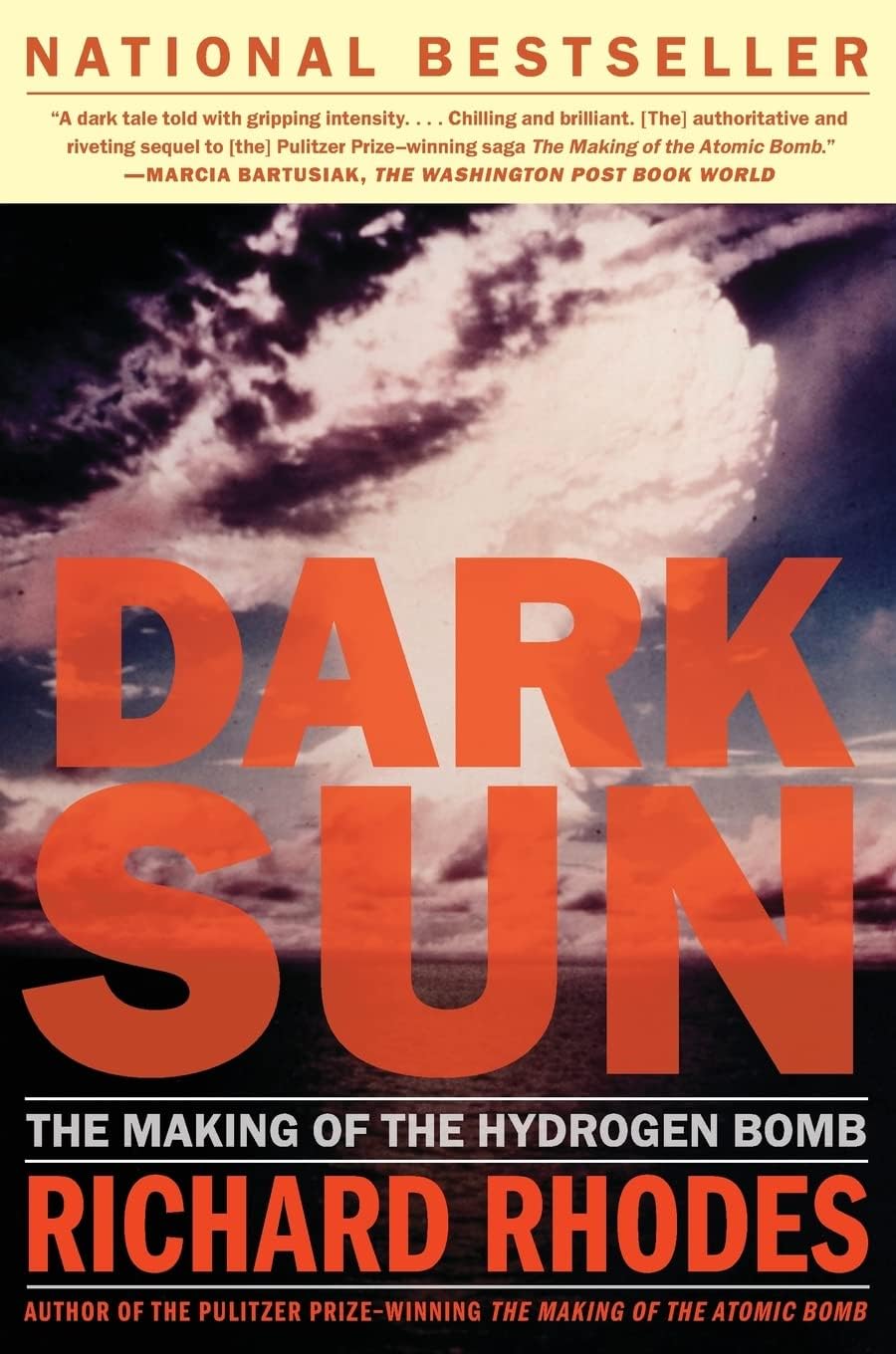
Dark Sun: The Making of the Hydrogen Bomb
Product ID: 3266477
📚Pulitzer Prize-winning author
🧨Definitive history of hydrogen bomb
🕵️♂️Based on secret US & Soviet files
Desertcart purchases this item on your behalf and handles shipping, customs, and support to Japan.
🧨 Unlock the explosive story behind the bomb that shaped the world.
Dark Sun: The Making of the Hydrogen Bomb is a Pulitzer Prize-winning historical account revealing the political intrigue, espionage, and scientific breakthroughs behind the hydrogen bomb’s development and the Cold War’s nuclear arms race. Drawing on secret US and Soviet archives, it offers a panoramic view of the era’s high-stakes decisions and their lasting global impact.
| Best Sellers Rank | #103,393 in Books ( See Top 100 in Books ) #10 in Nuclear Weapons & Warfare History (Books) #163 in History & Philosophy of Science (Books) #402 in Engineering (Books) |
| Customer Reviews | 4.5 out of 5 stars 1,104 Reviews |
L**S
Detailed, fascinating and horrifying
Again, following The Making of the Atomic Bomb, Rhodes has done a fantastic job of taking us back to the early days of the nuclear age. The constant underlying theme is that there were alternatives to the constant mutual nuclear terror under which we live every day, but which thankfully, for the sake of our mental and emotional health, we (mostly) don’t obsess over. Were those alternatives ever realistic? Perhaps not. But history has a way of making seem inevitable that which really happened. Part One of this book focusses on Soviet espionage up to the end of World War II. Because of such men as Fuchs, Gold and others, the Soviets had a pretty good idea of what was going on with American bomb developments and were able to “piggyback” and greatly accelerate their own bomb program. Little attention is paid to the details of the American programs at places such as Los Alamos and Oak Ridge, probably because Rhodes has already described these in The Making of the Atomic Bomb. Perhaps the most startling (to me) revelation here is that on August 12, three days after Nagasaki, the U.S. released a report on the Manhattan Project that supplied the Soviet Union with information “nearly equivalent” to that which the Soviets had acquired through espionage during the war. Part Two is a history of the early Cold War years, usually in the context of the development of nuclear weapons. Perhaps most surprising was the meagerness of the U.S.’s nuclear force in the early years. As Lilienthal told Truman, “[T]his defense did not exist. There was no stockpile.” There were no weapons, just “piles of pieces.” At least this one bit of information apparently did not make it to the Soviets, who were busy trying to steal every bit they could. Rhodes describes the attempts at control of atomic weapons at least until 1947, the overriding growing mutual suspicion and distrust between the US and USSR, and the meeting of scientific and mathematical challenges culminating in the “Super,” or hydrogen bomb. We learn, among other things, that the initial problem assigned to the world’s first working electronic digital computer, ENIAC, was the hydrogen bomb. We learn also that there was serious opposition to building the hydrogen bomb at all. Part Three takes us through the designs and tests of the first hydrogen bombs, by the US and USSR, to the Cuban Missile Crisis. The scientific details of the design of “Mike,” the US thermonuclear that vaporized the island of Elugelab in 1952, are as horrifying as they are fascinating. Throughout, Rhodes explores the dichotomy between those who perceived the mutually destructive futility of a nuclear arms race, and those who pushed for ever more bombs with ever bigger “yield.” As Rhodes points out, “nuclear weapons are not cannonballs; how many times could either country be destroyed?” Many of those, like Oppenheimer, who had the vision to perceive the ultimate futility of the arms race were blacklisted and/or persecuted. Rhodes asks a fundamental question: “If real political leaders understood from one end of the Cold War to the other that even one hydrogen bomb was sufficient deterrence, why did they allow the arms race to devour the wealth of the nation while it increased the risk of an accidental Armageddon?” The answer for both sides is essentially the power of the military-industrial complex about which Eisenhower warned: “Far more influential on the US side were such domestic political phenomena as competition among the military services, coalitions of scientific and industrial organizations promoting new technologies, the pressure of ‘defense’ as a political issue and defense spending to prime the economic pump, particularly in election years. Similar patterns obtained along somewhat different lines for the Soviet command economy.” Still, Rhodes ends on an optimistic note. While the world will not soon be free of nuclear weapons because they serve so many purposes, “as instruments of destruction, they have long been obsolete.” One can only hope that he’s right. But it’s been only just over three-quarters of a century since Hiroshima and Nagasaki.
N**L
Excellent as all of Rhodes' books are
I'm about halfway through (pp300 or so) and it's a fantastic book written in Rhodes usual style which manages to narrate history in a way that keeps you wanting to know what's next. However, the reason I gave it 4 stars instead of 5, and perhaps this is my own expectation, is that it is not so much like The Making of the Atomic Bomb. The first 250 pages jump between the Soviet Union's atomic bomb program and how much it depended on espionage from the US, as well as post-WWII atomic policy (and a little about the organizational structure of weapons development at LANL) in the US and the world. There's very little exposure to the science so far, which is markedly different from his first book on atomic weapons, and something I enjoyed greatly. Don't get me wrong; the policy aspects are also fascinating, especially given how much interest there was in building up a huge nuclear stockpile, including by secretly forcing Britain to give up their uranium supplies in return for helping them rebuild after they fought WWII (the agreement was kept from the United Nations so as to not alert other countries) In fact, one thing that surprised me was the intent on planning for the next war after WWII. It's been a long time since my last history class, but I remember that there was very little support for entering WWII in the years leading up to Pearl Harbor, and, after the war, according to Dark Sun, there was much hoo-ha about being prepared for the next war, in a way that seemed focussed on the offensive. I'm assuming these were different groups of people.
L**-
The First Atomic and Hydrogen Bombs
Dark Sun is put together by a master storyteller. His knowledge of the events and the ability to put them together in an interesting and authoritative way is breathtaking. The story here is about the development of the bomb, the spies that spread the knowledge across the world and the relationships among the scientists and their relatives. One is left with the belief that if one has the resources and is willing the commit them, it must not be too hard to develop the bomb. If one uses centrifuges to separate isotopes, for instance, one need not have just a few tens or hundreds of these but thousands or hundreds of thousands. The dozen or so hydrogen bomb nations indicate this. We are not aware of anyone failing to become an a nuclear bomb nation so one must dismiss the extreme difficulty of the design. It must come down to the extreme difficulty of amassing the resources. The development of a safe delivery system is probably even more demanding but this is not his prime concern in the book. Without bombers or ICBM's as operational delivery systems, the bomb would be still-born. One is expected to have quick reaction bombers on alert, missiles in launch holes, submarines with multiple missiles and bombs, etc. This brings it down to a massive array of bombs, delivery systems and trained people to operate the systems flawlessly and without failures. Therein is the rub. People are fallible. Procedures are inadequate or ignored. Fail-safe arming and fusing systems are not up to the task. Maintenance requirements demand people interact with the bomb and elements of the delivery system often. Each interaction seems to be an accident waiting to happen. Surely the design of the bomb and delivery system can be better than presently fielded. Wiping out a few cities by a nuclear bomb accident will not determine the victors in such a war. Probably, A single bomb can cause the victim's government to fall. At least, that was the lesson of Japan. The U.S. was said to have about 44,000 in our arsenal at one time. The transportation of such a plethora alone puts us at great risk. Further, people are making decisions every day at the general flag level. Every time we learn the insides of presidential systems, it is appalling how many of the decision-makers follow Gen. Curtiss Lemay's advice to bomb them back to the stone age. Joel Dobson's book, Broken Arrow, indicates how that operational system reacts to a nuclear accident, This time a Titan, a liquid propulsion missile. He suggests and illustrates how dysfunctional the operation can be. Mister Rhodes obviously has the capability of putting the story together of the operational considerations and how they put us at risk. We hope he addresses many of the larger issues in the future. Meanwhile, this book is the best read available and forces us all to think about this source of energy. This book is highly recommended.
D**.
This may be too long for many, but it worked for me
Richard Rhodes's masterpiece is The Making Of The Atomic Bomb. I was expecting this book to take the story on from there. Instead we get essentially three books in one. The early part of the book goes over the same ground as his masterpiece. Not in so much depth, but the reader looking for the history of the hydrogen bomb is in for a long wait. We are given intricate detail of the leaks to the Soviet Union over the development of both weapons. When he (finally) gets to the development of the hydrogen bomb, his account is first-rate. The physics of the hydrogen bomb is much more intricate than the physics of the fission bombs and Rhodes explains this with admirable quality. The third part of the book is essentially a history of the Cold War. I have read better accounts, but I was never tempted to put this down. So the reader is in for a long slog. I enjoyed it, but I can imagine others balking at the size of the task.
T**G
A masterful account
This book is an excellent companion to the author’s absolutely classic, “The Making of the Atomic Bomb.” It is the next step in atomic history. Perhaps, even to quote Fermi, “it can be done; and almost certainly will be done.” In that case; this book is an inevitability. The book starts out with a survey of what happened at Los Alamos and the invention of the fission bomb. Rhodes goes into painstaking detail regarding the development of the bomb and atomic espionage. He links the communist party of The United States to the infiltration by the Soviet Union the bomb project. Clearly there were enough holes in the system the Russians were nearly up to date on everything we knew and used that information to their advantage by taking years off their own bomb program. The book continues in describing the debate regarding the fusion bomb. Some scientists felt it should be made in the national interest and yet others thought it was a disaster. They preferred science spends its time on making nuclear power work in a non-military fashion Not only does the author do a fantastic job of showing this debate. But he also shows us how the US moved forward and eventually produced the first hydrogen bomb. He ultimately finishes the book by describing in detail the Cuban Missile Crisis and how close we came to mutually assured destruction. Without a doubt this is not an easy read. It’s the kind of heavy book you might read in a major history class. You need to know something about physics, history, some politics as they relate to the history. If you happen to have a keen interest in Atomic History, then this book is clearly written for you. Ultimately, the book was entirely enjoyable. I look forward to reading more books by author. His making of the atomic bomb book was required reading when I was in college and still remains on my book shelf. Somethings never get old. If you would like to know more about atomic history then I would suggest the author’s previous book, The Making of the Atomic Bomb or the magnificent book, “American Prometheus, “ by Kai Bird and Martin Sherwin.
C**R
A Dance with Death
This is a worthy sequel to the author's Pulitzer Prize winning `The Making of the Atomic Bomb.' It admirably relates the history of post-WW2 atomic weapons (including the Soviet program) and the development of the `Super' (hydrogen/thermonuclear) Bomb. Theoretical and technical challenges are clearly profiled with conceptual, developmental, and testing milestones. Not least, the political context (the Berlin Airlift, Korea, the Cuban Missile Crisis, etc) is also fully explored. Soviet espionage dating from the earliest efforts at Los Alamos is detailed (Harry Gold, Klaus Fuchs, David Greenglass, the Rosenburgs, Guy Burgess, Donald Maclean, the Cohens). It reveals a ruthless régime (Joseph Stalin and Lavrenti Beria), but also a parent country bled white by the loss of over twenty million in WW2 (and all the more susceptible to new threats). Though espionage no doubt accelerated Soviet progress, able scientists like Igor Kurchatov and Andrei Sakharov fulfilled Bohr's prediction that scientific progress was inevitable across the globe. Prometheus did not discriminate. Major figures (J. Robert Oppenheimer, Edward Teller, Stanislaw Ulam, Louis Strauss, Curtis LeMay, etc) are also depicted (with the increasingly divisive politics of their times). The testing of `Mike' 1 November 1952 at Eniwetok revealed a single bomb that yielded 10.4 megatons, more than twice the power of all explosives used in WW2. Subsequent improvements have increased the easy agency and disastrous yield of subsequent generations of this weapon. During the Cuban Missile Crisis SAC had 7,000 megatons in the air ready (and eager?) to strike the USSR. Does superiority in weapons of mass destruction (liable to kill us even if successfully deployed against an enemy) make us safer or less safe? Is it (as Oppenheimer predicted) a case of "scorpions in a bottle?" Read this account and decide for yourself.
F**R
The follow-up story of how the US made the leap to fusion weapons
This book is the follow-up to Richard Rhodes' The Making of the Atomic Bomb: 25th Anniversary Edition , which I strongly recommend to read first. By doing so you will get acquainted to the author's investigative style, and (hopefully) appreciate his top-down macro-micro broader approach, always trying to show all angles to a story. The book deals basically with the development of the hydrogen bomb (fusion weapon), and as such goes at the beginning in parallel to the Manhattan Project efforts, before becoming the main focus of the Los Alamos laboratories in the late 1940's. While the development of the atomic bomb was a scientific (and later industrial) story, the development of the hydrogen bomb tells a wider story of politics, espionage, and encompasses (at least at the beginning) also the Soviet side. Some reviewers have found this part of the book somewhat out of place, but it is a necessary part that enables the reader to understand why (in part) almost 7 years elapsed in the US until a first fusion device could be tested, whereas that time was halved in the Soviet Union (SU). Unfortunately, the later development of the fusion weapons in the SU is only briefly addressed, which is most probably due to the lack of reliable information sources. Overall, the author delivers an interesting and well-researched book of a scientific, political, social and espionage story that culminates in the establishment of a horrific arsenal of enough fusion weapons to `bomb human kind back into the Stone Age'. Today, almost 20 years after the final chapters of the Cold War, this looks so strange and difficult to understand that Richard Rhodes' book is a welcomed help. Having said that, the science fans will not be disappointed, either, for whom the chapter of the Mike device alone will be worth the price - highly recommended.
D**R
Flawed sequel
I first read this book back in 2005, immediately after reading The Making of the Atomic Bomb (referred to as TMOTAB from here on) for the third time. My initial feeling was that it suffered in comparison with its monumental predecessor, and proved once again the old adage that a sequel is rarely equal. Re-reading it hasn't changed my opinion all that much. This is essentially five or six short books loosely held together by an over-arching story of the nuclear arms race from Hiroshima to the Cuban missile crisis. There's a book on the early Soviet nuclear weapons program, one on Soviet espionage from 1942 to the mid 50s, a third on American fission weapon development to 1952, another on American nuclear weapons policy, a fifth on the development of the hydrogen bomb, and a sixth on the destruction of J Robert Oppenheimer. The result is a book that's frequently fascinating, sometimes gripping, but rather plodding at times, terribly unfocused, and nowhere near as satisfying on an intellectual level. If you struggled with TMOTAB, you'll doubtless find this an easier read. The science and physics have been streamlined and are easier to follow, the character introductions aren't quite as in-depth, and Rhodes has mostly done away with the heavy philosophy that tended to slow down that book's narrative. It's also a good 175 pages shorter, and the story moves along at a brisker pace. As I mentioned, there are some really fascinating parts, including detailed explanations of how the "Mike" device worked, insights into how deep the Soviets had infiltrated the Manhattan Project, and a rare look inside the Soviet atomic bomb program. Unfortunately, if you ARE a fan of TMOTAB (and it seems like a lot of people are), this book also does away with many of the elements that made it so compelling. The characters are so thinly developed they might as well have Mafia nicknames (Lemay the Creepy Warmonger, Teller the Backstabber, Oppenheimer the Scapegoat, etc.). The pacing is all over the place; the first half is chock full of lengthy passages describing spies moving about the US, complete with explanations of where they slept, what restaurants they ate at, what train they took to get from one city to another, etc. The first Soviet nuclear test doesn't occur until 3-5th of the way in, and from that point on that book essentially races to the finish line. The actual "making of the hydrogen bomb" only occupies three chapters, much of which is devoted to attacking Edward Teller at every possible turn. There's no doubt that Dr. Teller was a flawed and extremely controversial figure, but Richard Rhodes spends so much time dragging him through the mud that any pretext of journalistic integrity has essentially evaporated by the last page. "The Making of the Atomic Bomb" is not a flawless book; the first third drags a lot and Richard Rhodes is a little too in love with his own writing. It's still a much deeper, richer, more complex, and more satisfying read than "Dark Sun." I'd read two or three chapters of TMOTAB and go on an hour-long walk to process what I'd just read; I'd read 50 pages of "Dark Sun" and basically shrug my shoulders. To provide a relevant analogy, TMOTAB is a Fat Man implosion bomb - big, clumsy, and complicated, but nonetheless a monumental achievement that leaves a lasting impression. "Dark Sun" is akin to Andrei Sakharov's Layer Cake - a series of alternating heavy and light elements that provides a sufficiently large bang, but isn't particularly memorable when compared with the competition.
S**J
Richard Rhodes did an extensive research on Hydrogen Bomb invention
President Franklin Delano Roosvelt was very smar and he could sense the technology rapid advancement , and he knew the isolationism policy has already become invalid , and president Roovelt after receiving Albert Einstein 's Letter , he immediately started the Manhattan Project .
E**D
Good
Good comprehensive history narrated well
L**1
Magnificent and desperately sad
Some of the more negative reviews of this book are less than perceptive. Rhodes' earlier 'The Making of the Atomic Bomb' is an extraordinary book, an exhilarating intellectual adventure that suddenly becomes what we had forgotten it was all along; an appalling human tragedy. The description of Little Boy's effect on the city and people of Hiroshima is some of the most powerful non-fiction writing I have ever read. The atomic scientists believed, almost up until the last minute, that they would be permitted a role in the decision to drop the bomb. When they weren't, it affected them in many different ways. This book is about those ways. The claim that Rhodes should have 'spared the politics' is idiotic. This book is the shadowy aftermath of Hiroshima and Nagasaki, and it's primarily about the slow construction of the nuclear state. The politics are an integral part of the story, and they are fascinating. Rhodes is very good about the Soviet bomb program, which relied heavily on nuclear secrets stolen from the Americans but which was still a pretty heroic effort. Stalin put secret police chief Lavrenti Beria in charge of it, which probably set them back a couple of years in that the brutal, scientifically illiterate and deeply paranoid Beria never had the slightest grasp of what the Soviet scientists were doing or even that radiation could be bad for you. (When Beria finally gets arrested and executed after Stalin's death, the reader almost breathes a sigh of relief.) Bad as Beria was, the most chilling character in the book is actually the man who set the US H-bomb program back years: Edward Teller. Teller is spoken of as a great scientist, but he seems to have been incapable of sustained work on any one problem, preferring to flit about from topic to topic and constantly urging the authorities to funnel manpower and resources into his own fundamentally flawed H-bomb design, the so-called 'Super'. The Super never would have worked (the first H-bomb, Ivy Mike, was based on a quite different design), but Teller never seems to have admitted it to himself. Instead, he blamed his old boss Robert Oppenheimer for the failure to realise his own unworkable scheme and when a conniving incompetent named William Borden started making false and damaging claims about Oppenheimer's political loyalty, Teller jumped on the bandwagon and made similar claims of his own. Oppenheimer was subjected to a gruelling and punitive security hearing and his security clearance was ultimately revoked, even though Rhodes finds it easy enough to demonstrate that Oppenheimer could never have been a Soviet spy. Teller is the book's real villain - a vengeful, bitter and unreliable human being who ended up with enormous influence and power. The eventual key to the design of the H-bomb was in fact the work of Teller and Stanislaw Ulam, but Teller refused to recognise Ulam's contribution and to his death he continued to claim sole credit, something which his fellow scientists quietly insist he did not deserve. In spite of having destroyed Oppenheimer's career, Teller had the insensitivity to go up to him and behave as if they were still friendly, which Oppenheimer found more baffling than insulting. William Borden was apparently a fairly typical bureaucratic hack with no special understanding of nuclear war; he believed it to be 'inevitable', which as the intervening sixty years have demonstrated is not necessarily the case. He and sometime Atomic Energy Commission member Lewis Strauss are the two other least likeable characters in the book, motivated more by personal dislike of Oppenheimer than by any real proof that he was politically disloyal. Curtis LeMay is a somewhat tragic figure. A personally brave and skilful commander in WW2, he came to be motivated by the humanly commendable but militarily dubious desire to not risk his own men in combat. It doesn't seem to have occurred to him that any competent commander sometimes has to do just that. LeMay developed a theory of deterrence that came to encompass the necessity for preventive nuclear strikes; during the Cuban missile crisis, LeMay (at his blustering worst) urged Kennedy to let him nuke the USSR into oblivion and when Kennedy refused, he contemptuously wrote the President off as a coward. Kennedy may have been guilty of brinkmanship, but if he had listened to LeMay half the planet would now be a wasteland and the rest would be suffering from a nuclear winter. Men like Teller, Borden, Strauss and LeMay governed American nuclear policy for decades, which is one of the reasons why the US now has a colossal national debt. The Cold War ended the Soviet Union, but it also pushed the American economy to the edge on which it has been teetering for years, as well as shoving the mainstream of American politics grotesquely far to the right. 'The Making of the Atomic Bomb' is, among other things, a book about how wise and good men did a very bad thing. 'Dark Sun' is (among other things) about how those men were systematically ignored by powerful men who were less wise, more suspicious, more vengeful, more terrified. It's about how the Cold War came to happen. If it's less fun than the previous book (which of course ceases to be fun the minute the first bomb falls on Hiroshima), it's because it had to be. You need to read them both. Everybody does, because we still have thermonuclear weapons and if our leaders wanted it enough, it could all happen all over again.
T**R
Fascinating reading
Well written und superbly researched. Gives deep inside put into historical perspective. In short: a must to read for the historically minded
C**T
Excellent book
Excellent book, well documented on the genesis of A and H bombs. The Making of the Atomic Bob by the same author is excellent too.
Trustpilot
1 week ago
2 months ago