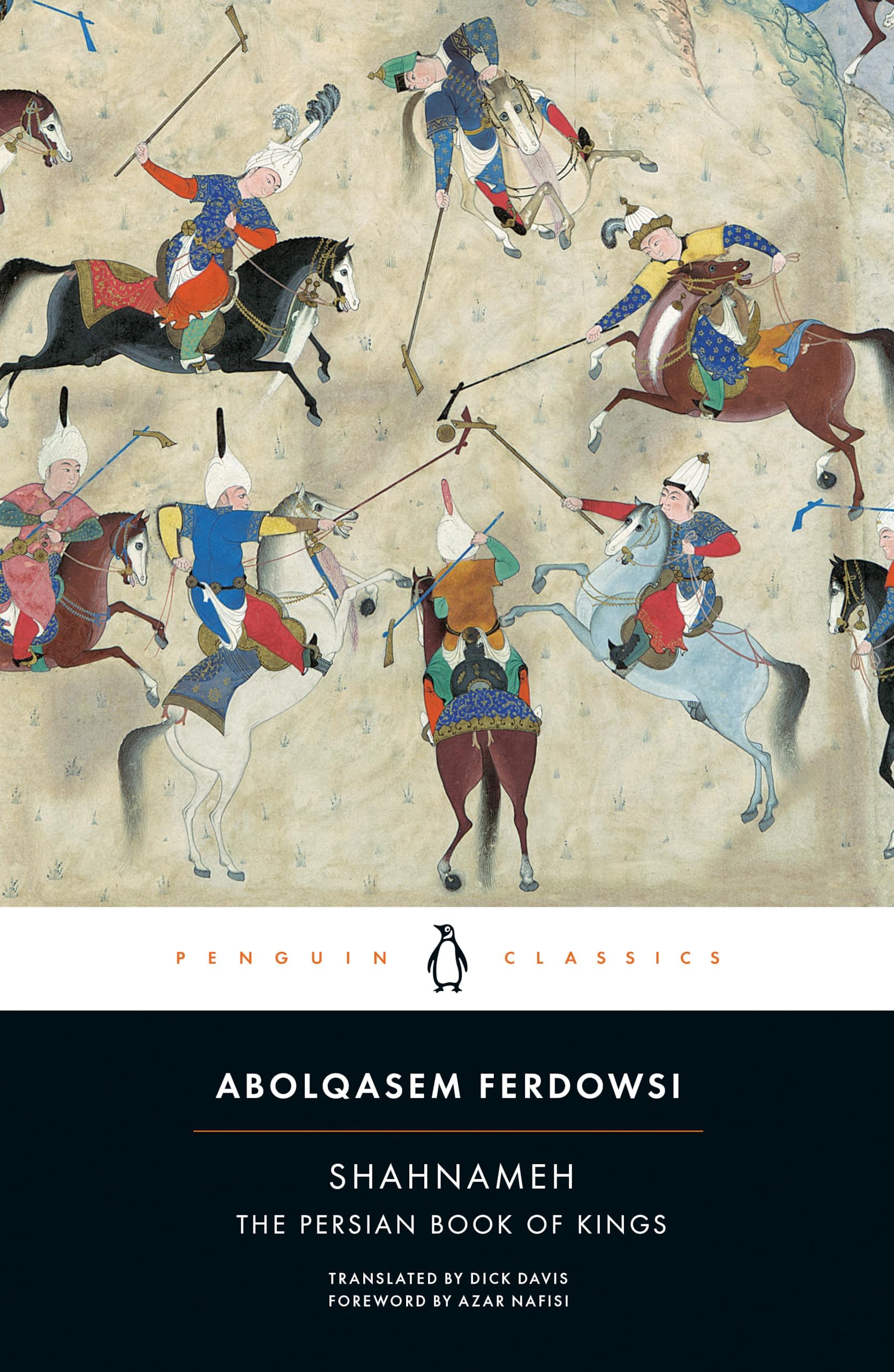

Shahnameh: The Persian Book of Kings (Penguin Classics)
Product ID: 28560401
Desertcart purchases this item on your behalf and handles shipping, customs, and support to Japan.
The definitive translation by Dick Davis of the great national epic of Iran—now newly revised and expanded to be the most complete English-language edition A Penguin Classic Dick Davis—“our pre-eminent translator from the Persian” ( The Washington Post )—has revised and expanded his acclaimed translation of Ferdowsi’s masterpiece, adding more than 100 pages of newly translated text. Davis’s elegant combination of prose and verse allows the poetry of the Shahnameh to sing its own tales directly, interspersed sparingly with clearly marked explanations to ease along modern readers. Originally composed for the Samanid princes of Khorasan in the tenth century, the Shahnameh is among the greatest works of world literature. This prodigious narrative tells the story of pre-Islamic Persia, from the mythical creation of the world and the dawn of Persian civilization through the seventh-century Arab conquest. The stories of the Shahnameh are deeply embedded in Persian culture and beyond, as attested by their appearance in such works as The Kite Runner and the love poems of Rumi and Hafez. For more than sixty-five years, Penguin has been the leading publisher of classic literature in the English-speaking world. With more than 1,500 titles, Penguin Classics represents a global bookshelf of the best works throughout history and across genres and disciplines. Readers trust the series to provide authoritative texts enhanced by introductions and notes by distinguished scholars and contemporary authors, as well as up-to-date translations by award-winning translators. Review: A Timeless Masterpiece Beautifully Presented - An extraordinary edition of Shahnameh: The Persian Book of Kings by Abolqasem Ferdowsi. The translation by Dick Davis is vivid and accessible, bringing the epic to life with elegance, while Azar Nafisi’s foreword adds meaningful depth. A stunning and essential read. Review: Great translation! - I can read Farsi but I ordered this English version because it is difficult for me to understand many words in the poetic form. This particular translation is extremely easy to understand . it is well written and the poetic integrity is intact. Two thumbs up . I bought two more for my father and my adult son

















| Best Sellers Rank | #39,668 in Books ( See Top 100 in Books ) #13 in Middle Eastern Poetry (Books) #61 in Ancient & Classical Poetry #85 in Epic Poetry (Books) |
| Customer Reviews | 4.7 out of 5 stars 532 Reviews |
A**S
A Timeless Masterpiece Beautifully Presented
An extraordinary edition of Shahnameh: The Persian Book of Kings by Abolqasem Ferdowsi. The translation by Dick Davis is vivid and accessible, bringing the epic to life with elegance, while Azar Nafisi’s foreword adds meaningful depth. A stunning and essential read.
M**M
Great translation!
I can read Farsi but I ordered this English version because it is difficult for me to understand many words in the poetic form. This particular translation is extremely easy to understand . it is well written and the poetic integrity is intact. Two thumbs up . I bought two more for my father and my adult son
P**5
A compelling work in a felicitous translation. A great pleasure. Elucidates the history covered and our times.
this is an expanded edition of Davis's earlier excellent translation. more of quite a very good thing. it is a delight to read and invites total immersion in this historical and literary world. as a general reader i was entranced by Ferdowsi's universe and Davis's language. this work elucidates the history of the entire vast region and period in a way which provides great pleasure in the work itself, admiration for its ethical and aesthetic universe, and better understanding of today's shifting alliances and dreadful conflicts (as well as circumstances in our own parlous times and characters in our own deplorable politics.) Davis's fine introduction mentions that it was impossible to include the entire work in this edition and, pressed by this stricture, the decision to leave out some of the moral minutiae (as being of less interest to contemporary readers.) certainly we could all benefit today from contemplation of moral teachings and from access to more of Ferdowsi's compelling work in Davis's felicitous and seemingly transparent translation.
J**6
Fascinating
Ancient script
D**R
A Rich Book that Keeps on Giving
The Shahnameh is an amazingly text of massive scope. It begins in legendary prehistory and continues to the Arab Conquest of Iran. Along the way you will meet complex, compelling characters who are often locked against each other in a tragic trajectory. Despite its didactic elements, the Shahmaneh offers plenty of moral ambiguity and elicits sympathy for both rising heroes and those whose stars have started to wane. The text is primarily concerned with masculine spheres, but it still features powerful and complex women from queens, to advisors, to assertive lovers, to warriors on the battlefield. The Shahmaneh also highlights the vast cultural diversity of Greater Iran. While I do not read Farsi myself, all my friends who do assure me that Davis’ is the English translation to go with, and I can vouch that it is a joy to read. Whether you are interested in pre-modern literature, the cultural heritage of Greater Iran, or just enjoy a good read, I can not recommend this highly enough.
M**I
Recommended
I love it; very well written and it has details too
M**Z
Good translation; so-so introduction
Davis' combining verse and prose is a wise choice, making this a readable 1000-pager, but more verse would transport more of the original flavour. His leaving out some sections (providing brief summaries of them) is perhaps unavoidable given the copious volume overall, but his omitting the section provided by Daqiqi, in which Zoroaster occurs and is prominent, is unfortunate: depending on how one reads and contextualises this epic, this is the most important section of all. Ferdowsi may not have composed it, but he incorporated (and possibly edited) it and built his Shahnahmeh around it; by adopting it, he endorsed it. Surely dropping some of the rather repetitive legendary hero and war stories would have been a better choice. Davis' introduction is generally adequate but its contextualisation of Ferdowsi is meagre. That the Turks (Turan) feature prominently but anachronistically in the "pre-historical," legendary part should raise eyebrows: the Turks featured heavily in the Samanid Empire in which Ferdowsi flourished, during his lifetime all but internally undermining and eventually destroying it, which surely begs the question in how far the "pre-historical" legends are camouflaged commentary and critique of events and developments of Ferdowsi's own lifetime. Such discussion may be speculative, but their anachronistic appearance must surely be taken as a "navel" (Freud) suggesting that Ferdowsi has his own present in mind when composing these legends (and that to some extent these legends, often held in the scholarship to be very ancient, are indeed fresh of the press, invented by Ferdowsi himself--in other words, to some extent this timeless epic comprises mirror of princes literature or polemic addressed at rulers contemporary with Ferdowsi.
S**I
Very interesting and eventfully epic
Most amazing part of Ferdosi book of king is that it revived and preserved the original Persian Pahlavi language that although written over 1000 years ago it is the sam's as the Farsi spoken in Iran today. Second was to bring back the Persian pride and nationalistic vigor to Iranian at the time being rulled by the Arabs that has survived to this day .... Also in my opinion, the author done an excellent job in translation to the English some resemblance of the original poetry of Ferdosi which total amazing.. I highly recommend it to all...
J**.
Fascinating
A great translation. Once started it’s hard to put down
A**E
Epic
I love shahnameh. This is the only affordable paperback version on Amazon.
L**T
Excelente libro
La épica persa, lectura amena con una buena traducción.
M**I
Great Read
As an avid reader of world literature, I recently delved into the pages of Shahnameh by Abolqasem Ferdowsi, and was absolutely captivated by the epic poem. From the very first lines, Ferdowsi's poetic language drew me into the mythical world of ancient Persia, where the gods created the universe and the first king rose to power. Throughout the poem, Ferdowsi's vivid descriptions and colorful characters brought the stories to life in a way that was both entertaining and educational. I was particularly struck by the tales of great heroes such as Rustam and Sohrab, whose bravery and sacrifice resonated with me on a deep level. Their stories, along with those of other kings and warriors, revealed a complex and nuanced view of Persian culture and history that I had never encountered before. But Shahnameh is not just a book about warriors and battles. The stories of love and loyalty, of treachery and betrayal, of human triumphs and tragedies, all wove together to create a tapestry of the human experience that transcends time and culture. Despite being written over a thousand years ago, the themes and values of the poem are still relevant today, and I found myself contemplating the lessons that could be gleaned from the pages. Overall, I would highly recommend Shahnameh to anyone interested in world literature or Persian culture. While the length and complexity of the poem may seem daunting at first, the beauty and richness of the language and the stories make it a rewarding and unforgettable read. Ferdowsi's masterful retelling of Persian history and mythology is a testament to the power of storytelling and the enduring appeal of human experience.
A**R
First 100 pages of the book are missing
Can someone explain why books starts from page 55? Introduction, 'The first kings', 'demon king-zahhak', 'story of bferaydun and his 3 sons', 'story of Iraj' and 'vengeance of manuchehr' are missing completely. Why?!?!
Trustpilot
1 week ago
2 days ago