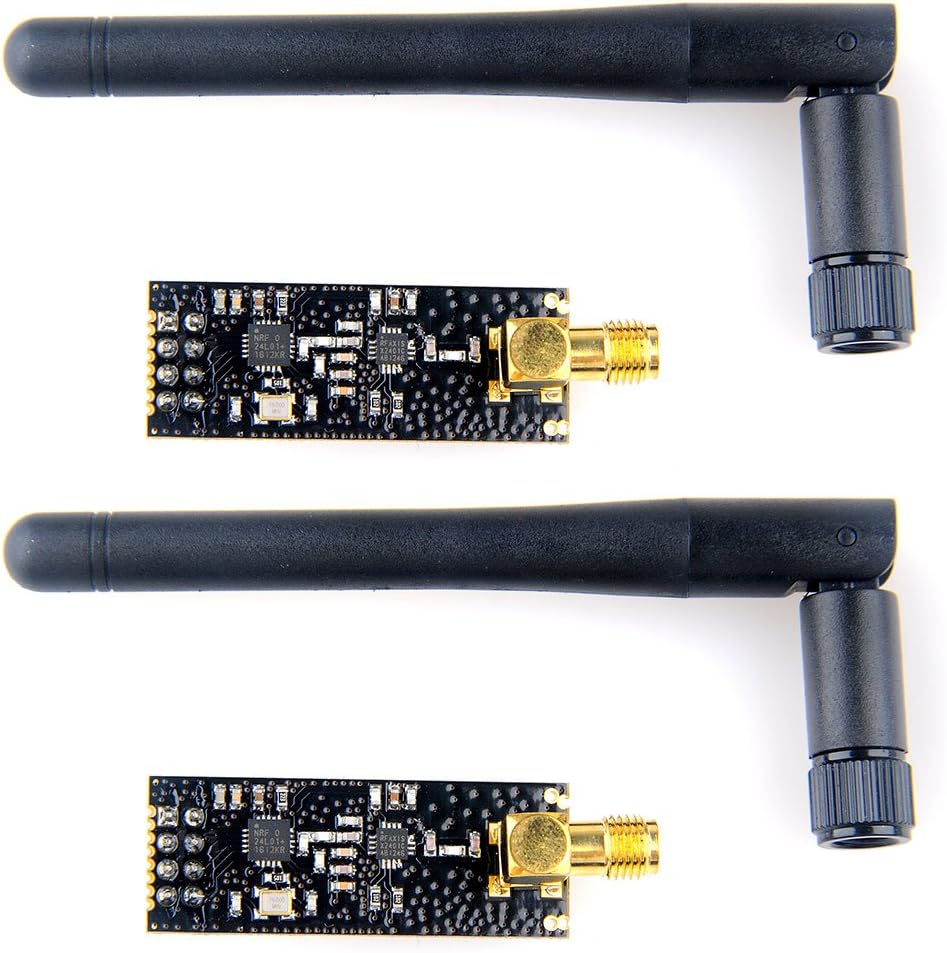
Makerfocus 2pcs Wireless Module NRF24L01+PA+LNA in Antistatic Foam Arduino Compatible with Antenna
Product ID: 269991262
⚡5V tolerant inputs
📡800+ m range
🔄Auto-retransmit & ack
Desertcart purchases this item on your behalf and handles shipping, customs, and support to Japan.
🚀 Elevate your IoT game with wireless range that breaks barriers!
The MakerFocus 2pcs NRF24L01+PA+LNA wireless modules operate on the 2.4GHz ISM band, delivering over 800 meters of line-of-sight range. Featuring integrated power and low-noise amplifiers, 5V tolerant SPI inputs for direct Arduino compatibility, and advanced auto-acknowledge/retransmit functions, these modules offer robust, customizable wireless communication ideal for professional-grade IoT and embedded projects.
| ASIN | B01IK78PQA |
| Are Batteries Included | No |
| Best Sellers Rank | #117,154 in Computers ( See Top 100 in Computers ) #1,051 in Motherboards |
| Brand | MakerFocus |
| Color | Black 2pcs |
| Customer Reviews | 4.3 4.3 out of 5 stars (153) |
| Date First Available | 5 August 2016 |
| Item Weight | 18.1 g |
| Item model number | 4328612760 |
| Manufacturer | MakerFocus |
| Product Dimensions | 10.6 x 7.8 x 0.32 cm; 18.14 g |
| Voltage | 5 Volts |
P**.
Works well, good range for my use (inside house through walls and ceiling). Trickier to get to work.
I have 2 types: the nrf24l01+ with antenna and the AS01-ML01 Quick test, they work as advertised. I did a small range test in the house, did not get any drop outs (i estimate about 300 ft). I used 1 with antenna and 1 with PCB antenna and already got improved range. I also tested a set with regular PCB board-antenna and they drop at the far end of the house, so this is an improvement in range. I also tried to get them really very close to each other without issues. They have the same standard (8 pin) connections so if you use headers you can simply swap them out HOWEVER... i have some strange experiences with the external antenna ones vs. the pcb antenna: i have several circuits and build a simple receiver and transmitter for testing these modules. I found that the PCB ones always work, the ones with antenna are trickier. They work fine in some circuits and not in others. Sometimes they only work when i touch the antenna or some of the pins with my hands and i have not figured out why it works fine in one cricuit and not in another. I think it's important to keep the (SPI) connections as short as possible, i also use a capacitor over gnd/Vcc (i tried moving from 100nF to 10uF but no change in behavior). In my case the antenna did not work when it points up 90 degrees (the obvious first one to try) but works great at some other angles. So all in all a bit finicky. Update: some people report better reliability if the module is housed in a metal case or even foil. Just be careful about short circuit
C**N
Bien
Funcionan sin problemas, ambos modulos vienen con su respectiva antena
M**H
Satisfied Customer
Plugged 'em in and they fired right up. No issues, no fuss. good product. The antennae are nice and tight so they stay in the position you 'twist' and 'bend' them into.
M**R
Well made and works wel
I havent tested these in the rain yet (little rain where I live) but so far the radios work well I had a little bit of a hard time getting them up and running. This is mainly due to I did no know if I had a known good working radio, or had a wiring problem (easily checked) or a software issue. But after doing a bit of research and testing I have had them working fine on and Arudino Mega, and Arduino Nano and a Raspberry Pi. Now that I have a known good pair adding radios should be easy.
T**.
Very Pleased With All Aspects
UPDATE: Device may have issues with temperature stability. Used in greenhouse remote controller, I found that when temps in my greenhouse dropped the communications link stopped working. It started working again when the temperature warmed up. I don't have a full engineering lab to test the frequency stability over temp, but my guess is the reference oscillator isn't well temp compensated. ORIGINAL: Received the units quickly and were packaged in protective anti-static bags inside the box. Connected to Arduino Uno R3 and used existing Arduino available libraries for drivers. Used an example program provided in Arduino library and both units were transmitting and receiving on my second attempt - the first attempt had errors due to overdriving the receiver simply had the transmit power too high for units slow close on a desk - turn power to minimum in the code and it worked perfectly. Wrote a sketch (program) to communicate back and forth between two units with text just to try it out. Saw some complaints from other reviewers about not working or communication being error prone - not the case for me at all. I just made sure that each radio was separated a few inches from the Arduino control unit (to avoid radiated noise into both transmitter and receiver) and that the Transmit power was at minimum when units are in close proximity (to avoid over-driving the other unit's receiver). I am using them with the 3.3V breakout boards also available on Amazon since they are high transmit power capable and have not had to add any capacitors to reduce noise on the power supply lines line some people mentioned as being required in some Arduino forums. The library also features the ability to turn on CRC error detection or you can add some yourself...there are ACKs and all sorts of features for enhancing the reliability of the communication. Good luck!
Trustpilot
5 days ago
1 month ago