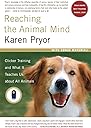
Reaching the Animal Mind: Clicker Training and What It Teaches Us About All Animals (A Gift for Animal Lovers)
Product ID: 2694999
Desertcart purchases this item on your behalf and handles shipping, customs, and support to Japan.
From the founder of “clicker” training, the widely praised humane approach to shaping animal behavior, comes a fascinating book—part memoir, part insight into how animals and people think and behave. A celebrated pioneer in the field of no-punishment animal training, Karen Pryor is responsible for developing clicker training—an all-positive, safe, effective way to modify and shape animal behavior—and she has changed the lives of millions of animals. Practical, engrossing, and full of fascinating stories about Pryor’s interactions with animals of all sorts, Reaching the Animal Mind presents the sum total of her life’s work. She explains the science behind clicker training, how and why it works, and offers step-by-step instructions on how you can clicker-train any animal in your life. For bonus video clips, slide shows, articles, downloadable exercises, and links expanding on the contents of the book, go to ReachingtheAnimalMind.com. Review: If you love animals, you need to buy this book. (Which, as an added bonus, it will teach you a lot about humans too). - As an already disabled woman, a recent diagnosis of a progressive brain disorder on top of everything else I live with daily was pretty devastating. One of the most highly recommended cognitive supports for me was a service dog. I don't know how long I will be able to personally train such a dog before my condition is too advanced, so we immediately set to work choosing a puppy and a training program. I could not be happier with the choice I made with this book and clicker training in general. "Reaching the Animal Mind" is both supremely practical in it's approach and very enlightening as to how both animals and humans really learn, and can become more active, happy participants in learning. It is an excellent way to tune in to an individual animal and connect, because to do it at all requires you to be focused on POSITIVELY REWARDING THE BEHAVIOR YOU WANT, and spotting the very first instant that the animal moves in the direction of that behavior. The animal is getting attention and instant reinforcement for doing well, instead of having meaningless words thrown at it in increasingly frustrated tones, while it tries to figure out what you could possibly want. I thought I was a positive person with my animals until I tried the training set out in this book. I was amazed at how hard it was at first to stop looking first and foremost at the negative and reacting to it over and over. It is still a challenge, but the great results and even greater happiness it brings to myself and my puppy when I do it right make it very worthwhile. As a side note, if you have trouble lining up your words the way I do now, you will love how the clicker allows you to respond to the animal's behavior instantly, with no frustration, while you try to get out that "good dog" before the behavior is already past and done. I highly recommend this book. Review: A Misleading Title for a Fascinating Book - This book is about far more than reaching the "animal mind", even if you include the human animal. Karen Pryor is one of those rare writers who can take information from several scientific fields, see how they interact and make the whole thing fascinating to the non-technical reader. She starts out by saying that she won't regurgitate what is found elsewhere or rephrase other people's experiences, instead she uses her own very wide experience to illustrate how she became a pioneer of a new way of teaching dolphins, dogs, zoo animals and finally people. Here you will meet a wolf named D'Artagnan who had learned that he could make people back away by rushing his fence and showing what big teeth he had. With a coffee can full of kibble and a dolphin-trainer's whistle, she convinces him that it is much more fun to show off how fast he can run to a tree and back. And for that the no-longer-scared humans give him kibble. Good deal. There are videos taken during some of the experiences described so that you can meet some rare birds whose looks only a mother (or a zoo biologist) could love. If they are too stressed to eat by being in captivity, they may well be last of their species. Enter a keeper trained in the new methods who teaches them not only to eat, but to let themselves be weighed and most rewarding, to play with toys. And you will meet sports coaches who stop yelling at the athletes and telling them what they are doing wrong. Instead they are able to pinpoint exactly the moment when the legs are perfectly straight or the shoulder is exactly aligned or the toe is pointed and turned out correctly. All by applying the same methods in a system called TAG Teaching. And as a bonus, there is a section describing the latest work by neurological researchers into the physical why this all works. The only drawback is that you find yourself dropping everything and starting to work with the nearest dog, cat, ferret, tropical fish or teenager. Be warned.
| Best Sellers Rank | #240,217 in Books ( See Top 100 in Books ) #229 in Dog Training (Books) #461 in Zoology (Books) #1,246 in Fauna |
| Customer Reviews | 4.6 out of 5 stars 529 Reviews |
H**N
If you love animals, you need to buy this book. (Which, as an added bonus, it will teach you a lot about humans too).
As an already disabled woman, a recent diagnosis of a progressive brain disorder on top of everything else I live with daily was pretty devastating. One of the most highly recommended cognitive supports for me was a service dog. I don't know how long I will be able to personally train such a dog before my condition is too advanced, so we immediately set to work choosing a puppy and a training program. I could not be happier with the choice I made with this book and clicker training in general. "Reaching the Animal Mind" is both supremely practical in it's approach and very enlightening as to how both animals and humans really learn, and can become more active, happy participants in learning. It is an excellent way to tune in to an individual animal and connect, because to do it at all requires you to be focused on POSITIVELY REWARDING THE BEHAVIOR YOU WANT, and spotting the very first instant that the animal moves in the direction of that behavior. The animal is getting attention and instant reinforcement for doing well, instead of having meaningless words thrown at it in increasingly frustrated tones, while it tries to figure out what you could possibly want. I thought I was a positive person with my animals until I tried the training set out in this book. I was amazed at how hard it was at first to stop looking first and foremost at the negative and reacting to it over and over. It is still a challenge, but the great results and even greater happiness it brings to myself and my puppy when I do it right make it very worthwhile. As a side note, if you have trouble lining up your words the way I do now, you will love how the clicker allows you to respond to the animal's behavior instantly, with no frustration, while you try to get out that "good dog" before the behavior is already past and done. I highly recommend this book.
P**N
A Misleading Title for a Fascinating Book
This book is about far more than reaching the "animal mind", even if you include the human animal. Karen Pryor is one of those rare writers who can take information from several scientific fields, see how they interact and make the whole thing fascinating to the non-technical reader. She starts out by saying that she won't regurgitate what is found elsewhere or rephrase other people's experiences, instead she uses her own very wide experience to illustrate how she became a pioneer of a new way of teaching dolphins, dogs, zoo animals and finally people. Here you will meet a wolf named D'Artagnan who had learned that he could make people back away by rushing his fence and showing what big teeth he had. With a coffee can full of kibble and a dolphin-trainer's whistle, she convinces him that it is much more fun to show off how fast he can run to a tree and back. And for that the no-longer-scared humans give him kibble. Good deal. There are videos taken during some of the experiences described so that you can meet some rare birds whose looks only a mother (or a zoo biologist) could love. If they are too stressed to eat by being in captivity, they may well be last of their species. Enter a keeper trained in the new methods who teaches them not only to eat, but to let themselves be weighed and most rewarding, to play with toys. And you will meet sports coaches who stop yelling at the athletes and telling them what they are doing wrong. Instead they are able to pinpoint exactly the moment when the legs are perfectly straight or the shoulder is exactly aligned or the toe is pointed and turned out correctly. All by applying the same methods in a system called TAG Teaching. And as a bonus, there is a section describing the latest work by neurological researchers into the physical why this all works. The only drawback is that you find yourself dropping everything and starting to work with the nearest dog, cat, ferret, tropical fish or teenager. Be warned.
C**L
The most important part of training is this book!
The foundation book of clicker training. This is the ABC book you need on +R Do yourself the favor and buy it. It will change how you think about training.
A**R
Lots of Interesting Anecdotes and a Few Pointers For Clicker Training
In Reaching the Animal Mind, Karen Pryor shares a lot of personal anecdotes about clicker training experiences she has had, and they are fascinating stories. Each of the stories illustrates a point that she is trying to make about the nature, practice or outcome of clicker training. The anecdotes are short and sweet and are often very poignant or funny which makes for engaging and interesting reading. This book focuses on clicker training's capacity to be applied in many different types of situations and its usefulness in shaping the behaviors of animals of almost any species. Ms. Pryor shares her experiences with clicker training all sorts of animals from guppies and chickens to horses and even to humans. This book is certainly not an instruction manual or how-to guide for clicker training. In fact, there are only about ten pages of "how-to" instruction where Ms. Pryor tells readers how to teach their pet cats to give high fives or how to get your golf or tennis coach to clicker train you to improve your swing. If you want to learn how to clicker train your dog, this book won't help you much. However, it will inspire you to try clicker training and give you creative ideas for how to use clicker training. Reaching the Animal Mind is almost purely a compilation of stories about the positive outcomes that came about in situations where clicker training was used. The tone of the book is very optimistic, making clicker training sound like the ideal solution to almost any behavior problem in both animals and humans.
H**R
Very insightful
I really enjoyed reading this book - and here I thought it would feel like work to read something like this. I almost feel as though the repetitiveness of how and why positive reinforcement works along with the timing of the great stories about the various animals she's trained is just Karen training us humans to use positive reinforcement the same way she trains other animals - with positive reinforcement! I've committed to using her clickers that I also bought on Amazon. It's a much better clicker than the free ones from puppy training or the cheap ones at the store. Worth it to buy this book, Don't Shoot the Dog (though I haven't finished it yet) and the clickers as a set. So far I've seen some improvement in my very hard headed, smart, stubborn 1.5 year old yellow lab mix by following Karen's guidelines. There are some things I don't think this answers - in my case I don't know how to apply it to my dog who shows frustration aggression towards my other dog when he can't get to something/someone/somedog he wants to play with. However, he is getting better at paying more attention to ME and that is priceless - he's gotten better at his usual commands - sit, lay down, shake, come, stick em up - and he's learned a few new ones easily with the clicker training - nose bump (like a fist bump), dance, roll over, bark, pick a hand. Stay and quiet are proving to be the most difficult, but I can tell he's catching on.
S**P
Not Just for Animals!
I feel the need to stress, up front, that while this book would appear to be a book about training animals, it has fundamental applications for anyone wishing to change or shape behaviour. You may have heard of Karen Pryor because of her now famous book, Don't Shoot the Dog!: The New Art of Teaching and Training. It was purchased by many dog lovers who then discovered it wasn't necessarily about training dogs! Reaching The Animal Mind Karen Pryor's book is based on BF Skinner's research with operant conditioning. The clicker is basically a metal tongue in a plastic housing that makes a click sound when pressed and is used to `mark' quite specifically the desired behaviour. There is hard scientific evidence to back up her work. Pryor, however, avoids the usual boring academic style of writing in favour of a lighthearted approach that makes it fun and humorous to read. Pryor began training dolphins at Sea Life Park in Hawaii in 1961. Remember that very little was known about dolphins in 1961. Her main qualification for getting the job was that she was married to the Director of the park. The other trainers were having only limited success with training the wild caught dolphins. This book follows Pryor's journey as she trains creatures as diverse as wolves, dolphins, horses, elephants, fish and dogs. She even trained a hermit crab to ring a bell. Have an open mind This book should be read with an open mind and the many step-by-step examples make it easy to understand why clicker training can be used to train ANY animal (including the human animal). There are many short videos on her web site showing how clickers are used with animals and people to achieve amazingly quick and often stunning results. When used with humans, clicker training is renamed TAG training (Teaching with Acoustical Guidance). Although it's exactly the same, some objected to the term `clicker training' being used with people because it's become associated with animal training. Improve sports performance Golfers, gymnasts and other sports people have all improved their performance with TAG training and children are able to TAG each other as peers. Autistic or disabled children have been taught ways to improve their behaviour. A group of fishermen were also trained to improve their performance despite language barriers. There's a description of how a group of young girls were taught to do a Fosbury Flop over a high jump in just 15 minutes of TAG training. You can watch the excellent video that goes with it on the Reaching the Animal Mind web site. The impact on the brain Karen proves that you can train any animal to do anything that it's physically and mentally capable of doing. The thing that I've found the most fun is exploring just how far those mental and physical capabilities extend. One of the most fascinating things about this book is that the `click' sound the clicker makes has a direct impact on the amygdala, the reptilian part of the brain. It registers the click as `new information' and all brains are wired to search out new information. Absolutely fascinating reading and recommended for those who have an interest in how people and animals learn and how behaviour can be shaped using only positive reinforcement.
P**N
Every animal person should read this book
When I was around 11 years old, I browsed the stacks in my local library for a book about dolphins. Among the books I took home that day was Karen Pryor's Lads Before the Wind : Diary of a Dolphin Trainer , her account of her instant transition from the boss' wife to the head trainer: a few weeks before the grand opening of Sea Life Park in Hawaii, the original hired trainers were gone, and there were no new ones to be had. Pryor, the only person in the group with animal training experience (she'd had dogs and ponies) was given a thick binder of instructions, some porpoises, and a whistle, and an impossible deadline. Through persistence and trial and error, they pulled it off. At first her memoir frustrated the young perfectionist me, because I wanted to read about the atlantic bottlenoses I'd seen, not these strange pacific porpoises... but not only did I read it cover to cover, I checked it out again and again. That she told not only of successes but of failures was deeply informative. It made a profound impact on how I related to animals, even if I didn't exactly use what would later be called "clicker training" myself. When I found a copy in a used bookstore as an adult, I marveled at my good fortune, jumping up and down at my find, and I've been able to reread it many more times. I was surprised and pleased to discover that in fact it was still in print, and bought copies for friends. I have been recommending it to other horsemen for years as one of the best animal training books anywhere. When I found this new book, I could hardly wait to read it. The opening chapters of this latest work retell some of the same anecdotes from Sea Life Park, and at first I worried that this would just end up being a rework of that earlier memoir, perhaps with some new anecdotes blended in. To see Pryor's work making life better for zoo animals and their keepers is a true pleasure; indeed, I've seen this for myself in zoos without realizing that this was becoming an organized conventional wisdom for working with animals deriving from her work - training them to present a wing, to walk from one location to another, to follow a target, and perhaps most importantly, to communicate back with their keepers. The training gives both animals and keepers more control and more fun in their environment. How many people know you can train a fish to jump through a hoop, or that a fish will sulk if it doesn't get the reward it deserved? By the second half of the book, Pryor (who has many scientific papers to her credit) is relentlessly looking for the science. She knows that it works, and in a wide range of species. But why does it work? They do experiments comparing the use of the clicker to the use of a voice marker for training dogs, and to my surprise, the clicker is hugely more successful. (We humans do babble on.) She seeks answers from neuroscientists, finds dead end after dead end until finally she finds the group who knows exactly what is going on, and is surprised that everyone didn't know that a clicker event marker goes straight to the amygdalia - what I personally think of as the "lizard brain", where all our instinctive reactions are stored. The same instant and permanent learning that occurs that keeps you from putting your finger in the fire a second time is occurring with clicker training. A click is information, and all brains are wired to crave information. She finishes up with applications of the clicker technique - truly a new training technology - to humans. Human gymnasts can be told that handstands must be vertical, but when they're upside down, they don't know where vertical is at first. A clicker - with the term changed to audible tag - can be pressed exactly at the vertical point with more precision and in less time than the coach can say, "there!" And human brains, hearing a click rather than trying to do the sensory processing to follow the words, can take a snapshot of exactly what that felt like right then and repeat it. Tagging can be used to help highly tuned and motivated athletes by both breaking down a skill into very small pieces and by giving very precise nonverbal information. And, of course, this means it can have value in other situations, where people speak different languages or who have no language. In the appendix, there are a multitude of references, including pointers to online videos of some of the training incidents reported, and some simple shaping recipes to teach a cat to give a high-five, and a dog to touch a target. I appreciated how they were broken down into very small details, down to practicing your hand coordination beforehand to know that you can click the clicker when you mean to, and present food tidbits without fumbling. This is an outstanding work that is certain to become a classic. I'm looking forward to buying copies of this book for my friends, too.
F**G
Too much non-specific detail for me.
I have no doubt about Karen Pryor's experience or skills in clicker training but for some reason I could not relate to this book and almost didn't finish it. IMO, it went on and on about her trailblazing years of clicker training cats-wild and domesticated, horses, dolphins, etc. If you want to know all about clicker training from its beginning to present day application...this is the book for you. If you want to learn specifically about clicker training dogs whether you are a trainer, wanna be trainer or like me a pet owner that is interested in clicker training her 3-month-old pup...Gail Fisher's "The Thinking Dog....." clicker training manual is right on and an excellent source for understanding the differences between thinking dogs and humans.
B**.
Amazing content, but the videos are not working now ?
Nicely writen with small stories that help understand the processus. Very nice reading. I red a firt 75-page on the first day and I am looking forwward finishing it today. It is now impossible to access the videos today, however.
C**N
Très utile.
Très éclairant en ce qui concerne les apprentissages (du chien en ce qui me concerne). A recommander !
M**Z
Fundamentos básicos de entrenamiento
Karen Pryor es una de las pioneras en el entrenamiento con refuerzo positivo usando herramientas como clicker o silbato, a través de anécdotas ella describe cómo funciona el condicionamiento clásico y operante con diferentes especies.
M**R
If everyone read this book, everyone would be converted to Clicker training!!!
As a dog trainer in my local club specialising in Clicker training, this book was an absolute joy! I read it in one evening, alternately crying and laughing out loud! If you ever wondered whether it was really worth trying the clicker, read this book and it will convince you! If you already use it, read this book to remind you how well the method works and how much fun you and your animals can have training using it! Also, confirms the special way the clicker noise itself runs straight to the 'reptile brain' rather than the cognitive part of the brain, meaning that using a clicker rather than just a 'clicker word' really is better! I loved this book and will be recommending it to my clicker training students rather than Karen's older book, 'Don't shoot the dog!', as it is more aimed at animal training for the most part.
A**R
One thing if you learn new from the book then it deserves 5 star and a + from me.
In life several days go by when I learn nothing New on my subject of liking. Even if when I learn one new thing its worth all the money. This book has several things I did Not know at age 67 ! So.... And Amazon delivery was prompt.
Trustpilot
2 weeks ago
1 day ago