Buy anything from 5,000+ international stores. One checkout price. No surprise fees. Join 2M+ shoppers on Desertcart.
Desertcart purchases this item on your behalf and handles shipping, customs, and support to Japan.
⚡ Drive your projects with unstoppable power and precision!
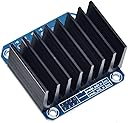
The HiLetgo BTS7960 is a high-power motor driver module featuring a 43A max current capacity, dual H-bridge design for bi-directional motor control, and integrated thermal and over-current protection. Compatible with 6V to 27V input voltage and controlled via simple PWM signals, it isolates and safeguards your microcontroller while delivering reliable, high-performance motor driving for smart car and robotic applications.
| Customer Reviews | 4.3 out of 5 stars 270 Reviews |
W**U
Worked great. For medium to small torque application.
Documentation is slightly lacking. Controls one motor bi-directionally. I used with an Arduino Mega (2 pwm pins, 5v times 3, and GND). I used them for a large robot (IGVC so ~100 lbs) and it worked very well on carpet and pavement but unfortunately the thick grass caused the bridge to eat about 8 out of 12 VDC so the wheels wouldn’t break away. They were undersized for this application but the linearity of operation in both directions is excellent. Had no issues with heat. All 4 came in excellent condition. Great for a medium to small torque application. I’ll find another use for them.
M**2
Prompt shipping and it works fine!
HiLetgo contacted me (email) the day the part arrived, was it functional and was I satisfied? Yes to both so I can't comment on their customer service. I've only tested the driver under light loads (<2A) and it works great. Other reviews suggested inspecting the driver before applying power, which is a good idea regardless, and I found several tiny solder balls lurking behind pins of the BTS7960 ICs. The driver was shipped in a padded mailer, encountered some rough handling and several header pins got bent (straightened with pliers). Other comments: mine arrived with no documentation (easy to find, just search IBT-2) and "the supply voltage 5.5V to 27V." means motor (load) voltage range. It will not work with 5V. Yes, I would buy more.
F**N
Low heat thanks to MOSFETs — Serious but fixable manufacturing flaws — Hints on PWM frequency
The lowdown — This module produces much less heat than designs not using MOSFETs. But beware of a potential short-circuit you have to check first. And if you aim to use it at high currents you need to address a manufacturing flaw. As for packaging, an earlier complaint, it now comes in a sturdy little box at least from this supplier. No more bent pins! MOSFET H-bridges such as the BTS7960 generate much lower heat than more common designs built around BJTs such as the L298. But whatever heat gets generated goes somewhere. Here it flows by way of tiny thru-holes called vias to a large heatsink bolted to the back. These vias are supposed to be filled with solder to provide thermal conductivity. A cute approach, but my module contained only 2 out of 60 intact thermal vias. See photo. This is a serious manufacturing flaw rendering the heatsink completely useless. The second flaw is a potential short. The anodized surface of the heatsink is very thin as other reviewers pointed out as well. This surface broaches easily, shorting out the motor terminals because the two chips' metal casings are internally connected to the two output pins. Check this before first use. As for the heatsink, at low current you can remove it altogether. I did this for a 4A-25W application running at 25kHz PWM frequency.* Almost no heat. So try this first. You can use the chips as guide because they shut down in case of overheating. This approach takes care of both issues at once. You have to make repairs if it gets too hot for the currents you are running. Gently scrape the lacquer off the rectangular areas. Drill out the holes to a slightly larger diameter. Cover the now bare copper surface with solder, making sure to fill up all the vias and keeping the solder surface as level, thin and smooth as possible. Then remount the heatsink with a thermal pad in between to provide electrical insulation. This also solves both flaws but now for higher currents. Note that the 43A current limit is lifted from the chips' spec sheet. It requires sufficient cooling. It seems unlikely that even perfectly filled-in vias provide enough heat flow to allow high currents before overheating. But it's worth a try. A next step would be to cut out the via areas altogether and use copper shims instead. Do remember the electrical insulation. Addressing the module is straightforward. There are plenty of videos and written application notes to show you how. Control signals are wired up with 2.43mm pitch DuPont connectors. The signal pins are marked well. All signals are buffered for isolation and safety, a very nice touch. The screw-type terminals on the power side are solid and adequately sized. Summing up — The major advantage of designs based on MOSFETs is very low heat loss. Indeed, at lower currents this module can be used without a heatsink. And this is a sophisticated chip with built-in overcurrent and overheating protection. Buffering its well-marked control and monitoring signals is an elegant touch. The price is very low for a device with this potential. And you can use it at higher currents after a fix. Subtracting one star for manufacturing flaws. _______________ * There is an excellent free Arduino library that allows PWM frequencies into high kHz range. (Arduino's standard analogWrite operates around 500Hz.) High PWM frequencies lead to smoother running and eliminate whine with somewhat more switching heat. It’s all a balance. Amazon does not allow external links in its reviews so look for pwm-frequency-library in the official Arduino forum.
K**P
Excellent quality and value for money.
Good quality. Handles the rated wattage.
A**R
Dirt poor design and assembly. Two units non-functional upon delivery.
If you read reviews; you already know units include bent header pins and overheating issues. However this review will address root cause of fundamental design and manufacturing deficiencies. Header pins are bent because all units are placed directly in ant-stat bag without protection; 80:20 chance you will receive damaged header pin. More seriously are design and manufacturing issues that render device non-functional and limit advertised performance. Design uses BTS7960 IC, which represents good performance H-bridge driver. However PCB design accommodates poor thermal heat transfer mechanism from chip tab to heatsink. PCB uses array of vias to transfer thermal flow to aluminum heatsink. This approach is completely inadequate to remove sufficient energy from chip for operation anywhere close to 43A as advertised. To make things worse, design includes no thermal pad under heatsink to electrically isolate or increase Q-flow. Both units purchased non-functional out of box, with direct short-circuit between motor output terminals. This short-circuit was due to fact heatsink aluminum was bolted down directly against bare PCB vias, without any electrical isolation pad. Apparently designer intended to use aluminum heatsink thin layer of anodized coating to provide reliable electrical isolation between motor outputs (which most likely was sufficient to pass factory testing). This problem can be corrected by adding thermal pad under heatsink. However Q-flow problem is still insufficient to remove energy for full current operation. Solution: Remove both IC's from PCB. Machine two square holes through PCB directly under IC's thermal tab. Place copper heat transfer pads on back of IC's to conduct Q-flow through PCB. Place silicone isolation pad between copper pads and aluminum heatsink. Finally place 50mm fan on threaded spacers directly under heatsink fins using existing PCB mounting holes. Now unit will function as intended.
J**E
BTN7960B Motor Driver
This is a very affordable and cost effective solution for driving large DC motors via PWM. I did a lot of research and found the Infineon single bridge IC's were the best sporting dual FETs and a driver all in 1 IC package! They have newer model ICs that support up to 70A spikes and 50A continuous but nobody has made a mass produced cheap module like this one. Searching for the Infineon IC model BTS7960B (Really BTN7960) will bring up this IBT-2 motor driver from everywhere. I would like to see the BTN8982 IC mass produced like this. Anyways, this IBT-2 motor controller also has a 74HC244 Octal buffer which isolates your Arduino/PIC/Arm microcontroller from the Infineon ICs. Good protection. Each IC can either drive 1 motor in 1 direction (2 Motors total -> One way) -or- you can combine them to form an H-Bridge and control 1 motor bi-directionally (Forward and reverse). I like configuration #2. If you are going to use this in H-Bridge mode, you must have the enable pins on BOTH ICs active. 1 IC will drive your + side, the other will be the - side and so both IC's must be enabled to conduct. Send a PWM signal @ 1khz-25khz to either IC to drive your motor in that direction. You will have to work out the logic to make sure you are PWMing on 1 input at a time. Last but not least I ordered 2 of these controllers and one of them came with mistakes, really bad mistakes. Like its gonna smoke and sizzle if you were to just plug it in and use it. Both ICs had obvious solder bridges between different sets of pins. These were not ground pins. One pair was Inhibit -> OUTPUT. The other bridge was OUTPUT -> Slew Rate. The chip was also skewed to the point where the slug(output) was a micrometer from the left ICs output. They were almost touching each other. Had to do some rework which I love doing anyways :). Pictures attached. I added solder to fill in some vias for heat transfer to the radiator. Also added some thin ceramique paste for the radiator. The solder pad on the left is OEM...not much solder in them vias. There is a "Too Much" limit though. You don't want the heat IN the solder, just transfered.
M**M
Great deal
I bought this for an automation project I was working on. I found it to be easy to use, and it works for me with no issues. Due to some other reviews, I did remove the heat sink and apply some heat sink compound prior to using it. I also checked for any solder bridges or short circuits prior to powering it up. Mind didn't have any solder bridges or shorts. For my project the motor doesn't run for more than 30-45 seconds at a time, with a good break in between, so heat is not an issue. I would buy one again if I needed it.
C**G
Works fine
The first one that I received died on arrival- it would move the motor in the forward direction, but would not move in the reverse direction. Second one that I got worked fine. I am using this with a microcontroller and limit switches to move a 24V linear actuator back and forth. There really isn't much to this controller but the relevant pinouts I used were: VCC- I provided 3.3V to this pin, but it's supposedly fine for 3.3 to 5V operation GND- ground L_EN and R_EN: Forward and reverse enable. I simply tied these together to VCC to enable the forward and reverse function LPWM and RPWM: Forward and Reverse control. You can PWM control these for speed control (or alternatively, use a single PWM control on L_EN and R_EN with normal logic voltage on LPWM and RPWM but that is incredibly inefficient), but for my purposes I just applied 3.3V and that worked fine for full speed control. I have not had to use the current alarm/sensing pins for my project, but if you are using a non-PWM signal to drive your motor, you can connect a 1k-ohm resistor to these pins and ground and read the voltage across that resistor- 1V=8.5A or about 120mV per amp.
C**D
Correct
Très bon produit Efficace Qualité correct
P**Í
Potencia
Fácil de configurar, lo uso para controlar piloto automático embarcación
N**M
works no flaws first time
works like BTS7960
M**E
Very handy module to have at a great price. I had some trouble trying to use ...
Very handy module to have at a great price. I had some trouble trying to use mine, but I think the problem was with my attached circuitry. The first one I bought is now happily running and the spare waiting for something big to drive (I've checked it works). Having the current sense pins of the drivers available is a nice bonus although I didn't try to use it. Like some other reviews, my first module had one of the driver chips dodgily attached, with a couple of its pins very close together. Easily solved but potentially catastrophic, so check yours over before use. Both modules also arrived with the control headers a little bent as they're shipped in nothing but an anti-static bag. Again easy to fix but also easily remedied by the supplier with a cardboard box.
C**I
SCHEDA DI POTENZA PER LA GESTIONE DI UN MOTORE DC
Questa è la seconda scheda di potenza che acquistiamo e funziona molto bene .Attualmente la usiamo a 12 VDC ma le prossime applicazione che realizzeremo saranno per motori DC a 24V , dopo potrò dire come funziona anche a quella tensione. Attualmente viene utilizzata abbinata ad una scheda di ARDUINO. Prodotto molto valido
Trustpilot
1 month ago
2 months ago