Some deliveries may take a little longer than usual due to regional shipping conditions.

DOWNLOAD THE APP


Customer Services
Copyright © 2025 Desertcart Holdings Limited
DOWNLOAD THE APP

🍏 Stay ahead of food risks with Greentest—because your health deserves precision!
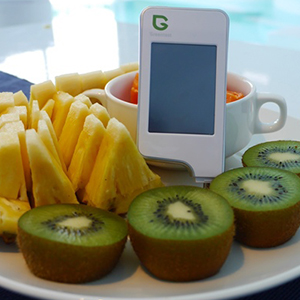
The Greentest High Accuracy Food Detector (Version 2) is a compact, USB-rechargeable nitrate tester designed to deliver fast, reliable readings within 3 seconds. Certified to exceed 90% accuracy by third-party labs, it supports testing over 50 varieties of fruits and vegetables, making it an essential tool for small-scale farmers, distributors, and health-conscious consumers aiming to ensure food safety and quality.




| ASIN | B01FJ9722K |
| Best Sellers Rank | #162,883 in Health ( See Top 100 in Health ) #317 in Home Medical Tests |
| Customer Reviews | 4.0 4.0 out of 5 stars (42) |
| Date First Available | 16 January 2020 |
| Item Weight | 45.4 g |
| Item model number | WDFRDATION-1 |
| Package Dimensions | 16.21 x 8.79 x 4.19 cm; 45.36 g |
M**A
Great device! No calibration, quick results on nitrate levels on a variety of vegetables and fruits + background radiation. Easy to charge using a standard USB (5V) charger. Charged it once, used it many, many times and still shows a full charge.
N**L
A great, and very useful product. With so much contaminated foods around, one has to safeguard one's family from related illness, This tool will certainly help if always used when purchasing your beef, veggies and fruits. I add, this seller provides excellent customer support throughout the shipping processs for the total satisfaction of the customer.
V**V
Great little gadget but it's missing a few vegetables and fruits from the list. Is it possible to add dates, avocado, and papaya to the list?
L**.
Works as advertised, quite eye opening on produce in stores vs earthy stores. Just bought another one for my gran niece, who has digestive issues
A**K
Look folks, I really wanted to like this one, but after testing it, comparing to other devices and even taking it apart, I fount it to be mostly useless at best. Although technically it does work, this device can only be used for very general reference and under perfect conditions. Results are inconsistent and highly unreliable. Allow me to explain. There are two tings this unit is supposed to detect: a) ionized (harmful) radiation b) nitrates in edible produce Radiation: It does detect Gamma and Beta, true. Mostly gamma though and a very limited amount of beta to the point of barely seeing it at all, unless radiation levels are considerably high. Overtime I have tested several different geiger-muller tubes, including Chinese and Russian ones, but I was unable to identify the one Greetest is using. It is smaller in size than most sensors of its type, which means its sensitivity and ultimately accuracy would both also be less simply because there are fewer ionized particles being detected. I have also tested this model on a bag of naturally radioactive fertilizer which emits almost exclusively beta. My professional-grade equipment showed 0.4 uSv/h. Greentest showed "normal" 0.22, which is half of what the actual level is. Conclusion: as a radiation detector this particular model is comparatively weak and inefficient even among low-cost devices. Again, it's good for only very general reference. Nitrates: This is my biggest peeve with this unit and what it claims to do. After doing some research and taking it apart, I can see that the sole principle here is conductivity, ie how well an electrical circuit passes through the mass of a vegetable. Salts like nitrates, nitrides and all sorts of different minerals are in there, both good and bad. This device does not differentiate and just measures everything at once. That means if a tomato or a watermelon was grown in soil which has elevated content of minerals, that would show up as "dangerous", even though the actual level of nitrates can be normal. I have used this particular device on a tomato and because of how the conductivity works, different depths of the fruit showed radically different results, sometimes by the factor of 10! Conclusion: this device measures conductivity, not "nitrates". I mean yes, it does detect nitrates, but along with every other type of salt and mineral that's in there, good and bad without making very important distinctions. This means to me this is useless, because I only need to know the bad stuff, ie nitrates and nitrides. At best, the pictures and descriptions are deceptive.
Trustpilot
2 days ago
3 days ago