
DOWNLOAD THE APP


Customer Services
Copyright © 2025 Desertcart Holdings Limited
DOWNLOAD THE APP
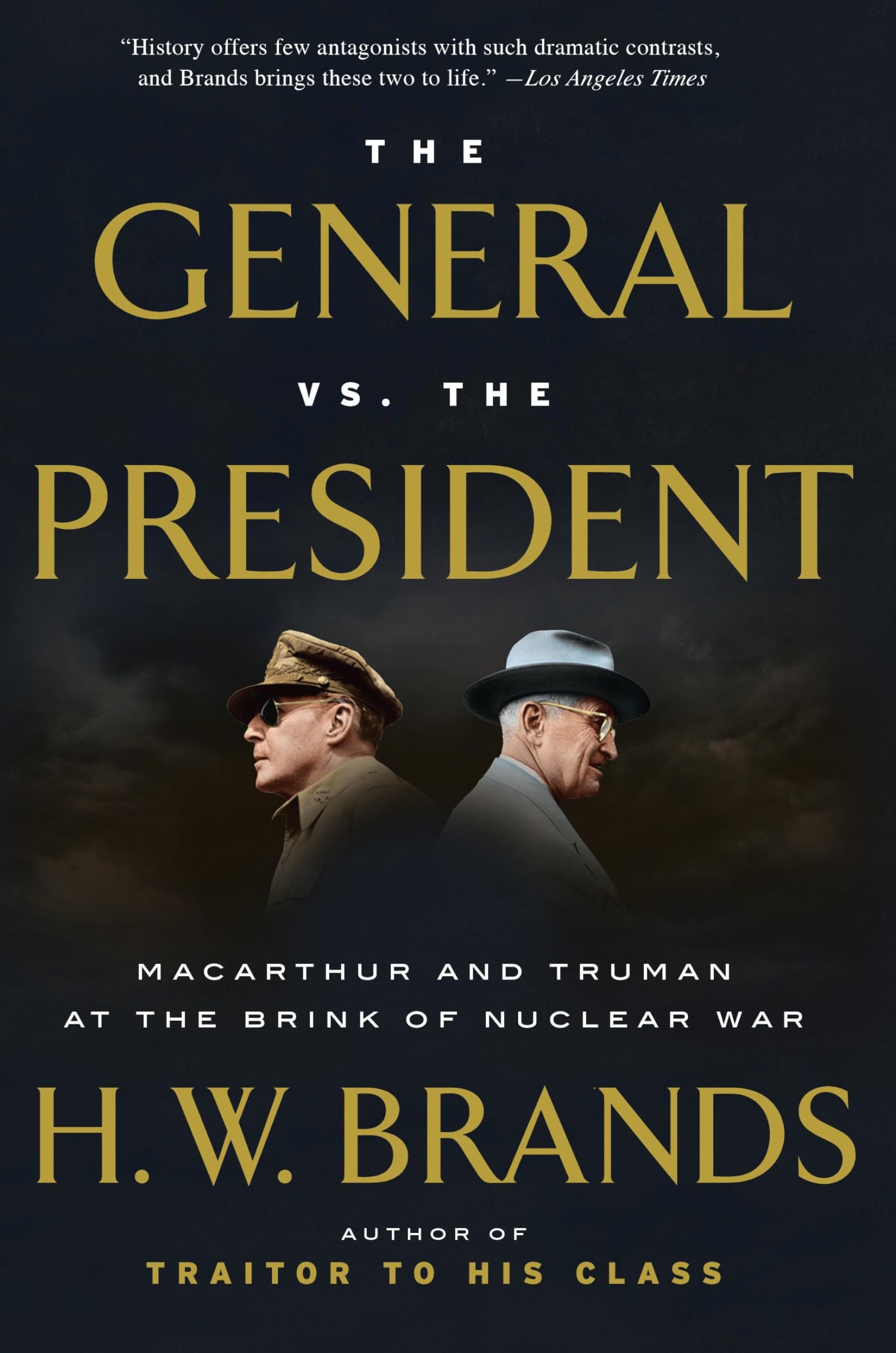
Buy Anchor Books The General vs. the President: MacArthur and Truman at the Brink of Nuclear War by Brands, H. W. online on desertcart.ae at best prices. ✓ Fast and free shipping ✓ free returns ✓ cash on delivery available on eligible purchase. Review: Very interesting book about two completely different personalities with completely different backgrounds. Review: History does repeat itself: U.S, Russia, China, North Korea (the same actors that were there in 1950-53) are ready for a nuke war again. Trump plays the role of MacArthur, Putin plays Stalin, Xi plays Mao, and Won Dum plays the role of his grandfather - all ready to go at it. It would seem that Truman's pacifism merely delayed WW III. Evidently there was no love no love between MacArthur and Ike Eisenhower so Mac would have been gone in late 1952 anyway. Dr. Brands details the conflict between MacArthur and Truman (and the Joint Chiefs of Staff). I found the book to be interesting and easy reading. It was particularly interesting because of the recent Winter Olympic Games in South Korea.
| Best Sellers Rank | #270,509 in Books ( See Top 100 in Books ) #1,370 in History of the Americas #1,795 in Historical Biographies #2,223 in Military History |
| Customer reviews | 4.7 4.7 out of 5 stars (349) |
| Dimensions | 15.62 x 2.67 x 23.11 cm |
| Edition | Reprint |
| ISBN-10 | 1101912170 |
| ISBN-13 | 978-1101912171 |
| Item weight | 499 g |
| Language | English |
| Print length | 480 pages |
| Publication date | 3 October 2017 |
| Publisher | Alfred A. Knopf |
R**L
Very interesting book about two completely different personalities with completely different backgrounds.
M**B
History does repeat itself: U.S, Russia, China, North Korea (the same actors that were there in 1950-53) are ready for a nuke war again. Trump plays the role of MacArthur, Putin plays Stalin, Xi plays Mao, and Won Dum plays the role of his grandfather - all ready to go at it. It would seem that Truman's pacifism merely delayed WW III. Evidently there was no love no love between MacArthur and Ike Eisenhower so Mac would have been gone in late 1952 anyway. Dr. Brands details the conflict between MacArthur and Truman (and the Joint Chiefs of Staff). I found the book to be interesting and easy reading. It was particularly interesting because of the recent Winter Olympic Games in South Korea.
W**H
Brands is a very good writer of history. He has David McCullough's ability to make non-fiction read like a ripping good story. The "General Vs. the President..." is an excellent case study of political maneuver, international affairs and constitutional checks and balances in one book. The author's treatment of the dance Gen. Douglas MacArthur and Harry Truman performed in trying to grapple with the Korean War and each other is a very good cautionary tale. What to do when a weak leader has a star underling who is a proven winner and both the leader, underling and other stakeholders know it? This is the situation that faced Truman when the North Koreans attacked the South and caught the US unawares and unprepared. MacArthur was a hero - the master of the Pacific in WWII. Although he was difficult to control and not willingly subordinate and provided Truman with ample reason to relieve the General, MacArthur's early success in flanking the NK at Inchon and crushing the enemy divisions as he chased them toward the Chinese border excused a lot of behavior that should have gotten him cashiered. Chinese intervention drasticly changed the nature of the war, proved MacArthur fallible, and made his maverick and insubordinate behavior intolerable. Particularly since the stakes were so high - MacArthur's statements, actions and disobedience risked a regional war igniting a larger, perhaps global, conflict - one the United States was ill prepared to see to victory and which would kill many even if we were. Truman had to fire MacArthur and right the relationship between President and military commander. (For those knowledgeable of the Civil War, this story will echo what Lincoln faced with Fremont, Butler, McClellan and Hooker among others). Truman and his Administration certainly made their share of mistakes in the run up to the North Korean invasion, and the author is honest in portraying the positive and negative of his actions as well as the good decisions MacArthur made and his laudable success in remaking Japan. But, for the sake of our Constitutional system, Truman took the only course of action he could (and arguably - even he argued to himself - should have taken earlier). Brands gives the right amount of background as he focuses on the machinations of MacArthur and Truman's response over many months as he tried to bring the hero-General to heel. It is a terrific and dramatic story with larger than life players and important issues. In Brand's hands a treasure of a book.
S**Y
Well-written and engaging piece of writing by HW Brands. The story of Truman's eventual decision to fire MacArthur is well-told, with a pacy style in an engaging way with some compelling anecdotes. The background of the two main protagonists is beautifully drawn and the meeting on Wake Island becomes the centrepiece. It's not the greatest historical work - mostly derived from published sources, journalism and secondary material - however, as a piece of historical storytelling, it is very well done. I was drawn to the book by Andrew Bacevic's review in the London Review of Books (July 2017) and agree with his summary that the book would have benefited as an historical work from putting the "contest" into the context of subsequent conflicts between the US Executive and its military leadership, such as Vietnam and the First Gulf War. I also agree that the subtitle of the book ("at the brink of nuclear war") as well as the cover image are both misleading: not to say that MacArthur's approach might have resulted in nuclear war - the main issue was about a general taking unilateral decisions against the will of the executive and being willing to risk war with China to overcome his own hubristic mistakes.
J**N
After FDR's death in April, 1945, an unknown senator-turned-vice-president was elevated to the presidency. His name was Harry Truman. During the waning months of World War II, Truman became privy to the Manhattan Project, whose scientists had been working on the atomic bomb for several years. Truman authorized the use of the bomb against Japan, and Hiroshima and Nagasaki were subsequently destroyed. The man chosen to lead the occupation of Japan was General Douglas MacArthur. This was the beginning of the Truman/MacArthur alliance; an alliance that would be tested five years later on the Korean peninsula. In June, 1950, North Korea invaded South Korea. MacArthur was picked to lead the UN forces in the South. During the next several months, Truman and MacArthur would butt heads on several occasions. Truman, while in office, was one of the most unpopular presidents in American history. Communism was spreading, and Truman had to "learn on the job" as to how to deal with the Soviet Union. Conversely, MacArthur was the hero of the Pacific war and the person who brought Japan back from ruin to become a valuable ally. Despite his status, MacArthur still answered to Truman. Truman favored containment in Korea, while MacArthur wanted to wipe out communism in Asia by escalating the war. He had his moments, such as the highly successful Inchon invasion, but he also suffered defeats, especially when China entered the conflict. This led to a downward spiral which ultimately led to MacArthur's dismissal. "The General vs. The President" is a fine book about a relatively forgotten chapter in our history. Author H.W. Brands has written a compelling book about how close we were to World War III. The narrative is full of interesting history, and I especially liked reading about MacArthur's interviews by members of Congress. In the final analysis, Truman's policies proved to be the correct ones. Highly recommended.
Trustpilot
1 day ago
2 weeks ago