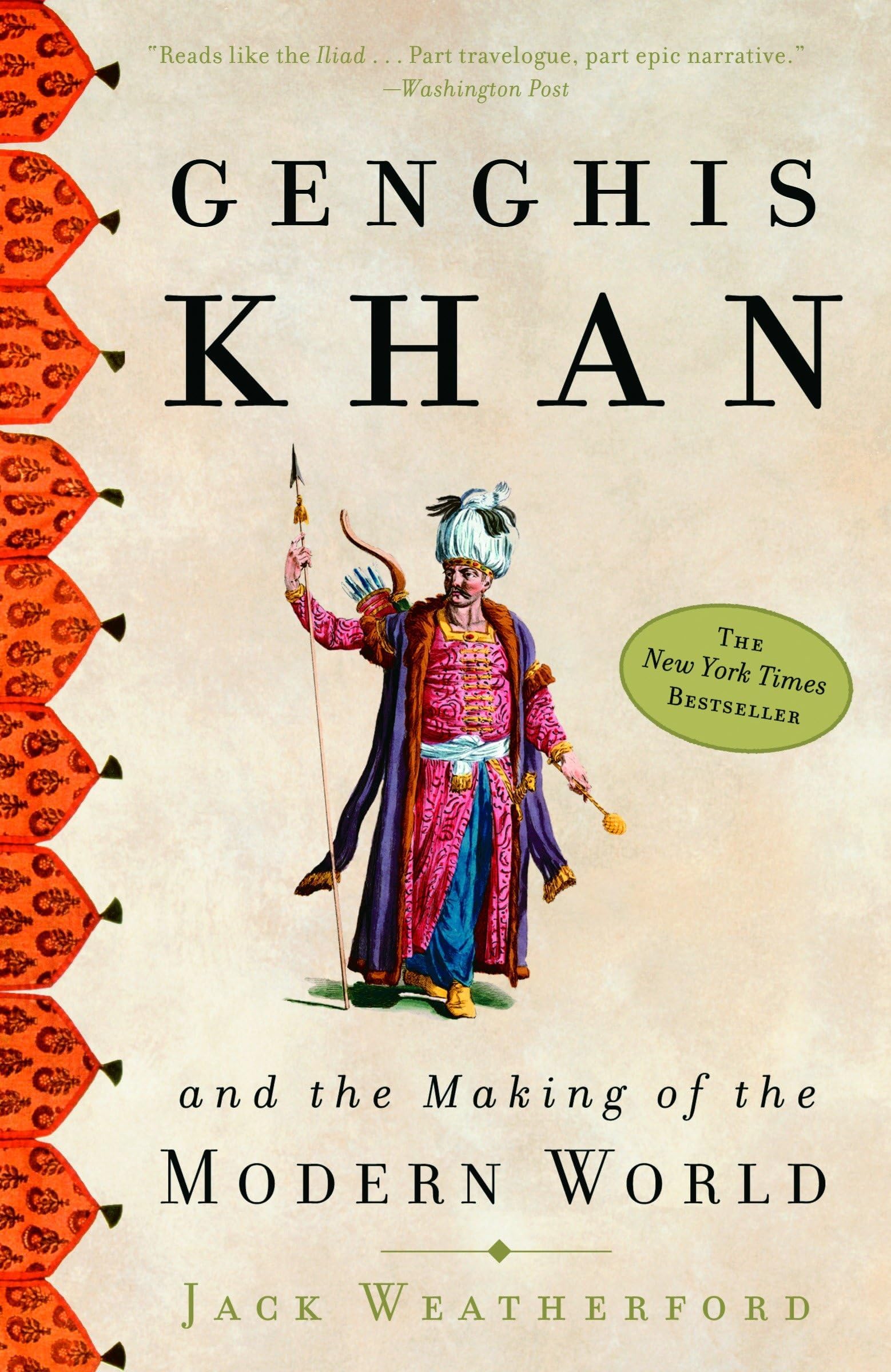
CROWN Genghis Khan: And the Making of the Modern World
Desertcart purchases this item on your behalf and handles shipping, customs, and support to Japan.
Description
NEW YORK TIMES BESTSELLER • The startling true history of how one extraordinary man from a remote corner of the world created an empire that led the world into the modern age―by the author f
Specifications
| Dimensions | 13.1 x 1.9 x 20.2 cm |
| Edition | Illustrated |
| Isbn 10 | 0609809644 |
| Isbn 13 | 978-0609809648 |
| Item Weight | 244 g |
| Language | English |
| Print Length | 352 pages |
| Publication Date | 22 March 2005 |
| Publisher | Three Rivers Press |
Reviews
User
good book
got the book in good condition. excellent read
User
Excellent read....
The books tells us about a force that once shook the lands......
User
A history book which unfolds itself like an adventure story
I'm a history buff and spend most of my spare time reading history books/magazines either from print or digital media. So having read a lot of history books I can say this one of the most interesting history book I've ever read. It's not just about the story and unknown facts of Genghis Khan but the way the book is written - the pace, the language - just awesome. I've now bought multiple copies of the book to give as gift to my friends.
User
Ottimo libro di storia
Per approfondire un tempo, un mondo davvero poco studiati
User
Defective book
Seller’s book is defective
User
An excellent introduction for the serious student and casual reader alike.
If you are just beginning to research the Mongol Empire, this is an excellent book to begin with. Also if you are just looking for a brief overview, this book would also be fit for purpose.This is and easy read without weighty voluminous detail and does not pretend to be a textbook, but a short informative introduction. The serious study of Mongol history has been hampered by centuries of secrecy by both the custodian, the Qing Dynasty and the repressive Soviet Union. The translation of the Secret History of the Mongols was first begun in the early 1980's by an Australian/Italian historian of noble Tatar (Mongol) descent, Igor de Rachewiltz. The torch was taken up by others following the collapse of the Soviet Union and the freedom of Soviet controlled Mongolia. However, the over a million Mongols remain under the repressive hand of China in an area of about half of the Mongolian Republic, called Inner Mongolia on the the republic's southern border.In full disclosure, in 1984, as an undergraduate, I wrote and extensive research paper titled, "The Sino-Mongolian Impact on Europe." The impact of the Mongols on world history cannot be underestimated. In the late Medieval Era, the Mongols created a superhighway into Europe that led to an explosion of knowledge and technological advancement. All the brilliance of science and technology in the Orient, particularly China, streamed into Europe leading to the Medieval evolving into the Renaissance and eventually the Agrarian and Industrial Revolutions. At the point of first contact in the mid-Thirteenth Century Europe was a millennium behind Asia in technology, art and science. Within less than two hundred years that gap had been closed and the sky was not even the limit.Rather than the blood thirsty and cruel invaders that later ignorant people portrayed them to be, they were brilliant administrators and free thinkers ended religious wars and banditry. In so doing, they intentionally and deliberately facilitated the free flow of trade and ideas from Asia to Europe. It was the restriction of this trade by the rising Ottoman Empire that led to the Age of Discovery. Europeans seeking direct access to China and India drove the creation of the modern world. For further reading, have a look at the work begun by Professor Joseph Needham of Cambridge, Science and Civilisation in China that is an ongoing work of 7 volumes in a current set 27 books.While the prosperity of the modern world has allowed space for new nihilistic and destructive voices decrying this advance, they, themselves, would not exist, nor be able to communicate with the books, technology and free trade were it not for the Mongol Empire.
User
Ótimo
Eu, provavelmente como todos que aprenderam História de uma perspectiva eurocêntrica, nunca havia estudado sobre Genghis Khan e o império Mongol e o pouco que sabia era negativo. O próprio autor deste livro coloca na introdução e no capítulo final tudo o que foi inventado e perpetuado pelo iluminismo europeu no século XVIII. Genghis Kahn se tornou o epítome de bárbaro que só se satisfazia com morte e destruição enquanto que o termo mongolóide foi cunhado para uma série de características negativas de cunho "cientifico".Neste livro, o propósito do autor é contar a história de Genghis Khan desde o inicio de sua vida até as consequências atuais de seu império, daí a "construção do mundo moderno" do título. Houve realmente a destruição completa de muitas cidades, mas assim que a paz era estabelecida havia tolerância religiosa, comércio fluindo como nunca antes, estabelecimento de direito internacional, submissão de governantes às leis, trocas culturais, desenvolvimento agrícola e muito do que reconhecemos e queremos em estados contemporâneos. Tanto que, mesmo com o fim do império, muitos estados sucessores asiáticos, mesmo atuais, quiseram se associar à imagem dele.O texto é bastante envolvente e didático. Não se trata de um livro técnico, às vezes lembra uma narrativa épica e mesmo as partes descritivas são fluidas.Enfim, é um excelente livro para aprender sobre uma figura e um império tão importantes para a história mundial e que definiram em parte o mundo como conhecemos hoje.
Common Questions
Trustpilot