
DOWNLOAD THE APP


Customer Services
Copyright © 2025 Desertcart Holdings Limited
DOWNLOAD THE APP
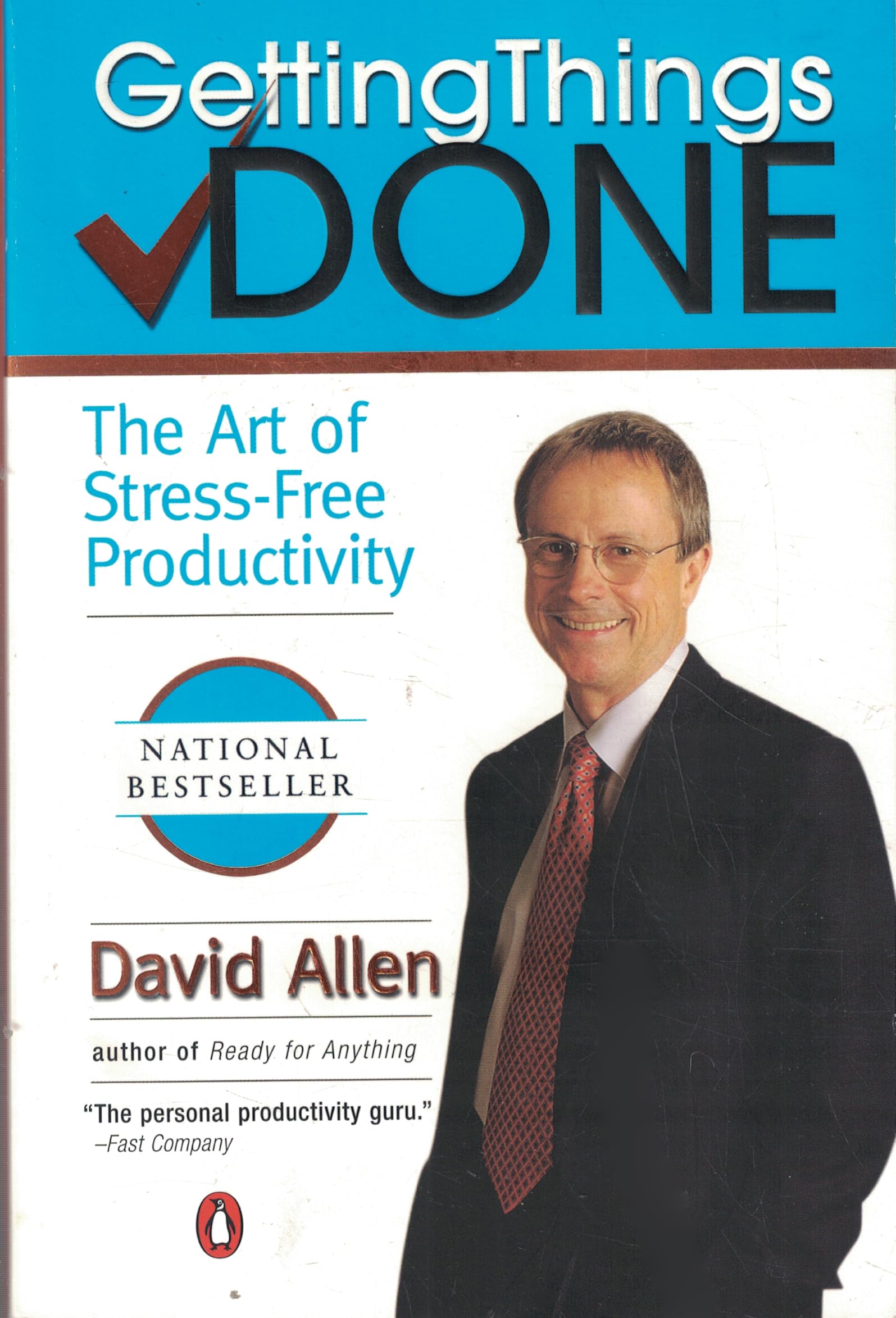
🚀 Unlock your brain’s full potential with the ultimate productivity blueprint!
David Allen’s *Getting Things Done: The Art of Stress-Free Productivity* is a groundbreaking book offering a practical, research-based system to organize tasks and projects. It introduces a simple five-step workflow that helps professionals clear mental clutter, prioritize effectively, and align daily actions with long-term goals. With over 5,000 reviews and a 4.4-star rating, this timeless guide is essential for anyone seeking sustainable productivity and mental clarity in both work and life.
| Best Sellers Rank | #127,176 in Books ( See Top 100 in Books ) #74 in Time Management (Books) #915 in Self-Esteem (Books) #1,455 in Motivational Self-Help (Books) |
| Customer Reviews | 4.4 out of 5 stars 5,352 Reviews |
K**B
Best personal productivity system
David Allen is a knowledgeable and practical productivity guru. This book has both the strengths of practical and theoretical qualities. I loved this book. I liked about it that it explains a few theoretical principals related to the way the brain works, but not too many. It keeps the subject flow down to earth and it introduces the reader in a very simple, common sense manner to a set of real life tools. I found the book really helpful. I managed to setup my own system using two in-trays, Outlook and One-Note using David's principles of organisation. The book is free of superfluous motivational talk, it is based on research, personal experience built on many years of consulting organisations and individuals. I use the same routine flow at work and at home with no effort. I sometimes realise that when I get a mental trigger to simplify, process immediately something, it is because of the book. One of the key elements David insists on is that you must process the "stuff" immediately no matter what. You must decide what to do with it. The books somehow manages to store this idea in your mind using simple but powerful anchors. What does this book for you? Assuming we live at our fullest potential we were born with, success is conditioned by four factors: focus, goals (strategy), motivation and energy. David's book is about organising your life to give you clarity and focus. I liked how he talks about project organisation and how the immediate tasks are aligned to long term goals. The book is excellent about managing the first two factors. Motivation and energy: that is your responsibility. If you need help there then you have to look somewhere else. How does the book help you do things better? One of the most common sources of frustration is hidden behind our little chores we have to do day by day. David has a take-no-prisoners approach: list everything you have in front of you and handle it, otherwise this procrastination will kill you. At this point, prioritisation makes no sense. To my surprise, this little principle does wonders. You have to have a system though, which is explained in the book very well. This is probably the best gem in the book: it gives you an workflow system that you can use without fail every day. David talks about how more complex tasks are actually projects, and he shows you how to manage that project naturally, using common sense. David then makes you look at this from the perspective of your personal life. He takes you on a nice flight from the ground level (daily little chores) to high altitude where you can view the distant horizons of your life. As usual, David alerts you that before you go up, make sure you do a good job on the ground. David says that the practice shows that this is the best way to discover your call and what is it really what you want. It makes sense: if you keep getting frustrated in seemingly never ending entangled tasks, you may never know what is it really that gives you pleasure and what is your natural talent. The main ideas of the book Workflow of the human activities: the humans are systems that have data input, process engine and output. Productivity is about managing all these three areas. David describes a very simple workflow that is made up of five steps: 1. Collect: get it out of your head 2. Process: decide what to do with it. 3. Organise: Decide where to put the stuff. 4. Review. Critical part of the workflow: weekly review. 5. Do The whole system is built around this workflow. It sounds simple, and it is, but it is very effective. It is implementable and reduced the noise that unorganised "stuff" creates in our head. You will have to read the book to understand that. Decision Making Process The system offers a fresh aproach to tasks organisation that is not based on common prioritised to-do lists system. I found that David links very well the concern of the moment with long term planning and ultimately with your life calling. The latter is a very complex task. You have to muster the daily tasks management before you get the black belt on life long achievements, because this is the only practical way of discovering what you can do and what you are best at. Project planning. David considers project as a collection of tasks. While individual tasks can be done almost in any order, projects require planning. Instead of relying on learning very complex project management tools, it is best to manage your project using natural planning. If you have experience with project management you will understand straight away what he is talking about. If not, you will still like his approach because it is simple and requires common sense. It is all about delivering outcomes, rather than getting lost in complex considerations. Overall these are the key principles discussed in the book: 1. Focus and fast track 2. Applied outcome thinking (intention & action, how do I make it happen?) 3. The magic of mastering the mundane 4. The power of natural planning The book has a very good structure. It is that kind of book you will come back to revisit some ideas. It requires a little bit of effort because, as David says, it will not work if you don't adopt it to suit your personal style and experience. I regard this book as an excellent investment.
E**S
A Masterclass in Personal Productivity That Actually Works
A Masterclass in Personal Productivity That Actually Works David Allen’s *Getting Things Done: The Art of Stress-Free Productivity* remains one of the most transformative books ever written on how to organize your life and reclaim mental clarity. It doesn’t just teach time management—it rewires the way you think about work, commitments, and attention. Allen’s premise is simple but powerful: your brain is for having ideas, not for holding them. His GTD system provides a structured yet flexible method for capturing every task, clarifying next actions, and reviewing priorities so that nothing falls through the cracks. Concepts like the “two-minute rule,” weekly reviews, and defining the “next actionable step” have become timeless productivity principles for a reason—they work in any career, at any scale. What sets this book apart is its practicality. Allen avoids the fluff that plagues so many motivational titles and instead gives a clear workflow you can implement immediately—whether on paper, in an app, or across an entire organization. The methods are adaptable, from executives to freelancers, and they age surprisingly well even in today’s digital era. I first read it years ago and still revisit it whenever my system drifts off track. Each reread brings a new layer of insight, proving how durable and deep Allen’s ideas are. Bottom line: *Getting Things Done* is more than a productivity book—it’s a lifelong toolkit for focus, organization, and peace of mind. If you only read one book to overhaul how you manage your work and life, make it this one.
D**N
very good system, but way too long for the content
David Allen’s Getting Things Done describes a very powerful system for controlling the long list of to-do items we all carry around in our heads. I have been using parts of this system since 1985. The basic principle is straightforward – write down everything you want to do – or might want to do – and keep those lists orderly and accessible. Get everything out of your mind and into this system and clear your mind, which, in theory, should make you more peaceful and consequently more effective. Your increased effectiveness, in theory, should make you more peaceful. And so on. Also, to become more peaceful and clear, get EVERYTHING off your desk. Unclutter your office, too. You might wonder why an entire book would be necessary to learn how to do this. You would be right to wonder, as most of the book is, in fact, an explanation of why it is better to not be anxious and what happens when your office and life are messy. Then much of that is restated in different words. Nonetheless, I encourage you to buy the book, because it will increase your commitment to using a system, perhaps this one. After all, you have known since you were 14 years old that is it better to be organized, and it may be possible that you haven’t lived that way. Here are the basics from the book: Get every possible item off of your desk and out of the pile on your windowsill and from the top of the filing cabinet. Everything. Write down every single possible thing you might ever want to do, see, look up, accomplish, plant, complete, give away, or build. Here is the key principle of the entire book and the entire system (it may actually be the key to life, the thing the guru on the top of the mountain should tell you): FOR EVERY SINGLE THING YOU THINK YOU NEED TO DO, DEFINE THE NEXT SPECIFIC, SINGLE ACTION STEP NEEDED TO ACCOMPLISH IT. Not “buy a car.” Not “look at Consumer Reports for car reviews.” Not “keep your eyes open for good looking cars.” Instead, “go online to Consumer Reports to learn which issue has the latest car reviews.” That’s it. If you can do that, everything else is easy. Write each of these next action steps on one of these lists: next action, projects, calendar, waiting for, someday/maybe. Except, if the item would take less than two minutes, do it right now. Put everything in an accessible and obvious place. (Rule of Jenny: Everything has a place, and it’s not “out.”) Buy a label maker and label your files at the moment you create them. On your desk, you are free to keep only these things: supplies, equipment, decoration, and reference. That’s it. Go through your lists regularly. Weekly reviews work for most people. Monthly may be better for you. To recap, for every single thing you think you need to do, define the next specific, single action step needed to accomplish it. The rest is icing on the cake. Buy the book. But feel free to skip over any sentence, paragraph, or chapter that seems to be explaining the benefits of getting organized. There are many such paragraphs. If you want to save some time, here are the most valuable sections (page numbers from the Penguin paperback edition of 2001): The Principle: Dealing Effectively with Internal Commitments (p. 12-18) The Major Change: Getting It All Out of Your Head (p. 21-23) Getting Control of Your Life: The Five Stages of Mastering Workflow (p. 24-53) Brainstorming (p. 70-74) Getting Started: Setting Up the Time, Space, and Tools (p. 85-103) Processing: Getting "In" to Empty (p. 119-137) Organizing: Setting Up the Right Buckets (p. 138-180) As I noted, I have been using some of these tools since 1985, when I attended a David Allen time management seminar. The tools have been helpful. I am committed to getting the rest of my time organized, thanks, in large part, to this book. I hope it helps you.
R**T
There aren't many books you need - You NEED this book NOW!!!
Who would not benefit from being more efficient about everything one has to do? Think about it for a moment. We go to school and learn a standard curriculum. We go to college, and again learn some sort of structured set of subject matter. There are two extremely important subjects that I never learned anything about in a lifetime of formal learning. · How to manage my time · How to manage relationships In both cases, you and I are on our own. Is it any wonder that the divorce rate in America hangs out at about 50%? We are all winging it, and how often does winging it get it done in real life. In the movies sure, in real life, not likely. The same is true for the management of time. I have probably read 50 books in my lifetime on time management, and I have attended a few seminars also. NOTHING COMPARES TO THIS BOOK in helping you to change the way you handle your affairs. Here is why you need this book. 1) You need to understand that your brain operates like a random memory computer. The author David Allen explains why you will be sitting in the car and all of a sudden you will start realizing that you have to do this, and you have to do that. This always happens when you are in a position that powerless to act like having both hands on the steering wheel of a car. 2) You will learn why your brain treats all "to do" items the same, with equal weighting, and you have to consciously overcome this tendency. 3) If it's on your mind, your mind isn't clear. You must capture your to do items in a system that is outside your mind. 4) The key to success is to determine YOUR NEXT ACTION. You just don't want to write down on your to do list, FIX THECAR. You want to write down the name of the service center and the phone number because that is an action you can execute on. You have to learn to think in terms of ACTION STEPS. If it's not actionable, it's not anything. Once you start thinking and planning this way, your efficiency will skyrocket immediately. 5) The essence of the system is to keep nothing in your mind. EVERYTHING has to come out of your mind, and put into some kind of system. It could be paper, it could be on your PC. Perhaps you used a Blackberry or a small voice recorder. It really doesn't matter. What does matter is you have to get it out of your mind. 6) You can never really do a PROJECT. You can only do some kind of ACTION associated with a project. Do enough ACTIONS, and the project is complete. There are a couple of very simple concepts that you can implement immediately that will CHANGE your life. Try these on: A) Never let your file drawers get more than 3/4th filled. B) Purge your files on a regular basis - once a month, or once a quarter C) I love this one - If you can get something done in under two minutes - Just get it done. Don't put it on a list - JUST DO IT. I guess Nike had it right. D) Handle things once. Yes, we have heard this before. This happens because you take something out of your "IN" basket, look at it, decide you are not going to process it now and put it right back in the basket. No, no, no - You process it right there, and then. Do it NOW. I have already begun to implement many of the suggestions that David Allen has suggested in this very helpful book. They are working. I am getting things off my desk. I keep a small notebook in each of my cars, if something occurs to me, I write it down immediately, and deal with it later. I keep a TO DO list on my personal computer. I update (delete and add) all day, and then at the end of the day, I e-mail the updated list to my home computer, and deal with it there. You need to implement the MINIMUM amount possible that will work for you. You do not want to add complexity to your life; there is already complexity enough. You will find yourself getting much more done than you are use to. This means you free up YOUR time, and what's more important than that. You have to be flexible though. What works for you, may not work for someone else. Allen's got the concepts right. Now you have to make adjustments to see what works for you. Always remember the POWER OF NO. You have to learn to say NO when it benefits you because if you don't take care of number 1, who is going to. My friends, you want to buy this book and take OWNERSHIP of the contents. You will change your life. Change your systems and you change your world. If fact, you will rock your world, and that's everything, isn't it. There aren't many books you need - You NEED this book NOW!!! Who would not benefit from being more efficient about everything one has to do? Think about it for a moment. We go to school and learn a standard curriculum. We go to college, and again learn some sort of structured set of subject matter. There are two extremely important subjects that I never learned anything about in a lifetime of formal learning. · How to manage my time · How to manage relationships In both cases, you and I are on our own. Is it any wonder that the divorce rate in America hangs out at about 50%? We are all winging it, and how often does winging it get it done in real life. In the movies sure, in real life, not likely. The same is true for the management of time. I have probably read 50 books in my lifetime on time management, and I have attended a few seminars also. NOTHING COMPARES TO THIS BOOK in helping you to change the way you handle your affairs. Here is why you need this book. 1) You need to understand that your brain operates like a random memory computer. The author David Allen explains why you will be sitting in the car and all of a sudden you will start realizing that you have to do this, and you have to do that. This always happens when you are in a position that powerless to act like having both hands on the steering wheel of a car. 2) You will learn why your brain treats all "to do" items the same, with equal weighting, and you have to consciously overcome this tendency. 3) If it's on your mind, your mind isn't clear. You must capture your to do items in a system that is outside your mind. 4) The key to success is to determine YOUR NEXT ACTION. You just don't want to write down on your to do list, FIX THECAR. You want to write down the name of the service center and the phone number because that is an action you can execute on. You have to learn to think in terms of ACTION STEPS. If it's not actionable, it's not anything. Once you start thinking and planning this way, your efficiency will skyrocket immediately. 5) The essence of the system is to keep nothing in your mind. EVERYTHING has to come out of your mind, and put into some kind of system. It could be paper, it could be on your PC. Perhaps you used a Blackberry or a small voice recorder. It really doesn't matter. What does matter is you have to get it out of your mind. 6) You can never really do a PROJECT. You can only do some kind of ACTION associated with a project. Do enough ACTIONS, and the project is complete. There are a couple of very simple concepts that you can implement immediately that will CHANGE your life. Try these on: A) Never let your file drawers get more than 3/4th filled. B) Purge your files on a regular basis - once a month, or once a quarter C) I love this one - If you can get something done in under two minutes - Just get it done. Don't put it on a list - JUST DO IT. I guess Nike had it right. D) Handle things once. Yes, we have heard this before. This happens because you take something out of your "IN" basket, look at it, decide you are not going to process it now and put it right back in the basket. No, no, no - You process it right there, and then. Do it NOW. I have already begun to implement many of the suggestions that David Allen has suggested in this very helpful book. They are working. I am getting things off my desk. I keep a small notebook in each of my cars, if something occurs to me, I write it down immediately, and deal with it later. I keep a TO DO list on my personal computer. I update (delete and add) all day, and then at the end of the day, I e-mail the updated list to my home computer, and deal with it there. You need to implement the MINIMUM amount possible that will work for you. You do not want to add complexity to your life; there is already complexity enough. You will find yourself getting much more done than you are use to. This means you free up YOUR time, and what's more important than that. You have to be flexible though. What works for you, may not work for someone else. Allen's got the concepts right. Now you have to make adjustments to see what works for you. Always remember the POWER OF NO. You have to learn to say NO when it benefits you because if you don't take care of number 1, who is going to. My friends, you want to buy this book and take OWNERSHIP of the contents. You will change your life. Change your systems and you change your world. If fact, you will rock your world, and that's everything, isn't it.
M**N
Thoughts on Allen's Getting Things Done - Build a structure for tasks, use it & clear your head. Great advice!
Overall I found the book a very good read. It helped me crystallize a number of ideas about how to organize tasks using simple lists and structures. The over arching theme I took away is that it is important to have a good organized structured to put ideas immediately into and to trust the structure so that one can free one's mind from constant distractions. What should be put down in this structure are immediate things that are actionable, what one can do next -- as opposed to generalities, which require more thought. A key aspect of course is breaking down a larger task into these smaller actions. Allen describes a structure of immediate lists to look at, calendars, todo lists, reference lists and so forth. Other bins include an incubator list for long term tasks and a “waiting for” list, which has tasks that are pending from other people to be completed. This seems like a sensible arrangement but I suspect that other people will have somewhat different structures. My impression is that the important idea is not letting immediate short term distractions cloud one's focus on a task, and tackling things sequentially in little chunks. Allen talks a lot about avoiding infinite loops. He mentions that a long term plan is not something that goes on someone's tickler list but rather something that is broken up into many actions as opposed to only a few. Practically he discusses how in meetings, before the end of the meeting one really should bring up the question of what is the immediate next action that is a follow up from the meeting rather than just talking in generalities. In the book Allen talks about the importance of having few distractions to really concentrate on the task at hand and one way of achieving fewer distractions is by designing a system to capture all of one's daily input into a well-designed inbox format. He talks about how if this is well done one does not have the guilt of constantly thinking about things that have to be done nor does one have to have the mental load of things constantly popping into one's mind -- given ones assurance that everything is captured in this universal inbox. He contrasts a company that has a way of capturing day-to-day tasks as smoothly running without people being interrupted with one that is constantly crisis and event driven. I read this book before the new 2015 edition came out. This new edition of course needs to be much updated for the new digital reality. The 2001 edition seems quaint, with its discussion of the correct file folders to use and how to organize things correctly in a close by file cabinet. It makes reference to a Palm Pilot but this seems almost prehistoric in today's age. That said, I really felt that the lessons in the original 2001 edition were quite timeless. One could easily see how they morphed into using email programs such as Gmail and perhaps even influenced the design of these systems. In fact, it is fascinating trying to connect a lot of the concepts in this book with the modern world of cloud computing, gmail and various online task sites. Many of these online productivity tools mimic very closely a lot of the ideas in Allen's work, particularly gmail's immediate function for archiving things from your inbox and putting various tags and stars on them. It fits very well into a system of de-cluttering your inbox quickly but then coming back to selected bits. Overall I would highly recommend this book, I think it is a good read.
C**Y
Creative People Can Adapt The Methods To Be Useful
I've heard a lot about this method from various places, so I thought I would read the whole book. I've been pegged as a "creative" and "right-brained," and my organization methods show it. I recently found myself getting very overwhelmed by all the different projects I have going at once and needed something to help me get moving on some of them. The book is definitely more oriented toward business-types, but I still thought I could get something out of it. The book has helped me see my projects and tasks at the different levels described. Most useful to me was getting everything possible that needed to be done in one location (for me this was on paper), identifying projects vs. actions, the next actions list (more detailed than a To Do list), and the popular two-minute rule. I have incorporated much of this into a Bullet Journal system, and I do find myself much less stressed, because I'm no longer using sticky notes and scraps of paper to remind myself of things. If I do, I put them in an inbox, which I also use to some extent. The inbox is where I got lost for a while and put the book down for a few weeks. Maybe if I were paying someone to come in and help me get organized, I would have been able to plow through the towering mountain of work this entailed. Since I recently started a business, I found it near impossible to set aside days, which is what I would need, to attempt this process. I opted to use my Bullet Journal as a type of inbox where I wrote things down instead of gathering them into a physical inbox. I will admit I was also put off by the corporate attitude of the whole book. While I might run my own company, I didn't feel like the book was speaking to me much of the time. The whole method also seems very dependent on checking each and every day, reviewing your lists, keeping on top of it all. And maybe this is the real key to organization, but it's not appealing to someone like me who likes to go hide away in a corner with her typewriter and forget the world exists for hours. After 45 years of existence, I've realized I am not the kind of person who is going to be the model of corporate efficiency. With that said, I am using some of the methods, and it has helped ease my mind. I no longer have random lists and notes everywhere (except the strays I haven't caught yet) but one central location where I keep projects, future projects, and next actions. I also quit putting things off so much by using the two-minute rule. So I got some useful information from the book, but it took me a while and required me to let go of the idea I was going to be able to follow all the rules as written.
S**A
Kaizen in Simpler Terms
I searched the web for some books on productivity. I was desperate. I could not find an easily readable and affordable book. I searched again. This time one book on Amazon attracted me. It is the book I was in search of. It is 'How to Get Things Done' by David Allen. I went through some pages and ordered the book before the expected arrival date. Thank you Amazon. This is a book which you can read and implement 5S system in your home/office/company. I am new to Kaizen but I learnt many things after reading the book. The contents are very applicable if you want to achieve higher productivity. You can eliminate waste and systematize your work. Allen talks about stress free productivity in his book. His argument is that anyone can get his/her work done. Further, he believes that much of our work is complicated for we do not pay attention to such things as ergonomics and work place cleanliness. Anything that may result in waste or redundancy may be prevented if careful planning is done. Major topics in the Part 1 include: 1. A New Practice for a New Reality 2. Getting Control of Your Life: The Five Stages of Mastering Workflow 3. Getting Projects Creatively Underway: The Five Phases of Project Planning These are the initial lessons you may read and get ready for the rest of the lessons. In the Part 1, you see the possibilities while in the other chapters you can taste some of the simplest things you can do to achieve higher productivity. You can easily digest the ideas as Allen's language is simple and easy to understand. The lessons, though they look simple make you reorganize your schedules and help better your understanding in areas where waste is likely to occur. I began applying simple ideas from the book and am in control of my work. He asks us to practice a little at a time and see the difference it makes. I am getting much free time now. The book is truly amazing. The book is truly thought provoking. The book is simply the best if you are into reorganizing schedules to have more free time. He says that time is money and that everyone should save time for greater enjoyment of life. He takes us to Japanese life. He gives examples from Japanese lives and advises us to practice ideas from the land of Kaizen. Kaizen ideas in this book are easy to comprehend, the language used is simple and ideas are worth practicing. `Your home is the paradise of the book worm.' said one of my students. I was puzzled to understand what the student said. It is a negative comment on how I had placed my books in my home. They were everywhere. On the dining table, in the bedroom, on chairs and even under my mattress. I was ashamed and immediately looked for a way to be organized. I am getting organized. True. I like practicing what Allen says. He changed my habits of being disorganized, not sorting things into useful and useless, and my dear friends, my home is spacious and livable now. The writer is a productivity specialist and he is a guru as well. I really like the ideas in it. Some ideas are so strong that you may implement them soon. They are eye openers and they help you better your life. Read the book. The book does not waste your time instead it helps you organize your work and save time and gives a greater sense of achievement once you begin to apply the ideas in the book. I truly enjoy organizing and making my home a place where there is less waste, things are nicely arranged, useless things are thrown away. Your friends will be amazed too. Susil Manchanayaka, B. A., PGDE, PGC T&HRD
T**N
Very Helpful (But Also Potentially Dangerous)
"Getting Things Done" is an incredibly helpful book. It's been indispensable for my personal productivity. It teaches you to do a few things well and does so in a relatively clear manner. However, it has two serious problems. First, it is presented as a complete organizational system, when it is not. Second, it encourages a seat-of-the-pants, ju-jitsu approach to daily life that can be very counterproductive and exhausting. But, first the good. For me, the main gist of the book is this: if you try to keep your life organized in your head, you will not be maximally productive. You'll be using an inordinate amount of energy trying to mentally keep track of all your "to do" items. "Getting Things Done" shows you how to get all of these out of your head and into a system so you can concentrate on the present and attack each action item one at a time. This is good stuff. But, now, the bad (or not so good): The first problem is "Getting Things Done" provides no guidance on how to prioritize your projects or sub-projects. It does not help you decide what to do next. Instead, it helps you produce very organized, contextual lists of next actions to take. To decide WHICH next action to take, it just recommends that you use your instincts. For many people, one of the big problems (and often THE big problem) with their organization is DECIDING which projects to work on when; and GTD is of absolutely no help. This is not an insurmountable problem as there are books ("Time Power" by Charles Hobbs) and computer programs (Life Balance from Llamagraphics), that can help you prioritize. The second problem, and perhaps considerably more grave, is "Getting Things Done" encourages you not to plan. It encourages you to simply decide in each moment what to do (based on the excellent lists and reminder system you've created). It encourages a seat-of-the-pants, ju-jitsu approach to daily life. And this is a BIG problem for a lot of people, myself included. If you have trouble prioritizing what to do next in your day and life, then having to make those prioritizing decisions 200 times a day, as GTD encourages, is incredibly draining. GTD preaches that you live life efficiently, but that there's no need for habits or rituals. This is a contradiction and truly counter-productive. If there's one common thread that you get from reading the biographies of incredibly productive and successful people, it's this: they have very regular, structured, and beneficial habits and rituals. They do not "wing it." "Getting Things Done" could be retitled "Winging It In the Most Efficient Manner Possible." There are successful people, of course, who do "wing it," but the vast majority of successful people are habit- and ritual- driven. That goes especially for work habits (and often for sleep habits, exercise habits, eating habits, and social habits, too). For a great example of this, read "On Writing," by Stephen King. If you read "Getting Things Done," seriously consider supplementing it with "The Power of Full Engagement," by Jim Loehr and Tony Schwartz -- especially chapter 10, "The Power of Positive Rituals." It explains very convincingly why purposefully "winging it," even in the most efficient manner, will not work and could be your undoing. "Getting Things Done" is still a great book, but it does not stand well, on its own, as a system for organizing your life. It needs supplementation.
Trustpilot
2 weeks ago
5 days ago