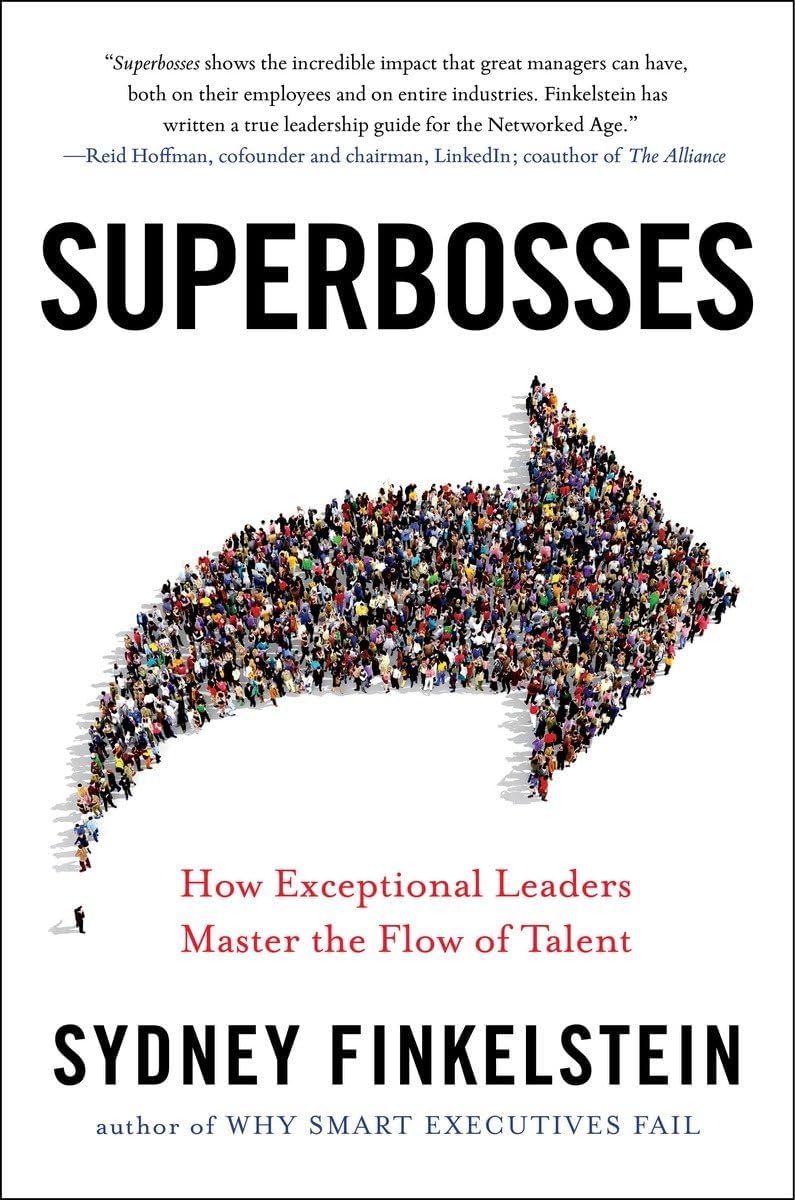

Superbosses: How Exceptional Leaders Master the Flow of Talent
Product ID: 23733729
Desertcart purchases this item on your behalf and handles shipping, customs, and support to Japan.
"Superbosses is the rare business book that is chock full of new, useful, and often unexpected ideas. After you read Finkelstein's well-crafted gem, you will never go about leading, evaluating, and developing talent in quite the same way.”—Robert Sutton, author of Scaling Up Excellence and The No Asshole Rule “Maybe you’re a decent boss. But are you a superboss? That’s the question you’ll be asking yourself after reading Sydney Finkelstein’s fascinating book. By revealing the secrets of superbosses from finance to fashion and from cooking to comic books, Finkelstein offers a smart, actionable playbook for anyo ne trying to become a better leader.”—Daniel H. Pink, author of To Sell Is Human and Drive A fascinating exploration of the world’s most effective bosses—and how they motivate, inspire, and enable others to advance their companies and shape entire industries, by the author of How Smart Executives Fail . A must-read for anyone interested in leadership and building an enduring pipeline of talent. What do football coach Bill Walsh, restauranteur Alice Waters, television executive Lorne Michaels, technology CEO Larry Ellison, and fashion pioneer Ralph Lauren have in common? On the surface, not much, other than consistent success in their fields. But below the surface, they share a common approach to finding, nurturing, leading, and even letting go of great people. The way they deal with talent makes them not merely success stories, not merely organization builders, but what Sydney Finkelstein calls superbosses . After ten years of research and more than two hundred interviews, Finkelstein—an acclaimed professor at Dartmouth’s Tuck School of Business, speaker, and executive coach and consultant—discovered that superbosses exist in nearly every industry. If you study the top fifty leaders in any field, as many as one-third will have once worked for a superboss. While superbosses differ in their personal styles, they all focus on identifying promising newcomers, inspiring their best work, and launching them into highly successful careers—while also expanding their own networks and building stronger companies. Among the practices that distinguish superbosses: They Create Master-Apprentice Relationships. Superbosses customize their coaching to what each protégé really needs, and also are constant founts of practical wisdom. Advertising legend Jay Chiat not only worked closely with each of his employees but would sometimes extend their discussions into the night. They Rely on the Cohort Effect. Superbosses strongly encourage collegiality even as they simultaneously drive internal competition. At Lorne Michaels’s Saturday Night Live, writers and performers are judged by how much of their material actually gets on the air, but they can’t get anything on the air without the support of their coworkers. They Say Good-Bye on Good Terms . Nobody likes it when great employees quit, but superbosses don’t respond with anger or resentment. They know that former direct reports can become highly valuable members of their network, especially as they rise to major new roles elsewhere. Julian Robertson, the billionaire hedge fund manager, continued to work with and invest in his former employees who started their own funds. By sharing the fascinating stories of superbosses and their protégés, Finkelstein explores a phenomenon that never had a name before. And he shows how each of us can emulate the best tactics of superbosses to create our own powerful networks of extraordinary talent. Review: SUPERBOSS is a classic!! - Roadmap to Success: Navigating the road from Entrepreneur to Leader Employee engagement costs US business over $300 billion annually. Sydney Finkelstein's exceptional book, "SUPERBOSSES: How Exceptional Leaders Master the Flow of Talent", will empower companies and managers to positively impact engagement and the bottom line. Finkelstein has written over half a dozen books on management and leadership. This will be one of his best contributions. Peppered with great stories and strategies from in and out of the corporate arena you will be in awe of the similarities and differences. How do SUPERBOSSES foster a culture of innovation, encourage smart risk- taking, remove obstacles, and drive change? They certainly set the bar high, empower teams, and sometimes eschew conventional leadership practices by staying in the ditches to ensure success. They also understand that in order to leave a legacy they have to win the hearts and minds of the talent they attract, develop, retain, and yes, let go. You would think that all SUPERBOSSES would have similar mindsets and motivations. That’s where Finkelstein turns our assumptions upside down. Dividing the SUPERBOSS pie into three pieces, he sees that SUPERBOSSES can be Iconoclasts, Glorious Bastards, or Nurturers. Some iconoclastic SUPERBOSSES single mindedly pursue their passion, like Alice Waters, Miles Davis, and Ralph Lauren. Glorious Bastards are focused on winning at all cost. Luminaries, like Larry Ellison, Bonnie Fuller, and Michael Milken, teach and reward the price of competition. Nurturers, like Bill Walsh, Norman Brinker, and Mary Kay Ash, enable new generations by their firm and encouraging guidance. All very different SUPERBOSSES and yet their impact is similar. You’ll find how the five traits of a SUPEBOSS play out in creating great companies and passionate followers. The traits include ;an ability to be confident, competitive, imaginative, authentic, and relentlessly committed to a vision. These traits and their unique styles are what create the difference between a boss and a SUPERBOSS. Finkelstein’s secret Playbook is invaluable for any leader. You’ll learn strategies like unconventional interviewing processes, from Alice Waters or Miles Davis; how Bill Sanders and Bill Walsh motivate exceptional people to do the impossible; methods for setting a culture of Master and Apprenticeship, exemplified by Bonnie Fuller and Michael Milken and the art of being a “Hand’s On Delegator", like Julian Robertson. While most companies want to retain the best you’ll learn the counterintuitive approach of luminaries like Berry Gordy; Roger Corman, Bill and Hillary Clinton. They gracefully let them go to extend their reach and impact. One universal truth among all of these bosses is how each of them is driven by the importance of leaving a legacy. Robert Mondavi’s story beautifully illustrates this. Beside the stories and the playbook Finkelstein provides some great assessments tools to point you in the right direction. Certainly, if you have been a student of leadership as long as I have you will have some questions. Here is a couple that comes to mind: "What is the fine line between those who become SUPERBOSSES and those that simply become narcissistic leaders with blind spots?" I’d love to see a chapter on how these SUPERBOSSES would score on Emotional Intelligence and Narcissism. It strikes me that it is just a hairpin turn on the road to leadership. Any of these SUPERBOSSES could have been derailed, as Finklelstein’ s classic Why Smart Executives Fail illustrates if they were not able to manage themselves, manage relationships, and eschew the addiction of narcissism and its concomitant blind spots. "What is the tipping point when someone is extremely confident, competitive, imaginative, authentic, and relentlessly committed to a vision and, as a result, becomes SUPER-SPURNING; not a SUPERBOSS ?" These bosses might disengage the majority of talent. The litmus test here is not only the profile of the SUPERBOSS, but the profile of, what I might call, the “SUPERPROTEGE”. For SUPERBOSSES to succeed there must be a cadre of SUPERPROTEGES whose traits include passion, resilience, determination, and ironclad defenses that do not enable the SUPERBOSS to whittle away their healthy self-esteem and drive. SUPERBOSSES cannot succeed unless the followers are passionate, resilient, and determined enough to pursue the gifts these SUPERBOSSES have to offer. The art and science of choosing this talent, it seems, is one of the greatest gifts of the SUPERBOSS. These questions will certainly be grist for the mill of a prolific researcher, writer, and contributor to the world of leadership and management like Professor Finklelstein. This book is indeed a great example of him as a SUPERBOSS spawning other SUPERBOSSES across a myriad of industries by writing a playbook for them. Finkelstein is a gifted storyteller. He has an ability to synthesize information and experiences, and pull them into a cogent theory to embrace. I wholeheartedly recommend this book for all leaders and students of leadership. Bonni Carson DiMatteo,Co-Founder, Atlantic Consultants Wellesley, Ma [...] [...] Review: What Makes a Boss Stand Out in the Crowd? - What makes a great boss? Most people have not worked under bosses that were exemplary and it is probably easier to answer the opposite question. But there are, indeed, some extraordinary corporate leaders out there and they are the subject of Superbosses. This book was written by a guy with extensive experience in the field of corporate management and leadership and his grasp of the subject matter is unparalleled. As the book explains, superbosses are common across American industries and they share common characteristics. They practice open communication. They do not smother their employees with micromanagement. They are able to motivate employees to be their absolute best and they encourage employees to venture out on their own when the opportunity presents itself, knowing that this will, if nothing else, aid the superbosses’ own networking efforts. Many individuals are offered as examples of superbosses in this book, and most of the names will be familiar to many readers. San Francisco 49ers head coach Bill Walsh is one example. Another is restaurant entrepreneur Alice Waters and yet another is jazz great Miles Davis. These individuals had a knack for bringing out the best in those who worked for them and the book discusses specific business and personnel decisions these superbosses made and why they were so exceptional, far reaching, and beneficial to all of the parties involved. Reading through this book and discovering what exactly makes a person a superboss, I realized quickly that the people whom I have worked under, unfortunately for me, did not qualify as superbosses for a multitude of reasons. Many of them, for example, micromanaged everything, which often leads to employee anxiety and distrust. So, I have not had much luck with my own bosses, but the good news is that, knowing what qualities are common to superbosses, I can formulate my own management style to match. I still have some work, but it is good to read about the qualities that make someone a superboss and the incredible impact it can have on morale. Management books are often boring, but Superbosses avoids that label by presenting useful anecdotes and talking about actual people and what they have done, rather than getting wound up on discussion of dull, sleep- inducing management theory. I found many things to like about this book and I recommend it to budding managers and veteran leaders who want to know ways they can improve their skills and approach.
| Best Sellers Rank | #1,032,995 in Books ( See Top 100 in Books ) #1,446 in Human Resources & Personnel Management (Books) #5,140 in Business Management (Books) #6,805 in Leadership & Motivation |
| Customer Reviews | 4.1 out of 5 stars 357 Reviews |
A**R
SUPERBOSS is a classic!!
Roadmap to Success: Navigating the road from Entrepreneur to Leader Employee engagement costs US business over $300 billion annually. Sydney Finkelstein's exceptional book, "SUPERBOSSES: How Exceptional Leaders Master the Flow of Talent", will empower companies and managers to positively impact engagement and the bottom line. Finkelstein has written over half a dozen books on management and leadership. This will be one of his best contributions. Peppered with great stories and strategies from in and out of the corporate arena you will be in awe of the similarities and differences. How do SUPERBOSSES foster a culture of innovation, encourage smart risk- taking, remove obstacles, and drive change? They certainly set the bar high, empower teams, and sometimes eschew conventional leadership practices by staying in the ditches to ensure success. They also understand that in order to leave a legacy they have to win the hearts and minds of the talent they attract, develop, retain, and yes, let go. You would think that all SUPERBOSSES would have similar mindsets and motivations. That’s where Finkelstein turns our assumptions upside down. Dividing the SUPERBOSS pie into three pieces, he sees that SUPERBOSSES can be Iconoclasts, Glorious Bastards, or Nurturers. Some iconoclastic SUPERBOSSES single mindedly pursue their passion, like Alice Waters, Miles Davis, and Ralph Lauren. Glorious Bastards are focused on winning at all cost. Luminaries, like Larry Ellison, Bonnie Fuller, and Michael Milken, teach and reward the price of competition. Nurturers, like Bill Walsh, Norman Brinker, and Mary Kay Ash, enable new generations by their firm and encouraging guidance. All very different SUPERBOSSES and yet their impact is similar. You’ll find how the five traits of a SUPEBOSS play out in creating great companies and passionate followers. The traits include ;an ability to be confident, competitive, imaginative, authentic, and relentlessly committed to a vision. These traits and their unique styles are what create the difference between a boss and a SUPERBOSS. Finkelstein’s secret Playbook is invaluable for any leader. You’ll learn strategies like unconventional interviewing processes, from Alice Waters or Miles Davis; how Bill Sanders and Bill Walsh motivate exceptional people to do the impossible; methods for setting a culture of Master and Apprenticeship, exemplified by Bonnie Fuller and Michael Milken and the art of being a “Hand’s On Delegator", like Julian Robertson. While most companies want to retain the best you’ll learn the counterintuitive approach of luminaries like Berry Gordy; Roger Corman, Bill and Hillary Clinton. They gracefully let them go to extend their reach and impact. One universal truth among all of these bosses is how each of them is driven by the importance of leaving a legacy. Robert Mondavi’s story beautifully illustrates this. Beside the stories and the playbook Finkelstein provides some great assessments tools to point you in the right direction. Certainly, if you have been a student of leadership as long as I have you will have some questions. Here is a couple that comes to mind: "What is the fine line between those who become SUPERBOSSES and those that simply become narcissistic leaders with blind spots?" I’d love to see a chapter on how these SUPERBOSSES would score on Emotional Intelligence and Narcissism. It strikes me that it is just a hairpin turn on the road to leadership. Any of these SUPERBOSSES could have been derailed, as Finklelstein’ s classic Why Smart Executives Fail illustrates if they were not able to manage themselves, manage relationships, and eschew the addiction of narcissism and its concomitant blind spots. "What is the tipping point when someone is extremely confident, competitive, imaginative, authentic, and relentlessly committed to a vision and, as a result, becomes SUPER-SPURNING; not a SUPERBOSS ?" These bosses might disengage the majority of talent. The litmus test here is not only the profile of the SUPERBOSS, but the profile of, what I might call, the “SUPERPROTEGE”. For SUPERBOSSES to succeed there must be a cadre of SUPERPROTEGES whose traits include passion, resilience, determination, and ironclad defenses that do not enable the SUPERBOSS to whittle away their healthy self-esteem and drive. SUPERBOSSES cannot succeed unless the followers are passionate, resilient, and determined enough to pursue the gifts these SUPERBOSSES have to offer. The art and science of choosing this talent, it seems, is one of the greatest gifts of the SUPERBOSS. These questions will certainly be grist for the mill of a prolific researcher, writer, and contributor to the world of leadership and management like Professor Finklelstein. This book is indeed a great example of him as a SUPERBOSS spawning other SUPERBOSSES across a myriad of industries by writing a playbook for them. Finkelstein is a gifted storyteller. He has an ability to synthesize information and experiences, and pull them into a cogent theory to embrace. I wholeheartedly recommend this book for all leaders and students of leadership. Bonni Carson DiMatteo,Co-Founder, Atlantic Consultants Wellesley, Ma [...] [...]
B**Y
What Makes a Boss Stand Out in the Crowd?
What makes a great boss? Most people have not worked under bosses that were exemplary and it is probably easier to answer the opposite question. But there are, indeed, some extraordinary corporate leaders out there and they are the subject of Superbosses. This book was written by a guy with extensive experience in the field of corporate management and leadership and his grasp of the subject matter is unparalleled. As the book explains, superbosses are common across American industries and they share common characteristics. They practice open communication. They do not smother their employees with micromanagement. They are able to motivate employees to be their absolute best and they encourage employees to venture out on their own when the opportunity presents itself, knowing that this will, if nothing else, aid the superbosses’ own networking efforts. Many individuals are offered as examples of superbosses in this book, and most of the names will be familiar to many readers. San Francisco 49ers head coach Bill Walsh is one example. Another is restaurant entrepreneur Alice Waters and yet another is jazz great Miles Davis. These individuals had a knack for bringing out the best in those who worked for them and the book discusses specific business and personnel decisions these superbosses made and why they were so exceptional, far reaching, and beneficial to all of the parties involved. Reading through this book and discovering what exactly makes a person a superboss, I realized quickly that the people whom I have worked under, unfortunately for me, did not qualify as superbosses for a multitude of reasons. Many of them, for example, micromanaged everything, which often leads to employee anxiety and distrust. So, I have not had much luck with my own bosses, but the good news is that, knowing what qualities are common to superbosses, I can formulate my own management style to match. I still have some work, but it is good to read about the qualities that make someone a superboss and the incredible impact it can have on morale. Management books are often boring, but Superbosses avoids that label by presenting useful anecdotes and talking about actual people and what they have done, rather than getting wound up on discussion of dull, sleep- inducing management theory. I found many things to like about this book and I recommend it to budding managers and veteran leaders who want to know ways they can improve their skills and approach.
D**G
A new language and framework for thinking about how great leaders achieve outsized impact
“Superbosses” is an immensely interesting read, in part because of the range of profiles Syd Finkelstein puts in front of us. Syd’s research has always explored leadership in ways that are both public and intimate, but what makes this book valuable is that, beyond the practical takeaways one would expect of a top-tier management professor, it’s an engaging summary of an in-depth study of inspired and inspiring leaders. Frankly, it’s also just fun to read as a set of stories and insights. As Syd points out, this idea of formally exploring the behaviors and mindsets that define what he calls a superboss is relatively undefined in the market. And viable approaches to realizing disproportionate returns on your activities as a leader—how to influence and impact the world beyond the scope of one’s direct interactions and operations—is increasingly a topic of discussion among executives. What’s unfortunate is that we often concentrate our search for learnings on the operational techniques and track record of leaders, but neglect the ways in which they foster intimate and inspiring relationships with the people around them—at scale. Over the course of the book, Syd gives us a language and framework for thinking about the challenges and art of outsized influence. This is a great read if you’re wondering how to get the most out of your boss or for looking at someone you’re considering learning from, since it offers some insight into the signals that the people you’re around might have potential to be truly great and what they’re looking for in their mentees. It’s also a great book if you have aspirations to superbossness yourself. For many leaders and managers, that can be a lonely position, since candid peer conversations are rare. Syd’s research offers a window into how unambiguously compelling leaders and their disciples articulate the assumptions, describe the consistent behaviors, and craft the visions that drive their successes—all valuable as inputs as you construct your own working model of leadership. My take? Well worth reading. Well worth writing down the questions and challenges that surface for you over the course of the book. Well worth seeing how far you can stretch yourself to surround yourself with superbosses and expand your own footprint in the world around you.
A**R
Ehhh
This book isn't bad, it just isn't great. It's very redundant, and the repetitiveness just makes it seem to drag on. Some interesting insights.
B**H
Great Book to inspire anyone.
If you are a boss already this book will help guide you towards being an even greater boss and teammate and will help grow both the business and the people around you. If you are not yet a boss this book will give you a good foundation for which you will have a renewed energy to drive your goals to become not only a good boss but a better, more respected, person. All of us do not possess the extreme confidence, competitiveness, visionary nature, integrity, and authenticity to become the most successful person in their industry but if we all aspire to greatness we will certainly go places as a society. The Superbosses and their protege do not wish to keep these successful traits a secret, they are more than willing to share because their achievable ideal is that we all win. Finkelstein was able to interview countless people who have been lucky enough to come in direct contact with these role models. A ten-year research project may have given rise to this book, but Finkelstein has been working on the ‘data’ behind it through the observations of a lifetime. By dedicating this mindful forward-thinking book to his mother, “the first Superboss I ever knew” he bestows on her legacy a treasure not achieved by many parents. I would like to read about Finkelstein"s insights from himself, his mother and other such great parents and teachers. What are the 'Supereducator' methods we can all use to create successful forward-thinking young people who will make the world a better place?
K**A
Great book for executives - perhaps not as much for line managers.
This book had a lot of interesting points. Ordered this book for a book club at work and it facilitated a lot of great conversation. Some of the examples are a little too detached for line managers, but it makes for great talking points.
J**S
The stories about people at the top of their industries for innovation,cultivating talent & hiring practices are interesting.
I purchased this book after watching Sydney Finkelstein in an interview on one of the local Sunday morning business programs. I listened to Mr. Finkelstein speak about the qualities that great innovators and employers have in common and I knew I needed to get the book. One thing that I found really interesting about Mr. Finkelstein's book is that no matter what industry you work, there are similar qualities in "Superbosses." Mr. Finkelstein uses real life examples ranging from the newspaper industry, Ralph Lauren, Oracle, and chef's from restaurant's like Chez Panisse to define what a Superboss is and does. Whether you are looking at the book because you are interested in data and research or you want to be a Superboss this is worth reading. Mr. Finkelstein doesn't use a lot of jargon and he doesn't use a million big words, he gets to the point and his stories about people he considers at the top of their industries for innovation cultivating talent and hiring practices are very interesting. This definitely will stay on my bookshelf and be highly recommended. I paid full price for this book and am providing this review for informational purposes only.
J**K
Disappointed
I have read about half of this book. Not too impressed with the concepts or recommendations. I have been CEO of a manufacturing company for 22 years, and was hoping to see examples from industry. There were few, if any. Examples were from a chief in a restaurant, and other types of service organizations. Very few different types of industries were represented, and the same examples were used over and over. Not much was from, or applicable to, industry. The author came out with nasty comments about Donald Trump. I was surprised to see that. The author is obviously a strong liberal with thinking that goes along those lines, and short on what works in typical businesses. I was very disappointed in this book. I have read a huge number of business and management books over the past 22 years, and I would rank this one near the bottom of the pile when ranked from great (top) to useless (bottom).
C**H
Worth it
Strong content, made me think about a few things when it came to leadership mentality.
N**E
Cross selling the workbook
While the book is OK (wouldn't give more than 3 stars), there are too many references to the workbook rather than providing the idea or practical stuff in this one. Might have been a 4 if everything was together for same price.
R**O
Livre utile
Vraiment interessant et concret,developper les talents est un art,et aussi une exigence pour construire L'avenir de la boite. C'est aussi un moyen d'attirer les meilleurs graduates chez soi et de creee une filiere d'excellence.
V**A
Five Stars
Excellent
J**O
Un libro ... de cabecera ... para consultar
Muy interesante , útil, fácil de llevarlo a la practica !! Se puede hacer un seminario de este libro para transmitir a otros ...
Trustpilot
1 month ago
1 month ago