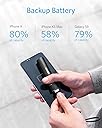
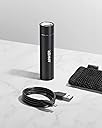
🔌 Power up your hustle with the mini charger that’s always ready to go!
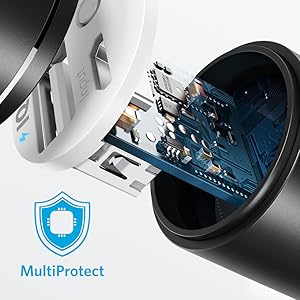
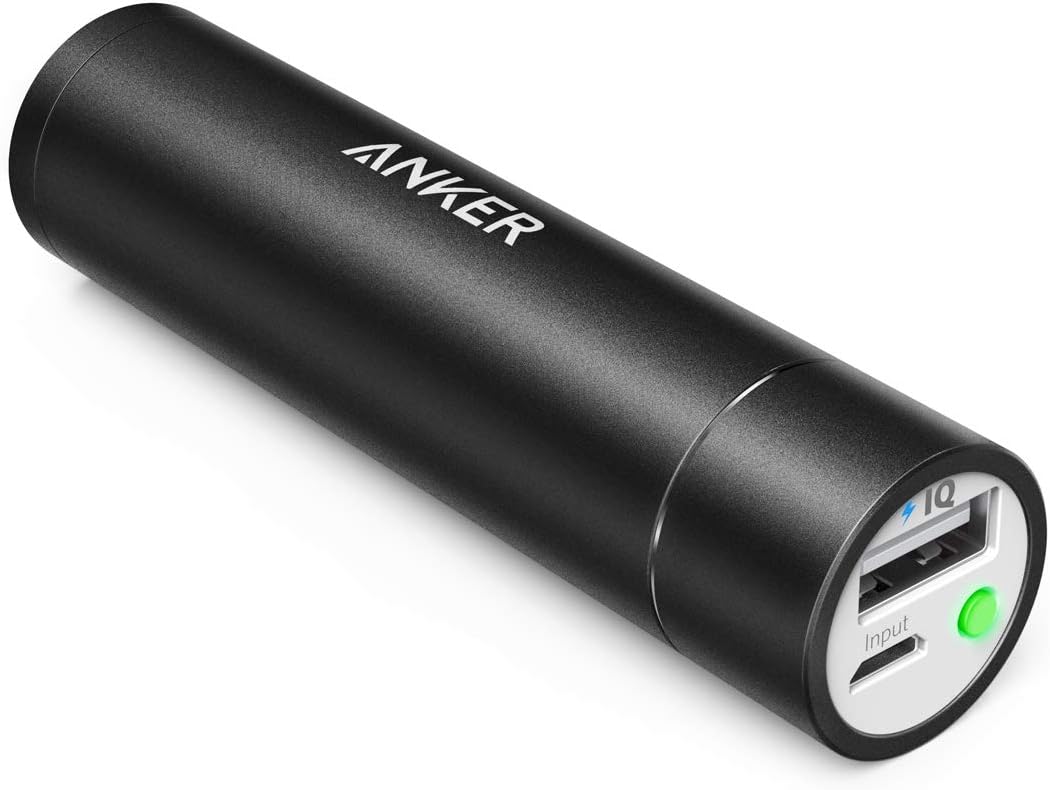
The Anker PowerCore+ mini is a premium, lipstick-sized portable charger featuring a 3350mAh Panasonic battery, PowerIQ fast charging technology, and a durable aluminum shell. Designed for professionals on the move, it delivers reliable backup power with advanced safety protections, all packed into a sleek, ultra-compact form factor that fits seamlessly into your daily carry.


| ASIN | B005X1Y7I2 |
| Amperage | 1 Amps |
| Antenna Location | Cellular Phone |
| Battery Capacity | 3350 Milliampere Hour (mAh) |
| Battery Cell Type | Lithium Ion |
| Battery Charge Time | 4 Hours |
| Battery Weight | 81.4 Grams |
| Best Sellers Rank | #613,969 in Cell Phones & Accessories ( See Top 100 in Cell Phones & Accessories ) #3,011 in Cell Phone Portable Power Banks |
| Brand | Anker |
| Built-In Media | Battery |
| Color | Black |
| Compatible Devices | apple iphone 6, google nexus 7, lg g2, samsung galaxy s6 |
| Compatible Phone Models | iphone-8 |
| Connector Type | Lightning, Micro USB |
| Customer Reviews | 4.4 out of 5 stars 22,556 Reviews |
| Global Trade Identification Number | 00848061087970 |
| Is Electric | No |
| Item Dimensions | 3.74 x 0.91 x 0.91 inches |
| Item Dimensions L x W x Thickness | 3.74"L x 0.91"W x 0.91"Th |
| Item Weight | 3.04 ounces |
| Manufacturer | Anker |
| Mfr Part Number | AK-79AN7913S-BA-0009 |
| Model Number | AK-A1105011 |
| Number of Batteries | 1 Lithium Ion batteries required. (included) |
| Number of Items | 1 |
| Number of Ports | 2 |
| Other Special Features of the Product | Portable Charger,Travel |
| Portable | No |
| Power Source | Battery Powered,Usb Cable |
| Special Feature | Portable Charger,Travel |
| UPC | 848061087970 848061066043 |
| Unit Count | 1.0 Count |
| Voltage | 5 Volts |
| Warranty Description | 18-month warranty and friendly customer service |
| Warranty Type | Limited |
A**R
Absolutely great!
I thought it about time to finally write a review about an Anker product. I am so impressed with this company and I hope that this may help others choose what I believe are the best products on the market. Over the past 3 years i have purchased multiple products form Anker. I don't remember how I first heard of the company or decided to buy/try the product, but I do remember it was a portable battery charger. If I remember correctly, it was one of the Astro products. I remember being so impressed with the charger that When I needed a specific product, I would look to see if Anker produced and sold it. Over the past 3 years I've purchased the following products. One 24W Dual Port rapid charger, four 40w family chargers, four 3 feet lightning cables, two 2nd generation Astro 3 chargers, 2 slim she'll 6s plus case protectors, 11 tempered glass protectors for various Iphones, 2 power core plus mini's, 10 6' lightning connectors, power line micro usb 5 pack, 2 CD slot car mounts and a premium aux audio cable. You must be thinking " what the heck is this guy doing with 10 of this or 6 of that. Every product I've listed, I bought and was so impressed with every aspect from the packaging to performance of the product that I have started giving them away as birthday and Christmas presents. For example , the CD slot car mount was the best mount I've ever purchased and believe me when I say " I've owned at least 10 mounts over the years" and they are all garbage when compared to the Anker mount. I had to have one for each vehicle. If you do not use you CD tray in your car to play CD's then this is the best phone mount you can buy. I've had a couple of problems with the 40W family chargers. 2 of the original chargers had a couple of the ports stop working. I called the Anker support line and all I can say is the customer service is a 15 on a scale of 1 to 10. They sent me a replacement product and no questions were asked. It was just done. I've had no further problems with the chargers and my children all have a 5 port charger as well as one behind the couch. One plug, one charger, 5 ports, 5 lightning cables and I have no more complaining children!!! I started this review to specifically talk about the PowerCore+ Mini. I received the product yesterday and was satisfied with the packaging. It was not what I am accustomed to with Anker products, but it was ok. If you buy an Apple product you will understand what I mean when I say "the packaging is as beautiful as the item inside" and you know the company has put tremendous effort into the small details. Anker is by no means on par with Apple but they are one of the BEST I've come across. The packaging was ok, but I have to mention that the thought did cross my mind that it could have been done a little better. I unboxed the mini and what I found inside was exactly what I expected. A beautifully crafted product that looks just as good as anything Apple might produce. I was very impressed with the aluminum body and the front layout with the led button. My second thought was " once USB Type- C becomes widely adopted and you have only one small connector on the front for charging and loading, this will be a slam dunk. I thought to myself, " If Anker would adopt the Type-C interface on this product, they could likely increase the battery size another 20 to 30%. Needless to say, I was impressed. I plugged the unit in and let it fully charge overnight. As you see in the list above, I have a couple of the larger Astro 3 chargers and I get multiple charges of my iPhone with those larger units. I'm thinking to myself, " what can this tiny thing do"? I decided that I would carry the charger with me all day and finally plug it into my phone after the battery goes dead. Now this was not as easy as you think it may be. I have the new iPhone 6s Plus with a 2750 mah battery and that thing last all day. I've had the phone 3 weeks now and I've never had the battery go dead on me. I've been close a few times, but never needed to hook it up to my Astro 3 for a boost. Driving out of Manhattan today I had my phone running 3 GPS navigation programs and had you tube playing videos all just to kill the battery. I finally noticed that the phone was dead and at exactly 7:00pm I plugged the Mini into the iPhone . 1 hour later It was at 33% and the light changed to yellow. At 1 hour 35 minutes I checked and it was at 49%. At 2 hours the light started blinking red and my phone was at 78%. I did turn on airplane mode as soon as the phone powered up. I wanted to get an idea of what the battery could do and be able for others to repeat the process under the same conditions. In my opinion, the only way to get close to this is to activate airplane mode for the duration of the loading. I was amazed at how far this tiny lipstick charger performed. I believe this is the perfect charger to carry all day just in case you need a boost. I would never replace my Astro chargers but this is the perfect compliment to my collection. :) Summery: This is the perfect product to grab when heading to the supermarket and realizing your phone is at 3%. With the mini, you have a product that can solve the "going out to dinner" and realizing your phone is almost dead problem. I would not carry this on the all day hiking trip where I know my phone GPS will be gobbling up power and I may not be home till late at night. I would have my trusty Astro 3 in my backpack. I am sure I will be using this charger almost every day!!
A**E
Quality versatile charger bargain! Must have
This is my first review and it's because I seriously like this product. The quality and functionality of the PowerCore plus mini is only exceeded by its bargain price. I'm not new to Anker products, they always seem to live up to or surpass my expectations. This little guy is no different. I get at least 2 full charges on my iPhone 5s from the charger from 5% or so to 100%. I take it in my bag or in the car and plug in to get me back up to a full charge on the go. I'm not tethered to a wall/car charger and get a charge just as fast as if I was. It intelligently charges your device as fast as your device allows which is great because over charging or rapid charging batteries can seriously shorten their lifespan. The size of the charger is a cylindrical tube 3.75 inches long by 0.8 inches in diameter. It has an aluminum body that feels robust and well-made. It's coated with a matte black powder coat finish. My unit came with a black mesh bag w/drawstring and a USB to micro-USB 24 inch long (23.5 inch of useable length) charging cable. The mini charger has a micro USB input port and a regular USB output port. Just push the LED status button to see Green (50-100%) indicator light, Yellow (25-49%), or Red (below 24%) to see the level of charge of the unit or to activate the unit to send power to the device you want to charge. The indicator light stays on and shows its capacity of charge remaining while charging. It's very easy to understand and use. The mini is small and light weight enough that I've taken it camping/backpacking too. I plug it into wall power before I leave and I'm good for a full charge anywhere in the field when I need it. I've got a rechargeable headlamp that plugs right into the USB of the mini and charges during the day inside my pack when I'm not using it. Same for my GPS, I plug its cable in to the mini charger and it lights right up for use- any power that isn't running the GPS gets funneled back to the NiMH batteries in it and it slowly charges. This is a great feeling to know that I'm not going to run out of battery power on the devices I need and use daily whether in the field or around the city. I recharge my PowerCore plus mini with the dual port Anker PowerPort Solar 21W solar charger at the same time as my phone if I'm out for a couple days or more which lets me recharge at night or on the move. I've begun researching the 800 mile Arizona Trail that spans the North/South distance of my state from Mexico to Utah and will be using a battery powered personal satellite transmitter to let my family and friends track my position via the web and let's me have access to emergency responders if I get into a life and death situation. All these devices would require literally pounds worth of spare batteries where this system mere ounces. The fact that I can keep power to all my stuff when I might be days away from civilization is amazing but even more incredible when I can do it with a lightweight, affordable, and reliable piece of gear like the PowerCore Plus Mini. Maybe power in the field isn't important to you but tell me your phone has never run out when you need it most! I know mine has. This gives that peace of mind that is well worth $10. I'm considering upgrading to the Anker 5000mAh version portable charger to go further between charges but have been more than impressed by the quality/ease of use to price ratio of the Anker PowerCore plus mini. I highly recommend it, you will use it often and I don't want to be caught without it. Thanks Anker for making great, reliable, high quality, and affordable products! Keep it up and I'm a customer for life.
T**T
Full Teardown! Not All Batteries Are Created Equal!
Power Teardown! Not All Batteries Are Created Equal ***NOTE*** This review contains technical observations which I have reported to Anker. Although they have responded to some of them, they have not yet addressed all of my questions. This review will be updated as answers to these questions come in. [Quick Summary] Curious about the build quality and what's inside? Me too, and I destroyed a battery so you don't have to, and at full price! Overall, Anker's build quality these days is pretty gosh darn good. Machined aluminum with an anodized finish, and tasteful silk-screening that complements the look and feel of the product. The battery I opened was verified to contain a high quality Panasonic-Sanyo NCR18650BF Lithium Ion cell, which is one of the finest cells available on the market today. Anker has clearly put a great deal of work into creating a fantastic product at a fantastic price. Unfortunately, I observed a number of inconsistencies in both order fulfillment and product performance, which I believe Anker will work to resolve ASAP, at which time I will update this review accordingly. It is important to note that the battery industry is chock-full of snake oil, shams, and scams. Even with the difficulties that I observed, I am convinced that Anker provides products of better quality and consistency than most (if not all) of the competition as any "problems" that Anker may have are generally much worse with other vendors I've worked with in the past. Yay: - Solid, Handsome Industrial Design - Extremely Compact, No Wasted Space Observed During Teardown - Premium Panasonic-Sanyo NCR18650BF Cells Inside - Finest in the Industry - Elegant and Intuitive Usage - Super-fast, Super-friendly Support with 18 Month Warranty - One of the Longest in the Industry - A.M.A.Z.I.N.G. Price! - 9.99USD at Time of Review for PowerCore+ Mini in Black Nay: - Inconsistent Fulfillment, Frequent Product Updates/Changes May Result in Order Errors and Old Product - Inconsistent Performance of Internal DC Boost Converter Between Batteries, Affects Output Current and Capacity, Actual Available Capacity Varies Between 8.5Wh and 9.5Wh. - Possible Inconsistent Quality Control - Based on my numbers Anker deemed 2 out of 4 batteries to be possibly defective and shipped replacements (not arrived at time of this writing). - Some Revisions May Be Prone to Overheating and Loss of Efficiency IMPORTANT!!! DO NOT USE CHEAP, THIN, OR LONG USB CABLES WITH EXTERNAL BATTERIES. YOU WILL WASTE UP TO 40% OF YOUR POWER! Would you like to know more? [Prequel] I'm a bit of a voltnut. I care about the stuff that most people don't. When it comes to batteries, I want every watt-second I can squeeze out of a cell. Unfortunately, the battery industry is full of lies, treachery, and deceit. Manufacturers are incentivized to fib here and there because now everyone shops by the numbers. People expect the numbers to be highly accurate, and don't realize how complicated modern batteries can be, how often vendors lie about specifications, and how often cells are counterfeit. I've become so jaded over the years that I now expect most vendors to lie until proven otherwise. That's why when I saw Anker advertise a 3350mAh USB battery for 9.99USD including shipping, I assumed it was too good to be true. It wasn't until I saw Anker advertise its "Premium Panasonic Cells" that I became truly curious and decided to not only buy some batteries, but resigned to tearing one of them apart in the name of science! For load-testing the batteries I am using a Maynuo M9712C Programmable DC Electronic Load . When I needed a power source I used a Rigol DP832A Programmable DC Power Supply , and verification of voltage readings was done using a Rigol DM3068 6.5 Digit Digital Multimeter . In order to minimize power loss in the USB cable during whole product testing I custom-built an extra-short USB cable using 22AWG conductors, meaning that all of my numbers will be best-case scenarios for each of the batteries I tested. Real-world numbers will vary wildly depending on the type, length, and quality of cable used (more on that later). So without further ado, let's get to it! [Ordering] Anker generally uses Amazon's fulfillment for almost all of their products, which is smart as it offloads a great deal of logistics and gives hundreds of thousands of customers access to their entire product line using Amazon Prime shipping. Unfortunately, it also means that when there are production changes or revision updates, inventory management gets a bit hairy. Sometimes product ASIN's get mis-coded, sometimes inventory gets mixed up, and other times there may be listing errors that result in the wrong product revision being dispatched from the warehouse. This was the case for me when I ordered two PowerCore+ Mini's in Black last week, and two Astro Mini's in Black showed up, although they were so close to the PowerCore+ in appearance (in fact, they are identical in appearance) that I didn't even notice the error until a couple of days later when during testing I noticed that the tail cap of the battery had "Astro Mini" written on it. At time of this writing both the Astro Mini and the PowerCore+ Mini are listed as separate products on Anker's website, and share the same capacity ratings, but have some minor published differences. Both are rated at 3350mAh/12.06Wh, and both claim 5V @ 1A output. In fact, the only published difference that I found was a small difference in charge rate; whereas the Astro Mini has a charge spec of 5V @ .8A, the PowerCore+ Mini can be charged approximately 20% faster with 5V @ 1A. I reached out to Anker's support on Friday to speak with them about the discrepancies, and later that evening, I saw that Anker had split and moved around a number of their listings for the PowerCore+ Mini (and increased their prices for most of their colors by 4USD). A follow-up call on Monday confirmed that there was likely an error in the listing with fulfillment as while Amazon's system showed that I had ordered two PowerCore+ Mini's, Anker's reported that I had ordered two Astro Mini's. During testing of the Astro Mini's I observed some troubling discrepancies that prompted me to order additional batteries. I ordered an additional PowerCore+ Mini in Silver, after the Amazon listing shuffle stopped a couple days later, another in Black. Both the Silver and Black units that I ordered in those ordered arrived correctly marked as PowerCore+ Mini's. [Packaging] I've ordered a number of Anker products in the past, usually USB hubs. Anker's packaging has always been efficient, easy-to open, and well-thought, and these batteries were no exception. I would consider to the box to be perfectly "stocking stuffer" sized. Each battery came with a short Anker USB Micro cable, a tasteful carrying case, and a short and sweet support pamphlet that tells you how to get questions answered or stuff fixed. Each battery's USB port is also covered with a sticker to remind you that the battery automatically cuts power to the port to conserve energy when not in use, and that a quick tap of the small button in the corner is all you need to get the juice flowing. Simple. Elegant. Functional. [External Materials and Construction] "Wow." This was my initial reaction. As I mentioned before, the phone accessory market is often a race to the bottom in terms of quality, and batteries are no exception. Fierce competition on price in markets such as Amazon drive manufacturers to cut corners whenever they can. A few nickels here and there can add up quickly when you think about the volume of product moved. If Anker did cut any corners with the casing of the battery, it doesn't show. The body is a beautifully anodized, slim, aluminum shell that wraps around the interior cell and electronics. This thing is *rock* solid, and shames all of those cheap-feeling plastic models out there. Why does it matter? Well, just do a quick search for "Lithium Ion Fire" on YouTube sometime and you'll see quickly why the FAA restricts how much lithium you can carry on an aircraft in the form of batteries, and why most major couriers won't allow you to ship Lithium batteries via Air Mail unless you have a hazmat contract with them. Lithium Ion cells can be downright dangerous if mishandled, and you want the hardest, crunchiest shell you can find to safeguard those cells, especially when the battery is this small. Anker got this 100% right, and for a stellar price. Anker's logo is silkscreened tastefully on the side in a way that doesn't look gaudy, and the aluminum tail cap has detailed specifications silkscreened onto it, including capacity in both mAh and Wh (yay!) and a serial number, which Anker uses in the event of a problem to determine which manufacturing batch it came from. Serial numbers on devices this cheap are the hallmark of a manufacturer that cares because while you are unlikely to file a police report for a stolen ten dollar battery, Anker certainly wants to know which manufacturing batches are having problems, if any. The only visible plastic on the unit is on top, and is done tastefully. The plastic doesn't have that cheap looking "sheen" that so many products today have, and as silly as it sounds, the button feels nice. In fact, everything on the battery looks and feels, nice. [Internal Construction and Quality] ***WARNING*** What I did here is totally and completely dangerous (see above dire warning about exploding lithium cells), and I would not have done so if it wasn't for my safety equipment and experience with lithium cells. Please, please, please, do not try to disassemble your battery! ***WARNING*** I don't pull punches with batteries or battery vendors, and I didn't intend to judge this battery by its casing alone. I wanted to see what was inside, but neither the tail cap or the head cap were budging. That's why I broke out my jewelry saw and with the utmost care, cut the casing apart! So what did my ten dollars, hour of nerve-wracking slow sawing, and wanton disregard for my own health and safety reveal? A pretty great design! Anker's PowerCore+ casings are threaded at both top and the bottom instead of press-fit, which means simply dropping this will not crack any part of it open, regardless of drop height. They've also sealed the threads with what appears to be cyanoacrylate glue (fancy way of saying super glue) which means you won't even be able to wrench it apart with vise grips if you tried (I did). Being well-versed in the 18650 cells that Anker uses, I knew there would be little to no "dead space" inside, but I was able to confirm how tightly everything was designed once I got the tail cap off. Eventually I was able to saw off the rest of the casing without putting a scratch on the battery cell itself, and was able to reveal a Panasonic-Sanyo NCR18650BF cell soldered to a small DC boost converter PCB and USB ports. The NCR18650BF cell is a beauty of a battery cell, and represents one of the highest capacity and quality cells available on the market today. It has a nominal capacity of 3350mAh / 12.06Wh at time of manufacture, with a maximum continuous discharge rating of 3.63A, which is more than enough for this particular application. It's older brother, the NCR18650B, has a similar capacity but sports a 10A max continuous discharge, which is overkill for this application. Technically Sanyo also now makes the NCR18650GA cell, which boasts an industry-leading 3500mAh, but this is a negligible bump in capacity that would result in a not-so negligible bump in cost. This is also the reason why I have mentioned the cost so many times in this review. I had to know what cell was inside. Most reputable outlets will sell just the NCR18650BF *alone* for 9.99USD. That Anker uses this cell and still manages to manufacture and ship everything else with enough room left in the margin to sell it at 9.99 and not lose money, is nothing short of a miracle, and it is what prompted this review. I did also have a look at the DC circuitry, and was impressed as well. Most phone accessories that I've repaired or inspected have had laughably poor design and manufacturing quality. Anker's DC board appeared to be well thought-out and laid out, and had solder welds of excellent quality, which is embarrassingly enough the thing that most vendors manage to screw up. The DC electronics appeared to be split into two boards. One for the battery protection and charge circuit, and the USB Boost Converter on another circuit, mounted perpendicular to the first. This was a smart design choice as it allows Anker to make revisions to each board independently of the other, and provides them with more flexibility in the long run. Not that it matters to most Amazon buyers, but my battery protection circuit had a marking of "7913P-2-V1.1 14.12.04", implying that it was revised December 4th, 2014, while the USB PCB was marked "13.11.29 7913P-1-V1.1" which implies that it was designed over a year prior to the former. Anker claims to use "high quality US-made IC's" in their products and I don't have an easy way of refuting this. None of the IC's bore any logos or enough information for me to identify the part without dissolving the chip in nitric acid and putting it under a microscope, but based on the rest of the build quality, I have no reason to doubt them on this point, although I would argue that it should probably read "US-designed", as very, very, very, very few chips are actually still manufactured in the US, with the exception of those intended for military or government applications. [Lab Performance and Capacity] This is the most important part, eh? Alright, let's dive in. First rule, everybody lies. Some people lie just a wee bit, some quite a bit more, but everybody lies. When the whole industry lies, it's called a "standard". :-) Second rule, batteries age. They age just by sitting there, doing nothing. They age even faster when you actually make them DO stuff. Third rule, most specifications are useless. mAh by itself is not an actual measurement of energy, although everyone and their dog treats it like it is. If your battery was a tank of water, the mAh rating would be akin to saying how many hours you can spray water for, but not telling you how big the tank is. You would have an extremely vague idea of of how much water you can hold, but not a real figure. It's a poor analogy for it, but the detailed explanation would add even more text to an already ridiculously long review, so if you want to read up more, please do so at your favorite search engine but in the meantime, let's just say that we only care about Wh, or Watt-hours. Every battery cell has two capacities. The "Nominal" capacity, and slightly lower "Minimum" capacity. Everyone only uses the first number in marketing. Everyone. What this means is that "12.06Wh" capacity that you see on the product is only true for a couple of weeks right after Panasonic made the battery cells. By the time those cells are stored, sold to Anker, then stored again, used in manufacturing, stored again, shipped to Amazon, stored again, and then eventually shipped to you, these cells have a usable capacity of around 11.52Wh to 11.70Wh, which is actually what is reflected in the official datasheet for the NCR18650BF. 12.06Wh is just the NOMINAL capacity and in real-life you never see that. So why does everyone use the nominal capacity? Because it sounds better, and technically speaking, it was true for at least a couple days, long long ago. So I started at the bare metal, the lithium. I ran the NCR18650BF cell just by itself against a load of .2C or .67A and a cut-off voltage of 2.50V, the same test that Panasonic uses to get their original rating, and got a capacity of 11.4834Wh, which is just slightly under the "Minimum" rating for the cell, but it's close enough that I can't fault Anker for it. This is the real-world, best-case, available capacity of the cell before it goes through any other losses, such as those introduced by the DC/DC conversion up to 5V, before the voltage drop in your USB cable, and before the conversion losses in your device as it charges the internal battery. We're already starting the race a with a handicap, but everyone has a similar handicap. However, capacity is more than just age, it's also directly related to current draw. The harder you run the battery, the lower the available capacity of the cell is. Furthermore, generally speaking DC boost converters like the type used in consumer hardware also lose efficiency as the input voltage drops. To determine how hard the USB circuit runs the battery and look for efficiency losses, I removed the battery and connected the circuit to the monitored output on the lab power supply. Using the electronic load I applied a 5V 1A load to the USB port and monitored current draw from the power supply: USB Load Battery Load DC Boost Efficiency 5.000V @ 1A = 5.00W 1.349A @ 4.2V = 5.67W 88.2% 4.991V @ 1A = 4.99W 1.637A @ 3.6V = 5.89W 84.7% 4.988V @ 1A = 4.99W 1.825A @ 3.2V = 6.06W 82.3% Anker claims 90% efficiency with their DC converters, but since they do not publish their testing process or procedure it is impossible to know under what ideal conditions they performed their tests. What is clear however, is that however great their design is, it fails to meet 90% efficiency in the specific battery that I took apart. Based on conversations with Anker, they are constantly updating and making changes to their designs, which is great, but because these changes aren't publicly tracked and because the batteries are sealed, there is no simple way to know what the characteristics of your battery are. It may sound like I am being harsh with Anker, but I am not. These are simply the facts, and the truth is that in my experience most of Anker's competitors are far worse. The point of this breakdown is to provide some real-world data on a product. Something else that I observed on the Astro Mini that I took apart (we'll call it "Unit A") is that the USB circuit was prone to overheating. While it didn't prevent the unit from working, it did reduce the power output and decrease efficiency as it heated up. I verified this by using Freeze Spray , and found that a short blast of freeze spray dropped the temperature instantly and restored efficiency back to the numbers above. It bears noting that so far all of the tests that we have discussed were performed on a battery that was labeled as "Astro Mini" and it is possible that my battery was manufactured during the early stages of the production shift. The rest of the batteries, units B through D, all exhibited different qualities that as I will discuss later, but I did not cut any of those open since I wanted to limit how much I was spending out of pocket. Remember the first capacity test I did? It was only run at .67A because that's the rate that Panasonic-Sanyo used for measuring the published capacity of the cell. That capacity will be lower when drained faster and as you can see above, in order to charge your device at 5V @ 1A, the drain on the battery cell is more than twice that. Since modern lithium cells have a stated nominal voltage of 3.6V, I used the current draw of 1.637A and cut-off voltage of 2.50V to re-assess the capacity of the bare NCR18650BF cell to determine the actual available capacity at the higher drain rate. Result? 11.08Wh. So as you can see, using the cell as intended we've already lost about .40 Wh of energy capacity before we even touch the losses in the boost circuit, and that's assuming a cut-off voltage of 2.50V! In my testing I found that when drawing 5V @ 1A the boost circuit cut-off and shut down when the cell voltage dropped to approximately 3.20V, which means we're still leaving some Watt-minutes on the table. How many? Start Voltage End Voltage Current Draw Capacity 4.20V 3.20V 1.67A 9.54Wh 3.20V 2.50V 1.67A 1.54Wh Anker is still leaving over 1.5Wh on the table! That's akin to a car manufactuer giving you a 11.08 gallon tank, but not designing the car in a way that it can access the last 1.54 gallons, almost 14% of your tank's capacity. Ever. They could have had great reasons for this, ranging from increased cycle life to thermal management and safety, and I am not in a position to refute them, but it's an interesting observation nonetheless. Furthermore, these are all tests on individual components. At the end of the day, what really matters is how the customer will use the battery, so let's get to... [Real-World Capacity and Performance] These tests were all performed with the batteries fully sealed, assembled, and as they came directly from Amazon. In total, I tested four batteries, two of which were marked as "Astro Mini", and two of which were marked "PowerCore+ Mini", all of which were marked 3350mAh/12.06Wh. All of them were ordered as "PowerCore+ Mini" from Amazon. They were all designated Units A through D. For the testing procedure, I charged each battery through the USB Micro port per the instructions from Anker until they were full. I then connected each battery to the electronic load and programmed the load for a constant current draw of 1.000A, and measured the output voltage ten times per second until the battery died. Each test was performed three times and the results were averaged. The results were beyond interesting to say the least, as no two batteries performed alike. Item Received Item Model Available Capacity Astro Mini (Black) (Unit A) A1105 8.769Wh Astro Mini (Black) (Unit B) A1105 9.345Wh PowerCore+ Mini (Silver) (Unit C) A1104 8.607Wh PowerCore+ Mini (Black) (Unit D) A1104 9.578Wh The difference in capacity between the best-performing battery and the worst-performing battery was over 11%!!! I've attached the discharge curves for each battery to this review. My notes regarding each unit tested are as follows: Astro Mini (Black) (Unit A): Discharge remained flat and stable until the battery was approximately 75% depleted, at which point the voltage became unstable and dropped significantly. Based on the erratic behavior of the drop I believe the boost circuit began to overheat as it tried to cope with the lower input voltage of the battery cell. Astro Mini (Black) (Unit B): Discharge failed to remain flat after approximately 10% capacity used and declined consistently and rapidly through the complete discharge cycle. The relatively smooth discharge curves indicates a failure of the boost circuit's design to maintain 5V @ 1A. Based on observations with Unit A it is possible that overheating contributed to this, but since I did not cut open the exterior casing this is just an educated guess. PowerCore+ Mini (Silver) (Unit C): Discharge remained extremely flat through the cycle and output voltage increased slightly as charge was slowly drained. Based on conversations with Anker this is likely due to Anker's "Voltage Boost" feature which provides a slightly higher output voltage in order to compensate for the loss in the USB cable. While this does provide a slightly faster charge, it also results in a slightly lower available battery capacity, although this small discrepancy alone does not account for the near 1Wh difference between Units C and D. PowerCore+ Mini (Black) (Unit D): Out of all four batteries, Unit D exhibited the best performance. The output was not only super-flat through the discharge cycle, the available capacity tipped the scales at 9.578Wh @ 1A draw, which was better than any other of the batteries that I tested. Interestingly enough, the "Voltage Boost" feature appeared to be absent from this particular unit, as well as units A and B. So what does all this mean? First, it is important to note that I was using a programmable load for testing, and not a device. In actual usage, your device is always going to try to draw 5V, and if the battery can't maintain it, the current output will drop, resulting in a slower charge rate. I would also like to make clear that charge rate and battery capacity are completely independent of each other. While charging a device as fast as possible might be the most important thing when connected to a wall outlet, that may shift when one starts to think about how a portable battery is used. Personally, I would much rather have my phone take a few more minutes to charge to a higher percentage, than to charge much faster to a lower one. All that said, I am somewhat unhappy with how inconsistent the results were. I ordered four of the same battery, and ended up with four batteries that performed completely differently, which brings me to... [Anker's Response] On 11/23/2015 I forwarded my results to Anker Support along with relevant purchase dates, serial numbers, and other information they requested. Anker followed up with me later that day, and explained that not only were the Astro Mini units possibly shipped out to me because of a fulfillment error in the system, but that at least one of them, possibly both of them, may be "defective". I'm putting defective in quotes here because this is an issue with a lot of grey area. Batteries in the real world are not an exact science, and there is a "range" that is considered normal. Even though the results may look bad when the data is presented the way I have presented it, without knowing the design intent it is difficult to know if the problem is really a defect in manufacturing, poor quality control, over-eager marketing, or some combination of these issues. The Anker representative advised that they would replace Units A and B with new PowerCore+ Mini's from Amazon's inventory because of the order-mix-up and possible defects. When I pressed for more information about why there would be a nearly 1Wh difference between the other two batteries I had, Units C and D, and why one of them appeared to have Voltage Boost but not the other, I was advised that they would send a message to the Product Management team and get back to me. This review will be updated with that response when if and when it is received, along with additional capacity measurements for the replacement batteries I receive. [A Note About Cables] Not all USB cables are created equal, and I'm not just talking about how they look or feel. When it comes to charging, the two most important factors that will affect your charge rate and efficiency are cable length, and conductor size. The longer the cable, the higher the resistance, the lower the efficiency. Thinner wires also result in a lower current carrying capacity, a higher resistance, and lower efficiency. So while that extra-long or extra-cheap cable might be really convenient while traveling or easy on the wallet, if you use it with an external battery you're throwing away capacity. In my preliminary tests of several cables I saw some of the worst cables reduce efficiency by up to 40%!!! This is a ridiculous number, and it doesn't just mean slower charging. It means you're potentially throwing away vast amounts of battery capacity in your external battery pack by using an inadequate cable. My recommendation, when using an external battery use the shortest cable you can get away with using comfortably. If that means you have to carry around two different lengths of cable, so be it. Don't waste your precious battery power! [Final Thoughts] So far my impression is that Anker is a high quality vendor with a high quality product that is possibly a victim of their own success right now. I don't know how many batteries they're producing right now, but as one of the top vendors on Amazon, it's got to be astronomical. What I would like to find out is if the issues that I observed in my technical analysis were short-term incidents or long-term problems, and only time will tell. Certainly Anker's customer service is beyond reproach, and based on my experiences so far I am confident that Anker will fully stand behind their 18-month warranty if anyone reports any problems. It is unfortunate that most customers wouldn't know necessarily if their battery is not performing ideally or not, but then again, most customers probably wouldn't care at this price point. If you were to ask me which brand I would buy following the conclusion of this review, for the moment I would still say Anker. :-) Finally, I've put a ridiculous amount of effort into writing up this review. [...] If you think something could make it better, leave a comment!
J**E
Great little charger to have for heavy phone users!
This super portable charger is a handy thing to have if you're a heavy phone user, and you need assurance that your phone won't die in the middle of the day. It's small enough to store in any pocket or bag, and light enough that you won't even notice it. I bring it with me every day, and I gotta say, on sunny days when I need to turn my screen to 100% brightness, this little guy has saved my butt a couple of times. It has at least 1 full charge for my iPhone 6, and I would even say it has enough juice to charge it to 30 or 40% if it ran out of battery AGAIN, which basically means it amounts to 130% worth of iPhone 6 battery. That's not a lot, but it's enough if you're just carrying it with you for the day. I charge mine at night whenever I need to use it, and it doesn't charge lightning fast but I don't need it to, so that's fine. The power button initiates the charging, so even if you plug your iphone into it, it won't start charging until you turn it on. The light changes from green to yellow to red depending on how much charge is left. But I also found that there was no way to turn OFF the charger once I was done using it. Pressing the power button when it's already on doesn't do anything. That's not a huge deal, though. Usually I just unplug it from my phone and put it back in a pouch so it can turn off by itself. All in all, it's a great thing to have. It's convenient, and helps a lot. I'd recommend it for anyone who uses their phone constantly throughout the day, and have to hold their breath when they're on 7% until they get home.
R**.
Simple and convenient
This is my second Anker Astro Mini 3000, and the Mini was my first Anker purchase, my "gateway" product that introduced me to Anker. Like most companies, they make good stuff, but what has really set Anker apart is their attention to customer satisfaction. Plan on being happy with what you get from Anker, their designs are simple, smooth and elegant; but as with any piece of electronic equipment, sometimes they don't work perfectly coming off the assembly line. Anker will make it right and you will quickly find that you, too, will get sucked into looking at more of their stuff because Anker stood by what you bought. Mine have worked flawlessly from the get go, but if you read reviews for Anker products, if someone has an issue, Anker fixed it ASAP. It's rare to see that type of proactive customer service. And it's awesome. When I posted my 1st review on the Astro Mini 3000, Anker sent me a follow-up message to see how I was enjoying the product. It does great at phone charging, totally convenient and invisible in a jacket or pants pocket. I can even throw my phone [a Nokia N9] into my pants pocket *with* the Mini attached because I'm low on phone power and it doesn't look all "Is that a phone charger in your pocket or are you just happy to see me?" I can use the phone with the Mini attached and it isn't too clunky. This is a very convenient product for phones. The Mini is small, lipstick case sized, and will provide a smart phone with more than a full charge. If you need more than one full charge + a little bit while you're out and about, get a bigger battery from Anker. They have a lot of different sizes avaiable, but none as conveniently sized as the Mini. My favorite feature is that the Mini outputs 1 full Amp of charging power. You'll find most USB chargers, wall chargers, etc., will output .8A, what this means is that using the Mini [or most any of Anker's external batteries] will get your device charged *faster* than when plugged in at home. Sometimes I'll use the battery to charge my phone or GPS for a daily maintenance charge because it *is* faster and I don't have to wait as long as the wall charger. I've got places to be! Anker was interested in how else I use the Mini; I use it mounted on my mountain bike stem to power my handle bar-mounted GPS because I often ride longer than my GPS' 6-hour battery life. I have a 24-hour mountain bike race in February and the Mini will be mounted as a necessary piece of equipment on my bike for the race to let me track and log the entire 250 or so miles. So Anker supplied me this 2nd Mini to mount on my bike and sample for test and evaluation, and I promised that my review is fair and honest. For the price, you can't go wrong, a car charger is almost as much as the Mini 3000 and nowhere near as convenient. Get one. Or two or three. Great stocking stuffers too!
S**2
Small battery; smaller life
I bought this item based on some other reviews and I was rather disappointed with it. The battery takes forever to charge and then when you plug your phone into it to charge, it takes longer than forever to boost your phone's battery. You're lucky to get a 5% charge out of it. If you need an external battery for the iPhone 4 (which I did), I highly recommend the Mophie Outdoor Edition. This little lipstick-sized battery doesn't even make a good doorstop. Edit: After this review hit the website, I received a phone call on my cell phone from an unfamiliar phone number. Curious, I answered. It was an Anker representative who had read my review! (Like, within an HOUR of my review being posted!) I have to admit: I was shocked that anyone paid any attention to my review, much less the company that put out the product. (No, really, I was; I guess I'm just jaded, thinking that companies don't care what you have to say, as long as you fork over bucks for their product. Are you listening, Big Business?) The lady was very nice and asked for specifics on why I wrote what I did (see original review, above "Edit") and we spoke for several minutes. I mentioned that I felt the battery was slow to charge and didn't last long when not plugged into its charging port. She offered to send me a replacement if I would send back the first one and revisit the review once I had the chance to use the latest and greatest model. It's been a while since our conversation, but I've had the chance to use the replacement battery and I'm here now, to revisit the review, as promised. The replacement battery was the same size as the original, so the size of the product, about the size of a large lipstick case, makes this battery highly portable. I'm still concerned about the battery's speed at recharging a drained device, but to be fair, I used it on my iPad, not my iPhone. It managed to charge the iPad up some 5% in about 40 minutes, which, given the probable battery size of the iPad versus the iPhone, sounds pretty good. I wish there were some other kind of indicator as to the amount of life left in the battery, besides the red-light/green-light indicator, so I have an idea of how long I can let it just sit without hanging out on the charger all the time, but since it's a small tube, there really isn't anywhere to put such an indicator. I'd say that, for emergency situations, this is a good 'last resort' charger - something for when your phone's completely dead and you need just that little oomph to charge it enough to make a 911 call, or something to that effect. It's more a battery to keep in your backpack (after making sure it's fully charged) for a day's hike, rather than to keep it as a primary energy source - I fully admit that I still like my mophie for that - but at the end of a long day, when the mophie's drained and the phone's battery is hovering just above zero, that's the time to pull out this little gem to give it a little boost so you can call home and let them know you're filthy from hiking and Geocaching, but now you're on your way home, and the teenagers better have dinner ready since they couldn't be bothered to come out and enjoy Mother Nature with you.
M**Y
Invaluable aid for and device which runs off a USB powered device.
Well, hard to know what brought you to this item, but assume it to be a wall charger for your device without the wall :-). It isn't simply like an extra battery or battery pack (although it could do that too), it is designed as a portable battery charger. Right now I use my Android phone for two serious power hungry applications. Both applications require GPS, Bluetooth and WiFi to be enabled all the time. One is a Golf app (GolfPadGPS) that gives you every geo function imaginable from distance to pin to Google Maps of the hole, including location, club and distance of every shot hit to a database recording everything forever. The other app is a Garmin GPS for flying airplanes and it communicates, GPS, Bluetooth and wireless and talks to several connected devices from music, to tower audio to WASS GPS and ADS-B connectivity. They all use a lot of power and my Android note has an 1600 ma battery. That makes this last about 2 hours and it dies. I can do a lot with the gold app by turning off functions, but it's still hard to get 4-5 hours of "on" time. When I get the "Battery low, plug device into a charger" warning, I plug this in, push the on button and everything goes back to full power *AND* it has enough juice left over to recharge my device. I can usually finish my flight or my round of gold and have a 100% recharged phone. It provides twice the power of my phone battery and can discharge at a very high rate, which is why it can charge my phone while running everything on board. It's light, easy to use and appear fairly rugged. I added a Velcro strip to keep it attached to my phone when in use, but it comes with a little carry bag, cable that can be used for charging it and discharging to a phone. As a guess, I'd say I can get eight or nine hours of high energy usage. I have not tried watching high def movies with it, but I am 100% certain you could watch 2 3-hour hi def movies during a flight. If you were going to be downloading them wirelessly while watching, I'm certain you could watch at least 2 2-hour movies and probably three, but that's nine hours at full power with wireless and video and that may use up more than this device offers. The good news is you could have two with you if you were doing overseas flights that required 9-12 hours of video time. Excellent product, excellent service.
J**O
A little extra power in your pocket.
I am relatively new to the whole smartphone thing -- I only got my first smartphone in the summer of 2013 -- so I continue to struggle to adapt to the different landscape that is the smartphone. A "feature phone" (or "dumb phone," as my dad calls it) has a battery that can last for several days of moderate use. A smartphone can last about a day and a half of moderate use, and forget about using it heavily for a day. Your battery will run out, and you are left looking for an outlet (and hoping that you remembered a charger), or you are suddenly without your phone! This happened to me one too many times, and I came to Amazon looking for a device like my friends' iphone second-battery attachment, but for a different type of smartphone. What I found instead was a little "lipstick-style" battery pack that I could attach as needed to my smartphone to have an extra portable charge. I was skeptical -- can a whole charge really fit in something this size? And does it make sense to charge from a device like this? I'm not an electrical engineer, but I remember a whole thing about AC to DC to AC conversion that a friend of mine told me once. Still, it was worth a shot, so I got one. In short, I am extremely pleased with this device. Let me tell you why. 1. Portability. They say it's a "lipstick style" battery pack, but you should know it is bigger than a lipstick. It's about the size of a roll of quarters, though, so it's not that much bigger. It's reasonably light, and it comes with a little usb cord and a little cloth baggie to put both the battery pack and the cord into. I wouldn't say that you should carry this around in your jeans pocket -- it would be a little bulky for that -- but it definitely could go in a medium-sized purse or a coat pocket or briefcase. In a standard backpack, you'll forget it's there until you need it. You can even have your phone plugged into it while you carry the phone around, if you don't mind the bulk of the two items in your pockets at the same time. 2. Functionality. It charges pretty quickly, or at least no more slowly than my wall/car charger does. I have charged my smartphone (a Samsung Galaxy Stellar) from about 10% to 100% with no problem, and I even used this to charge a digital camera with an internal battery. In fact, I used it to power AND charge that camera, so I was able to use the camera even as it charged. I'm not sure how much charging the battery pack can actually do on a single charge, because I'm not an engineer/physicist, but it certainly fulfills my basic needs for modern usb-powered devices. 3. How to use it. Okay, so the one thing that it didn't come with (which I sort of think it should) is an AC-to-USB power converter. That said, maybe Anker is trying to appeal to the international market by not including such a device. Plus, who doesn't have a dozen devices in their homes with USB ports at this point? Anyway, you plug the USB-Micro end of the cord into the Anker, and then the other end goes into a USB port on a computer or charger brick. Then you let it charge until the LED light on the Anker turns from yellow to off. Then, when you want to charge a device, you change the plug so that the USB-Micro end plugs into the device you want to charge, and the other end of the USB cable plugs into the Anker. (Note: this means that you can charge the Anker only with a USB-Micro cable, but you can use any USB cable to charge a device, though I haven't tried anything other than my smartphone). Now, once you have plugged in the device, you have to press the little button on the Anker! I cursed Anker's hearts the first time I tried to use this thing, because I didn't read the instruction manual and thought I had been swindled. Nope, I'm just kind of dumb. I pressed the button and VOILA! It started charging. I keep meaning to see if the Anker will power my usb-powered speakers, because that would be really neat. I haven't tried it yet, though. 4. Aesthetics. This seems silly, I know, but I really like the look and feel of this battery pack. No joke, it's just kind of satisfying how it looks and feels. I can't put my finger on it. Sometimes, I just like using electronic devices. This is one of those times. I I'd recommend the Anker mini battery packs to anyone who wants to carry around a little extra juice. You'll probably get a charge, maybe a charge and a half (depending on your smartphone make and model) out of it. For this price point, you can probably get two, if you're really worried about it.
D**G
Anker Astro Mini
I had recently purchased a new Blackberry Z10 after years of having an older Blackberry. I loved the features, big screen and apps. However, with the big bright screen, tonnes of apps, Bluetooth, Wifi etc... I found my phone battery almost depleted by mid afternoon. Then I came across the Anker Astro Mini and it was the solution to my problems. The Astro Mini is a portable power source which can be used to charge a wide variety of different devices. The best thing about it, is the size. It truly is the size of my wife's lipstick. So that makes it extremely portable. The device feels solid, not flimsy like other external power sources. It has an all metal design and feels like it could take a beating. To charge the device is simple - just plug it into any micro USB travel adapter (which is not included, but for $25 who cares). It takes 4-5 hours to fully charge and keeps its charge. It contains 2600 mAh which is enough for one full charge (while the phone is still on) of my smart phone. It comes with a cable that has a variety of adapters which can plug into either an iPhone (sorry no iphone 5 adapter with this model), Blackberry or Android phone. While it is charging the device (which is the same time as a travel charger - for me 5 hours from a completely depleted battery), you can still use your phone. It is very simple to use. After getting this product, I bought a few more for family and friends. Overall this is a great product. Well made, reliable, and best of all... reasonably priced. I must say, someone at Anker was thinking when they came up with this product. Highly recommend this product to all individuals with smartphones and are heavy users! Excellent, excellent, excellent.
J**L
Excelente Regalo
Mi madre necesitaba la bateria, así que decidí regalarsela. Carga mi Galaxy S6 hasta el 80% aproximadamente, su galaxy S7+ aproximadamente igual. El unico inconveniente es que tarda mucho en cargarse y que no tiene fastcharge al momento de conectarle el celular. La salida es de 1.0A así que tengan eso en cuenta también.
C**O
Excelente calidad
La batería cumple con creces lo que promete. Los materiales de construcción son durables y bonitos. La mayor parte está construida en aluminio, sólo la entrada de las conexiones es de plástico, pero de excelente calidad. La capacidad de carga es exactamente cómo se describe y en resumen es una excelente compra, la recomiendo ampliamente.
P**W
Best battery under $15
Top quality battery, purported to use NCR18650BF 18650 cells that represent the current creme of the crop in terms of rechargeable cells today. While it wont outclass a Qualcomm QC2.0/3.0 charger, the circuitry pushes roughly around 2A, a safe (but not the fastest) output that delivers, for most modern phones, a 1% increase in capacity per minute. That's really solid in my book and will perform considerably better than any other budget battery sold in a big-box or chain electronics store. Input is rated at 1A, which isnt the best, but at this price, and given its Panasonic cell, can you complain?! In short, performance, build and price is outstanding. I hold these in higher regard than my Xiaomi, Belkin and Aukey batteries and it remains my daily driver. One last thing- my friend in the USA has notified me that there are several generations of this product available. Based on product images and comparing the dimensions between my friend's and my battery, I can say with some confidence that the ones sold in Canada should be the Gen 3 model.
A**R
Great product
Works really well in charging my iPhone 4S! Came right on time as well. So far I haven't had any problems with the product. Comes with a small pouch to put everything in. In the tittle when it says that the apple adapter is not included it means the adapter you plug into the wall and not actually the part that you plug your phone. I got a little worried after I purchased it cause I thought the cable would only have a USB end and a micro USB. Only the iPhone 5 has the micro USB to charge but iPhone 4S is different. I was glad to know that it did come with the tip to charge an iPhone 4S as well. It charges my phone really well and fast however I find that the days it's fully charge but don't even use it the battery still gets drained a little. Other than that it's an amazing product and really useful as you never know when you can find an outlet.
Trustpilot
5 days ago
3 weeks ago