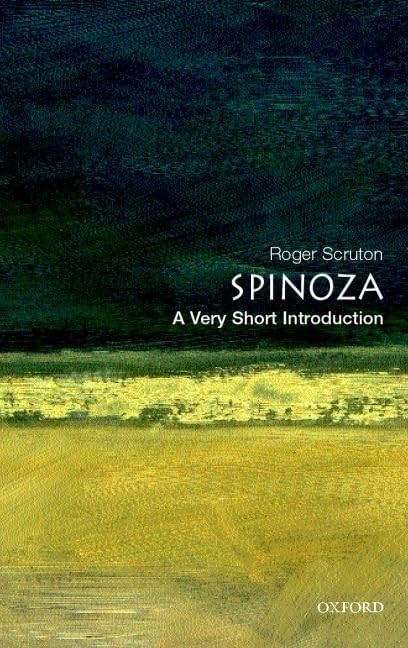

Spinoza: A Very Short Introduction
Product ID: 215834413
Desertcart purchases this item on your behalf and handles shipping, customs, and support to Japan.
Spinoza: A Very Short Introduction [Scruton, Roger] on desertcart.com. *FREE* shipping on qualifying offers. Spinoza: A Very Short Introduction Review: GOOD INTRO TO SPINOZA - Scruton, in my opinion, gives a good introduction to Spinoza's philosophy. Although at times complicated and especially to those with little or no prior knowledge of the topic, his analysis is sound and he has much appreciation for Sponoza's approach to ethical matters and political philosophy. However, Spinoza's thinking to justify pantheism meets with much, and according to me, justified criticism. Some attention is given to the assessment of Spinoza by others like Betrand Russell and Goethe as well as his impact on philosophers like Hegel. A good read. I also would recommend Scruton's introduction on Kant. Review: Spinoza: A Philosopher We Should All Be Much More Familiar With. - In SPINOZA: A VERY SHORT INTRODUCTION, Roger Scruton treats us to one of the most interesting, courageous and forward thinking philosphers that has ever lived. Spinoza, living in the right place (Netherlands) at the right time (17th century), harnessed the provocative and forward leaning teachings of Descartes, Maimonides, Grotius and others togehter with logic to construct a Euclidean-like axiomatic world view that was a first of its kind. With some revision his teachings still hold validity for many of our top intellectuals and scientists today - Einstein was a proponent. One might go so far as to say that to him we owe much of our modern concept of constitutional government and democracy. Look for his very own words in the writings of Montesquieu and thus Jefferson's Declaration of Independence. Read this book and you will be transported to the cradle of our modern western worldview. I don't recall much emphasis being put on Spinoza in the classroom. It's not enough to stop at Descartes - he's just a beginning. Read how Spinoza puts Descartes ideas to work. See how he combines the mind and the body to be one entity. See Spinoza's ontology and how he posits God in relation to man. The text is quite readable and there are nice surprises including the magnetic attraction to Spinoza of many well known contemporaries who personally interacted with him including Leibnitz and Christian Huygens to name but two. I had fun visualizing Spinoza's world and it got me wondering about mine. Enjoy!

| ASIN | 0192803166 |
| Best Sellers Rank | #774,462 in Books ( See Top 100 in Books ) #276 in Modern Western Philosophy #432 in History of Philosophy |
| Customer Reviews | 4.4 4.4 out of 5 stars (386) |
| Dimensions | 7.02 x 4.5 x 0.36 inches |
| ISBN-10 | 9780192803160 |
| ISBN-13 | 978-0192803160 |
| Item Weight | 2.31 pounds |
| Language | English |
| Print length | 144 pages |
| Publication date | August 29, 2002 |
| Publisher | Oxford University Press |
W**G
GOOD INTRO TO SPINOZA
Scruton, in my opinion, gives a good introduction to Spinoza's philosophy. Although at times complicated and especially to those with little or no prior knowledge of the topic, his analysis is sound and he has much appreciation for Sponoza's approach to ethical matters and political philosophy. However, Spinoza's thinking to justify pantheism meets with much, and according to me, justified criticism. Some attention is given to the assessment of Spinoza by others like Betrand Russell and Goethe as well as his impact on philosophers like Hegel. A good read. I also would recommend Scruton's introduction on Kant.
A**R
Spinoza: A Philosopher We Should All Be Much More Familiar With.
In SPINOZA: A VERY SHORT INTRODUCTION, Roger Scruton treats us to one of the most interesting, courageous and forward thinking philosphers that has ever lived. Spinoza, living in the right place (Netherlands) at the right time (17th century), harnessed the provocative and forward leaning teachings of Descartes, Maimonides, Grotius and others togehter with logic to construct a Euclidean-like axiomatic world view that was a first of its kind. With some revision his teachings still hold validity for many of our top intellectuals and scientists today - Einstein was a proponent. One might go so far as to say that to him we owe much of our modern concept of constitutional government and democracy. Look for his very own words in the writings of Montesquieu and thus Jefferson's Declaration of Independence. Read this book and you will be transported to the cradle of our modern western worldview. I don't recall much emphasis being put on Spinoza in the classroom. It's not enough to stop at Descartes - he's just a beginning. Read how Spinoza puts Descartes ideas to work. See how he combines the mind and the body to be one entity. See Spinoza's ontology and how he posits God in relation to man. The text is quite readable and there are nice surprises including the magnetic attraction to Spinoza of many well known contemporaries who personally interacted with him including Leibnitz and Christian Huygens to name but two. I had fun visualizing Spinoza's world and it got me wondering about mine. Enjoy!
R**L
But this small introduction is both excellent, clear and concise
I am going to quit trying to understand the convolutions of the Ethics of Spinoza. But this small introduction is both excellent, clear and concise. What more could you ever ask of a Philosophy book? I wish there was a study of Spinoza that translated his wording and pseudo mathematics into real logical statements. With a background in both, mathematics and logic, I find him incomprehensible. Leon
K**.
Inspirational
Scruton's Spinoza is an inspirational little book that serves well as a first introduction to Spinoza. It's also a great rejuvenator, for when one tires of analysing Spinoza's arguments. Scruton has a beautiful prose style, and his reading of Spinoza seems to be right on target. The small size of this edition also makes it convenient to slip into your pocket, for short readings while traveling. It seems there are three ways to approach Spinoza: metaphysical, academic (historical), and political. If you're in one of the latter two categories, then you should heed the reviews that trashed this book and look elsewhere. But if you're a truth-seeker, this is the book for you. If you're new to Spinoza, another accessible, enlightening introduction is Stuart Hampshire's Spinoza. It would be a good follow-up to this book. Be sure to have a copy of Spinoza's Ethics to read alongside. A further source of Spinoza-based inspiration is Spinoza's "On the Improvement of the Understanding". It is available online at several sites.
K**R
Succinct and comprehensive
Scruton has, as one comes to expect in his writing, made a profound thinker accessible to a mind that desires a taste.
T**D
Short but Sweet; Needs more "sugar".
I knew Spinoza was a difficult read, so I was hoping for a little succinct commentary on the major points. Also, realizing that this is a "very short" introduction, I guess I can't complain too much about how much went unsaid. It was a little irritating, though, to read from the author that even he didn't understand what Spinoza meant! Not particularly helpful. The book however is very readable and avoids abstract technical and philosophical terms. I didn't get as much as I hoped, but I did get enough to give this book a qualified recommendation. Unfortunately, if you go on to more demanding books, this little book will be of only marginal help.
B**F
Excellent, but very compact review of Spinoza's philosophy
This is about Spinoza's history and philosophy. Very well written. Need to remember that this is a concise review of his philosophy. A lot is packed into a few pages. This requires much concentration. It is well done.
M**R
Provides much needed context
Spinoza is very difficult to appreciate (get into his head) without understanding the fundamental and driving assumptions behind his thinking, and this book helps articulate those.
M**S
In this short book Roger Scruton attempts to clarify in an easy language some of the perturbing ideas of Spinoza’s that have continually baffled readers of philosophy to our day. First, Scruton contends that Spinoza is not a materialist, but rather a believer that takes God to be nature or parallel to nature, but also beyond nature. The principal qualities of the human being is to struggle to make the world comprehensive by means of adequate thinking, mostly rational thinking, but also a thinking beyond rationality, intuitive thinking, which is capable of understanding things beyond time and space, as eternal entities, as emanations of God’s way of being and thinking.
A**D
Rather hard to read but good for anyone studying Spinoza
C**K
...but challenging. Already on p. 26, we read, re Anselm's argument (concerning the concept of Necessary Being), put "very simply": "We understand by God a being greater than which nothing can be thought." Huh? Let's hope that knots like this come to be unravelled in the subsequent text. What you can expect when you read philosophy, I guess.
A**A
Reading Spinoza alone is quite difficult to decipher, but this introduction really helped me understand what he was saying, and why he was saying it. Ideas such as free will and determinism were clearly explained, which helped me a lot. It would have been good if the book included some details about Hermeticism, which I think would have been one of Spinoza's influences. It was very entertaining to read about Spinoza's life story, which is given in the first part of the book. I recommend this book to anyone wanting to get to grips with his ideas.
L**R
Hard read.
Trustpilot
4 days ago
3 weeks ago