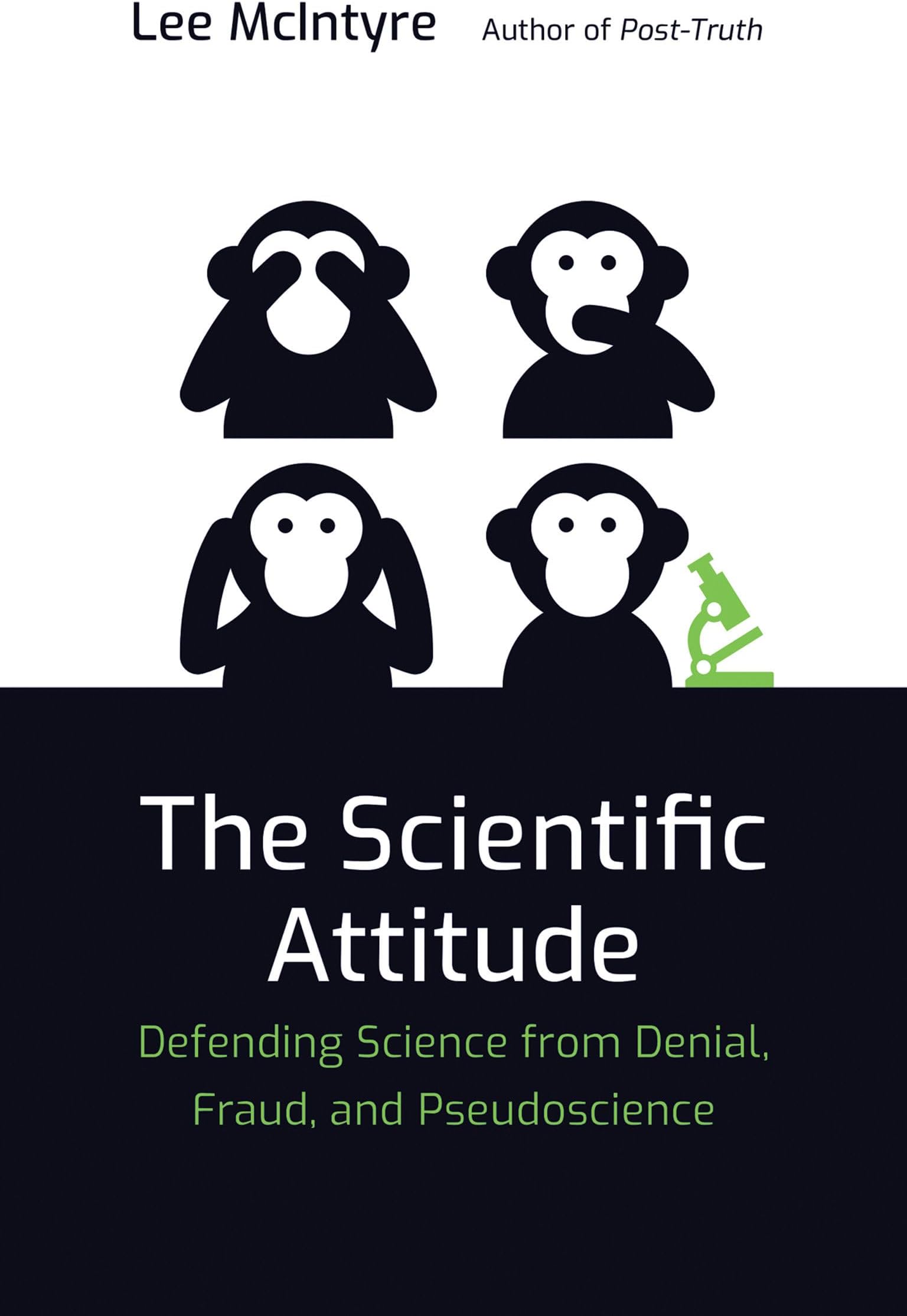
The Scientific Attitude: Defending Science from Denial, Fraud, and Pseudoscience (Mit Press)
Product ID: 213756475
Desertcart purchases this item on your behalf and handles shipping, customs, and support to Japan.
This “intelligent treatise articulates why the pursuit of scientific truths, even if inevitably flawed . . . matters” in our post-truth world ( Publishers Weekly ). What separates science from other disciplines? An attitude that respects evidence and is willing to evolve as new evidence arises. Attacks on science have become commonplace. Claims that climate change isn’t settled science, that evolution is “only a theory,” and that scientists are conspiring to keep the truth about vaccines from the public are staples of some politicians’ rhetorical repertoire. Defenders of science often point to its discoveries (penicillin! relativity!) without explaining exactly why scientific claims are superior. In this book, Lee McIntyre argues that what distinguishes science from its rivals is what he calls “the scientific attitude”—caring about evidence and being willing to change theories on the basis of new evidence. The history of science is littered with theories that were scientific but turned out to be wrong; the scientific attitude reveals why even a failed theory can help us to understand what is special about science. In this book, McIntyre explores: • Historical cases that illustrate both scientific success and failure • The transformation of medicine from a practice based on hunches to a science based on evidence • Scientific fraud and ideology-driven denialists, pseudoscientists, and “skeptics” • How social science should embrace the scientific attitude Ultimately, McIntyre says, the grounding of science in evidence offers a uniquely powerful tool in the defense of science itself. Review: Easy enough to digest for a non-philospher - Very nicely written compared to other books I have read on this topic in that it is more accessible and understandable. Philosophy of science is just difficult to communicate to us non-philosophers - it seems to be intrinsic in that it is hard to put into words the most abstract of thoughts but I think McIntyre does it as well as I have read. (A little repetitive at times because I think he is trying to say it in different ways so it clicks with different readers.) I think it's a really and truly important topic and one that needs to be addressed in earlier education than university philosophy courses. Teacher training courses for even elementary and secondary education need to be better versed with the scientific attitude and the associated issues of the demarcation problem between science and pseudoscience given our society's current anti-science trend. Having something to read that is more accessible and understandable to an average reader is critically important and I think it has been achieved in this book. Review: Science as way of knowing - Readable, well crafted treatment of “science as a way of knowing”. So-called “non-scientists” will enjoy. Less about hypothesis testing, and more about the attitude one adopts when doing science; an attitude that helps to ensure credibility of science done.
| Best Sellers Rank | #938,851 in Books ( See Top 100 in Books ) #2,359 in History & Philosophy of Science (Books) #5,863 in Public Affairs & Policy Politics Books #15,758 in Philosophy (Books) |
| Customer Reviews | 4.4 out of 5 stars 146 Reviews |
S**R
Easy enough to digest for a non-philospher
Very nicely written compared to other books I have read on this topic in that it is more accessible and understandable. Philosophy of science is just difficult to communicate to us non-philosophers - it seems to be intrinsic in that it is hard to put into words the most abstract of thoughts but I think McIntyre does it as well as I have read. (A little repetitive at times because I think he is trying to say it in different ways so it clicks with different readers.) I think it's a really and truly important topic and one that needs to be addressed in earlier education than university philosophy courses. Teacher training courses for even elementary and secondary education need to be better versed with the scientific attitude and the associated issues of the demarcation problem between science and pseudoscience given our society's current anti-science trend. Having something to read that is more accessible and understandable to an average reader is critically important and I think it has been achieved in this book.
M**D
Science as way of knowing
Readable, well crafted treatment of “science as a way of knowing”. So-called “non-scientists” will enjoy. Less about hypothesis testing, and more about the attitude one adopts when doing science; an attitude that helps to ensure credibility of science done.
R**S
An Exceptional Cotribution to Philosophy of Science and the Pursuit of Science
Lee McIntyre writes not only with clarity, but with a precise and unrelenting logic. Carefully defining his terminology, he provides many examples for the topics of each chapter so that readers with a background in science, philosophy, or the social sciences can follow and understand his conclusions and recommendations. With the proliferation of pseudoscience and what amounts to anti-science found in many areas of popular culture, his book is important not only for professional scientists, it is also an essential read for lay people who are interested in science and what sets science apart from what attempts to be passed of as science, that is, the scientific attitude. Although it had been some 40 odd years since I had a Philosophy of Science class, I found McIntyre’s book to flow in an exciting and entertaining manner while maintaining a professional presentation. For the lay reader, there are many references to dig deeper, to reference previous chapters, to anticipate upcoming chapters. I hope this work becomes both the standard Philosophy of Science textbook and the foremost tool that lay readers of science turn to when considering the barrage of “denial, fraud and pseudoscience” that proliferates in the current socio-political climate.
K**R
Understanding Science
Lee McIntyre's The Scientific Attitude addresses one of the most important issues of our time: What is science, exactly, and why does it deserve special deference? With conspiracy theories, science denial, anti-vaxxers, and new agey pseudosciences all contending for our credulity, it's imperative that we understand what makes science special. No one treats this issue better than Lee McIntyre, and no one will give you a more forthright answer: science is set apart by the curious, inquisitive attitude at its core. This attitude places finding the truth first, while relegating competing ends--profits, political power, that heady feeling you get when you think "I, at least, can see through the global conspiracy"--to the sidelines. The last five hundreds years provide stirring testimony that we need this attitude now, perhaps more than ever. McIntyre's writing is smooth and engaging, and his thinking is top notch. Highly recommended!
P**B
More than a defense of science; a very accessible celebration of what makes science special
This book is much more than a defense of science. It is a celebration of what makes science special, which is the approach to seeking truth, constantly comparing theories to evidence, and being open to new theories when new evidence is discovered. It is both philosophical and practical, and an accessible book for readers who are neither scientists or philosophers. While many politicians want to focus on, debate and exploit uncertainty in science, the rest of us on all sides of the political spectrum would do well to read this book to better understand why there will always be uncertainty in science and why that uncertainty, and the scientific approach to it, is a strength. This is an easy read and a very good follow up to Post-Truth.
I**R
The Philosophical Attitude
The Philosophical Attitude Lee McIntyre’s The Scientific Attitude from MIT Press is a well constructed book, and for that matter well written, yet, it reads like Philosophy 101. Though there is no arguing the logic, as a reviewer, I found the book to be rather bland, and a slog to get to the end. My introduction to McIntyre was through an essay he wrote after his attendance at a flat earth conference. As the anti-science movement in the country expands, I thought I would give The Scientific Attitude: Defending Science From denial, Fraud, and Pseudoscience a read. As a person of science, I do grow weary at the criticism and ignorance expressed by anti-science cabal. But, McIntyre began to lose my interest in the first chapter, The Scientific Method and the Problem Of Demarcation, basically Science is not the scientific method, and where does one draw the line between what is and is not science. Perhaps not all problems in science are addressed using the scientific method, but some sort of process is required to submit for peer review, of which McIntyre spends much time. In the past, I gave my students a problem, helped them with a hypothesis/abstract and then turned them loose on lab tables loaded with equipment and told them to make it work. But I also emphasized the Scientific Method in that their lab write-up was subject to review. Anybody else in the classroom should be able to read their write-up using the SM, and get identical results. If not, your write up was wrong, or the reviewers couldn’t read. Again, as a reviewer, I find myself as very philosophical about life, but find the discipline of philosophy about as dry as attempting to whistle with a mouth full of graham crackers. McIntyre quotes Hume in regard to induction “... I dine, I play a game of backgammon, I converse and am merry with my friends, and when after three or four hours of amusement, I would return to these speculations, they appear cold, and strained, and ridiculous, that I cannot find in my heart to enter into them any farther.” I quite often felt this way about reading McIntyre’s book. McIntyre provides fodder for the anti science folks with statements such as, “The most important thing about science is that we try and find failure.” I would submit that the most important thing about science is that we try to find truth, and along the way, in sciences self correcting nature, we expose failure. Quoting Pigliucci, “Science is an inherently social activity, dynamically circumscribed by its methods, it’s subject matters, it’s social customs (including peer review, grants etc), and its institutional role (inside and outside of the academy, government agencies, the private sector).” McIntyre shines when addressing: scientific failure and self correction with the cold fusion and anti-vaccine fiasco, all the while refuting: climate change deniers; creationism/intelligent design; flat earth, etc. I understand he wants to establish a solid logic based platform on which to mount his attacks and defenses, he just takes too long getting there. Then he goes off on tangents about how the social sciences might become “science”, using medicine as a prime example of a pathway to be followed. Basically, McIntyre is preaching to the choir, and during the times in which we live, the logic he cites to support his argument is wasted upon those from whom he attempts to defend science, as they are solid in their “faith” or mindset. Perhaps if science is really under attack, it’s defenders should develop more of a spine, and invite those who detract from science a trip back to the Middle Ages and the times that preceded them. If your cup of tea is the language of philosophy, with an emphasis in science, this book is probably for you. If you find the language of philosophy as per the above mentioned section of Hume’s quote, this book may provide an anguishing journey.
H**N
Science deniers beware.
I was fortunate enough to get an advance look at this book through the publisher and it is outstanding. If you've ever wondered how best to fight back against science deniers, this is the book for you. McIntyre offers a straightforward, readable account of what is most distinctive about science and SURPRISE, it's not the method it's the attitude that scientists have when they approach evidence. This just may be the book that helps us turn the tide against climate change deniers and anti-vaxxers. A great account of pseudoscience and scientific fraud as well. Highly recommended!
B**D
The method and the attitude
I liked this book a lot. Two aspects stand out for me. 1) Although I'm a physicist, I was unaware that philosophers of science had long ago abandoned the notion that there is a "scientific method," despite it being still taught as rote learning in schools. Rather, scientists seek understanding in any way they can, then attempt to check that understanding. 2) McIntyre proposes that there is however a "scientific attitude" and that, crucially, it isn't an individual's attitude, it is an attitude shared widely across the community of scientists. These two contributions to a theory of science enable McIntyre to address the "demarcation" issue -- the search for a way to distinguish cleanly between science and pseudo-science.
T**K
Fast delivery. I haven't read the book
The book was a gift
D**S
Fascinating and full of insight
Had high hopes for this book and I wasn't disappointed. Superbly written, teasing out the intricacies of the demarcation problem. Full of fascinating anecdotes, many of which I had never come across before. A timely and important book for anyone interested in science.
F**S
Qualidade
O produto é de ótima qualidade.Ainda não tive a oportunidade de lê-lo. Pretendo usá-lo em algumas reuniões de grupo de estudo.
Trustpilot
3 weeks ago
1 month ago