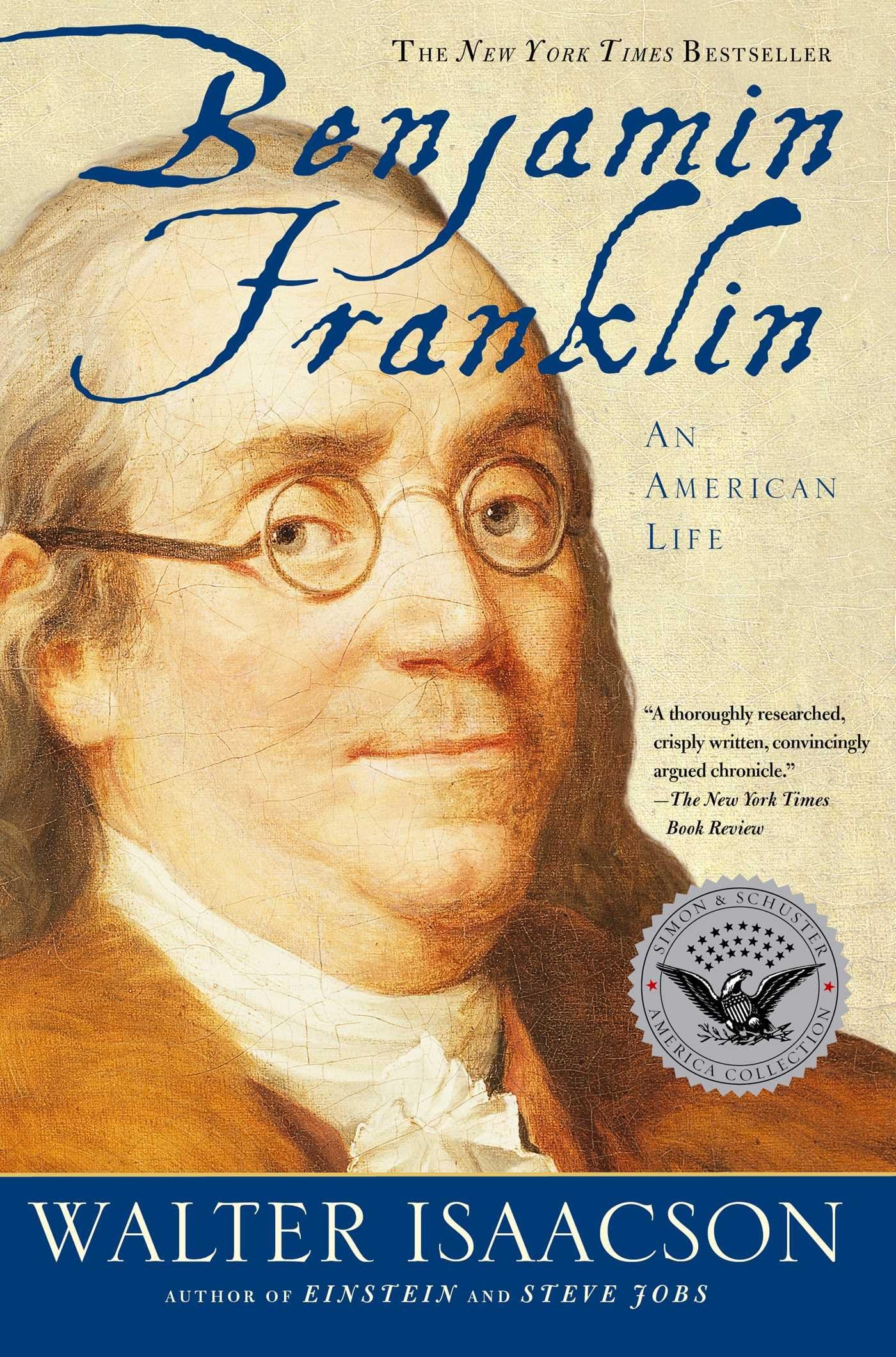
Benjamin Franklin: An American Life
Product ID: 199518
Desertcart purchases this item on your behalf and handles shipping, customs, and support to Japan.
In this authoritative and engrossing full-scale biography, Walter Isaacson, bestselling author of Einstein and Steve Jobs , shows how the most fascinating of America's founders helped define our national character. Benjamin Franklin is the founding father who winks at us, the one who seems made of flesh rather than marble. In a sweeping narrative that follows Franklin’s life from Boston to Philadelphia to London and Paris and back, Walter Isaacson chronicles the adventures of the runaway apprentice who became, over the course of his eighty-four-year life, America’s best writer, inventor, media baron, scientist, diplomat, and business strategist, as well as one of its most practical and ingenious political leaders. He explores the wit behind Poor Richard’s Almanac and the wisdom behind the Declaration of Independence, the new nation’s alliance with France, the treaty that ended the Revolution, and the compromises that created a near-perfect Constitution. In this colorful and intimate narrative, Isaacson provides the full sweep of Franklin’s amazing life, showing how he helped to forge the American national identity and why he has a particular resonance in the twenty-first century. Review: "He snatched lightning from the sky and scepters from tyrants." - WHAT I LIKED: - Benjamin Franklin. He is an absolutely amazing person, whose splendid character shines forth in his own writings and the descriptions of his activities. Even one of Franklin’s famous rivals, John Adams, later in life said, “There is scarce a scratch of his pen that is not worth preserving.” - The narrative style approach. This isn’t a boring book that simply chronicles what happened and when. It is like a story, and despite being so comprehensive, it doesn’t seem long enough. It gets more and more exciting as you go through it, even showing hints of a spy novel at one point. While I typically don’t read biographies more than once, this is a book I will likely read many times again. - The technical detail. As Franklin was an inventor, the author could have been excused for glossing over many of the technical details of his inventions. But he doesn’t do that. The author presents the information in a way that any person can understand. It makes the reader appreciate Franklin all that much more. - Time travel. This book takes you back to 18th century America, and you feel very close to the many famous personalities who helped in forming the country. The author has done a wonderful job in making something so distant seem so accessible. You get a taste for England and France from that time period as well. - Reference material. In reading this book, you come across a lot of names. There are many people who had the pleasure to meet Franklin, and one thing I started doing in the course of reading was looking up many of these people. I was surprised to find out how famous and influential they were. And wouldn’t you know it, the author provides a nice glossary at the end which gives a brief description of each character. There are some nice photos and paintings included as well. WHAT I DIDN’T LIKE: - Snide commentary. There are many, many instances of where ill motives are erroneously ascribed to Franklin. The author many times attacks Franklin’s own autobiography, saying he wasn’t entirely honest. And these criticisms are of minor points, such as the way Franklin characterized his own parents. I would have preferred the author save his judgments for a separate chapter instead of interweaving it throughout the narrative. - Gossip column/Tabloid reporting. There is one section of this book in particular which was done in very poor taste. Without giving away too many details, imagine if your worst enemy hacked your email account, took your personal correspondence and then sent it to others. And then imagine that this enemy put their own comments in parentheses after each paragraph. This describes a major section of this book, dealing particularly with Franklin’s time in England. The author obviously invested much time and effort in writing this book, and so he has a right to formulate opinions. But the manner in which they were inserted in some places was very off-putting, due particularly to the fact that I considered the negative comments to be completely off base. - Chastising of Franklin’s character. By all accounts, Franklin was a stand-up guy who had affection for everyone. Perhaps in having little to criticize, the author decided to take issue with the fact that Franklin was friendlier and more open in his dealings with his friends than he was with his family. The author wants you to think that Franklin liked his friends more than his family. But in reality, the level of interaction doesn’t necessarily equate to affection. We make friends with equals, whereas our family members are either our dependents or our superiors. We treat dependents differently than we do friends. The famous Indian philosopher Chanakya said that disciples and children should never be coddled; only criticized. This is for their own good. Franklin seemed to follow a similar approach, though he wasn’t very harsh. To me the way he treated his family is actually a sign of his great affection for them, and not the other way around. VERDICT: A lot of the commentary I didn’t like had footnotes to it, suggesting that perhaps the author was merely passing on the opinions of previous historians. Despite the few negatives, this is an excellent book. I first read the “A Benjamin Franklin Reader” book by the same author, and that interested me enough to purchase this one. Franklin wrote and did so much that one book could never do him justice, but this is a great start. I give many thanks to the author for taking the time to compile this wonderful and insightful work. Review: A Magnificent Life - From the get-go, the brilliant American biographer, Walter Isaacson, reminds us that Benjamin Franklin is the Founding Father, "who smiles at us." He was a "Renaissance Man" in every sense of the term: a brilliant statesman, eminent scientist, and peripatetic sage of the Enlightenment. Benjamin Franklin's characteristic balance of an often generous, but nonetheless caustic wit and propensity for constant self-improvement remain, for my money, the imperishable fixtures of the American Enlightenment. From Birth, Franklin was determined to rankle and enlighten in equal measure. He grew up under the patronage of Calvinism, as was his father's (Josiah Franklin) wont, and young Benjamin was instructed to defer to its inflexible posture. Josiah refined his own pedagogy in such a way to augment his children's future to be without any particular consequence; it was a stern mixture of homespun paternal wisdom, conservative industry and, most importantly, the virtues of thrift. Josiah was less concerned with Franklin's personal fulfilment than he was with his ability to service the practical ends of industry and labour in a then largely agricultural America. From a young age, Franklin was experimental by nature, and the import of this trait was particularly present during his bold scientific adventures and as a man of letters, but his characteristic successes were often frustrated by other failed excursions. His first job was as a tallow chandler (candle maker) perhaps the least coveted occupation in history. His next job as an apprentice printer under his brother James was more fitting and it gave the young Franklin a taste of things to come in the world of the free press - both rewarding and detrimental. At this time, Franklin impertinently chose fraternal solidarity in an attempt to discredit Cotton Mather's support of smallpox inoculation; a glaring error on Franklin's part. This is an important historical anecdote, as it reveals Franklin's intransigent sense of duty to a cause and his disposition for self-improvement. After Franklin's self-imposed exile from Boston, Isaacson effortlessly chronicles his custom of travel and worldly pursuits. His next stop on the canvas of the American colonies would be, ironically enough, his official place of residence until death. It was to be Philadelphia that Franklin called home, and befitting to his fondness for the state of Pennsylvania, the region which complemented his love of practical sciences and writing. From political intrigues against the Penn proprietors to drawing electricity, Franklin intensified his scientific endeavours, and with a deft pen he infused playful prose with biting insight and political clarity as the official method of diplomacy. These traits were a real boon to his standing in England and, particularly as Minister Plenipotentiary, in France. He gladly assumed the role of an avuncular icon to the American people, and his patronage was returned with warmth and reverence. One of the reasons I found the narrative style so compelling is that Isaacson was apt to dispense with hero worship and has instead developed a synthesis of incisive political history, as well as an intimate portrait of a brilliant, but nonetheless flawed man. The Founding Fathers have been deified by the Christian apologetic in America as indefatigable, stoic, portentous stalwarts leading the charge of revolution against a criminal empire, but this is a grotesque and palpably untrue misapprehension. Not only was there great (and justified) trepidation with emancipation among the Founding Fathers and the American people, such an assertion also serves to undermine the irreverent charm and wit, which is what endeared the people to the Founding Fathers in the first place. Franklin had an insatiable sexual appetite, and never was this trait more distinct during his time as ambassador and courtier in France. Franklin's mission in France was an interesting social and political experiment because it suffused the salacious hedonism of the continental bourgeoisie with the starched can-do attitude of American stoicism. It was a harmonious cultural feast for the witty and lecherous Franklin and a complete disaster for the dour puritan, John Adams. France was a second home to Franklin, in more ways than one. His cause was to America, but it was the cultural bedrock of the European Enlightenment that defined Franklin as a human being. He was intimate with the likes of David Hume, Lord Kames, Adam Smith, Joseph Priestley, Thomas Paine, and Voltaire. These men were not only profound influences on Franklin; they were instrumental in forging the economic, scientific, political and ethical value systems we still live with today. As a result, Franklin's calculus of personal rights/oughts often clashed with his preternatural joy of high culture. This is a classically American tale, one of ambition, insight, intrigue, power, tragedy and farce. Isaacson, perhaps best known for his biography on Steve Jobs, artfully weaves the underpinning political, social, and moral issues, which drove Franklin and his countrymen into an epoch of breathless cultural achievements. This is top-drawer popular history.


| Best Sellers Rank | #3,250 in Books ( See Top 100 in Books ) #2 in American Revolution Biographies (Books) #5 in U.S. Revolution & Founding History #11 in Political Leader Biographies |
| Customer Reviews | 4.6 out of 5 stars 6,104 Reviews |
K**L
"He snatched lightning from the sky and scepters from tyrants."
WHAT I LIKED: - Benjamin Franklin. He is an absolutely amazing person, whose splendid character shines forth in his own writings and the descriptions of his activities. Even one of Franklin’s famous rivals, John Adams, later in life said, “There is scarce a scratch of his pen that is not worth preserving.” - The narrative style approach. This isn’t a boring book that simply chronicles what happened and when. It is like a story, and despite being so comprehensive, it doesn’t seem long enough. It gets more and more exciting as you go through it, even showing hints of a spy novel at one point. While I typically don’t read biographies more than once, this is a book I will likely read many times again. - The technical detail. As Franklin was an inventor, the author could have been excused for glossing over many of the technical details of his inventions. But he doesn’t do that. The author presents the information in a way that any person can understand. It makes the reader appreciate Franklin all that much more. - Time travel. This book takes you back to 18th century America, and you feel very close to the many famous personalities who helped in forming the country. The author has done a wonderful job in making something so distant seem so accessible. You get a taste for England and France from that time period as well. - Reference material. In reading this book, you come across a lot of names. There are many people who had the pleasure to meet Franklin, and one thing I started doing in the course of reading was looking up many of these people. I was surprised to find out how famous and influential they were. And wouldn’t you know it, the author provides a nice glossary at the end which gives a brief description of each character. There are some nice photos and paintings included as well. WHAT I DIDN’T LIKE: - Snide commentary. There are many, many instances of where ill motives are erroneously ascribed to Franklin. The author many times attacks Franklin’s own autobiography, saying he wasn’t entirely honest. And these criticisms are of minor points, such as the way Franklin characterized his own parents. I would have preferred the author save his judgments for a separate chapter instead of interweaving it throughout the narrative. - Gossip column/Tabloid reporting. There is one section of this book in particular which was done in very poor taste. Without giving away too many details, imagine if your worst enemy hacked your email account, took your personal correspondence and then sent it to others. And then imagine that this enemy put their own comments in parentheses after each paragraph. This describes a major section of this book, dealing particularly with Franklin’s time in England. The author obviously invested much time and effort in writing this book, and so he has a right to formulate opinions. But the manner in which they were inserted in some places was very off-putting, due particularly to the fact that I considered the negative comments to be completely off base. - Chastising of Franklin’s character. By all accounts, Franklin was a stand-up guy who had affection for everyone. Perhaps in having little to criticize, the author decided to take issue with the fact that Franklin was friendlier and more open in his dealings with his friends than he was with his family. The author wants you to think that Franklin liked his friends more than his family. But in reality, the level of interaction doesn’t necessarily equate to affection. We make friends with equals, whereas our family members are either our dependents or our superiors. We treat dependents differently than we do friends. The famous Indian philosopher Chanakya said that disciples and children should never be coddled; only criticized. This is for their own good. Franklin seemed to follow a similar approach, though he wasn’t very harsh. To me the way he treated his family is actually a sign of his great affection for them, and not the other way around. VERDICT: A lot of the commentary I didn’t like had footnotes to it, suggesting that perhaps the author was merely passing on the opinions of previous historians. Despite the few negatives, this is an excellent book. I first read the “A Benjamin Franklin Reader” book by the same author, and that interested me enough to purchase this one. Franklin wrote and did so much that one book could never do him justice, but this is a great start. I give many thanks to the author for taking the time to compile this wonderful and insightful work.
D**P
A Magnificent Life
From the get-go, the brilliant American biographer, Walter Isaacson, reminds us that Benjamin Franklin is the Founding Father, "who smiles at us." He was a "Renaissance Man" in every sense of the term: a brilliant statesman, eminent scientist, and peripatetic sage of the Enlightenment. Benjamin Franklin's characteristic balance of an often generous, but nonetheless caustic wit and propensity for constant self-improvement remain, for my money, the imperishable fixtures of the American Enlightenment. From Birth, Franklin was determined to rankle and enlighten in equal measure. He grew up under the patronage of Calvinism, as was his father's (Josiah Franklin) wont, and young Benjamin was instructed to defer to its inflexible posture. Josiah refined his own pedagogy in such a way to augment his children's future to be without any particular consequence; it was a stern mixture of homespun paternal wisdom, conservative industry and, most importantly, the virtues of thrift. Josiah was less concerned with Franklin's personal fulfilment than he was with his ability to service the practical ends of industry and labour in a then largely agricultural America. From a young age, Franklin was experimental by nature, and the import of this trait was particularly present during his bold scientific adventures and as a man of letters, but his characteristic successes were often frustrated by other failed excursions. His first job was as a tallow chandler (candle maker) perhaps the least coveted occupation in history. His next job as an apprentice printer under his brother James was more fitting and it gave the young Franklin a taste of things to come in the world of the free press - both rewarding and detrimental. At this time, Franklin impertinently chose fraternal solidarity in an attempt to discredit Cotton Mather's support of smallpox inoculation; a glaring error on Franklin's part. This is an important historical anecdote, as it reveals Franklin's intransigent sense of duty to a cause and his disposition for self-improvement. After Franklin's self-imposed exile from Boston, Isaacson effortlessly chronicles his custom of travel and worldly pursuits. His next stop on the canvas of the American colonies would be, ironically enough, his official place of residence until death. It was to be Philadelphia that Franklin called home, and befitting to his fondness for the state of Pennsylvania, the region which complemented his love of practical sciences and writing. From political intrigues against the Penn proprietors to drawing electricity, Franklin intensified his scientific endeavours, and with a deft pen he infused playful prose with biting insight and political clarity as the official method of diplomacy. These traits were a real boon to his standing in England and, particularly as Minister Plenipotentiary, in France. He gladly assumed the role of an avuncular icon to the American people, and his patronage was returned with warmth and reverence. One of the reasons I found the narrative style so compelling is that Isaacson was apt to dispense with hero worship and has instead developed a synthesis of incisive political history, as well as an intimate portrait of a brilliant, but nonetheless flawed man. The Founding Fathers have been deified by the Christian apologetic in America as indefatigable, stoic, portentous stalwarts leading the charge of revolution against a criminal empire, but this is a grotesque and palpably untrue misapprehension. Not only was there great (and justified) trepidation with emancipation among the Founding Fathers and the American people, such an assertion also serves to undermine the irreverent charm and wit, which is what endeared the people to the Founding Fathers in the first place. Franklin had an insatiable sexual appetite, and never was this trait more distinct during his time as ambassador and courtier in France. Franklin's mission in France was an interesting social and political experiment because it suffused the salacious hedonism of the continental bourgeoisie with the starched can-do attitude of American stoicism. It was a harmonious cultural feast for the witty and lecherous Franklin and a complete disaster for the dour puritan, John Adams. France was a second home to Franklin, in more ways than one. His cause was to America, but it was the cultural bedrock of the European Enlightenment that defined Franklin as a human being. He was intimate with the likes of David Hume, Lord Kames, Adam Smith, Joseph Priestley, Thomas Paine, and Voltaire. These men were not only profound influences on Franklin; they were instrumental in forging the economic, scientific, political and ethical value systems we still live with today. As a result, Franklin's calculus of personal rights/oughts often clashed with his preternatural joy of high culture. This is a classically American tale, one of ambition, insight, intrigue, power, tragedy and farce. Isaacson, perhaps best known for his biography on Steve Jobs, artfully weaves the underpinning political, social, and moral issues, which drove Franklin and his countrymen into an epoch of breathless cultural achievements. This is top-drawer popular history.
J**S
A Complicated Man for an Extraordinary Time
Recently, I have been spending time exploring the lives of America's founding fathers. Benjamin Franklin was someone that I thought I knew. In grade school we learn about the pithy Philladelphia boy who rose from poverty to wealth, flew a kite in a rain storm, and became an immortal figure in the "Pantheon" of the American founders. However, I discovered that I really did not know Franklin very well at all; the one-dimensional description that I knew was not sufficient to capture the essence of this complicated man. Walter Isaacson carefully depicts one of the most controversial and beloved founders in our history. Isaacson is not a historian but he certainly does a great job and often proves to be objective in his analysis; albeit, not as objective as I would always liked him to have been. There are many admirable qualities about this work and there are a few things that I thought could have made the book a much stronger work. Here are a few pros and cons about the book that might help you in your decision to purchase it. Isaacson is very passionate for his subject and that is something that he cannot keep veiled very well. The beginning of the book starts out slow but once he gets moving then he keeps a strong steady pace. It is refreshing to see a writer with so much enthusiasm for his subject and while some historians frown on that; I don't. I like the way he traces Franklin's life and family history. In fact, his family history really gives us a context for understanding the way Franklin thought and acted. His strong puritanical upbringing did not make him a religious man, but it did tend to create a desire to be socially proactive. In fact, I appreciate the way that Isaacson traced the religious journey of Franklin and I wish that more authors would concentrate on this aspect of the political/ social figures they are writing about. Franklin's religious life is not one that is static but rather one that was constantly evolving and moving towards a more coherent view. His religion like everything else in his life, was strongly pragmatic. In many ways, we find in Dr. Franklin that strong American pragmatism that has come to define the American people in the past and present. Franklin's home life was a very slippery slope and it was difficult to know what to make of his relationship with family. Franklin had a son born out of wedlock and their relationship was rocky thoughout his life, and particularly at the latter end. He had a grandson by this son that was also born out of wedlock and yet he loved this boy, perhaps even more than his own son. His marriage to Deborah was also very strange. Some historians have concluded or at least suggested that Franklin did not love her. He spent years of his life away from her and his letters do not reveal a tender affection towards her. Yet, Isaacson suggests that there is a way in which Franklin did regard her. Many have painted him as a philanderer whose nefarious dalliances and sexual escapades are among the most outrageous among the founders. Isaacson suggests that while Franklin certainly had emotional affairs that he remained faithful to his wife. To be honest with you, it seems a little difficult to believe. It is hard to imagine that a man who sits in a bathtub with another woman is not physically involved with her. I think he is right that we should assume that Franklin was probably not as wild as he is taken to be, but I am not convinced of his monogamy. This was an area where I felt the authors personal feelings for his subject may have interfered with his better judgment. The writing style of the author was easy and generally engaging despite the fact that I thought he had a weak beginning. There were a few discrepancies that caught my attention and I will have to read a great deal more about this topic to be certain. Most people know that John Adams and Benjamin Franklin were selected to help Thomas Jefferson in the drafting of the Declaration of Independence. Most historians seem to suggest that Adams was the one who really pushed for Jefferson to write it and states his reasons as: 1. Jefferson is a Virginian and a Virginian should be at the head of this business. 2. Jefferson was liked while he thought himself to be obnoxious and not well liked by many in Congress. 3. Jefferson is a far more eloquent writer than the others. Isaacson suggests that it was Franklin who said this not Adams. This seems to be a mistake as Franklin is the one who is thought to have suggested Jefferson change "sacred and inviolable" to "inalienable" because the former smacked of the pulpit. I think that it was in fact Adams who stated the three basic reasons that Jefferson should write the document. Franklin was not obnoxious and seemed to always be generally well thought of and that alone caused me to question Isaacson on this point. There were other small issues that I wondered about through the book. Generally, he seemed to be factually accurate and his writing style was interesting enough to attract a reader who may not be prone to read history books. I was happy to see that this writer spent a great deal of time salvaging the reputation of Franklin. His reputation has suffered as he is often portrayed as an intelligent man that prone to buffoonery. Certainly, he had a sense of humor and he could be somewhat crude. The funniest piece I read was his fake letter to the royal academy of farts. However, to see Franklin as a mere jester is to miss the force of his convictions, visions, and political prowess. Franklin had the foresight to see that America needed to unite along the lines of the Iroquois Confederacy long before many others. He was a man who believed in internal improvements, pragmatic scientific discovery, and a strong middle class. His vision for this nation has been a strong guidepost for two centuries of American thought. His work as a diplomat in France is a model for modern diplomacy. He was a fox when it came to dealing with other humans and his penchant for compromise is what helped to give us the constitution that we know have. Overall, it was a good work that serves as a solid starting point for Franklin's life. He honored Franklin and while he was often soft on his shortcomings he did not altogether deny them. His portrayal of Adams seemed a little warped and his dislike of Adams bled through the descriptions. While I know that Adams had a side that made him a hard man to deal with, I did not always feel that he gave hm enough credit. His ending was solid and I love the way that he wrapped up the loose ends by explaining what happened to Franklin's family and close friends. It would have been nice if the book had included images so as to see some of the people that are discussed throughout the book. These are just minor complaints and do not detract from the work in any significant way.I will give it 1 star for readablity, 1 star for solid research, 1 star for bibliography, and 1 star for content. As far as the last star is concerned I would take away 1/2 star for minor discrepancies and a 1/2 star for the slow and laborious start to the book.
L**N
Read this book-- unless you want to be bored.
Delightfully informative without the pedantry many historians seem to think they need to pepper into their books to be taken seriously--let's face it, many history books are boring. Really, history is very informative while being entertaining. It's the very definition of "You can't make this stuff up."So jump in and enjoy the ride and consider the that knowing history provides a roadmap to our present and our future. Clothes, manners and ethical approaches to problems may evolve over time but human nature is always there to keep us centered on the things that matter. Clearly, Mr. Franklin understood this. Kudos to Mr. Isaacson for presenting us with this enjoyable book.
J**T
An enthralling biography and very good on Audble
Franklin was a very busy man and did so much as a business man, statesman and inventor. Isaacson presents a wealth of information in a clear, readily digestible way. The Audible book is well done, a pleasure to listen to. An excellent choice to read about Franklin, especially if intending to read about a number of our founding fathers.
J**N
THE ONE AND ONLY BENJAMIN FRANKLIN
To say that Benjamin Franklin led an interesting life would be the understatement of the century. Dr. Franklin was the first American to be world famous. He was an American Revolutionary, a theorist on government, a scientist in nearly all fields, and a printer being his first profession. In the end, one can say that there is nothing that the man did not do in his lifetime. Walter Isaacson brings this extraordinary American to life, allowing the reader to explore the world that was with this incredible human being. The thirteenth of sixteen children, and a youngest son of a youngest son for five generations, Ben Franklin learned early on that if he wanted to be noticed he would have to work hard. Franklin went to work at an early age as an indentured servant for his brother James's print shop in Boston. He even get his first by-line, after getting in trouble with the state legislature and order to print no more work under his own name, James Franklin decides to publish everything under his brother's. However, life as an indentured servant is no fun even when your master is your own older brother. Ben Franklin decides to escape to Philadelphia, where he opens his own print shop. As a printer, Franklin has tremendous success, his paper, the Pennsylvania Gazette, was popular. He would also publish the famous Poor Richard's Almanac. Franklin, however, does some things okay for his time, but now we would frown upon. For example he, from time to time, makes up stories or writes letters to the editor under pseudonym often to express a political point or to tell a funny tale. "Like most other newspapers of the time, Franklin's Pennsylvania Gazette was filled not only with short news items and reports on public events, but also amusing essays and letters from readers. What made his paper a delight was its wealth of this type of correspondence, much of it written under pseudonyms by Franklin himself. This gimmick of writing as if from a reader gave Franklin more leeway to poke fun at his rivals, revel in gossip, circumvent his personnel pledge to speak ill of no one, and test-drive his evolving philosophies." p.65 Ben Franklin was also an accomplished scientist, even though he was not formally trained. His work in electricity would be revolutionary as his later political ideas. Franklin's most famous invention outside his silly stove was the Lighting Rod. He would also map the Gulf Stream, and would always be fascinated by oil's effect on water.* "In fact, these terms devised by Franklin are the ones we still use today, along with other neologisms that he coined to describe his findings: battery, charged, neutral, condense, and conductor. Part of Franklin's importance as a scientist was the clear writing that he employed. `He has written equally for the uninitiated as well as the philosopher,' the early nineteenth-century English chemist Sir Humphry Davy noted, `and has rendered his details as amusing as well as perspicuous.'" p.135 Ever a political and social creature he was member of local clubs and debating societies. He would marry Deborah Franklin after her first husband abandoned her. He would have also father an illegitimate son who he would personally raise**. As the colonial postmaster general, he would found the origins of what would become the post office. Benjamin Franklin would spend almost an entire decade in Britain trying to be an advocate to the people of Pennsylvania on a variety of issues. He was an opponent of most the tax laws that Britain made during this time. When letters from the colonial Governor Thomas Hutchinson came to Franklin's attention, he leaked them so that the Americans would see that the threat to their liberties was coming from home rather than the mother country. The Privy Council of George III however saw that event differently, and he was brought before them and ridiculed. After this misadventure, he went home and joined the Revolution. Joining the rebels would cause a permanent break with his son William that was never healed. As a member of the Second Continental Congress, he was a strong advocate for Independence for America. He was part of the famous Committee of Five with future presidents John Adams and Thomas Jefferson. There he aided in drafting what would become the Declaration of Independence. Franklin was dispatched by the Congress to try to form an alliance with King Louis XVI of France. There after the Battle of Saratoga, Franklin negotiated the most important military alliance in the young history of the Republic. He would later take part in the signing of the Treaty of Paris the ended the American Revolutionary War. "As he would prove in France, Franklin not only knew how to play a calculated balance-of-power game like the best practitioner of real-politik, but he also knew how to play with his other hand the rousing chords of American exceptionalism, the sense that America stood apart from the rest of the world because of its virtuous nature. Both the hard power that came from its strategic might and the soft power that flowed from the appeal of its ideals and culture would, he realized, be equally important in assuring its influence." p.338 At the end of his life, Franklin would do two more things that are incredible. In 1787, he would take part in the writing of the Constitution of the United States; his plea for unity became a part of his legend. Two years later, as his life was about to end, he became the president of the Pennsylvania Abolition Society and wrote letters to the First Congress urging an end to slavery. Ben Franklin's incredible life ended on April 17, 1790, he was the man who did it all. Everything written in this review and more is covered in Mr. Isaacson's work, and I highly recommend this book to anyone. *Which means Franklin would have quite a bit to say about this latest crisis in the Gulf of Mexico. **William Franklin's mother was most likely a prostitute.
B**S
A remarkable survey of an eclectic life
Trying to summarize a life as remarkable as Benjamin Franklin’s within a single volume (even a relatively large volume like this one) is no easy task. One could easily fill entire volumes on just any one of Franklin’s pursuits and accomplishments. His scientific work rivals that of any of his contemporaries (indeed, though he’s better remembered today for his role as a statesman during the American Founding, his scientific work alone would be sufficient to immortalize his name as one of Western civilization’s greatest minds). Similarly, he earned his enduring reputation many times over, both jointly and separately, as a printer, an inventor, a philosopher, a diplomat, and more. Presented in mostly chronological order (with some allowances for presenting like ideas together), this book represents something of a triumph for rendering Franklin’s story seemingly in fairly complete terms, yet also briefly enough to remain approachable. Somehow, Isaacson’s approach seems appropriate to the subject. After all, as he pointed out in the first chapter, “Benjmain Franklin is the founding father who winks at us.” To put it even more forcefully, he’s arguably one of the most accomplished polymaths in human history, yet he somehow still seems like the sort of person with whom one could have a conversation. This book details those accomplishments with appropriate gravity but also with sufficient humor that I’d like to this its subject would have approved of it. To his credit, the author treats his subject with all due respect but nut utter deference. He doesn’t mind describing Franklin’s complicated relationships with his own relatives and isn’t even shy about criticizing the relative simplicity of Franklin’s views (especially earlier in his life) on matters of religion and philosophy. Though if I were to offer a word of criticism of my own, I’d suggest Isaacson probably could have taken the time to more fully trace the evolution of Franklin’s theology over the years. It’s a minor criticism, though; the reader gets the broad strokes of Franklin’s thinking from this book and can easily read the great man’s own papers (which are readily available in a variety of books and other sources) if they want more detail. At the end of the day, Isaacson’s work in this biography is excellent and certainly worthy of his reputation as one of the preeminent biographers of our day. But the subject is also so fascinating I’m not sure which of them to credit more for the book’s simultaneously enlightening and entertaining manner.
K**R
An excellent book
A detailed, well-written biography of Ben Franklin. The author tells the story without falling in love with Ben, but it's hard not to be impressed with this man's life and accomplishments. It's a long read, a bit under 500 pages, but it's an interesting and detailed one. A lot of research went into it, so if you want to know about "the first American," this is a great place to start.
L**Y
Good
Good
R**M
Very well written
Great topic. Interesting detail that are not well known
L**K
One of those books that you should be embaressed if you haven't read...
Read if you are looking for: A greater understanding of the USA, leadership, philosophy Walter Isaacson is one of the greatest biographers writing today, and this book is exceptional (he is also known for his biography of Steve Jobs). Isaacson leads you through Franklin’s long and fascinating life, starting with his success as a printer and writer in Philadelphia, and spanning through his forays and discoveries as a scientist and inventor, his success as an ambassador during the American War of Independence, where he helped broker support from France, and the ultimate peace with Britain, and as a signatory to the Declaration of Independence and the United States Constitution. Franklin championed the virtues of industriousness and values of the working class and thus was instrumental in shaping the development of the American character and national identity. In many ways, Franklin personifies the difference in attitude between the United States and the old world of Europe in the 18th century. Franklin is an inspirational character and his focus on self-education is particularly noteworthy. Although his formal schooling ended when he was ten, he continued his education on his own through reading voraciously, writing under a pseudonym for his brother’s newspaper and forming clubs and societies with the intention to develop and share knowledge. During his time in Paris towards the end of his life, he was revered as a philosopher and academic and even considered by some a peer of Voltaire - pretty good for someone with only two years of formal education. His success as a statesman and ambassador can be attributed to his ability to control his pride and ego, utilising silence as a tool in negotiations and most importantly his understanding of the power of compromise. Franklin’s ability to compromise contributed to much of his success and his skill at knowing when to concede and let his opponent save face can be seen again and again during the negotiations for French support, peace with Britain and facilitating agreement regarding the United States Constitution. Moreover, this understanding of compromise can also be seen in his wider beliefs, from balancing the desire to be financially successful with his belief of frugality, to his religious tolerance. Franklin deep curiosity shaped how he viewed the world, never taking himself too seriously, he didn’t approach problems as an expert or academic. Instead his playfulness and ability to experiment galvanised his success as a writer, inventor, scientist and statesman. Franklin definitely deserves the title of the greatest American and is a role model to us all. Major Takeaways: (i) The importance of Franklin in creating the American identity (ii) The power of compromise (iii) importance of self-education (iv) the power of silence and listening during a negotiation.
S**H
A well-crafted history of a Man and the early development of the United States.
The most compelling aspect of reading a biography for me is not just admiring the person, but recognizing their humanity. Isaacson’s book makes this so clear and relatable that you almost forget you're reading about a remarkable individual, seeing them in all their authentic, human complexity.
C**Z
Casilda
Such an interesting and complex personality that really shaped his country. Read this book after the one on Einstein- to recommend!
Trustpilot
2 months ago
2 weeks ago