
Buy anything from 5,000+ international stores. One checkout price. No surprise fees. Join 2M+ shoppers on Desertcart.
Desertcart purchases this item on your behalf and handles shipping, customs, and support to Japan.
🦋 Unlock the butterfly effect of storytelling — where nature’s warning meets unforgettable prose!
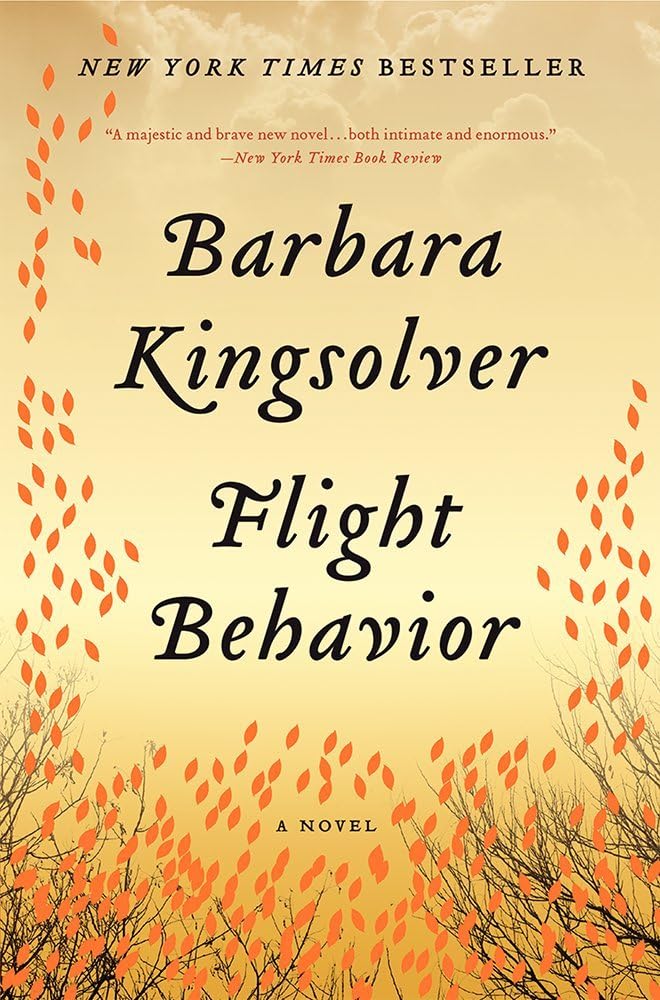
Flight Behavior by Barbara Kingsolver is a bestselling novel blending environmental urgency with rich Appalachian storytelling. This used copy in good condition invites readers to explore a poetic narrative centered on monarch butterflies as symbols of climate change, featuring complex characters and vivid prose that have captivated over 10,000 reviewers.





| Best Sellers Rank | #39,181 in Books ( See Top 100 in Books ) #901 in Women's Domestic Life Fiction #1,389 in Literary Fiction (Books) #1,474 in Contemporary Women Fiction |
| Customer Reviews | 4.3 out of 5 stars 10,356 Reviews |
B**T
Enjoy the dance of a talented author
For months the book sat in my "to read" pile. Then I pulled it out and placed it on the coffee table. It teased me as I savored the anticipation building to the moment I opened the cover and began reading the poetry of Barbara Kingsolver's prose. Flight Behavior, Kingsolver's latest novel, did not disappoint me from the first word to the last, although there were some plot techniques that disconcerted me. The environmental theme interwoven throughout the plot was executed with a unique choice of characters as the mouthpieces. Using the monarch butterfly as the harbinger of ecological disaster captivated me from the first description of the main character, Dellarobia, when she encounters the unusual sight of thousands of monarchs clustered on tree limbs at the top of a mountain in Appalachia. She believes she's seeing the apparition as a warning against the adultery she's is about to commit, until her epiphany on the mountainside. Here's the vision from Dellarobia's viewpoint: "Unearthly beauty had appeared to her, a vision of glory to stop her in the road. For her alone these orange boughs lifted, these long shadows became a brightness rising. It looked like the inside of joy, if a person could see that. A valley of lights, an ethereal wind. It had to mean something." Kingsolver received criticisms for her "preachy" tone on climate change. Readers who love her previous works, yet disagree with her politics in this novel, gave her harsh scores and reviews. I'm reviewing this book on its merits. But be forewarned - this book is entertaining and educational, if you want it to be. If however you're the type of person who doesn't wish to read anything other than what repeats what you already know and believe and if you believe the claims by scientists of climate change are bogus, don't read this book. You'll learn nothing and walk away muttering about the "tree hugger" author. I loved the book for creating a fictional "what if" picture. What if the monarchs, so unsettled by climatic changes in their wintering spot in Mexico, decided to roost in the Appalachian Mountains? Kingsolver creates a main character in Dellarobia who is a victim of her decisions in life and her circumstances. But never once did I feel sorry for this young mother burdened with the grief of the unmentioned dead baby that tied her down to the husband who is clearly not her match made anywhere. Dellarobia is going through her own "climate change" as she becomes an assistant to the scientists who have come to the mountain to study the anomaly. She becomes our interpreter of the complicated nature of shifting atmospheric patterns and the potential destruction of an entire species. The plot is woven around Dellarobia's problems and that of the monarchs. One of the foils for Dellarobia is her mother-in-law Hester who is very unsympathetic and seemingly mean in the first half of the book. As Hester's story unfolds, Kingsolver is able to deftly turn Hester into a completely sympathetic human character, flaws and strengths both on display. I didn't like the transition between chapters. Often, Kingsolver would bring the reader to the brink of a breakthrough in discovery of both the human drama and the plight of the monarch, and then the chapter would end. I would eagerly begin the next chapter only to find the plot had moved ahead a few days. I also felt the ending was very quickly tied up in a nice little bow. Some of it was symmetrical, but much of it seemed as if Kingsolver was told by her editors to shorten the book so she rushed the resolution. Even with the few things I found disconcerting, I would still recommend this book if for nothing else than to enjoy the beauty of a skilled writer dancing her dance for our enjoyment. See for yourself: "A movement of clouds altered the light, and all across the valley, the butterfly skin of the world transfigured in response, opening all the wings at once to the sun. A lifting brightness swept the landscape, flowing up the mountainside in a wave Dellarobia opened her mouth and released a soft pant, anticipatory gusts of breath that could have become speech or laughter, or wailing. She couldn't give it shape."
C**N
Excellent - with minor irritations.
In the opening chapter, as Dellarobia made her trek up the mountain, intent on violating her marriage vows, I thought this was going to be another chick-lit piece of fluff. Happily, the assignation didn't happen and the story quickly redeemed itself with serious content. Likewise, it was heartening that the author resisted the opportunity to include an affair between the heroine and the renowned scientist. This has to be one of the most stunning pieces of descriptive prose I've ever read, describing the terrain, the people and the irremediable poverty of the Appalachian region of America. Kingsolver outdoes herself without being cloying. She provides just enough rich, graphic description to set the scene, then goes on to fill each chapter with succinct, satisfying narrative. The book's central theme - global warming - is presented in a way that the lay person can understand. The example of the Monarch butterflies is something that hits so close to home it should be enough to scare the daylights out of even the most stalwart debunkers. All is nicely woven into a believable story with believable characters. One minor irritation: The heroine's name. The author might have given her something less awkward. Failing that, a shortened version ("Dell" or "Della") or even a judicious, greater use of pronouns might have saved the reader having to endure reading the long and bizarre "Dellarobia" eighteen times on each page. Kingsolver must have had a "hot key" programmed to save typing it out every time. There are some really great moments in the story. I think my favorite was where Dr. Byron cut the urbane and clueless TV newswoman down to size, while our heroine's best friend videotaped the whole thing and sent it viral. Nice. I was a bit disappointed with the ending. The reader is left wondering if the Turnbow home survives the flood, and whether Della's separation from her husband is permanent or only for the duration of her continuing education. I would have been nice to have at least a few small hints about the heroine's future. Overall, a good read. Go for it.
N**R
Wonderful writing
This is a genuinely beautifully written novel - Kingsolver has mastered the art of the evocative sentence, the witty turn of phrase. But more than that, it is her characterization that carries the reader and turns this potentially preachy novel into a page-turner. Here, her focus is on small-town Appalachia, and her characters ones which, in other novels, would be sketched as ignorant Bible-belt hicks. The protagonist even references "Deliverance" to indicate the way these towns have been depicted. Instead of judging these characters, however, we are offered a very convincing window into their worldview, such that at the end of the day, it is the scientists and world-wise media who come across as unsympathetic and prejudiced. But by entering this worldview, Kingsolver runs the risk of coming across as patronizing - and occasionally, especially towards the latter half of the novel, she does fall into the trap of oversimplification. The line between the characters and the reader becomes dangerously blurred, for example in her explanation of the phenomenon of the butterflies to pre-schoolers, to which we, the readers, have to listen to. We are thus presented with the same explanations and thoughts on this strange occurrence (why the butterflies are over-wintering in Appalachia rather than their usual spots in Mexico), and on climate change in general, several times during the novel, at various levels of complexity. It is as if Kingsolver is convinced to bridge the same gap she depicts in the novel, between the scientists and the so-called 'hicks,' amongst her readers, such that anyone picking up this book will leave with at least a basic, pre-school level understanding of climate change. This is admirable, but potentially misguided - generally speaking her target audience is not going to be low-information readers (especially since this book retails at almost $15). Thus the novel becomes increasingly repetitive, especially as all of the major character development happens early on - there are certainly some surprises in the second half, but the character arc of all the main figures is set within the first few chapters. The butterflies themselves become a character in the novel, and you find yourself passionately rooting for their survival. The main event depicted in the novel (the displacement of the butterflies from their usual roosting place in Mexico to southern Appalachia) is fictional, although parts of the story are based on true events (the destruction of a Mexican mountain town through flooding, for example), and all of the examples of "global weirding" are eerily within the realm of possibility. Kingsolver is clearly passionate about the issue of climate change, and this is a powerful novel making a crucial intervention on this subject. You will leave this novel, probably having learnt new facts and theories, but definitely having extended your comfort zone and challenged your own prejudices.
A**A
Fine story, kinda preachy
If Demon Copperhead was a 10 on the Kingsolver scale, I’d put Flight Behavior at maybe 6 or 7. It’s a good story. The author writes amazingly well, has great human insight, and is relentlessly, hurt-you funny. After an accurate and not too baldly done lecture on the crucial difference between correlation and causation, though, we are assigned dunce caps for not automatically buying the magic science from the 70s that says co2 causes global warming. Is there no one who appreciates irony any more, just asking. And again, here’s an involved and not overly finger-waggy explanation that science is a quest for the next set of questions, and will never become a set of pat answers. Didn’t work for inquiring minds during the late great pandemic, but surely when it comes to something as amorphous, as impossible to measure, as huge and poorly modeled as the global climate— “NO. That’s Settled Science, you ignorant fool.” Sorry to question the cult religion, but climate change is not subject to World-is-Round-level proof. Even if it was, that science could not be done while dogma rules and all must bow to it. So yeah, really good story, if you can take yet another Rant of Supreme Certitude on behalf of The Science, lol.
S**L
Her Best, I say
In my opinion, this is her most beautiful book in many ways, on many levels. And since my opinion means nothing to anyone who might be reading this -- I'll just say that I'm a 60 year old novelist and poet, ex English teacher and creative teacher for many years, and that I've been a passionate read all of my life. And also, if this clarifies anything, I am definitely one of those over-educated, hyper articulate types who ran for their lives from academia in the late 90s (there are millions of us), in order to preserve our sanity, and in my case, my ability to know and see beauty. So. I love Kingsolver's books. She's one of those rare writers who can build the most complex plots, the most fully developed and sometimes twisted characters, thread this all through with a strong weave of societal diagnosis, give the whole a strong sheen of compassion, and do ALL of this in clear, wonderful sentences that never get tangled up in themselves. With this latest book, she's, as they say, on top of her game. But this isn't a game. The whole lovely idea of this moving novel is that the seemingly tiniest thing, like a butterfly, can be a symptom of something as large as the end of the world as we know it. And yet she never, ever, preaches. Sometimes she has her characters do it, but that serves to mirror the variety of all the people that you and I know, sometimes too well. Kingsolver knows that you can see the ocean in a drop of rain, but she also knows all the ways in which such an idea resonates, enbroiders itself inside minds and lives, and comes to bear weight in our lives in the deepest possible way. Kingsolver's books are always a joy to read, sensuous, beautiful, sad and joyful, and always ordinary. She knows that the most magical things in the world are deeply set in the most ordinary things and moments. I have yet to read one book of hers in which she doesn't pull off this kind of wondrous miracle which what appears to be amazing ease (but I'm sure is really hard work). I admire her very much. She does all this, and then manages to make her books best sellers, over no one's head. That's really first class.
M**R
about more than butterflies and climate change
Why bother. Why bother to write, to read, to write about what you read? Does anything matter or is it (human behavior) just something that happens regardless of our thoughts and intentions? Are we no more in control than insects? Why bother. Barbara King-solver's (haha) latest novel is about those questions; and she's hardly the first. I can draw a line from Ken Kesey's Sometimes A Great Notion (1964) to Michael Crichton's State of Fear (2004) to Jonathan Franzen's Freedom (2010) to Kingsolver's Flight Behavior (2012) and make an argument - either yes or no. On the surface all four novels are about environmental and human issues and their interaction: logging & unions, global catastrophe & corruption, strip-mining & bird watching, butterflies & global warming, & growing up, growing into yourself; but all four books are far more than what they are on the surface. They are more than story, characters, and craft - they are influence, some of which the authors likely had no idea of when they were writing and thinking and imagining. Of the four, IMHO, Kesey's is the best - maybe the best novel ever written; Crichton's was the most effecting and ironically, probably had the opposite effect of what he intended--was the most damaging; Franzen's, again ironically, the most forgettable; and finally, ironically, Kingsolver's at once both the smallest and biggest, the most hum-drum and most interesting. I almost quit her this time. I just wasn't that into the story. It was humdrum - about people, a protagonist, a place, not all that engaging for me. But I didn't. This is the fifth novel of Kingsolver's that I've read, so I must like her, right? What I like is the way she thinks - her curiosity and imagination. Not so much her style or voice. Too many similes. If you were to take out the word "like," the page count would substantially be reduced. So what is Kingsolver curious about here that finally caught up with me and grabbed my attention? It was the clash of worldviews that so dominates the politics of people today. It happened on page 138 with this: "How strange, she thought, to see the forest floor laid bare that way. It gave the impression of the earth as basically just a rock, thinly clothed." See that? A metaphor for the story without simile: How one woman, trapped in a world by birth, not choice, was impacted by an unusual event, and then an opportunity to break out; and her struggle with the clash of worldviews thrust upon her. It was the ignorant, simple, incurious, religious interpretation and understanding of the world of a small, rural Appalachian town getting smacked in the face by the informed, curious, scientific, unstable and uncertain outside world that is. Dellarobia, the 28 year-old, married (to a dull man) with young children, protagonist comes face to face with the fact that she is not a simple minded girl, but a smart and curious creature who must leave- if she, her soul, is to survive -take flight, if you will. Flight behavior. Flight Behavior is a story that, many times, brought water to my eyes. It was the imprisonment of poverty and the unsophistication of the town and the family that she had married into that got me sympathetic. I felt for her and her children. She did not belong (she was orphaned early) but did not know what was wrong until the event and the outside world presented itself. What, for me, is sad also is that even though Kingsolver does a nifty trick in getting things to a hopeful end - I know that that is just a nifty literary trick. In the real world things are more grim, and that the best hoped for outcome is what people usually do - just muddle through, staying alive but not thriving. You want proof of that? Take Kesey's great novel, written in the early 60's with his "heroic" Stamper family, led by Henry and Hank, father and son, carving out a life in the Northwest by logging, with no regard for the larger world. Now we have Kingsolver's novel, written 44 years later, with the "heroic" Turnbow family, Bear and Cub, father and son, carving out a meager existence off the land, with no regard for the larger world - and in each instance the women have no say, their purpose being only to bear children, cook and clean, and support the men. This narrow, "natural," worldview still persists over much of the world and much of this country. It seems to me that a progressive, naturally evolving, worldview peaked in the 70's; and that there has been a slow, but gaining, regression back to the `old ways.' Thus, while I was rooting for Dellarobia and glad that Kingsolver ended the story the way she did. The "Story" doesn't end there. The pull of the herd is great, and to try and break away and "improve" yourself is, while admired and cheered, is rare and getting harder. More evidence? Before Crichton's novel it appeared that we (humans, the educated) might be able to head off global warming; but that one novel seemed to be just the thing needed for the herd to reverse course and go back. The book was waved in the chambers of congress as proof that the educated elitists (scientists, academics, and the media) were conspiring for personal gain, and lying to the herd about the negative consequences of unregulated and unrestrained use of resources. People just needed an excuse to say, "yes, that's the world." The world's the way they believe it is. Franzen's novel? More evidence of the negative consequences of the `old ways' being cast aside for new ways, despite, as I said, being a forgettable story - it was widely hailed and read. There was not a "happy ending." The Burglund's, the heroic family, and society just barely muddled through. So, why bother? Are we simply tethered to our fate, which is determined by our history - events that have so much momentum there is no sense in trying to break away. As Henny Stamper tells Viv, Hank's wife, "Why there's eating and sleeping and working and fighting and screwing - that's all there is." And Kesey tells the reader: " ... there is solace and a certain stoical peace in blaming everything on the rain, and then blaming something as uncomfortable as the rain on something as indifferent as the Arm of the Lord." (p.382) And Kingsolver tells the reader: " ... the Lord moves in mysterious ways." (p.43) Why bother? That's just what some of us do.
C**4
A thoughtful and complex novel about climate change, and another great read from Kingsolver
This book starts a bit slow but I really got into it. Dellarobia is a wife and mother of two living in a very small town in Tennessee. As the book opens, she is hiking up the mountain behind her house to meet a lover. Only, her hike up the mountain is halted by the sight of the entire mountain going up in orange flame. While this is a book about climate change, what really spoke to me was Kingsolver’s portrayal of the clash of cultures between rural, conservative America and more upper-class liberals. The farmers in this community actually see climate change, and it is impacting their ability to work – yet because it’s seen as a liberal issue, they won’t acknowledge it. At the same time, more affluent liberals see themselves as “environmental”, yet they contribute more to the problem of climate change by their consumer habits. Unfortunately the divide between “us” and “them” seems insurmountable. I’ve often wondered why the conservative poor in this country vote so often against their interests (e.g. not supporting universal health care or increased taxation for the wealthy). This book put that in human perspective for me. The other thing I loved about this book was the character of Dellarobia. She is so strong, and so frustrated with her life. At times I found this book really depressing, because it’s hard to see a way out for her that doesn’t involve losing her children. But she’s someone who needs to do more than she’s doing. She’s living a life with no freedom and nothing that is intellectually challenging, which I’ll admit in some ways is kind of my worst nightmare. This is really a story about her growth as a person. At the beginning of the book she’s ready to throw her life away, but not in a constructive way. You hope, throughout this book, that she’ll either find a way to be content with the life she’s leading, or negotiate a change without hurting her family too much. And like the climate issues, and the political issues, at times this seems an impossible challenge. This book really made me think, and for that reason I would call it one of Kingsolver’s best. My full review is at http://thebookstop.wordpress.com.
P**N
They Fly and We Fly
Barbara Kingsolver is one of my favorite authors, but I was a little hesitant about how she would approach the topic of global warming. I did not want that theme to overwhelm her exploration of the characters caught up in that story. I wanted that story to stay in the background. I need not have worried. Flight Behavior is the very best of Kingsolver's novels, in my opinion, containing elements of her other recent novel, Prodigal Summer, but applied to a more vivid and, ultimately, desperate situation. The main character, Dellarobia, is an unhappily married young woman with two young children, living in the Appalachian farmland of Tennessee, who stumbles upon an astounding sight on a nearby mountain, while planning to throw away her family life by starting an affair with a younger man. She thinks that "Realistically, the family could be totaled. That was the word, like a wrecked car wrapped around a telephone pole, no salvageable parts." But, she is determined to move forward because "Apparently, today was the day she walked out of the picture. Distinguishing herself from the luckless sheep that stood down there in the mud surrounded by the deep stiletto holes of their footprints, enduring life’s bad deals." The astounding sight appears to be virtually apocalyptic: "It looked like the inside of joy, if a person could see that. A valley of lights, an ethereal wind. It had to mean something. ... A mighty blaze rising from ordinary forest, she had no name for that. No words to put on a tablet as Moses had when he marched down his mountain." That the astounding sight occurs while many areas of the world are experiencing unprecedented rain and others unendurable drought gives rise to a fear that the End of Days is at hand. The beauty of this novel, however, is not in this background of environmental disaster but in the awakening of Dellarobia's personality in this period of personal and community stress. The author's understanding of Dellarobia, of her husband, Cub, and of her mother-in-law, and of the scientist who is drawn to the area, is remarkable, while remaining totally human and unheroic. I can read about global warming anywhere, but where can I learn about the human character faced with such stress? The ending of the novel is both beautiful and frightening, full of symbolism. "Some of the starlings let out a collective metal cry and flew off at low angles across the field. Man is born unto trouble as the sparks fly upward, she thought, words from the book of Job, made for a world unraveling into fire and flood. . . . (H)er eyes held steady on the fire bursts of wings reflected across water, a merging of flame and flood. Above the lake of the world, flanked by white mountains, they flew out to a new earth."
Trustpilot
3 weeks ago
1 month ago