💧 Stay dry, stay ahead — the future of flood-free yards!
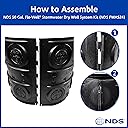
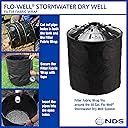
The NDS FWAS24 Flo Stormwater Dry Well System Kit is a 50-gallon underground solution designed to collect, temporarily store, and slowly infiltrate excess rainwater. Its innovative gravel-free design provides 250% more detention volume than traditional dry wells, while its modular panels allow stacking up to 8 feet deep and easy connection to standard 4" sewer and drain pipes. Built to withstand pedestrian and lawn tractor traffic, this system is ideal for residential and commercial landscapes seeking efficient, scalable stormwater management.


| ASIN | B000BO58CU |
| Best Sellers Rank | #31,232 in Patio, Lawn & Garden ( See Top 100 in Patio, Lawn & Garden ) #17 in Rain Barrels |
| Brand | NDS |
| Capacity | 50 Gallons |
| Color | Black |
| Date First Available | August 17, 2005 |
| Global Trade Identification Number | 00052063003207, 10052063003204 |
| Is Discontinued By Manufacturer | No |
| Item Weight | 9.6 ounces |
| Item model number | FWAS24 |
| Manufacturer | NDS, Inc. |
| Material | Plastic |
| Product Dimensions | 24"L x 24"W x 28.75"H |
| Shape | Round |
| UPC | 052063003207 |
J**S
Used 3 of these for my yard; no more water collecting during heavy rains! Sharing some installation ideas rcvd from others...
Installed 3 of these for my back yard. Used one for each of 3 downspout gutters, along with underground NDS French Drain tubing as well. Have had several rains now and we no longer see any waters building up in large sections of the yard any more. Did a lot of study beforehand and looked at a multitude of other brands, as well as other methods. This was the solution I chose and it's been great for us. I also used the NDS Surface Inlet Drain on each. It is true that the drain could be sealed to the top of this dry well but, the general rule is not to, to allow for ground shifting over the years (such as earthquakes, etc.). I didn't seal mine. I did read a lot of items on others reviews all across the Internet so I hope the following notes help others. I read a lot had to cut out the little drain holes and couldn't pound them out like the instructions mentioned. I actually read the instructions and it mentioned to place each of the curved well walls onto a hard supporting surface such as cinder blocks. I did this and they all popped out easily, except one (our of 3 wells, 9 wall sections total). I tried it without the blocks support and sure enough, it didn't work so, reading the instructions helped! The larger holes, for joining piping, are mentioned to perform some cutting prior to "popping" them out. A few reviewers across the Net also mentioned that the wall sections sometimes fell apart when handling them or installing them. So, one of the tips a couple of people mentioned (which I followed and did) was to use a water proofing sealant when joining the sections together. It worked absolutely perfectly. I constructed each well prior to digging each hole so it would have time to set for a couple of hours. Some reviewers had assumed it would come with a bottom but, being this is a dry well, the open bottom is intended for maximum drainage at the bottom. There are some scenarios where a bottom might be desired, e.g., if you're connect several of these together and you want to force it to drain into other dry wells or to drain out only through tubing. I've seen where a bottom can be purchased for those scenarios. I had to read a lot about draining on how it's done because we have no place to expel excess water. Thus, the dry well with no bottom was our solution. Also, I did line the outside of each dry well with the type of fabric that is recommended for french drains and dry wells. That fabric, by the way, is not the typical landscape fabric, by the way. Won't go into those details but a lot of people across the Net have posted they just used regular landscape fabric. From what I've read (including by engineers, etc. on the topic), I don't recommend it for long term usage. I did also use the draining fabric to line each of the dry well holes. I hope this helps others.
M**Y
Great product and great price
Had to make a homemade septic system and this was perfect for a small rv - for one person.
S**.
Sump pump dry well
Worked perfectly for a dry well of my sump pump
M**E
NDS FWAS24 Flo-Well
This product is best understood by examining the assumption not explained to you about its use. And by realizing that NDS is out to make a profit, which means it is not in their best interest to tell you about these assumptions. This does not mean they are selling a defective product. It means that they did not spend a lot of time making the installation fool proof, nor in teaching you what they know. It has some problems. It does not stay together well if it is moved around roughly during installation and the top is hard to fit if the sections are not well aligned and level. It does not need a bottom for a dry well is supposed to dissipate water. If the water won’t dissipate, then having no bottom is also an advantage in that the water can easily seep into the dry well cavity from the bottom. It is a better solution than the traditional dry well hole dug in the ground and filled with gravel, as long as you realize that the plastic dry well cannot prevent by itself the earth around it from collapsing. Which is why they have described layers of drain rock and fabric between it and the dirt walls, which assist in the support of the walls. NDS assumes you have determined your soil will drain. Obvious, sort of. You must determine if the soil at the location you want to install the dry well can drain water. The only way to determine that is to dig a hole deep enough for the proposed dry well and see if: 1. The test hole fills with water. 2. If the test hole does not then add water and see how long it takes to dissipate from the hole. If the surrounding soil does pull water from the hole, then more than likely following the NDS installation requirements will work. They have a set of parameters that must be clarified to determine the size of the dry well on their website which I recommend you review. If not, then the dry well can serve as a container for a sump pump better than a traditional sump pump basin. As the dry well does not come with a bottom, its use allows the installation of a sump pump without requiring any additional effort to allow the water to get into the dry well. You only need a rigid tile to support the pump. In this application, there is no need to cut any holes in the dry well, nor install filter fabric. Without a bottom and the existing slits in the dry well sections, when connected, allow water to seep into the cavity of the dry well. If in the case that the ground will not drain water, this product is still cheaper than a sump pump plastic tank. And if a sump pump tank is used instead, not only will it cost more, but you must drill holes in it to allow the water to seep in and it can not be extended easily by adding additional sections if you are more than 34 inches below grade. You are however required to determine how the sump pump pipe will exit the top of the lid which is not well thought out in the existing lid design, but not impossible. This application is particularly effective when the dry well is required to be placed in soil that has clay. Clay will not drain water, but it will not collapse when the dry well is installed. This means the hole for the dry well does not have to be much bigger than the dry well, certainly not the four feet they recommend. And since the water won't drain, there is no need for filter fabric. The down side is that you will need a sump pump. In my application, just digging the hole for the dry well cut into existing flow patterns in the clay layer found at the dry well depth. The hole I had to dig naturally filled with water because of the reduced pressure caused by the hole. Once I realized that there was water coming from the hole I dug and it would not drain, the dry well became a better choice than a sump pump basin because it is easier to install and is cheaper and can be stacked as my final hole was about 6 feet below grade. As in my application, I had to dig down 5 feet below grade to catch the water that was filling a patio that was located below the grade of the soil it was adjacent to (the single dry well is only 24 inches high, the lid adds another 4 inches which is useless). The dry well allows a lot more water than a hole filled with gravel, as long as you know that the hole will not collapse under the weight of the earth around the dry well. But remember that if the water will not drain from the hole to the surrounding water at a rate greater than the rate the water enters the hole, you will need to include a sump pump in your design. The three dry well sections do not stay together well, unless after installed they are carefully handled. This is because the alignment between the hooks and the slots in each section are not beveled to lock after the pressure of the installation. Any upward movement will unlock the sections. Just make sure that the ground the three sections rest on is reasonably level, and that you are careful in installing the assembled dry well sections. Yes they could have allowed for the addition of at least one screw between the 3 sections, but that would increase their cost. And they don’t listen any better than any other company. Since all 3 sections are the same, the mold to make the plastic is used for all three sections. This reduces the cost of manufacturing. So this is why it is cheaper than other products, but it is still over priced considering my estimate of what their cost is to build it. And what would it cost to add a location for at least one screw on between each section? It would require redoing the mold, and someone would have to convince the chief executive who looks at the cost versus the improvement. Therefore forget the improvement. Last comment. If you need to extend the dry well up, as in a stacked application, it is still cheaper to buy two dry well kits than to buy one dry well kit with a lid and then three additional sections without a lid. I observed that buying 3 sections without the lid was usually over 120 dollars, while buying the kit with 3 sections and lid was about 89 dollars.
D**B
Easy to put together and seems durable.
This 50 gallon underground storm water drainage container was easy to snap together with no tools needed. A hole was dug and some plumbing was nessassary using user supplied PVC. It is the perfect size for my application. You can add more containers if needed. In my case I needed to buy a reducer to reduce the inlet from 4 inches to 2 inches. I'd recommend this if you need to get rid of some standing water.
T**M
Good dry well dome for 50 gallons of water
Good unit for dry well system. Easy assembly and installation. It was a little work to knock out 1.5" round holes but just took a little extra time.
M**S
Water Problem Solved!
I'd been eyeing this stormwater system for years before I finally decided to pull the trigger and order one. It's not terribly complicated to install (get your shovel ready) and it will solve a drainage problem that has plagued my neighbor for many years. Definitely two thumbs up!
T**.
Everything I needed and expected. Better to cut out the drainage holes instead of hamming them out, second attempted hold cracked a bit so I knifed them out quite easily. I tuct taped the inside seams to prevent it coming apart while backfilling. Very pleased and I got my money’s worth.
A**R
This dry well arrives flat packed, and the assembly is easy. The plastic is sturdy, I have no concerns about it holding up over time. I would buy this again (but I hope to not need to).
K**M
Very easy to install and connect the pipes to it.
N**Y
This well works well. When assembling, it wants to come apart. Needs to be in position in order to lock everything in place. Have installed about ten of these for French drains.
A**O
Customers are very happy with this product. It's a MUST for residential drainage systems.
Trustpilot
4 days ago
3 weeks ago