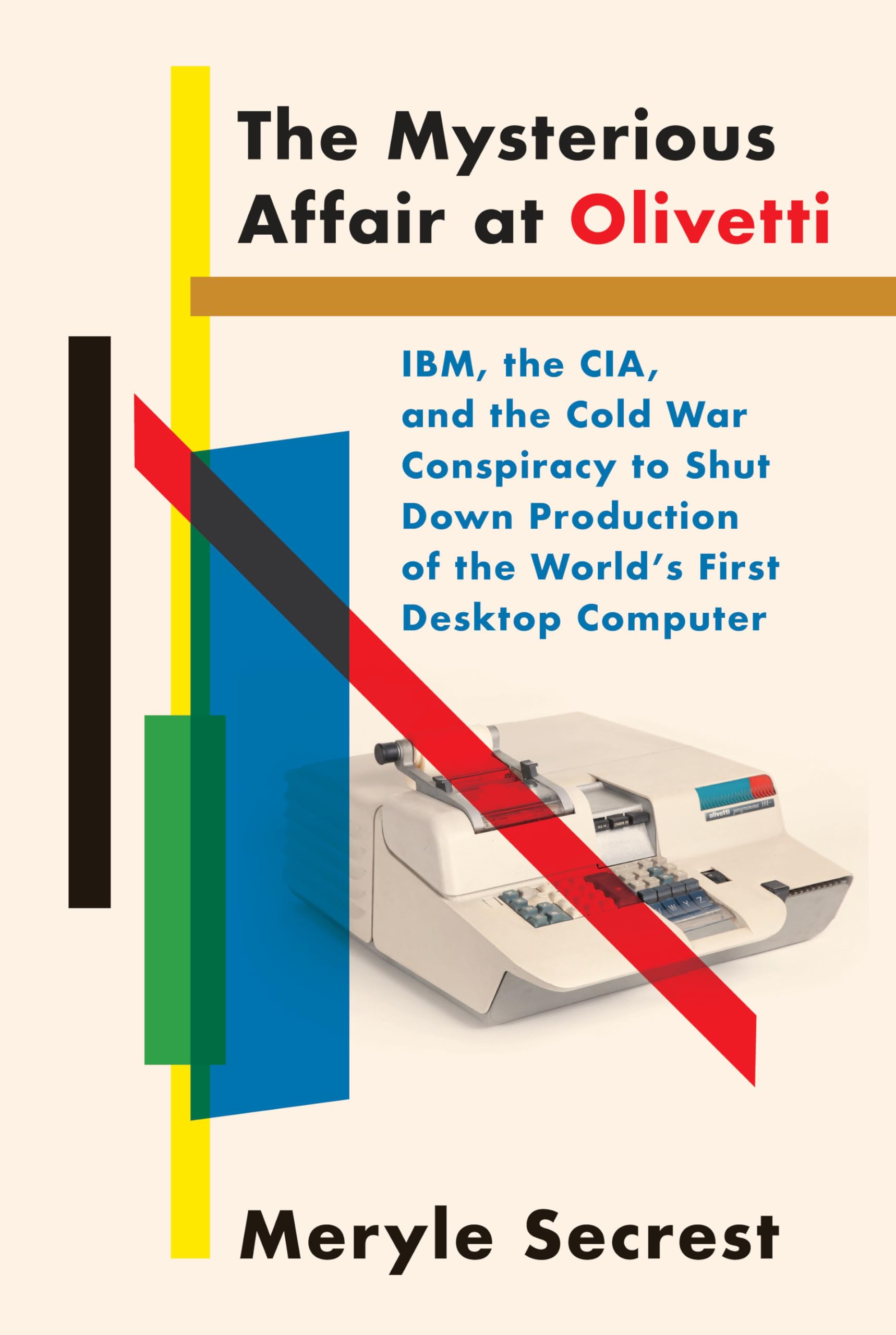
desertcart.in - Buy The Mysterious Affair at Olivetti: IBM, the CIA, and the Cold War Conspiracy to Shut Down Production of the World's First Desktop Computer book online at best prices in India on desertcart.in. Read The Mysterious Affair at Olivetti: IBM, the CIA, and the Cold War Conspiracy to Shut Down Production of the World's First Desktop Computer book reviews & author details and more at desertcart.in. Free delivery on qualified orders. Review: È proprio un piacere trovare libri usati che sono perfetti. Review: Perhaps the title is a bit misleading as people expects probably a breakthrough account about the invention of what can be considered the first personal computer and how the company lost the advantage. The book is a good, well written and detailed account of the Olivettis' fortunes. I found some new insights as I have read other books about Adriano Olivetti.
| Customer Reviews | 4.1 4.1 out of 5 stars (74) |
| Dimensions | 16.51 x 2.54 x 24.13 cm |
| Generic Name | Book |
| Hardcover | 320 pages |
| ISBN-10 | 0451493656 |
| ISBN-13 | 978-0451493651 |
| Item Weight | 635 g |
| Language | English |
| Publisher | Knopf (1 November 2019) |
L**E
È proprio un piacere trovare libri usati che sono perfetti.
M**O
Perhaps the title is a bit misleading as people expects probably a breakthrough account about the invention of what can be considered the first personal computer and how the company lost the advantage. The book is a good, well written and detailed account of the Olivettis' fortunes. I found some new insights as I have read other books about Adriano Olivetti.
O**I
Very interesting
C**.
I had learned about this book reading a synopsis and excerpt online months ago and thought it would be a great read. The excerpt was fascinating! If you like history - the real, unvarnished history of how things happen and by whom and why, this book is for you. I won't go into details and spoil the book but really - buy this book and and read what all transpired regarding Olivetti. Very much recommended!
A**R
The subtitle of this book is "IBM, the CIA, and the Cold War Conspiracy to Shut Down Production of the World's First Desktop Computer". This subtitle illustrates the confusion that permeates the book, due in part to the author's reluctance (or inability) to delve into the technology. The "World's First Desktop Computer" refers to the P101, which Olivetti released in 1965. It was not a computer, but rather a programmable calculator, a desktop version of the hand-held calculators that would be introduced by HP and Texas Instruments in the early 1970s. Like those devices, the P101 was a huge improvement over existing mechanical calculators, much less over hand calculation, and it sold well. But it was not remotely a computer, and was not even the first of its kind. The Wikipedia entry on computer history has this to say about early programmable calculators: "The world's first all-electronic desktop calculator was the British Bell Punch ANITA, released in 1961.[35][36] It used vacuum tubes, cold-cathode tubes and Dekatrons in its circuits, with 12 cold-cathode "Nixie" tubes for its display. The ANITA sold well since it was the only electronic desktop calculator available, and was silent and quick. The tube technology was superseded in June 1963 by the U.S. manufactured Friden EC-130, which had an all-transistor design, a stack of four 13-digit numbers displayed on a 5-inch (13 cm) CRT, and introduced reverse Polish notation (RPN)." The Friden device, which was introduced two years before the P101, gets no mention in the book. The subtitle would have us imagine that the P101 was somehow the predecessor to the Apple II or the IBM PC, but this is a very, very long reach. Speaking of IBM, the company's role in the "Conspiracy" is completely unclear. The author makes much of IBM's dreadful behaviour during WWII, but makes no clear connection between the company and Olivetti. The author's antipathy towards IBM shows up, for example, in a passage claiming that the company produced missiles, and in another passage (p 246) claiming that in 1962 IBM held a "monopoly" in mainframe computing -- there were at that time seven competitors (Burroughs, Univac, NCR, etc), each of which held a reasonable share of the market. Moreover, that IBM would be worried about a desktop calculator is simply ridiculous -- the company itself did not recognise the risk to their business model from personal computing until the late 1970's. With regard to the CIA, one of the more interesting, and hopefully more accurate, aspects of the book is the description of Italian politics in the WWII era. The book quotes numerous senior American officials, including some from the CIA and its predecessor, who saw Italy as an American puppet state in the decade immediately after the war. Some of their shenanigans would be worthy of Donald Trump. The British shared the Americans' low opinion of the Italians, and the Italians felt the same way about them. Several people associated with Olivetti, including Adriano Olivetti, died under mysterious circumstances, and the author demonstrates her enthusiasm for conspiracy theories by putting forward a number of seemingly far-fetched possibilities. However, even if these people were in fact murdered, there is no reason to believe that the motive(s) for the killing had anything to do with the P101. The book describes the very tangled network of big business in post-war Italy, including of course a number of powerful mafiosi. Deals were constantly being done and undone -- perhaps one of them went wrong. In any case, a simpler explanation for the demise of Olivetti is the confection of arrogance, hubris, and nepotism that the author describes (without naming any of it), combined with some very poor strategic thinking. In retrospect it may be surprising that the company lasted as long as it did. The main interest in the book for me was the description of Italian life in the period up to and including WWII, with the Olivetti family providing the framework for the story. (It's very difficult to keep track of who is who among the male Olivettis, since many of them had children with various partners, some of whom re-partnered with other members of the family later on. Probably some of this detail could have been left out with no loss to the reader's understanding of the story. The Mysterious Affairs at Olivetti would have been a more accurate title for the book as a whole.) There is a good book to be written from a business history/strategy perspective about the rise and fall of Olivetti, but this is not that book -- the author is too busy burrowing down rabbit holes to describe the larger picture. Perhaps that book will be written some day; I would certainly like to read it.
Trustpilot
2 months ago
3 weeks ago