
Buy anything from 5,000+ international stores. One checkout price. No surprise fees. Join 2M+ shoppers on Desertcart.
Desertcart purchases this item on your behalf and handles shipping, customs, and support to Japan.
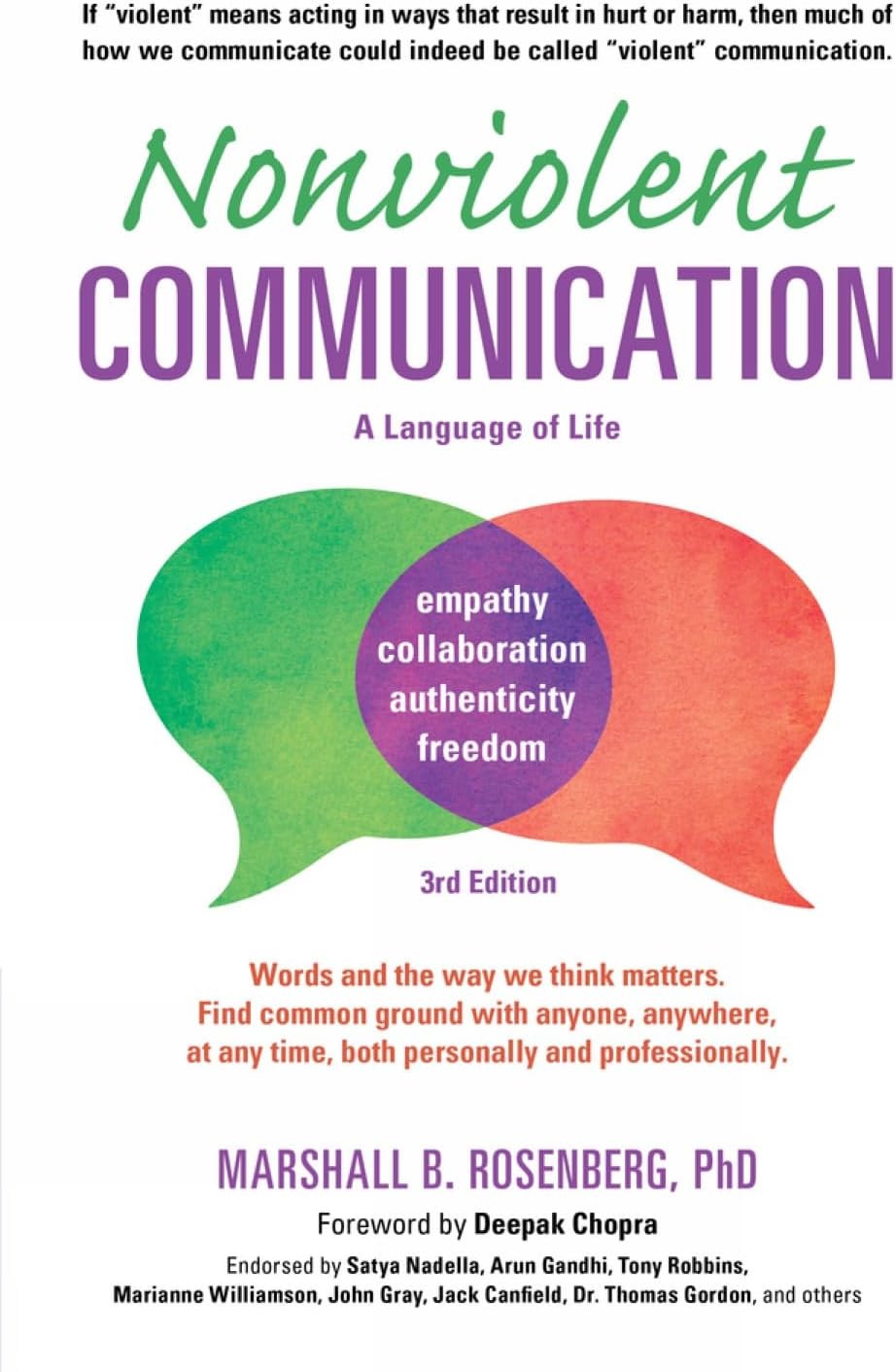
5,000,000 COPIES SOLD WORLDWIDE • TRANSLATED IN MORE THAN 35 LANGUAGES What is Violent Communication? If “violent” means acting in ways that result in hurt or harm, then much of how we communicate —judging others, bullying, having racial bias, blaming, finger pointing, discriminating, speaking without listening, criticizing others or ourselves, name-calling, reacting when angry, using political rhetoric, being defensive or judging who’s “good/bad” or what’s “right/wrong” with people— could indeed be called “violent communication.” What is Nonviolent Communication? Nonviolent Communication is the integration of four things: • Consciousness: a set of principles that support living a life of compassion, collaboration, courage, and authenticity • Language: understanding how words contribute to connection or distance • Communication: knowing how to ask for what we want, how to hear others even in disagreement, and how to move toward solutions that work for all • Means of influence: sharing “power with others” rather than using “power over others” Nonviolent Communication serves our desire to do three things: • Increase our ability to live with choice, meaning, and connection • Connect empathically with self and others to have more satisfying relationships • Sharing of resources so everyone is able to benefit Review: Communicating Honestly and Receiving Empathetically - we NEED this book right now - Are you a violent communicator? Though this book does not pose this question directly, it is a question that I’ve had to reflect on while reading this book. And I haven’t really liked what I’ve been forced to admit - that many of the ways we communicate in our everyday life take from the well-being of others. Marshall Rosenberg’s Nonviolent Communication has caused me to reflect deeply on how I use communication in my day to day life, and the ways in which we can either give life to others or take it away. Every time that we communicate with others, we can either build deeper understanding, connection, and compassion, or we can simply ignore them or worse, create further disconnection and less understanding. Marshall makes clear his ultimate goal, which is largely reflected in this book. “What I want in my life is compassion, a flow between myself and others based on a mutual giving from the heart.” Practically, Marshall outlines the tenets of Nonviolent Communication, a system he developed as a counselor and spent his career teaching all over the world. At its core, Nonviolent Communication is about communicating honestly and receiving empathetically, a way of communicating that “leads us to give from the heart.” Underneath each aspect of nonviolent communication is four key components: observations, feelings, needs, and requests. In his estimation, all frustration and anger is about unfulfilled need, and therefore our communication should be about getting to the core of those needs. Though it sounds simple, this is profoundly difficult; most of us are unaware of the needs we truly have, and communicating those needs is incredibly difficult, even in close relationships. While some of it can read as touchy-feely or robotic language, I’ve found this book to be both challenging and inspiring. On a practical level, I’ve found Rosenberg’s work to resonate deeply with me at a time where I feel few people are heard or really communicate fully and honestly what they think, both in public and in private. Secondly, as someone who studies Communication, I see significant overlap with Rosenberg’s suggestions with significant realms of Communication scholarship that suggests to me that this is much more than some counselor’s idealistic approach to being in the world. True, there has been no empirical research done on this, but I think there are still deep truths and practical tips that could help anyone and everyone communicate in ways that enrich the lives of others. In the end, I encourage you to read this book. For those that want 30,000 feet, skim through it and you’ll be better for its overarching ideas. For those that want in-depth tips, Rosenberg is clear and precise in showing you how to implement the language. And if you read this and don’t like it, leave a comment and tell me about it so we can dialogue more about it. I know for me, I’m better for reading this book, and I think I’ll show up for others better too. Review: There's a basic framework to NVC: observe without evaluation, feeling, need, request. - I got this on Audible a couple weeks ago and was pleasantly surprised with the quality of the book...so I bought it on kindle, too! I listened to the entire book within a day or so, and I started implementing the techniques on the first day! It made it so much easier to figure out what I really wanted out of sticky relationship situations, communicate in a way that is in line with my values, and not feel so bad if I receive venom in return (though usually these techniques nip the issues in the bud). The author's narration is perfect. A lot of the information seems intuitive...yet it does take work! - because, sadly, many if not most of us grow up in an environment with distorted social constructs, violence, and trauma. It takes a bit of "un-learning I have read dozens of "self-help" books and other resources on psychology, mental health, and relationships. Some of these were woo-woo fluff which missed the point, others were more specific to certain types of conflicts.....really they all say the same things from different perspectives... Rosenberg's "Nonviolent Communication: A language of life" is one of the books that stands on a shelf of its own, and one that I will surely revisit over time. The book lays things out clearly and simply (comprehensively). It's refreshingly un-biased. It provides practical tips and examples of how to execute NVC so that everyone's needs get met and we move toward harmony/real connection. There's a basic framework to NVC: observe without evaluation, feeling, need, request. NVZ is hard work, but it's a valuable skill! Nonviolent Communication is a great resource for anyone new to non-violent communication. I think this book is also an excellent "refresher" book for those Jedis out there who want to brush up on their communication skills while working on emotional intelligence and self-awareness. If you've ever been stuck in a victim/bully situation, co-dependency, any form of interpersonal abuse or trauma...or not - I think most if not all people can benefit from reading this book! - then you may find the information in this book to be healing and empowering (also humbling). Best wishes for your process of building a peaceful life, relationships, and personal autonomy :-)
| Best Sellers Rank | #952 in Books ( See Top 100 in Books ) #8 in Interpersonal Relations (Books) #11 in Communication & Social Skills (Books) #36 in Personal Transformation Self-Help |
| Customer Reviews | 4.7 out of 5 stars 12,231 Reviews |
C**S
Communicating Honestly and Receiving Empathetically - we NEED this book right now
Are you a violent communicator? Though this book does not pose this question directly, it is a question that I’ve had to reflect on while reading this book. And I haven’t really liked what I’ve been forced to admit - that many of the ways we communicate in our everyday life take from the well-being of others. Marshall Rosenberg’s Nonviolent Communication has caused me to reflect deeply on how I use communication in my day to day life, and the ways in which we can either give life to others or take it away. Every time that we communicate with others, we can either build deeper understanding, connection, and compassion, or we can simply ignore them or worse, create further disconnection and less understanding. Marshall makes clear his ultimate goal, which is largely reflected in this book. “What I want in my life is compassion, a flow between myself and others based on a mutual giving from the heart.” Practically, Marshall outlines the tenets of Nonviolent Communication, a system he developed as a counselor and spent his career teaching all over the world. At its core, Nonviolent Communication is about communicating honestly and receiving empathetically, a way of communicating that “leads us to give from the heart.” Underneath each aspect of nonviolent communication is four key components: observations, feelings, needs, and requests. In his estimation, all frustration and anger is about unfulfilled need, and therefore our communication should be about getting to the core of those needs. Though it sounds simple, this is profoundly difficult; most of us are unaware of the needs we truly have, and communicating those needs is incredibly difficult, even in close relationships. While some of it can read as touchy-feely or robotic language, I’ve found this book to be both challenging and inspiring. On a practical level, I’ve found Rosenberg’s work to resonate deeply with me at a time where I feel few people are heard or really communicate fully and honestly what they think, both in public and in private. Secondly, as someone who studies Communication, I see significant overlap with Rosenberg’s suggestions with significant realms of Communication scholarship that suggests to me that this is much more than some counselor’s idealistic approach to being in the world. True, there has been no empirical research done on this, but I think there are still deep truths and practical tips that could help anyone and everyone communicate in ways that enrich the lives of others. In the end, I encourage you to read this book. For those that want 30,000 feet, skim through it and you’ll be better for its overarching ideas. For those that want in-depth tips, Rosenberg is clear and precise in showing you how to implement the language. And if you read this and don’t like it, leave a comment and tell me about it so we can dialogue more about it. I know for me, I’m better for reading this book, and I think I’ll show up for others better too.
H**.
There's a basic framework to NVC: observe without evaluation, feeling, need, request.
I got this on Audible a couple weeks ago and was pleasantly surprised with the quality of the book...so I bought it on kindle, too! I listened to the entire book within a day or so, and I started implementing the techniques on the first day! It made it so much easier to figure out what I really wanted out of sticky relationship situations, communicate in a way that is in line with my values, and not feel so bad if I receive venom in return (though usually these techniques nip the issues in the bud). The author's narration is perfect. A lot of the information seems intuitive...yet it does take work! - because, sadly, many if not most of us grow up in an environment with distorted social constructs, violence, and trauma. It takes a bit of "un-learning I have read dozens of "self-help" books and other resources on psychology, mental health, and relationships. Some of these were woo-woo fluff which missed the point, others were more specific to certain types of conflicts.....really they all say the same things from different perspectives... Rosenberg's "Nonviolent Communication: A language of life" is one of the books that stands on a shelf of its own, and one that I will surely revisit over time. The book lays things out clearly and simply (comprehensively). It's refreshingly un-biased. It provides practical tips and examples of how to execute NVC so that everyone's needs get met and we move toward harmony/real connection. There's a basic framework to NVC: observe without evaluation, feeling, need, request. NVZ is hard work, but it's a valuable skill! Nonviolent Communication is a great resource for anyone new to non-violent communication. I think this book is also an excellent "refresher" book for those Jedis out there who want to brush up on their communication skills while working on emotional intelligence and self-awareness. If you've ever been stuck in a victim/bully situation, co-dependency, any form of interpersonal abuse or trauma...or not - I think most if not all people can benefit from reading this book! - then you may find the information in this book to be healing and empowering (also humbling). Best wishes for your process of building a peaceful life, relationships, and personal autonomy :-)
A**R
Please, for the sake of humanity, read this book
I first want to indicate that the five stars I am awarding this book is not because everything was perfect. There are a lot of issues I have with how the chapters are ordered, the flow of the book, etc, but the content of this book is so helpful and necessary to humans that it certainly compensates for the other faults of the book. A weirdly titled book, sure, but a necessary read nonetheless. Essentially, humans don’t do a very good job at communicating with each other. The author suspects this is due to some communication patterned that came to exist when their were kings and servants, but regardless of where it came from, it certainly exists now. Have you every felt attacked when someone said something? Have you ever reacted to a statement instead of actually contemplating it. This book is able to teach us why we act the way we do and how to better communicate our feelings, wants, and needs all in a couple sentences. When we say “I feel...” “I think...” generally these are not expressing our feelings, but rather some thought. For example, “I feel like a lazy slob today”. That isn’t a feeling. That’s an interpretation of the situation we are in through our own mental prism. What we should say is “I feel discouraged from working due to the topic of the work I am working on.” Expressing what we are feeling helps us to figure out what we really need (so that when we talk to someone for advice/help, we can more effectively obtain that assistance). The breakdown of the method is as follows: 1) Determine what we are observing; 2) Determine what we are feeling; 3) Determine what we are needing; 4) Determine what we would like to request in order to fulfill that need. If we can follow these simple steps as humans, the constant complaining and miscommunication that constantly occurs between us would dramatically decrease (not go away completely of course). Our inabilities to determine what we are actually feeling and most importantly, to express that to whoever we ware talking to (and feel relatively comfortable doing so) is what really hinders us as humans. One way to get better at communicating is to sit back and think about what we are feeling an to express that to others. Don’t just react to what someone says, but rather say what their statements/words made you feel. To advance your progress, try to get other people to express what they are feeling. Try to guess at their thoughts (if you guess wrong that is okay, they will likely correct you and lead you in the right direction). For example, if someone says to you “I can’t believe the weather person got the predictions wrong again! This is crazy!”. You could easily reply with “It sounds like you’re upset that the predictions weren’t correct.” The person might continue on and get to why they are really expressing their thoughts (perhaps because they really wanted to go for a walk with a family member that day but it had to be canceled due to the poor weather). This is all about receiving someone’s words empathically. Listening for feelings and trying to guess at them could really help you and the other person out in terms of effectively communicating with one another. Overall, this is a fantastic book. A book that I wish was mandated in schools, in businesses, etc. I promise you will pull out something useful from this book and subconsciously start employing some of the information you learned. And if you can diligently practice what it teaches, that would be even better. Words are the easiest way for people to hurt one another and to cause problems. If we can better communicate to achieve the desirable outcome for both parties involved, then that would lead to a more satisfying and happy life.
J**L
A Satisfied Customer
I order this book for a class that l'm taking on Tuesdays. I can't wait to complete and write a finish review. I enjoyed reading transformational books, and we're students of learning.
K**E
A life changing look on how we communicate
Book recommended by a therapist for relationship communication and it has been a fantastic read. My girlfriend and I both have read through the book and it’s honestly just a fascinating book to read on how people communicate and how to have hard conversations. Dare I say it’s a “save your marriage” type of book but it really is. Each chapter has great examples and ends with a problem that you can work through and practice. Non violent communication is surprisingly difficult as you’ll see reading through the book, but with lots of practice you can really start to break down your own biases and notice/catch yourself when you start saying something that is deemed violent. It’s amazing how much further a conversation can go when you use the techniques described in the book. Highly recommend this to anyone no matter what type of relationships you have. I think there is a lot to learn in here especially now more than ever when it comes to creating positive, productive, and meaningful conversations with a fellow human.
B**E
I can't believe I'm saying this, but...
This book is legitimately life changing. I first checked this book out at the library, however I found myself really needing to take time as I read it. The beginning is about learning to identify your own needs and verbalize what you really mean. I didn't realize the extent I wasn't doing that. (This is about the book, but it's also something I really wish university students and their parents knew) For example, it talks about taking responsibility for what you're doing and it used grading papers as an example. When I was a prof at a university, if I could have I would have done away with grades. They are a better reflection of the skills a student enters a course with than how they performed in the course. Students who already knew the material from more advanced courses would get As with minimal effort, while students who were actually L E A R N I N G would get lower grades because their work at the beginning was weak. But putting grades at just the end of the course stress them out. Ultimately what makes far more sense for learning and preparing students for work is a pass/fail system. But that's not what the schools want. So I would assign grades because the school made me assign them. ... Until I read that example in the book. The school never forced me to do it. I did it, but I did it because I would loose my job in other words. That's the example in the book. A teacher needing to say, "I assign grades because I want to keep my job." It puts the responsibility on the teacher but also explains that the consequences that were set up by forces outside her control. So, I tried to internalize it. "I assign grades because I want to keep my job." That when it finally, really sunk in that while I love teaching I hated teaching as an occupation. I don't want to spend all my time assigning grades to essays clearly written just before the deadline and with no real consideration or thought. I hated it for myself and then. But I "had" to do it. By stating "I assign grades because I want to keep my job" it became clear that I wasn't there to teach students and have a lasting positive impact on them, I was there to serve the university's need to make money. I don't blame them. Funding on a federal level was cut and supposed to be reinstated by now but it never was, so universities simply CANNOT function as they were intended to. And the increasing price of colleges and universities? That mostly goes to administration and other non-academic areas. It's not going to the professors. So I realized I should quit a job I hate for a job that I might still hate but pays me triple what the school did. The change has significantly eased my depression in a way medication, therapy, life style changes, diet, yoga, mediation, and exercise never could. It's not even a small exaggeration that it changed my life. And that. That was JUST the first few chapters of this book.
J**H
Basic & intuitive & deep - extremely valuable
Yeah so chapter 1: we have feelings because we have needs... yes of course but ... who ever thinks about this. Book is full of intuitive & basic things that aren't obvious until pointed out. It's like a human user manual. Of course, everything we do is communication & we only exist in existence with others so effective communication is the backbone of human existence. This book reads like a negotiation text book & should be required reading in law school. I'm an attorney. I wish we'd read this in the first year of law school. It's applicable to all communication & reads also like a spiritual guidebook. I'm very much into those too. You can't really separate high vibration living in terms of professional vs personal ... to quote a very cool Los Angeles pastor I once negotiated a lease deal with: "you is who you is." And who we are always comes down to how we made others feel. Our success as humans in every way depends on this. They may not remember what you said or did, but they always remember how you made them feel. At the core of this concept is how we communicate, and that stems from how we feel. I realized recently in a difficult personal relationship that I should just shut up & work inside myself if I'm feeling triggered. If you ever communicate with others ... and wish for your relationships or your results to be more satisfying, this is a very valuable read. My brother recommended it to me over breakfast. He's a good honest man with very open and authentic communication. I understand I've struggled in this area, tending to circle around inside myself, isolate or run, so I finally got around to picking up this gem.
P**P
A book that can change your life
In simple, understandable prose, Marshall Rosenberg lays out his brilliant guidelines for empathic communication. I've read it through several times (the book rewards study) and have practiced NVC as best I can over the past 7 years, during which time I've seen some amazing improvements in my relationships with both friends and family.
K**R
Top
Really helped to improve my communication skills, enrich my life and I have a strategy for solving day to day conflicts.
A**K
Cutting Through the Fluff: Why 'Nonviolent Communication' Stands Out
I'm usually hesitant about self-help books, yet find myself reading many. This might seem contradictory, but there's a reason. The ratio of substantial content to fluff in these books is often disappointingly high, leading to my reluctance. However, the few valuable insights gained from a lengthy book can be incredibly impactful, making the read worthwhile due to their long-term benefits. 'Nonviolent Communication' excels in offering meaningful content. It provides practical advice that enriches daily personal and professional interactions. The book keeps a focus on a communication framework, while relating it a wide range of topics, including conflict resolution, negotiation, and parenting, offering actionable advice and real-life examples. I highly recommend it for its insightful and applicable guidance.
P**A
It is difficult to apply, yet to understand it is a breeze — so well written!
This book is clear. It is simply so well structured, with quick summaries at the end of all chapters; almost every other chapter has a "NVC in Action" at the end, also, that presents a complete exchange between persons in conflict using NVC; each chapter is divided in bite-sized sections that follow the steps in the presentation of the topic. You may find the content hard to practice, but you will get all the concepts. The sheer quantity of examples is amazing, truly betrays the experience of the author using it in real life. Whenever I felt unsure wheter I understood a concept he came with a situation that made it clear, all in a style that is very engaging and readable. If you have any interest in Non Violent Communication, do pick this one up and read. It introduces and gives firm ground in presenting the topic to anyone.
W**E
How to Talk So People Actually Listen—And You Stay Friends!
This book is like a masterclass in communication that should honestly be required reading for, well, everyone. Marshall Rosenberg breaks down the art of speaking and listening in a way that helps you avoid conflict and actually connect with others (even when you really don’t agree). The best part? It’s not just about avoiding fights; it’s about building stronger relationships. The steps are practical, with real-life examples that make you go, “Oh, I’ve totally been in that situation!” The focus on empathy and understanding makes it feel less like a self-help book and more like a life skill manual. A minor con? It takes some practice to apply the techniques, especially if you’re used to reacting emotionally. But hey, Rome wasn’t built in a day, right? Some parts might feel repetitive, but I think it’s intentional to drive home the key points. Overall, it’s a powerful guide to communicating in a way that reduces misunderstandings, resolves conflict, and fosters compassion. Highly recommend if you’re ready to level up your people skills! 4.8/5
C**D
Great tools to use in conflict
Important read for anyone who is impulsive in conflict
Trustpilot
3 days ago
2 days ago