Desertcart purchases this item on your behalf and handles shipping, customs, and support to Japan.
💡 Print smarter, not harder — support that disappears like magic!
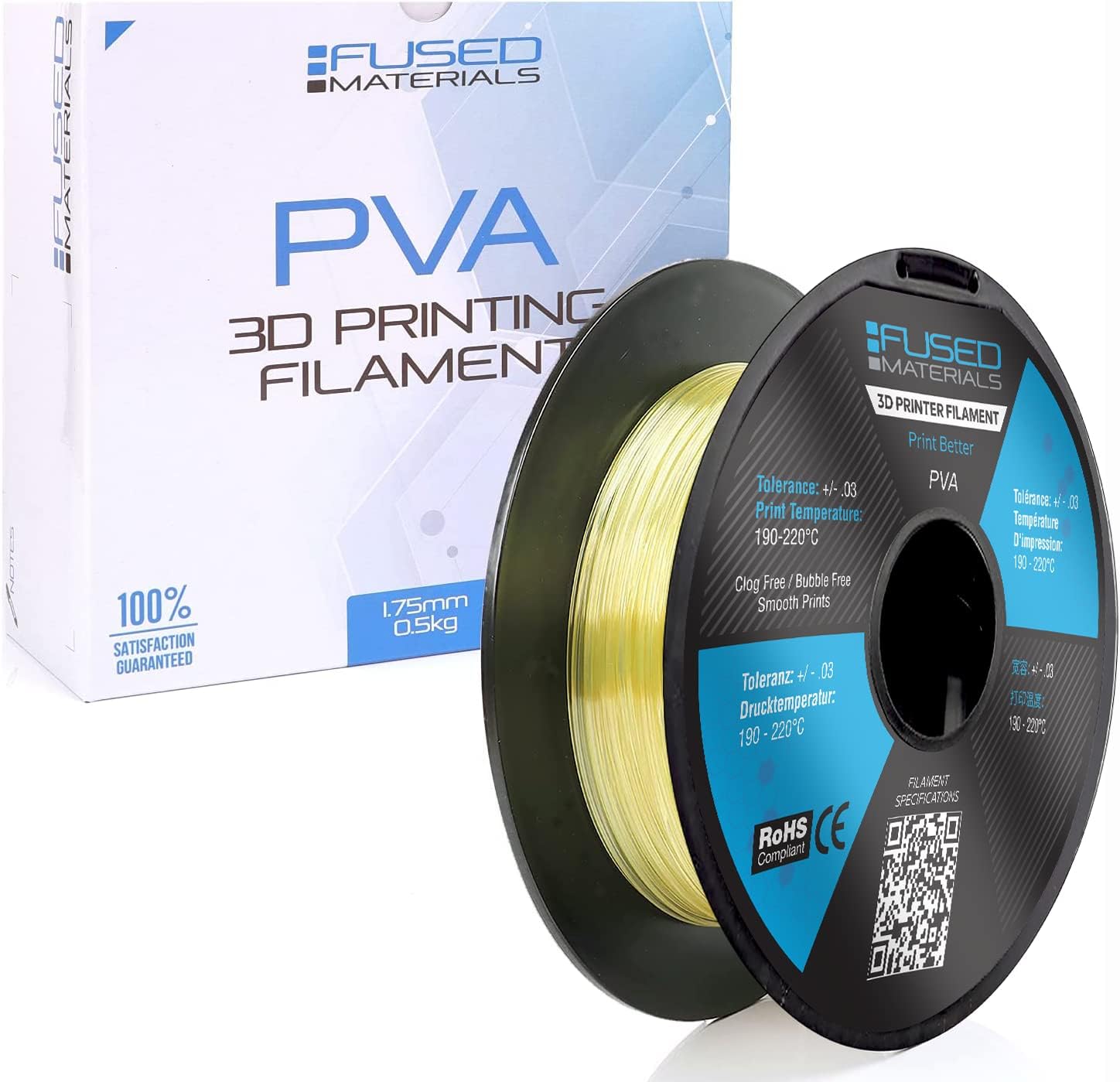
Fused Materials PVA Filament is a premium, water-soluble 1.75mm support material engineered for dual-extruder 3D printers. With ±0.03mm diameter accuracy and vacuum-sealed packaging, it guarantees smooth printing, strong adhesion with PLA and other common filaments, and effortless post-print cleanup by dissolving in water. Ideal for professionals crafting complex geometries, it delivers reliable, bubble-free, and warp-resistant performance.


| ASIN | B07XZHCNZV |
| Additional Features | Water-soluble support material for 3D printing |
| Best Sellers Rank | #43,755 in Industrial & Scientific ( See Top 100 in Industrial & Scientific ) #690 in 3D Printing Filament |
| Brand | FUSED MATERIALS |
| Brand Name | FUSED MATERIALS |
| Color | Clear, 1.75mm, 0.5kg |
| Customer Reviews | 4.1 out of 5 stars 378 Reviews |
| Global Trade Identification Number | 00860001943610 |
| Item Diameter | 1.75 millimeters |
| Item Weight | 1.1 pounds |
| Manufacturer | FUSED MATERIALS |
| Manufacturer Part Number | 13457324 |
| Material | Plastic |
| Material Type | Plastic |
| Model Number | 13457324 |
| Number of Items | 1 |
| Number of Packs | 1 |
| Special Feature | Water-soluble support material for 3D printing |
| Unit Count | 35.27 Ounce |
J**H
Excellent for creating internal geometries for parts
I've been using this PVA to create complex internal spaces for some of my products. It prints well, and dissolves in water. I've had some issues with stringing - but I think this is because of my print speed (50 mm/s) and printer settings, which I haven't adjusted because it's not a big deal for me. It takes a while for the material to completely dissolve (depending on the water temperature and how much of the surface is exposed to the water). It becomes mushy / soft after about 30 minutes of exposure to warm water, and can be removed fairly easily with a pick or tweezers (if you don't want to wait for it to dissolve completely). Because I'm printing parts with a larger volume per surface area (i.e. fairly round parts), I usually soak in warm water for 30 minutes, remove the softened areas, and soak again, repeating a few times until all the PVA is softened and removed (I'm not the most patient person in the world). The dissolved PVA does have a slight odor to it, but dissipates after washing your final part. I haven't tested the adhesion to other plastics while printing because I don't own a dual extruding 3D printer - I've only printed the parts separately and then assembled them together afterwards. Superglue works very well on PVA. Because PVA is fairly brittle, I've broken pieces from accidentally dropping them, and easily superglued them back together, and to other 3D printed plastics.
M**A
Great Customer Service
I have recently started 3D printing and was having difficulty getting PVA to work with my dual extruder. I have bought other brands of PVA before but was unable to diagnose the issue until I bought this brand of PVA and realized that it comes with a customer support number. When I called the number, I was impressed by the dedication of the customer support team, and ultimately with their help was able to get the PVA to stick to the model. The issue that ended up being the problem was as it turned out my PLA and not the PVA. For some reason the brand of PLA I was using did not stick to PVA and I thank the customer support team for helping me catch this. My experience with the performance of this PVA overall is pretty good. It does stick to most brands of PLA, but I was told for best performance to use the same brand of PLA for best results, however, I have yet to try this. The only issue I notice is that this PVA sometimes breaks off during a print, but this is most likely due on my part from incorrect settings and by not using the same brand PLA.
E**N
So brittle on open box. It sanps with just a little bending. Not usable.
I just opened a new box of the PVA. It is very brittle not even able to be bent a little bit. It just snaps. Is it supposed to be like that? Am I missing some procedure to use it? Basically not usable. Update: After opening the box and storing the filament in a heated drying chamber for a few hours, it became soft and usable. The loose filament strands outside the box also softened. I believe the packaging was too dry, which made the filament extremely brittle. Once conditioned, it adhered well to PLA and printed successfully.
Z**E
This PVA works well
This review is for the PVA, NOT the PLA that is also on this same link. PVA has a reputation for being difficult to print, possibly because the printers themselves are not well calibrated. To get PVA to stick to the build plate and to stick to your PLA part it is really important that the build plate is leveled, that the z offset for both nozzles is correct, and that the X-X offset between the nozzles is good. You also need to change some setting in your slicer. My slicer defaults to a .1mm offset for the raft, .1mm Z axis offset and a .4mm X-Y offset for the supports. These all need to be set to 0mm offset (because you will be dissolving the supports/raft and the default gap causes adhesion issues). The attached photos show a 2-inch (50mm) diameter sphere. The PLA printed at 205c, the PVA at 215c, and the build plate temperature was 45c. The first photo shows the sphere after most of the PVA support was removed with finger pressure. The second photo shows surface of the sphere after the PVA was dissolved, it does have some texture. The third photo shows the portion of the sphere that was not in contact with the supports and it is much smoother. Over all, I’m really pleased with the result. This is much better than using PLA supports, but I do wish the surface finish at the interface of the supports was better.
D**S
Brittle and doesn't adhere
Extremely brittle, multiple breaks throughout my printer. Not as hearing. Define do not recommend
J**N
More fragile than I expected
Not sure if this is just how PVA is, but the filament is kinda brittle and snaps easily, and I can accidentally peel off individual layers of the print once it's done. On the plus side I was able to print without issues using the default PVA settings on my Neptune 3 Pro with Elegoo's version of Cura. I used this filament as an inner mold for an epoxy mold and this did dissolve with water easily, it just took some time. I recommend both warm and running water.
P**K
Hands down the best PVA I've used
Initially, I was very frustrated by the lack of adhesion to my Prusa i3 MK3 print bed. I tried every variation of nozzle and bed temperatures I could think of; nothing worked. Within 1/2 hour of contacting their customer support, I had a response! Within an hour they had provided me with a solution: cover the print bed with painter's tape. Success! (Thank you, Kevin!) Every print since then has been flawless in its precision. I've tried BVOH and various brands of PVA and this is by far my favorite! It has great adhesion to painter's tape and itself. But, best of all is the ease with which it dissolves. It is so easy to remove any residue after dissolution in warm to COLD water. This is definitely my go-to PVA from here on out!
A**H
Fixed Issue with Constant and Immediate Filament Blockages on Ender 3
**Update on Cause at Bottom** Had an issue that came up after a print ran for a least a couple of hours after a blockage. Not sure exactly where the problem was occuring but after "unblocking" blockage with nozzle wire, the blockage would get reblocked after only 10 - 30 mm or so of filament. I replaced the nozzle, changed filament (mulitple times), and even changed to dual gear extruder, nothing worked. I pushed (used extrude in touch menu) about 200mm of this cleaning filament through the nozzle, several colors of filament came out with it. Then pushed regular filament through and re-tried print. I'm honestly suprised this stuff fixed that issue. Once again, not sure exactly where or what the problem was, but this fixed an issue that reoccured 20+ times of unblocking with nozzle wire. **The issues was that the nozzle and heat throat/PTFE tubing was right against each other** The nozzle doesn't need to be flush with the heat block but the Heat throat and PTFE tubing needs to be right up to the nozzle.
M**V
Brittle despite adequate packaging.
PVA Filament. This arrived tightly packaged and sealed with a moisture bag. Will all those precautions it was still extremely brittle and snapped every time i fed it into the hot end. Very disappointed and cannot recommend.
B**B
A simple way to clean your nozzle
I haven’t figured out cold pulls yet but I haven’t had to: when switching from PETG to PLA I retract the PETG, crank the temperature back up to 250, and run about a foot of this cleaning filament through. I can see the filament that gets extruded stained with the colour of the orevious filament, then eventually it comes out clear. Using a foot at a time means it looks like I have a few years’ supply. Well worth the small investment.
Trustpilot
2 weeks ago
2 weeks ago