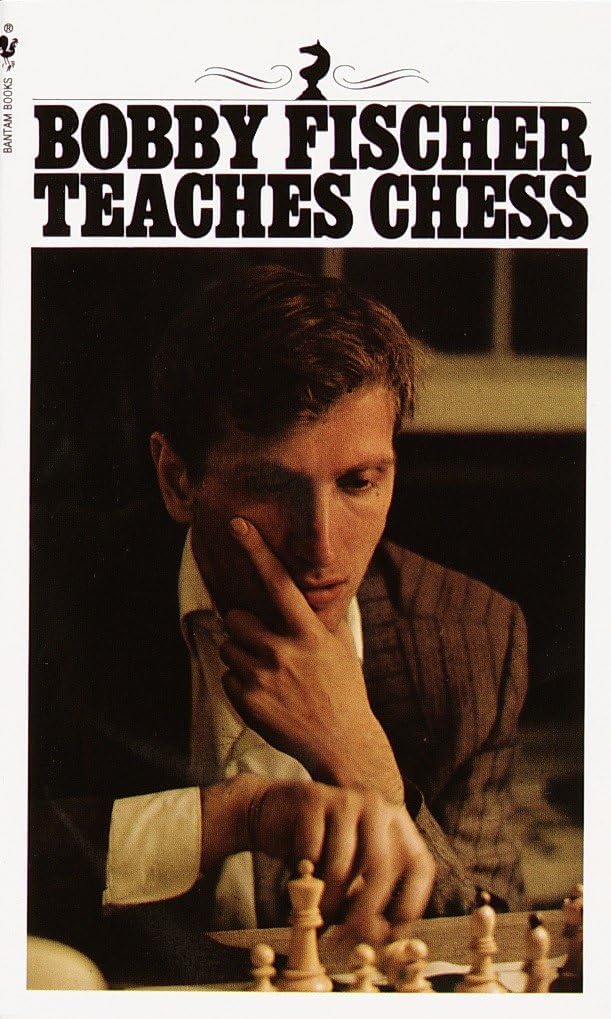
Bobby Fischer Teaches Chess
Product ID: 1641940
📚352 pages of chess mastery
♟️Programmed learning method
✈️Compact & travel-friendly
Desertcart purchases this item on your behalf and handles shipping, customs, and support to Japan.
♟️ Unlock Your Inner Chess Grandmaster – Don’t Just Play, Dominate!
Bobby Fischer Teaches Chess is a compact, 352-page chess training book that uses a unique programmed learning method to help players of all levels master checkmate strategies. Praised for its interactive puzzles and efficient knowledge transfer, it’s a top-rated bestseller that builds strategic thinking and pattern recognition, making it an essential tool for anyone serious about elevating their chess game.


| Best Sellers Rank | #6,406 in Books ( See Top 100 in Books ) #3 in Chess (Books) #8 in Board Games (Books) #8 in Puzzle & Game Reference (Books) |
| Customer Reviews | 4.6 out of 5 stars 10,361 Reviews |
L**E
Excellent for beginners
Having finished the Bobby Fischer teaches Chess book. I can say it's really good, the whole book is puzzle solving and tactical motiffs setup in a structured way that continuously improves upon the prior teachings. By the end of the book you are looking for check mate 3-5 lines in advance, via methods such as back rank mating, pinning, forcing king moves, overpowering, or discovering attacks. The book itself is a few hundred pages but is fairly short to get through, I spent maybe 8-10 hours on it at the hospital over a few days. A lot of the puzzles are actually challenging, I found myself getting some wrong or missing something a few moves in. Overall it's not gonna make someone a GM or anything but I highly recommend it to anyone looking to help build pattern recognition and mating recognition. 10/10
M**S
Fisching for Perfection?
Having previously attempted to optimize various aspects of my existence – from the psychological to the biochemical – I decided it was high time to upgrade my strategic processing capabilities. My previous attempts at chess involved a lot of hopeful piece-shoving and bewildered staring, a highly inefficient algorithm for achieving victory. Recognizing the need for a more direct data injection, I acquired Bobby Fischer Teaches Chess. I didn't see it as a book, but rather as a firmware update for my brain's chess module, delivered via a 1982 analog interface. From a purely functional standpoint, this 352-page volume is a masterclass in efficient knowledge transfer. It bypasses the often-tedious theoretical lectures and gets straight to the core function: achieving checkmate. The programmed learning method feels less like reading and more like interacting with an early, highly effective training program. Each page presents a problem, a challenge to your pattern recognition subroutines, followed by the solution on the next page. The physical design, with left-hand pages printed upside down, is a stroke of genius in user interface design for self-discipline. It's the book's way of saying, "Prove you've processed the data before you get the answer, buddy." It's a physical barrier to premature gratification, a feature I honestly appreciate in a world of instant digital answers. The near-perfect 4.6-star rating from thousands of users is compelling empirical evidence of its efficacy in upgrading human chess-playing units. The inherent humor in this artifact lies in its earnest, almost relentless focus on checkmate. It's like buying a comprehensive guide to automotive repair and finding that 90% of it is just detailed instructions on how to install lug nuts. Essential? Absolutely. But the singular dedication to this one critical task is delightfully intense. One can almost hear Bobby's voice echoing from the pages, demanding, "Did you find the checkmate? No? Flip the page (and the book!) and try again." It's a no-nonsense approach that borders on the comically rigid, yet it undeniably works. Positively speaking, this book delivers precisely what it promises. It doesn't clutter your mental RAM with obscure opening variations. It focuses on the critical end-game sequence, the digital handshake of victory. Working through the problems felt like debugging a complex system, identifying the faulty moves and correcting them based on the provided optimal path. It built my confidence not by explaining why a move was good in abstract terms, but by showing me, repeatedly, how to achieve the desired outcome. It's like getting a cheat code for the final boss, but you still have to earn it by solving the puzzle yourself. In conclusion, if you're looking for a unique, highly effective, and humorously direct method to hardwire checkmate patterns into your strategic thinking, Bobby Fischer Teaches Chess is an exceptional tool. It provides the structured training environment and the built-in anti-cheat mechanism; the resulting ability to confidently deliver checkmate is the highly satisfying system upgrade. I highly recommend it for anyone ready to move beyond random piece-pushing and start finishing chess games with purpose.
A**R
I became a grandmaster
Just kidding. But this really helped my chess skills improve. I bought this book after learning chess, and after about a month, I went to a real life tournament. Keep in mind, I had NO chess skills, I had only been playing for about a month or so. I didn't plan on playing, only spectating, but my chess teacher told me I had to play since we were missing players (I'm in HS). After playing, I completed the game with an official elo of 768. Before this book, I was probably a 200 or 300. I'm not saying you'll get a 400+ elo boost, but this definitely changed the way I play games, and I am really good at chess now. I can easily compete with a 1500 elo player (might not win but I'll give them a hard time!), and I can also feel very confident when playing against 1000 elo or less players. I feel like to get the most out of this book, you really need to practice. I read this book while also implementing the things I learned into real life practice games with other players. I love this book so much, it is the only chess book I ever needed. I recommend you purchase this if you want to become better at chess, or challenge your brain for a little while. After reading this book, I didn't need advice from others; I began giving it. Good luck nerds.
A**W
Good but not what I was expecting
I would consider myself a beginner in chess only starting about a month ago. I purchased a cheap board and a book to hopefully improve my game somewhat, just so happen I purchased this one. Long story short i needed help in literally every area of my game, from opening to closing. This is pretty much a book solely focusing on mate. It lays the pieces out and asks you to find mate with no details or explanation on why or how the pieces got there. Just so happen that is exactly what I need help on. While this book definitely helps a beginners game sense and helps spotting possible mate patterns but that's about it. I do believe my game has improved because of it since mate is the most important part of the game, but I was expecting something completely different. Would be good if you also bought a book to teach you the details of getting your pieces where you want them..
A**R
One of the best Chess books available
I played a lot of chess in college and in my 20's and the stopped. I coming back to the game after almost 40 years. This is the best book I've found for my situation -- I know how the pieces move but I've forgotten the elements of strategy that will lead to a win. This book leads you there! It uses a "programmed learning" format that was popular in the 1960's and 70's that I think is very effective but has fallen out of vogue. Each concept or problem is presented on the right-hand-side page. The answer is printed on the right-hand-side after you turn the page. At the end you just turn the book over and continue. No paging through to find the answer page disrupting your progress. The only other negative comment I found in the reviews was that the book was too focused on checkmating! Duh...! Chess is about checkmating! It's the object of the game! Learning how to set up moves that get you to checkmate is where it's at. If your less that a 1200 player I believe it's what you should focus on. You need to be playing against over 1200 rated players to worry about openings and memorizing defenses. Most under 1200 rated players lose because they don't recognize checkmate situations or make stupid moves they should have seen because they didn't understand basic tactics leading to checkmate. Playing the right variation of an opening isn't their biggest problem. If your under 1200 start with this book and then move on to a puzzle book. Save the tristes on openings for later. The only thing I wish the book had that it doesn't is a table of contents. After you finish the book you'll want to come back to certain sections to review them. Here's my contribution... Chapter 1 -- Elements of Checkmate -- pg 15 Chapter 2 -- The back-row mates -- pg 103 Chapter 3 -- Back-Rock Defenses and Variations -- pg 155 Chapter 4 -- Displacing Defenders -- pg 193 Chapter 5 -- Attacks on the Enemy Pawn Cover -- pg 236 Chapter 6 -- Final Review -- pg 292 Buy this book! It can't help but to improve your game.
U**A
Great chess book
Excellent book to start as absolute beginner.
P**O
A must read
This is a wonderful book for anew chess player. I have learned so much. The material is easy to understand.
J**.
A fun and interesting read, but the space-wasting format and poor print quality detract
The format is interesting and easy to follow but the print quality is poor, with some diagrams partially faded and in others the print is so dark that the black pieces on black sqares are invisible. There is also a great deal of wasted space, with many half pages wasted with big boxes with words inside like "turn the page and continue" as the only thing printed.
B**N
TERS-DÜZ SAYFALAR BİLİNÇLİ, O ŞEKİLDE OLMASI GEREKİYOR, KİTAPTA AÇIKLAMASI VAR!!
Sayfaların ters-düz/karışık olması gerekiyormuş. Kitabı aldım ve sayfaların bir kısmı ters bir kısmı düz ve sayfalar karışık biçimdeydi. Yanlış basıldığını sanıp değişime gönderdim ve elime ulaşan diğer kitap da aynı şekilde basılmıştı. Ufak bir araştırmadan sonra bu basımın bilinçli olduğunu öğrendim. Kitabı normal düz bir şekilde bitirdikten sonra ters çevirip kaldığınız yerden (sağ taraftaki sayfalardan) devam ediyorsunuz. Kitapta bunun açıklaması mevcut.
K**A
Great book for some check mate strategies. Don't expect it to teach you opening to end game
There is a reason why Fischer is considered to be one of the best chess players of all times, so needless to say that the book would be high quality as expected. The book is more a strategy book for check mates than a complete chess tutorial. As you work through Fischer's puzzles, it kind of opens you up to the number of ways you can check mate the opponent. The book is quite lucid and exciting as well and focuses on a few strategies. However, if you are a beginner and want to learn about the game as a whole (opening, mid game, ending), then Logical Chess Move my Move is a good choice.
J**J
Makes learning chess easy.
I bought this book for an elderly relative who has never played chess, and he was very impressed with it, and so was I. He has played less than 10 games, and his game has improved significantly. We love the diagrams, and the brevity of the authors' language. Thank you for this amazing book. It keeps our brains ''young''.
A**R
Exercise Book - Fun and effective
Practical exercises rather than theory. Note this book appears to have half it's pages "printed upside down", however it's designed this way. It's so exercises can be completed without seeing the response on the adjacent side. I wish some exercises had more explanations, since I don't understand why I get some responses wrong.
A**O
Buen libro para principiantes
Tiene un problema de impresión y se repiten como treinta páginas.
Trustpilot
4 days ago
2 days ago