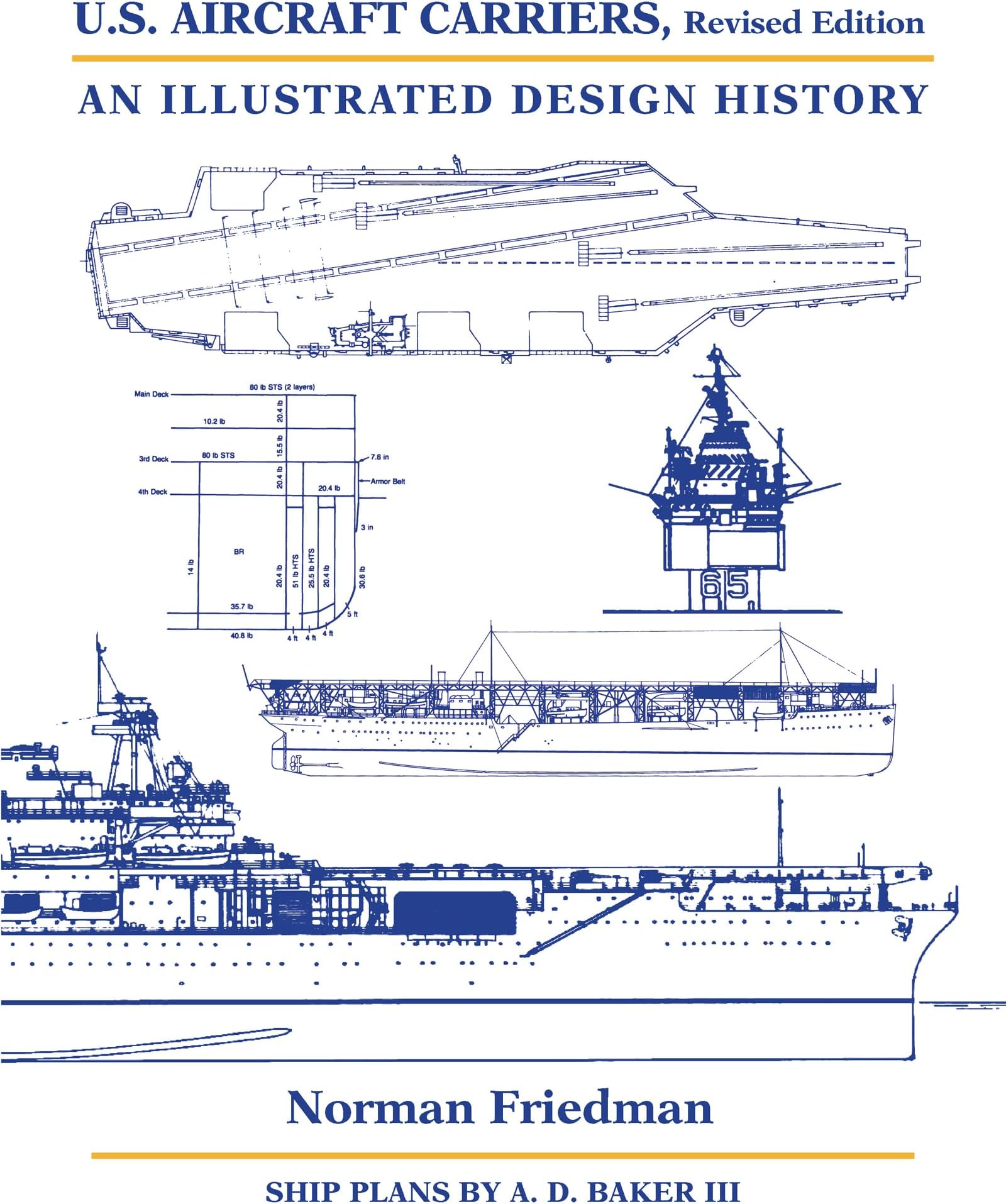
U.S. Aircraft Carriers, Revised Edition: An Illustrated Design History
Product ID: 1609598
Desertcart purchases this item on your behalf and handles shipping, customs, and support to Japan.
This fully illustrated series offers detailed descriptions of the evolution of all classes of the principle U.S. combatant types, as well as plans, profiles, and numerous detailed photographs. Review: Superbly Detailed and Fascinating - This volume, one of many in Norman Friedman's naval design histories, is amazingly thorough in its coverage of U.S. aircraft carrier design from the 1930s-era Saratoga and Lexington through the nuclear-powered Nimitz-class, as well as the offshoot amphibious assault carriers. The book is filled with design schematics, ships' specifications and more esoteric naval information than you could possibly absorb in a lifetime. The rich wealth of information is the consistent strength of this series that makes it a bit overwhelming for the casual reader looking for a narrative history of U.S. carrier. The emphaisis here is on ship design, its impact on operations and little else. If there is any shortcoming to be found within the book, it is that it is rather old, having been last updated in 1983, when the Nimitz class was just hitting its stride and long before the design innovations fueled by the Navy's growth in the waning years of the Cold War. Review: An Outstanding Reference on Design and Development! - Outstanding reference on U.S. aircraft carriers. What I appreciate most is the many details or backstory about the various designs and why the ships ultimately were built the way they were. Thorough explanation of why armored decks were desirable or not, the compromises required for flight deck size, speed, air wing size, open hanger or closed, etc. Enough pictures to keep young readers interested, and enough detail to interest the collegiate or post-graduate level scholar. Highly recommended!




| Best Sellers Rank | #1,529,038 in Books ( See Top 100 in Books ) #85 in Ship Pictorials #236 in Aviation Pictorials #568 in Ship History (Books) |
| Customer Reviews | 4.5 out of 5 stars 90 Reviews |
D**H
Superbly Detailed and Fascinating
This volume, one of many in Norman Friedman's naval design histories, is amazingly thorough in its coverage of U.S. aircraft carrier design from the 1930s-era Saratoga and Lexington through the nuclear-powered Nimitz-class, as well as the offshoot amphibious assault carriers. The book is filled with design schematics, ships' specifications and more esoteric naval information than you could possibly absorb in a lifetime. The rich wealth of information is the consistent strength of this series that makes it a bit overwhelming for the casual reader looking for a narrative history of U.S. carrier. The emphaisis here is on ship design, its impact on operations and little else. If there is any shortcoming to be found within the book, it is that it is rather old, having been last updated in 1983, when the Nimitz class was just hitting its stride and long before the design innovations fueled by the Navy's growth in the waning years of the Cold War.
C**.
An Outstanding Reference on Design and Development!
Outstanding reference on U.S. aircraft carriers. What I appreciate most is the many details or backstory about the various designs and why the ships ultimately were built the way they were. Thorough explanation of why armored decks were desirable or not, the compromises required for flight deck size, speed, air wing size, open hanger or closed, etc. Enough pictures to keep young readers interested, and enough detail to interest the collegiate or post-graduate level scholar. Highly recommended!
O**R
Detailed history of the development of US carriers
The history of the development of carriers is here, often in far more detail than I really needed. Pages of direct quotations from memos from times long past. What Friedman does, he researches well, though I think he has written too many books too quickly to do them as well as he is capable of. Book is dated, 1983, and parts of it are barely current to then. Read the subtitle carefully - this is a design history, that is the history of the designs, and it lacks a good deal of detail about the designs themselves. You need a good background in ships and the Navy in order to make your way through some portions. Although I have not read every word of this massive work, I've found only one serious error, and that in a table in an appendix. As he states clearly, there is no operational history covered. A massive work researched in detail and easily used as an authoritative reference. I've not tested the index enough to say if you can actually find stuff buried in it. I down-rate it because I would have liked to see more detail on the actual designs, beyond the major features like deck size, armor, and propulsion. Also, ships as built varied. For example, the armor on the 5-inch deck mounts on the Essex class ships is given as one number, whereas I understand (not a definitive reference) that although on each ship the four mounts were protected equally, there was great variations between different ships. Nothing is given on flight deck construction, unless it was armored, yet flight deck construction is a vital part of the design of carriers. As long as your expectations are kept within bounds, the book is certainly recommended.
M**1
Good reference book.
Great illustrations.
M**2
Serious Library Addition for Serious Historians
This book is not a take-to-the-beach-for-light-summer-reading fare. It is a technically dense, exhaustive study of United States aircraft carrier design, from the first awkward experiments, (the Langley), through a brief description of the then-new (1983) Nimitz class. Reading it is like trying to run through knee-deep mud, but oh, what mud. Everything a serious historian--(or naval architect, for that matter)--could possibly want to know about pre-1983 American carriers is here. Want to know where the avgas tanks were in the first Yorktown class ships? You got it. How about a complete description of the electronic suites--radars, HF/DF, communications, meterological--on the post-war carriers? Every minute iteration in the continually evolving systems is there, and which ships had which systems and when they were installed, upgraded, replaced or removed. Why did some of the Essexes have fold-up gun sponsons? (To fit through the locks of the Panama Canal.) There is even the only good description I've ever seen--with photographs--of the two WWII carqual carriers converted from paddle-wheel (!!) steamers that operated in Lake Michigan. CVEs, the post-war conversion projects, LPHs, dedicated ASW carriers, the second Enterprise, catapults, arresting gear, and on and on. If you are a serious naval historian, this book belongs on your shelf.
K**F
Above average U.S. aircraft carrier book.
I bought the book for my father-in-law's 80th birthday. He was in the Navy and served on a air craft carrier and he talks about his years of service so fondly. I wanted to give him a good book on air craft carriers so I read as many reviews on the books available and decided to order it. After he opened his present, he started looking through the book and he was instantly interested. He couldn't put it down and he said that he had never seen such a thorough book on aircrafts. I was thrilled with his response. He isn't easy to please and I know I bought him the perfect gift.
C**N
Another Great Norman Friedman book Poorly made *HANDLE WITH CARE*
So, I recently wrote a review on the U.S. Cruisers book in this series. Thankfully the only complaint I can wage against this is the poor quality of the production. Unlike the U.S. Cruisers book. I am fully aware of Dr. Friedman having newer information covering multiple sections, but it was not included in the latest printing... The U.S. Aircraft Carriers book has plenty of new information, including data on the most modern US aircraft carrier-class, the USS Gerald R. Ford Class. Saying that, though, brings a quote to mind "the island is shorter and 20 feet taller" when discussing the Gerald R. Ford in a photo caption... Editing in the new content is a little light. As stated in my previous review... the white Case-bound edition is of poor construction. If this had been produced to the level of the Original printing in book quality, this would have earned four stars and if the new content's editing had been more on point 5 stars. All in all an Amazing book and if you don't own the original edition, remember this edition won't stand up to the use and abuse like the first printings would. So handle it with care!
S**R
An incomplete update
There are new chapters on the USS Ford and amphibous carriers, but the appendix on catapults has an almost useless rivial update, while he appendices on arresting gear and magazines haven't been touched at all. Considering what a huge part of the USS Ford these changes were, it comes close to feeling like I wasted my money. The Foreword and Introduction weren't updated either ("For the past twenty years ..." and "Six decades have passed since the emergence of the aircraft carrier in the U.S. Navy ...") Don't get me wrong about the book itself. If you don't have the first edition -- get this, it's full of info. But if you've got that, I'd think twice before springing for this new "revised" edition.
I**D
worthwhile update
Even though the update is only the last 100 or so pages, I felt it was worthwhile for the coverage of the Nimitz and Ford classes
R**S
Jein
Leider keine wesentliche Verbesserung zur Erstausgabe. Der Text wurde nirgends verbessert um die aktuelle Forschung und Wissensstand einzufügen. Es ist nur die Kopie der Erstausgabe die um ein sehr kurzes Kapitel zur aktuellen Entwicklung ergänzt wurde. Die Risse sind weiterhin von teilweise sehr schlechter Qualität. Wer die Erstausgabe besitzt, kann sich das Buch sparen. Mit ein wenig mehr Aufwand hätte es herausragend werden können. Sehr schade!
Trustpilot
1 month ago
3 weeks ago