
Desertcart purchases this item on your behalf and handles shipping, customs, and support to Japan.
๐ฉ Dress for belonging, not just for show.
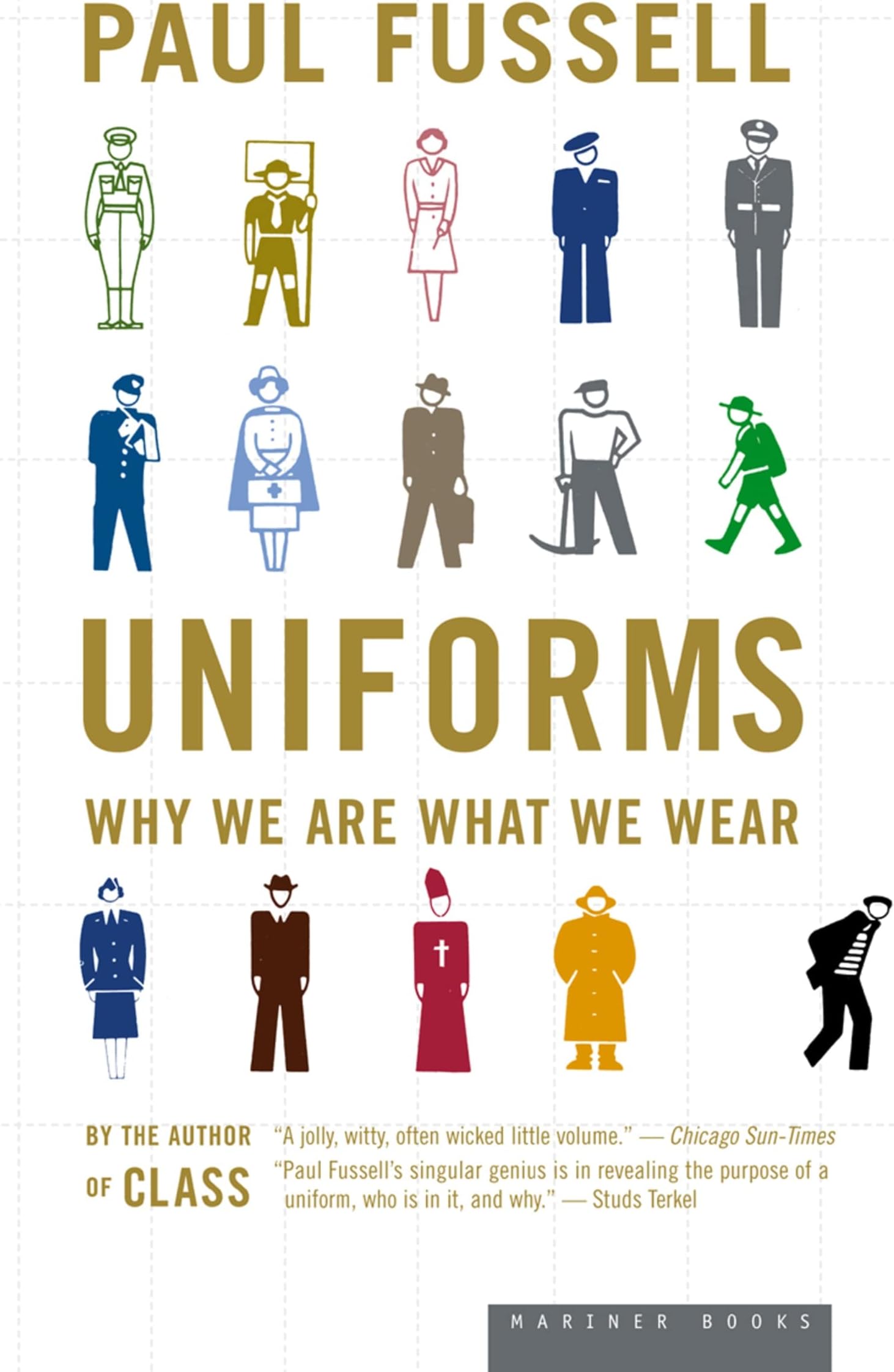
Paul Fussellโs 'Uniforms' offers a sharp, witty exploration of how clothingโfrom military brass buttons to casual blue jeansโreflects and shapes social class, identity, and cultural norms. This used copy in good condition is a compelling, accessible read blending history, sociology, and humor, perfect for professionals curious about the hidden power of attire.
| Best Sellers Rank | #236,503 in Books ( See Top 100 in Books ) #151 in Design History & Criticism #244 in Customs & Traditions Social Sciences #273 in Fashion History |
| Customer Reviews | 4.3 out of 5 stars 29 Reviews |
P**V
A New Word In Anthropology.
Fussel is the first to look so sharply at the common traits of our surreptitiously approaching brave new world. We almost arrived.
S**T
Excellent overview
I am VERY surprised by the number of negative reviews here. You'd think most of the unhappy reviewers were PhD students trying to meet a deadline for a paper, and was bummed that this material was not as "academically respectable" as it needs to be for their purposes. Historically exhaustive? Fastidiously archival? Psychoanalytical? Filled with statistics? No, this book is NOT that kind of book. Better: it is a TERRIFIC overview of how people - you, me, everyone - are affected by the sight of uniforms. And Fussell gives you plenty of anecdotal examples of how this is so. A lot of women are turned on by men in uniforms - by men they would give 2 shite to if in jeans. A lot of women apparently have confessed to eagerly waiting for the DHL or the UPS guy to show up, making his daily deliveries. Who knew that a slight change in design in the Navy uniform would cause such a big fluctuation in enrollment? That the airplane-using industries had to borrow 'nautical' terms for their purposes makes a fascinating story about how the airlines and the Air Force had to design their uniforms. General Patton was a real fop, and used to change - when time allowed - his uniform 3 times a day. You can be sure HE had a lot to say about, and DID say, how soldiers should look on the battlefield as well! All in all, a very delightful, funny, thought-provoking introduction to a topic that COULD BE otherwise tedious and too serious, and even "politically-correctional." Don't be so serious: read this and enjoy your flight. You will look at those flight attendants in a wholly new way, and be surprised by what the flight crew call the male stewards.
E**F
not as expected
I've read Fussell's book "Class", which is very funny and I expected this to be a more general look at how people dress. It is literally about different uniforms and, after a short discussion about military uniforms of different countries, it is really very boring.
R**Y
The Universal Attire
Everyone wears a uniform. Of course, the military, the church, sports teams, and letter carriers all have their uniforms, but then so do lawyers, doctors, and businessmen. In these less regimented occupations, there is a universal dilemma: "Everyone must wear a uniform, but everyone must deny wearing one, lest one's invaluable personality and unique identity be compromised." So writes Paul Fussell in _Uniforms: Why We Are What We Wear_ (Houghton Mifflin), a funny look at all sorts of intentional and unintentional uniforms. Fussell is a historian with plenty of hefty, well-regarded books to his credit, but here he has adopted a perfect light tone for what he admits is "unabashedly a book about appearances." In over thirty chapters, some only a couple of pages, some full of research, some personal essays, Fussell has called attention to the way we dress, something he shows we are already paying a great deal of attention to anyway. Of course, uniforms are most closely associated with the military. It shows up in surprising ways. Despite any Bolshevist tendencies, Russian uniforms had style and elegance, perhaps as a compensation for the poverty of the officers. The tendency for lesser states to compensate by overdress in uniform is cited here repeatedly. The pictures of the Japanese surrender on the _USS Missouri_, for instance, show "the triumphant Allied officers in their informal, unpretentious khakis, pressing forward for a sight of the humiliated, overdressed Japanese officers and diplomats wearing standard hot uniforms and striped trousers, black tailcoats, and silk top hats." The crisis in current military uniforms is that they are looking the same, in different services and in different nations. Camouflage patterns have become the style. "The hope was that the infantrymen would look like leaves or some natural flora and thus deceive the enemy." American commanders can choose between the most popular "Woodland" version, also favored by hunters, and the alternates "Desert," "Arctic," and "Urban," the last one "imitating building surfaces like stucco, concrete, and brick." But this is decidedly not a book about military uniforms only. The Catholic religion, baseball and basketball teams, the Salvation Army, police, brides, firemen, doctors and nurses, academics in dress robes, chefs, the Mounties, the National Park Service, war reenactors, the Ku Klux Klan, the Boy and Girl Scouts, and many more uniformed services are treated here. There is only a bit of organization to Fussell's book, though there is plenty of insight and humor. The subject is a perfect one for some joshing, but it is serious all the same. He reminds us, "Dressing approximately like others is to don armor against contempt. Better to be not noticed at all than noticed and targeted as odd."
M**H
Good, fun pop sociology
Having grown up in an army family, I've always been aware of the subtle distinctions among military uniforms, while at the same time being semi-unaware of them because they were so fundamental to my world. In his urbanely witty but sharply observant way, Fussell identifies much deeper distinctions: The Russian love of large shoulderboards, the 20th century German fascination with black, the Italian thing for plumes, and the different perception and philosophy between British class-conscious khaki and American egalitarian olive drab. And the essential reason army and navy uniforms are so very different: until the Cold War, the army and its uniforms were made up anew for each new major conflict, while the navy continued to exist much the same in peacetime as in wartime. But "uniform" means more than the military -- witness the ubiquity of blue jeans in the United States and, eventually, all over the world. Fussell also asks the questions most of us wouldn't have thought of, like why do British and American cops tend to dark blue uniforms, quite unlike the tradition in Continental countries? Why do commercial airline pilots wear uniforms at all? (The early ones didn't.) Why are UPS men considered sexy while FedEx guys aren't? And what was it with Elmo Zumwalt and Richard Nixon when it came to bizarre uniforms? This isn't a very long book, nor is it scholarly in style, but it's a lot of fun. And you'll find yourself looking at all the uniformed people around you with a new eye.
K**S
An intresting read for my teenage sons, the free thinkers....
I have senior and sophomore boys in high school (who are also in boy scouts, one is an eagle scout) and it was interesting for them to see how folks in uniform are looked upon and "classified" (the younger one wants to go into the Navy before college). Interesting topic for the dinner table.
J**D
Disappointing Effort from a Great Social Critic
Hardly a week goes by that I do not reference Paul Fussell's Great War and Modern Memory, so I was thrilled to find he had turned his powers of observation to uniforms. Like Fussell, I must confess to my own odd fascination with uniforms. I too think they carry far more significance than mere convenience or even natty appearance. Unfortunately, I found the book very disappointing. Fussell has reached a point in his life and work where he can write about whatever he damn well pleases, and there are points in this book that remind us why. His basic thesis, that uniforms represent the eternal dilemma between individualism and belonging, is interesting, and he does a good job of pointing out the irony of people wearing a uniform to emphasize their uniqueness. Those strengths do not overcome the books weaknesses, which begin with some glaring factual errors. On page 64, Fussell concludes his chapter on the U.S. Army's uniforms and the "Battle of the Berets" by claiming that the battle ended with the Rangers in possession of their traditional [not really] berets and the rest of the Army wearing khaki models. This is a complete reversal of the true outcome and could lead air travelers to believe that the elite Rangers, rather than the National Guard, are now guarding airports. It may seem like a minor error, but it obscures the point that the outcome could not have been otherwise. Uniforms are an expression of authority, and the Army Chief of Staff could never have given in on such a trivial matter, nor could his superiors have overruled him, without precipitating a much more serious crisis in confidence. From the moment General Shinseki said "you will," the matter was decided for better or for worse. Fussell does not really examine this element of "uniformity" as much as he probably should, choosing rather to focus on the individual's desire to be in a uniform. There are a couple of other errors, both glaring and probable. Fussell claims (page 59) that the campaign hat is no longer worn in the military except by Marine drill instructors. Not so; male Army drill sergeants also wear the "Smoky Bear" hat, while their female counterparts wear an abominable green contraption with a turned-up Aussie style brim. Nobody knows why. I do not have the time to find it right now (more on that shortly), but I believe Fussell also refers to the Army's World War II service cap at one point as the "service or overseas cap." I defer to his own experience-perhaps the terminology has changed-but both before and after World War II, the service and overseas caps were different things. On page 36 Fussell claims that George Patton's grandson, Robert H. Patton "knew him about as well as anyone" but Robert's father George was only born in 1923, making him 22 at the time of the great general's death, and Robert writes that he, "came of age in...the 1960s." That makes it highly unlikely that the grandson knew his grandfather at all. Two other issues of interpretation bear mentioning. Fussell's description of the National Park Service attitude toward uniforms does not ring true to me. During my own short stint with the Park Service, I never found rangers to be slobs, but neither were they particularly concerned with or proud of their uniforms. This may be a difference of geography, as is my other quibble. Fussell's description of student attire fits me and my friends to a tee. However, it bears little resemblance to the undergraduates I encountered while attending graduate school at a large western land grant university. I come from a traditional academic background very similar to Fussell's Ivy League experience at Penn, but I found students at Colorado State were more likely to wear baggy jeans and tie-dyes (no less uniform of course) than khakis. My own favorite uniform item is the hat. In particular, I am fascinated by the tendency to select this most useful of clothing items based on appearance rather than function. Fussell is under no obligation to fulfill my idiosyncrasies, but I think he could have done more here. More generally, the lack of notes or an index makes it virtually impossible to use the book for serious scholarship or even to find items like "service cap" to cite in criticism. Fussell has essentially written an extended essay on a subject that amuses and interests him. His careless use of evidence (I have cited only the most concrete instances here) obscures some trenchant observations about uniforms and their uses. On the positive side, it is a quick read and may generate some ideas for those who wish to pursue them more seriously. If you too have a "thing about uniforms," borrow this book from the library. MAJ James W. Vizzard Department of English, USMA
A**N
Cohesive composition on society's use of uniforms.
Paul Fussell narrates the legacy of society's garments through to their modern inheritance. He analyzes not only the uniforms we commonly associate with blue-collar workers, but also the nature behind dress outside of the workplace. Fussell shows the ways in which human nature leads us to want to fit in - to assume our uniformity - while claiming to maintain individuality. His writing is crisp, refreshing, and cutting - his words convey comical anecdotes, historical accounts, and incisive analysis in a palatable fashion. While tracing uniforms throughout history, Fussell's work primarily focuses on the uniforms in our contemporary society today. Uniforms: Why We Are What We Wear transcends mere history, making probing social commentary and examining deeper meaning of cloth - showing how society might just be made out of cloth. Fussell's work is a treasure and remarkably astonishing - Uniforms tells the reader just how important our clothing is in conveying our place in society, how uniforms speak volumes beyond their superficial appearances, and how uniforms persist even in the absence of official doctrine. This book brings to light many things that we take for granted and demonstrates the significance of our society made of cloth.
Trustpilot
2 months ago
2 weeks ago