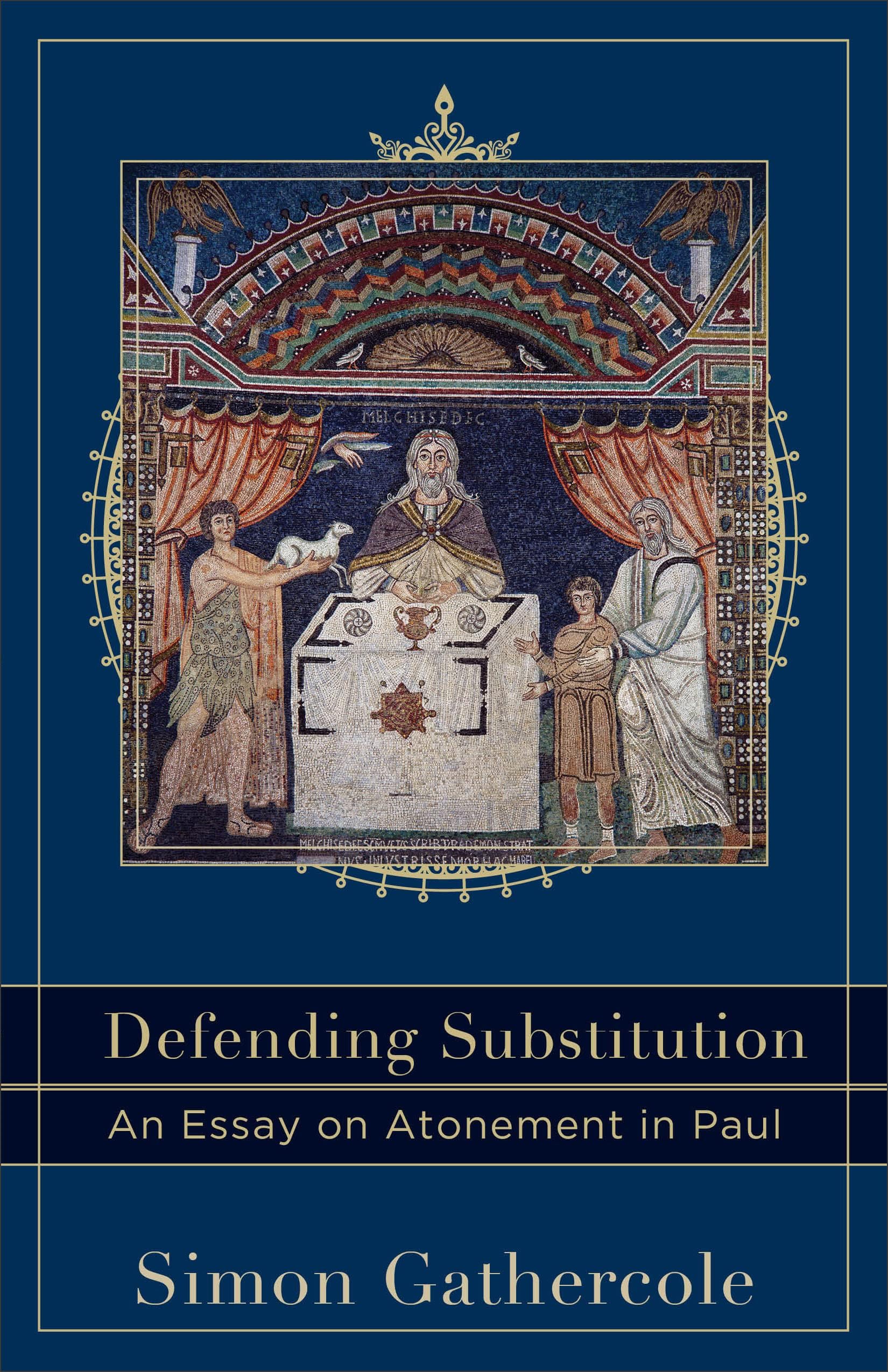
Defending Substitution: An Essay on Atonement in Paul (Acadia Studies in Bible and Theology)
Product ID: 14705424
Desertcart purchases this item on your behalf and handles shipping, customs, and support to Japan.
In recent decades, the church and academy have witnessed intense debates concerning the concept of penal substitution to describe Christ's atoning sacrifice. Some claim it promotes violence, glorifies suffering and death, and amounts to divine child abuse. Others argue it plays a pivotal role in classical Christian doctrine. Here world-renowned New Testament scholar Simon Gathercole offers an exegetical and historical defense of the traditional substitutionary view of the atonement. He provides critical analyses of various interpretations of the atonement and places New Testament teaching in its Old Testament and Greco-Roman contexts, demonstrating that the interpretation of atonement in the Pauline corpus must include substitution. Review: A clear and helpful analysis of Christ’s substitutionary death - A concise, but clear and convincing defense of Christ’s substitutionary death in Scripture. It provides a helpful analysis of one of the aspects Scripture’s accounts of Jesus’s death Review: Modern and Concise Revisiting of a Classic Evangelical Doctrine - Multiple atonement theories have always been postulated in the Christian Church, each aiming to shed light on what the death of Jesus signifies for it's adherents, as well as connecting its correspondence to the deeply-rooted cultic themes of blood sacrifice, priestly office and temple worship so embedded in Old Testament history and narrative. Our modern-day context is no different, with numerous interpretations again at odds, and continued strife within the Evangelical world wrestling with what the death of Christ and His 'at-one-ment' means for our proclamation of the Gospel. Broader Christianity today aims to distance itself from the violent motifs of the Old Testament, along with a punitive character of the atonement which has colored much of the conservative Christian witness regarding its teachings and tellings of the death of Christ. Some Christian schools of thought are embracing a less-punitive, and even non-violent perspective on the atonement, akin to more classically liberal (German) Christian thought. Others follow a more participatory model of the atonement, following Barth, Torrance and others, seeing atonement more intently through the lens of incarnation. Enter British Biblical and New Testament Scholar Simon Gathercole. In a concise 100+ page book, Gathercole begins Chapter 1 by revisiting the current dialogue on atonement, discussing the "Tubingen School" of 'Representative Place-Taking' from the critical pens of Hartmut Gese and Otfried Hofius; Morna Hooker's "Interchange" theory; and J. Louis Martyn's "Apocalyptic Deliverance" paradigm. Each school of thought is critical of a substitutionary view of the atonement. Gathercole carefully evaluates each position, and finds them wanting as it pertains to Apostle Paul's constant discussion of human "sins" (Plural). Gathercole sees each current school of scholarship marginalizing this issue in Paul's writings. Turning from a generous and irenic critic of the previously mentioned scholars, Gathercole takes up two brief exegetical case studies with 1 Cor. 15:3-4 (Chapter 2) and Rom. 5:6-8 (Chapter 3). Gathercole opens up 1 Cor. 15:3-4, bringing Paul's use of Isaiah 53 and his phrase "Christ Died For Our Sins" together to highlight the substitutionary character of atonement. He shows how the passage is highlighting Christ's dealing with "Our Sins" as one "On Behalf Of Us", and "On Behalf of Another". Gathercole also reveals how the issue of "Our Sins" (plural) is dealt with by Christ in a transformative way, taking us from Old Testament Promise (Prophets) to New Testament Fulfillment (Gospels). In Chapter 3, Gathercole continues building his argument by illustrating from Rom. 5:6-8 Apostle Paul's use of the "vicarious death" motif from well-known Greco-Roman literature of the time to explain the character of Christ's death. In ancient literature, there are a number of known instances where friends or loved ones actually did voluntarily die "In the Place Of" the other person. Gathercole highlights the use of Paul's contrasting statements, that while "Christ died for the ungodly", "scarcely will anyone die for a righteous person", to build his conclusion, namely, that Christ died for people who HATED Him (Rom. 1:30). Gathercole shows how this further illustrates the incredibly virtuous (and vicarious) nature of Jesus' death for us. While this book is fairly technical, it is concise, easy to follow, and a very helpful and irenic approach in arguing for the substitutionary nature of Christ's atoning death. Whether you are a church layperson, volunteer, or a Gospel minster, this book is immensely encouraging and Gathercole is a joyful read as an academic. Highly recommended.
| Best Sellers Rank | #579,893 in Books ( See Top 100 in Books ) #814 in Paul's Letters (Books) #877 in Christian Salvation Theory (Books) #1,327 in Christology (Books) |
| Customer Reviews | 4.5 out of 5 stars 29 Reviews |
F**Z
A clear and helpful analysis of Christ’s substitutionary death
A concise, but clear and convincing defense of Christ’s substitutionary death in Scripture. It provides a helpful analysis of one of the aspects Scripture’s accounts of Jesus’s death
W**R
Modern and Concise Revisiting of a Classic Evangelical Doctrine
Multiple atonement theories have always been postulated in the Christian Church, each aiming to shed light on what the death of Jesus signifies for it's adherents, as well as connecting its correspondence to the deeply-rooted cultic themes of blood sacrifice, priestly office and temple worship so embedded in Old Testament history and narrative. Our modern-day context is no different, with numerous interpretations again at odds, and continued strife within the Evangelical world wrestling with what the death of Christ and His 'at-one-ment' means for our proclamation of the Gospel. Broader Christianity today aims to distance itself from the violent motifs of the Old Testament, along with a punitive character of the atonement which has colored much of the conservative Christian witness regarding its teachings and tellings of the death of Christ. Some Christian schools of thought are embracing a less-punitive, and even non-violent perspective on the atonement, akin to more classically liberal (German) Christian thought. Others follow a more participatory model of the atonement, following Barth, Torrance and others, seeing atonement more intently through the lens of incarnation. Enter British Biblical and New Testament Scholar Simon Gathercole. In a concise 100+ page book, Gathercole begins Chapter 1 by revisiting the current dialogue on atonement, discussing the "Tubingen School" of 'Representative Place-Taking' from the critical pens of Hartmut Gese and Otfried Hofius; Morna Hooker's "Interchange" theory; and J. Louis Martyn's "Apocalyptic Deliverance" paradigm. Each school of thought is critical of a substitutionary view of the atonement. Gathercole carefully evaluates each position, and finds them wanting as it pertains to Apostle Paul's constant discussion of human "sins" (Plural). Gathercole sees each current school of scholarship marginalizing this issue in Paul's writings. Turning from a generous and irenic critic of the previously mentioned scholars, Gathercole takes up two brief exegetical case studies with 1 Cor. 15:3-4 (Chapter 2) and Rom. 5:6-8 (Chapter 3). Gathercole opens up 1 Cor. 15:3-4, bringing Paul's use of Isaiah 53 and his phrase "Christ Died For Our Sins" together to highlight the substitutionary character of atonement. He shows how the passage is highlighting Christ's dealing with "Our Sins" as one "On Behalf Of Us", and "On Behalf of Another". Gathercole also reveals how the issue of "Our Sins" (plural) is dealt with by Christ in a transformative way, taking us from Old Testament Promise (Prophets) to New Testament Fulfillment (Gospels). In Chapter 3, Gathercole continues building his argument by illustrating from Rom. 5:6-8 Apostle Paul's use of the "vicarious death" motif from well-known Greco-Roman literature of the time to explain the character of Christ's death. In ancient literature, there are a number of known instances where friends or loved ones actually did voluntarily die "In the Place Of" the other person. Gathercole highlights the use of Paul's contrasting statements, that while "Christ died for the ungodly", "scarcely will anyone die for a righteous person", to build his conclusion, namely, that Christ died for people who HATED Him (Rom. 1:30). Gathercole shows how this further illustrates the incredibly virtuous (and vicarious) nature of Jesus' death for us. While this book is fairly technical, it is concise, easy to follow, and a very helpful and irenic approach in arguing for the substitutionary nature of Christ's atoning death. Whether you are a church layperson, volunteer, or a Gospel minster, this book is immensely encouraging and Gathercole is a joyful read as an academic. Highly recommended.
B**S
A Concise, Thoughtful and Gracious Defense
Summary: Gathercole defends the oft-maligned doctrine of substitutionary atonement, responding to the criticisms and challenges raised and demonstrating from key biblical texts that it can be argued from scripture that “Christ died in our place.” The idea of “substitution”, that Christ died in our place, for our sins has come in for criticism from many quarters. Some claim this amounts to “divine child abuse.” Others argue that substitution has not necessarily been the church’s understanding of how Christ’s death on the cross atoned for human sinfulness. In this brief “essay”, Simon Gathercole engages this criticism and gives a modest but important argument for the biblical foundations of the idea of substitution. First of all he contends that substitution is important both for our theological grasp of the gospel, the message of Christ and also pastorally vital in providing Christians assurance of their pardon before and acceptance by God. He defines substitution as “Christ’s death in our place, instead of us.” and sets this apart from other views such as representation and satisfaction. He also defends this idea against various criticisms, particularly that this is immoral by arguing that this was fully an act of Jesus own will, out of love for us, and not forced upon him. Then he engages three exegetical challenges to substitution. The first is that of Harmut Gese proposing the atonement occurring through “representative place taking.” The second is Morna Hooker’s idea of “interchange” in which Christ becomes what we are so that we become what he is. The third is J. Louis Martyn’s idea of apocalyptic deliverance from Sin. In addressing this latter, he also provides textual evidence that Christ died not only for Sin but for the sins of people. In engaging each of these theories he shows what is of value in our understanding of the work of Christ, what is problematic or actually suggestive of substitution, and at the same time approaches these in such a way that substitution need not exclude other insights into the nature of Christ’s death. The latter part of the book is concerned with careful exegesis of two key texts, I Corinthians 15:3, and Romans 5:6-8. In the first, he argues for the substitutionary understanding of the idea that Christ died for us, and makes a compelling case that the scriptures according to which this is so include Isaiah 53, where the idea of the servant’s death for Israel is, on the basis of his word study, very clear. In his study of Romans 5:6-8, he takes a very different approach in arguing that the idea of one who would scarcely die for a good man has parallels in the literature of Paul’s day. He appeals to the tale of Alcestis, and also to Philonides, Epictetus, and Seneca for proposing similar “substitutionary” ideas. In between these two chapters, he includes an excursus on the question of why, if Christ’s death is indeed substitutionary, do Christians still die. His argument considers various senses of “death” and argues that while we die, we do not perish. In concluding, he argues for the continuing importance of substitution and that this idea, along with representation, and liberation might be understood as part of Paul’s thought. Perhaps the most winsome aspect of the “defense” he makes is that it is an argument for the “inclusion” of substitution rather than for the “exclusion” of other ideas. This is a short book, only 128 pages with bibliography and indices. The reason for this is that it is more or less a transcript of Gathercole’s Hayward Lectures at Arcadia University. This concise and readable account, while not covering with the depth some might want all the texts and theories of the atonement, serves as a theological resource for adult education in a variety of contexts, both lay and seminary, around this important Christian doctrine. Above all, it graciously argues why substitution matters, how it may be defended, and pastorally, how important these truths are to proper Christian confidence. _____________________________________ Disclosure of Material Connection: I received this book free from the publisher. I was not required to write a positive review. The opinions I have expressed are my own. I am disclosing this in accordance with the Federal Trade Commission’s 16 CFR, Part 255 : “Guides Concerning the Use of Endorsements and Testimonials in Advertising.”
D**O
Great!
Excellent exegesis!!! Makes a great argument from scripture for the fact that Christ’s death was a penal substitution for our sins. Denying that claim would simply require denying the clear evidence from scripture. A great and fast read (only took me an afternoon) that will edify your life
G**I
Basic to the evangelical approch to the doctrine of the ...
Basic to the evangelical approch to the doctrine of the atonement but does not deal with its early sourece
M**G
A Short But Valuable Resource
As Christians, we believe that the death of Jesus on the cross accomplished something, namely dealing with the sin and death problem that has faced all of humanity since Adam’s fall in the Garden. With that said, what exactly was accomplished, for whom, when, and how it all plays out has been a source of debate among biblical scholars. Some aver substitutionary atonement while others support a more representative approach to Christ’s sacrifice. Professor Simon Gathercole in his helpful book Defending Substitution: An Essay on Atonement in Paul unpacks a difficult theological subject in an effort to demonstrate the validity from a biblical perspective of substitutionary atonement. The focus of this book is not to provide an in-depth or exhaustive discussion of this topic not to interact with every single argument present over the years in favor of or in opposition to substitutionary atonement. Conversely, the purpose is to provide a definition of substitutionary atonement, to show its importance in particular in two key Pauline passages, to interact with some representative criticisms and alternative viewpoints, with again the underlying purpose being to show that substitutionary atonement is an essential and vital element for grasping what Christ did for us. Gathercole provides valuable interaction with three specific alternative viewpoints to what Christ did, namely the Tubingen View, Hooker’s Interchange View, and finally the Apocalyptic Deliverance View. I found the discussion of these views to be quite valuable and Gathercole does a great job of noting their respective positions as well as their merits. It was interesting to note that portions of these views are valid; however as Gathercole aptly summarizes, "they adopt a particular view of the atonement in Paul, and this theory tends to take on the role of a dominant or all-encompassing explanation.” Those dominant explanations seem to focus on sin collectively while failing to interact with the reality that Paul does deal with specific sins in relation to the atonement. Chapters 2 and 3 provide some excellent theological reading as Gathercole interacts with two key Pauline passages – 1 Corinthians 15:3 and Romans 5:6-8. He keys in on some specific portions of both passages that speak of Christ doing something for us. This is by definition an act of substitution, the action of one on behalf of another. The discussion provided by Gathercole on the examples from classical literature that reveal the concept of a friend willingly dying for another was quite interesting. What this discussion reveals is more than the fact that substitution was an act understood prior to and during the time of Paul. The real point of importance Gathercole drives home is the fact Christ did far more than what was demonstrated in classical literature. Unlike those examples, “Christ’s death creates a friendship where there had been enmity” meaning even though we showed ourselves not to be friends of God, even though we have failed our marriage vows, and even though we have rejected relationship with God, Christ dies for us. Such love was unknown in the classical literature examples, thus revealing the true nature of Christ’s sacrifice, one of love for those who were an enemy of God. Written in an easy to read lecture style that is accessible to both scholars and laymen, this book is an important read. While Gathercole does not engage every minute detail of substitutionary atonement, that is not his intention. He set out to show that substitutionary atonement is indeed taught by Paul and forms an important element of the Pauline discussion on this topic. To some degree, substitutionary atonement can co-exist with representation and other perspectives; however, there can be no doubt that substitutionary atonement is aptly defended by Gathercole in this book and rightly so. I highly recommend this book as a valuable resource. It will prove to be a relatively quick read but it will also be a text the reader will refer to in future studies of substitutionary atonement. I received this book for free I have expressed are my own. I am disclosing this in accordance with the Federal Trade Commission’s 16 CFR, Part 255 : “Guides Concerning the Use of Endorsements and Testimonials in Advertising.”
D**H
Concise, convincing exegesis: The defence wins!
"There is a strong tendency in current scholarship on Paul to resist seeing Christ’s death as in our place, instead of us. Rather, scholars prefer a view of Christ’s death with us—where he identifies with us rather than dying a unique death alone for us. Indeed, the point that Christ’s death is representative and therefore not substitutionary can often be made briefly in passing, as if it were understood to be an uncontroversial thought." (Gathercole, 29) It is this “uncontroversial thought” that Gathercole aims to challenge in this brief (128 pp.) book. I think he does so well. It is important to recognize what this book is not: It is not a systematic discussion of the doctrine of substitutionary atonement. It is not a survey of all the texts that may support this doctrine. Nor is it a defense of any particular version of substitutionary atonement, such as penal substitutionary atonement. It is certainly not an attempt to assert substitutionary atonement as the only or even the chief theory of the atonement. What Gathercole does aim to do is to provide evidence, based primarily on two Pauline passages, that substitution is one biblical and valid way of understanding Christ’s cross-work. Defending Substitution is based on several lectures given by Gathercole, but it reads very well as a book. Here is the table of contents: Introduction The Importance of Substitution Defining Substitution: Christ in Our Place Criticisms of Substitution 1. Exegetical Challenges to Substitution The Tübingen Understanding of Representative “Place-Taking” Interchange in Christ Apocalyptic Deliverance The Omission or Downplaying of “Sins” Conclusion 2. “Christ Died for Our Sins according to the Scriptures” (1 Cor. 15:3) The Importance of 1 Corinthians 15:3-4 “According to the Scriptures” Substitution in 1 Corinthians 15:3 Conclusion Excursus: An Objection—Why, Then, Do Christians Still Die? 3. The Vicarious Death of Christ and Classical Parallels (Rom. 5:6-8) The Translation of Romans 5:6-8 A Sketch of the Exegesis Vicarious Deaths in Classical Tradition The Comparison in Romans 5:6-8 Conclusion Conclusion Bibliography Index of Subjects Index of Authors Index of Scripture and Other Ancient Sources In the Introduction, Gathercole defines substitution as “Christ’s death in our place, instead of us… He did something, underwent something, so we did not—and never will—have to” (pp. 15-16). He carefully emphasizes scope and aims of his study: "The matter of what precisely it was that Christ bore in our stead will not be treated here… Substitution is logically distinguishable from related concepts such as penalty, representation, expiation, and propitiation… The investigation here is to be focused not on these other themes but quite narrowly and specifically on substitution… To repeat…, the aim here is not to say that Scripture teaches substitution rather than representation but to say that both are important parts of biblical teaching." (pp. 18-23) Despite not focusing on penal substitution, Gathercole does provide three helpful responses to those who say that this doctrine makes Jesus the victim of “cosmic child abuse”: “First, such theological criticisms neglect the obvious fact that the death of Christ is not that of a third party but is the ‘self-substitution of God’… Second, …Jesus offers himself as a sacrifice in line with his own will… Third, …a response can also be offered that is more subjective but… certainly no more subjective” than the caricatures of “certain atonement theories as cruel, violent, unjust, and the like”: “this is not how millions of Christians over the centuries have experienced such teaching.” Indeed, criticism of penal substitution seem to come more from academia than from “the world’s lay Christians” (pp. 24-25). In Chapter One, Gathercole responds to three atonement theories which aim to leave no room for substitution. The “Tübingen understanding of representative ‘place-taking’” (popular in parts of Germany) draws on a particular interpretation of Levitical sacrifices to assert that “when Christ dies, all die with him” (p. 36). A second theory, promoted by Morna Hooker, “considers substitution to be not only un-Pauline but actually something criticized by Paul” (p. 38). “Paul’s understanding of the process is therefore one of participation, not substitution; it is a sharing of experience, not an exchange. Christ is identified with us in order that—in him—we might share in what he is” (Hooker as quoted by Gathercole, pp. 40-41). A third theory, popular particularly in North America, is “apocalyptic deliverance.” This view, associated with scholars such as J. Louis Martyn, asserts that it was Paul’s opponents who emphasized that Christ died to provide forgiveness. For Paul, in contrast, “the human plight consists fundamentally of enslavement to supra-human powers; and God’s redemptive act is his deed of liberation” (Martyn as quoted by Gathercole, p. 44). Graciously, Gathercole finds much of value in all three theories. (So did I.) But he faults each on several points, and all for downplaying the problem of sins (individual acts of evil), as opposed to Sin (singular, evil personified). He presents abundant evidence to show that sins were a frequent and important focus of Paul’s writings. Chapter Two takes a refreshingly positive turn, with its constructive exegesis of 1 Corinthians 15:3. “Dying for sins,” Gathercole notes, is not the same thing as “dying for us” (p. 55). “The aim of this chapter, then, is to examine Paul’s theology of the atonement through the lens of the words ‘Christ died for our sins according to the Scriptures’” (pp. 56-57). After demonstrating the importance of his chosen text, Gathercole assembles impressive linguistic evidence that Paul is alluding to Isaiah 53 in 1 Corinthians 15:3. This is important because “vicariousness—in the sense of exclusive substitution—is clearly present in the Hebrew text” and Greek versions of Isaiah 53 (p. 68). Multiple OT texts present a norm that forbids substitution (Num. 27:3; Deut. 24:16; Josh. 22:20; 1Kings 16:18-19; Jer. 31:30). “In this sense,” Gathercole observes, “Christ’s death is not according to the Scriptures” (p. 71). But Isaiah 53 turns the OT norm on its head, describing salvation being achieved through an innocent individual bearing the sins of others. “The default Old Testament position would be ‘he died for his sins’ or ‘we died for our sins.’ The miracle of the gospel, however, is that he died for our sins” (p. 73). Paul’s allusion to Isaiah 53 suggests that he understands Christ’s work as being, like the Servant’s, substitutionary. In a brief excursus Gathercole explains why, if Christ died for us, believers still die. He suggests that Paul writes about death in four ways: (1) the physical death of believers, which he often “undermines” by language like “falling asleep”; (2) “the death to sin and burial in baptism that occurs in Christian initiation”; (3) the death of unbelievers, the penalty for sin and living according to the flesh, which Paul describes without softening, using language like “perish”; (4) the death of Jesus, which Paul never softens with terms like “falling asleep,” nor finalizes with terms like “perishing.” “The main point to conclude is that believers do still go on to die death #1 above but will not ‘perish’ (#3 above)… Christ has undergone a death like death #3 above to save us from death #3; therefore death #1 is not nearly so serious—it is a mere falling asleep” (pp. 80-83). In Chapter Three, Gathercole asks what examples Paul might have had in mind when he writes that “for a good person someone might perhaps even dare to die” (Rom. 5:6-8). He concludes that “the most natural link in Romans 5 is with examples of vicarious death in classical texts (broadly understood). There are a number of such classical works… where this same substitutionary language is used” (p. 90). The most prominent of such classical examples is Alcestis, who was referenced by writers spanning a time from Euripides (c. 438 B.C.) to the second century A.D. and beyond. The story of Alcestis was part of common culture in Paul’s day: “An exact contemporary of Paul, the philosopher Musonius Rufus, uses Alcestis” as a positive example (p. 96). There are interesting parallels between accounts of Alcestis and Paul’s language in Romans 5 and elsewhere: classical writers said that Alcestis “dared” to die “on behalf of,” “in place of,” or “instead of” her husband, who is described as a “good” man. Other substitutionary deaths are described by classical philosopher and writers, but they are understood to be rare (cf. Paul’s “one will scarcely die… perhaps… one would even dare to die”), occurring only in the contexts of conjugal love, the institution of friendship, and family ties. “Paul sees that there is common ground between these pagan instances and the death of Christ”but “for Paul the differences are more striking than the similarities,” for Jesus dies for “the ungodly… sinners… enemies” (p. 104). Yet the core similarity remains: in these classical examples, “the death ‘for’ another is not merely a death ‘for the benefit of’ another—‘for their sake’ in a general sense. Nor is it death with them. Rather, it is… a death that averts death” (pp. 106-107). Thus Paul’s apparent allusion to these classical examples supports the conclusion that he sees Christ’s death as being substitutionary. I find little to fault in Gathercole’s book. A few times I wondered if there was a bit of slippage in his logic, with him (a) proving that Paul was interested in our need for forgiveness for individual sins and then (b) using that evidence as proof that Paul believed in a specifically substitutionary atonement. But might not representation also be—at least theoretically—a solution for the problem of sins, with us dying with Christ for our sins (rather than he dying for our sins)? But this tentative critique is peripheral to Gathercole’s main arguments. This book left me hungry for more. Other texts should be tested for substitutionary theology (Rom. 4:25; Gal. 1:4; 2:20; Heb. 2:9; etc.), and I would like to read an equally careful defense of a specifically penal substitutionary atonement. But what I liked best about this book—besides the excellent exegesis of its two main texts—was Gathercole’s repeated insistence that we allow for the NT’s multiple images of the atonement. Let me end as Gathercole himself ends: "The choice between salvation as dealing with both ‘trespasses’ or ‘debts’ (plural) and with liberation from the power of (the) evil (one) was a choice apparently not faced by Jesus in his formulations of the Lord’s Prayer. Similarly, we need not be forced to opt either for Jesus’s substitutionary death, in which he deals with sins, or for a representative or liberative death, in which he deals with the power of evil. What therefore God hath joined together, let not man put asunder!" (pp. 112-13) Gathercole achieves his goals well in this book. I give it 4.5 out of 5 stars. ------- Disclosure: I received this book free from Baker Academic through the Baker Academic Bloggers program. The opinions I have expressed are my own, and I was not required to write a positive review. I am disclosing this in accordance with the Federal Trade Commission’s 16 CFR, Part 255 http://www.access.gpo.gov/nara/cfr/waisidx_03/16cfr255_03.html.
J**O
a brief and accessible introduction to a vital doctrine
Defending Substitution is the latest volume in Baker Academic’s Acadia Studies in Bible and Theology series. Sponsored by Acadia Divinity College and in conjunction with its Hayward Lectureship, this series is designed to offer brief, accessible volumes that present the cutting edge of academic biblical and theological scholarship in a form amenable to the nonspecialist. In Defending Substitution, Simon Gathercole offers a brief and accessible overview of the most prominent objections to substititionary atonement and provides a brief but robust positive defense of the the doctrine. Gathercole begins in the introduction by setting forth his modest aim of arguing that “Christ’s death for our sins, in our place, instead of us, is in fact a vital ingredient in the biblical (in the present discussion, Pauline) understanding of the atonement. It should be emphasized, however, that the argument here does nothing to undermine the importance of representation and participation. Rather, the point is that substitution can happily coexist with them” (14). He also briefly defines substitutionary atonement and clarifies what he will and will not address in this short volume. Specifically, the focus is narrowly on substitution as Christ’s death instead of us, in our place and not on related issues such as representation, propitiation, and satisfaction. Gathercole concludes the introduction by briefly addressing some common theological, philosophical, logical, and exegetical objections to substitution. It is exegetical objections that are the focus of this study. In chapter 1 Gathercole addresses three prominent cases against substitution: the Tübingen understanding of representative “place-taking,” interchange in Christ, and apocalyptic deliverance. He notes the strengths of each of these positions but also points out their difficulties and weaknesses. Gathercole points out their common weakness of downplaying the importance of individual sins/transgressions. The next two chapters make a positive case for substitution, with chapter 2 focusing on 1 Corinthians 15:3 and chapter 3 focusing on Romans 5:6-8. Chapter 2 first makes a case for the central importance of Christ’s death “for our sins” in Paul, then examines the influence of Isaiah 53 on 1 Corinthians 15:3, next draws attention to the substitutionary nature of Christ’s death in 1 Corinthians 15:3, and finally looks at 1 Corinthians 15:3 as a test case for whether the Tubingen view of representative “place-taking” works. Next an excursus is devoted to responding to the objection of why Christians still die if atonement is substitutionary. Gathercole notes four elements or “kinds” of deaths (literal deaths of believers, metaphorical deaths of believers, deaths of nonbeliever, death of Christ) that need to be seen in the background in order to see how this objection is not valid. In the final chapter, Gathercole mines the classical literature of antiquity to show that “Paul’s language about Jesus dying ‘for us’ echoes very closely the language used frequently in non-Christian literature to describe substitutionary or vicarious deaths” (85). The upshot is that “Jesus’s death is both similar and different: it is comphrehensible to a gentile as a substitutionary death like other, more familiar cases, but it is also a shocking instance of it” (86). He notes examples of conjugal love (Acelstis), friendship (Phintias and Damon), and family members (Philonides). In comparison of these classical examples with what Paul wrote in Romans 5, the point of commonality is that there is a death of one person for another. The difference is that in the case of Christ the death is for an enemy, not a spouse or friend or family member. Defending Substitution is an excellent introduction to some of the scholarly debate surrounding the atonement and provides a brief and accessible exegetical defense of substitutionary atonement through two Pauline texts. It’s a great book for laity with academic interest in soteriology as well as beginning Bible college or seminary students. Given its intended audience and intentionally limited scope, there’s really nothing to criticize in this book. *I received a free copy in exchange for an honest review*
J**M
then your time might be better spent on slaying the next boss in your favorite ...
Don’t know why, but I’m occasionally a sucker for articles/books on atonement theology. I suppose it’s out of a curiosity that this idea has retained its full vigour (in Christian circles anyway) down to our present day. An Old Testament example of an ANE deity who was appeased by (child) sacrificial substitutionary deaths as a form of februation was the Ammonite pyro-god Molech. In fact as Gathercole himself points out, the Old Testament could sometimes be rather negative towards the concept vicarious death. In Defending Substitution, Dr. Gathercole stresses that the understanding of Christ’s death as substitutionary (in our place for our sins) represents the earliest strand in understanding his crucifixion by his followers. As select examples taken from the earliest Christian writings (Paul’s letters), Gathercole focuses almost exclusively on two passages and unpacks the substitutionary understanding of Jesus’ death embedded in I Corinthians 15:3 and Romans 5:6-8. His arguments for the former follow standard apologetics, while for the latter passage, he offers the argument that Paul was likely familiar with stories of vicarious deaths from classical Greek literature. He then proceeds to detail examples of well-known Greco-Roman stories of the day that Paul might have worked off of. Although possible, it’s maybe not slam dunk, at least in my armchair opinion. So in my view, Dr. Gathercole’s “Defending Substitution” would be of interest solely to those who are attracted to Christian apologetics. If apologetics is not your cup of tea, then your time might be better spent on slaying the next boss in your favorite MMORPG.
P**D
The common sense reading of Scripture confirmed by careful scholarship
To the average Christian (like me) it is blindingly obvious that the Bible teaches substitutionary atonement. Then the scholars weigh in and tell you it's not so straightforward and you think, "What am I missing?" Then Simon Gathercole weighs in and shows you actually it is that straightforward, you aren't missing anything - the cross includes more than substitution but definitely not less. I really enjoyed reading this book. Gathercole commences with the popular alternative views to substitution: representative place-taking; interchange; apocalyptic deliverance. He shows that these views are scriptural but not exhaustive views of the cross-work of Christ. They can't account for all the scriptural data particularly because they fail to account for the issue of sins (plural). His second chapter looks at 1 Corinthians 15:3. He shows that this verse draws from Isaiah 53 - a passage that is explicitly substitutionary (after all, it's with His stripes we are healed not with His stripes we are scourged). He also shows that the verse draws a contrast with those in the Old Testament who died for their own sins. 1 Corinthians 15:3 uses similar language to these OT passages thus giving substitutionary force to the verse - Christ died for sins, but they were ours. "The default Old Testament position would be 'he died for his sins' or 'we died for our sins.' The miracle of the gospel, however, is that he died for our sins." (Loc 1480) There is an explanation of why believers die if Christ died as their substitute. Gathercole points out that the sense in which believers die is different than the sense in which Christ died. In His death He bore the penalty for sins, which believers will never pay. The third chapter deals with Romans 5:6-8. Verse 7 proves that when Paul talks about Christ's death for us it is obviously in a substitutionary sense (the way one man would die for another). The really interesting thing about this chapter is the evidence he produces that Paul was drawing on the well-known work by Euripides about Alcestis dying for her husband, Admetus. Clearly her death was a substitutionary death, and Paul not only makes the comparison but draws the contrast - Christ didn't die for a family member who loved Him and displayed virtue, He died for sinners. This shows that while Paul drew his doctrine from the scriptures (1 Cor. 15:3 from Isa. 53) he was prepared to draw his illustrations from things well known in the culture - a helpful point for the preacher to remember. This was an enjoyable read, and edifying too. Admetus' father said to him, "I have no obligation to die on your behalf." I think of how the Lord Jesus Christ could say the same to us, yet He did it anyway. The simple, straightforward truth of substitution rests on the rock-solid foundation of Scripture. This book proves that.
C**S
Amazing
No problems first class.
Trustpilot
2 days ago
1 month ago