

Desert Online General Trading LLC
Dubai, United Arab Emirates
Desert Online General Trading LLC
Dubai, United Arab Emirates

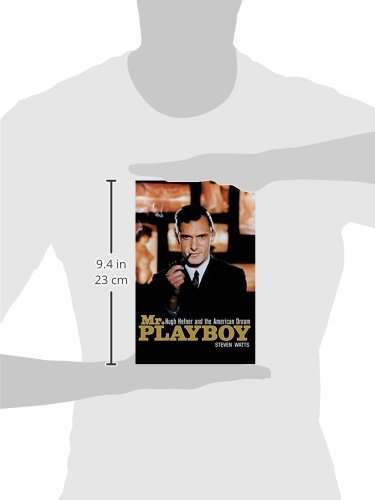
Full description not available
J**R
Author never asked me to proofread before publishing
There are myriad ways to live a life; Hugh Marston Hefner choseone. The people who condemn his choice and criticize him as ahuman being lack awareness. They are quick to pass judgment,as though their choices for living are the ideal. It is so easy tocondemn - to sit in judgment of a fellow human who merely soughtto find the things that produced happiness and contentment forhimself. His choices may conflict with yours but he never forcedanyone to participate in his choices. He had a dream that withhard effort he manifested. He followed what he believed to be truefor himself. He never badgered or coerced anyone to participate inhis dream. It's pure arrogance from some people who postdisparaging reviews on this site vilifying Mr. Hefner for thechoices he made for his life.The author Steven Watts sets out to place Hugh Hefner in thecontext of the last half of the American twentieth century. To do thishe has to also describe what preceded those decades in America. Hetakes us back to Victorian times to reveal the repressive and limitingcustoms many Americans adopted and passed on to subsequent generations.We then follow Hugh Hefner from his birth in 1926 up to about 2007 wherethe book ends. It's a long history of not only Mr. Hefner but also of America.Mr. Watts presents a selected history of the culture of America fromthe late19th century into the early 21st century as he speaks of HughHefner. The main section of the book comprises 454 pages. The notessection occupies another 59 pages. From the notes section one candiscern that Mr. Watts did do research. Some of his conclusions, hestates, did go against Mr. Hefner's view of things. He makes his pointand allows Hugh Hefner to make his. This merely illustrates that muchhistory is about perception.The book is a sweeping panorama of life in America. And amongall of the events is one man pursuing his dreams. Mr. Hefner is shownto be a man with a conscience. He stands up for racial equality whenthat stance was not popular. He fights censorship and advocates firstamendment rights of freedom of expression. He challenges laws on thebooks that imprison people for various sexual acts. He is for individualexpression and entrepreneurial endeavors. He speaks out for homosexualrights. And, contrary still to some public perception, supports women'srights and liberation from the sexist environment in which he grew up.He starts a foundation to support his beliefs and to offer assistance tothose deserving of help. Over the decades he evolves as a man and a thinker.Whether people embrace it or curse it, there was indeed a sexualrevolution in America in the last part of the twentieth century. Twolarge factors in that revolution were the birth control pill and Playboymagazine. Mr. Hefner had convictions that propelled him to becomea significant contributor to the lessening of repression in Americansociety. This book chronicles his activity and the problems heencountered as he stood up for what he believed to be right. Not all menor women are that strong to follow their dreams and beliefs and to fightwhere necessary to prevail. It takes courage and fortitude to go againsta prevailing opinion. To risk everything for what you believe in.Mr. Watts cites many obstacles Mr. Hefner faced as he published hismagazine. He provides background on the various historical periodsin America as Mr. Hefner moves through them. At the end we emergewith an understanding of what America promises its citizens. It is aland of liberty. You can make dreams come true here.Admittedly, my title line is for attention. It disturbs me to somedegree when I read a book and find glaring errors of fact. A lot oflife is subjective but there are some things that are easily provenand when an author overlooks them it causes, in me, a slight degreeof doubt for everything he is offering. Mr. Watts presents threepages of acknowledgements but apparently none of those peoplenoticed the errors in the manuscript that I easily discovered inreading his book.On page 221 of Mr. Playboy the author states: "By early 1967, atage forty-two ..." But in early 1967 Hugh Hefner was age fortyhaving been born on April 9, 1926.On page 351 the author states: "... brought the Playboy Interview: JohnLennon and Yoko Ono - it appeared on the newsstands the night theformer Beatle was killed in 1981 ..." But John Lennon was (senselessly)murdered on December 8, 1980. (The date of the Playboy magazine inwhich the interview appeared is January 1981). Following page 118 thereis a section of unnumbered pages of photographs. The caption for one of thosepictures states: "The youthful editor at his desk during the early days of Playboyin 1954" In the foreground is a stack of magazines with an issue of Playboyon the top. That particular issue is a May 1955 Playboy. Therefore, theauthor's 1954 date is in error.Small points? Yes, perhaps. I did not do any research for this bookand I've never met or talked to Hugh Hefner. These are things Inoticed that were erroneous and therefore could contribute to somedoubt about other facts in the book I'm unaware of.A few things that I would have liked to have read are more informationon the relationship of Mr. Hefner and his first son David. There is littlemention of David. Their relationship would provide more insight as tothe father Hugh Hefner is. Perhaps in interviews he declined to speakabout his son; perhaps the author never asked. Hugh Hefner's father,Glenn, died in 1976; this is not cited. In fact, there is little told aboutthe relationship he had with his father. I have a documentary filmwhere Barbi Benton speaking of the death of Hefner's father saysthat his father never acknowledged the accomplishments of his son.Mr. Watts references a lot of the editorial staff of Playboy magazine,especially Art Paul, Auguste Spectorsky, and Arthur Kretchmer. Butwhen it comes to the photography department only Vince Tajiri receivessome notice. The photography of women has been a defining part ofPlayboy's history. A few words either from or about some of thesetalented artists would have helped further explain the success of themagazine. Hefner did not create the photographs but he hired thesephotographers and edited their work. They interpreted his vision.My criticisms of this book are few. Steven Watts did an excellent jobdescribing a part of American history. It's a broad history with itscenter being Hugh Hefner. It addresses ambition and materialism andsexual freedom and determination and repression and morality and traditionand rebellion and religion and conviction and dreams and reality andculture and establishment and sexism and affluence and liberation andfirst amendment and politics and art and discrimination and perception.Hugh Hefner seized life and molded it to what he wanted it to be.Not everyone does that. I think he should be celebrated as aconsummate individual. You do not have to agree with all of hischoices or even respect him as a person (but I do). Just recognizeand applaud the fact that he did not settle. He pursued his dreamsand vision and made his life what he wanted it to be.Jack WegenerSavannah, GA
F**K
Deep and academic look at Playboy universe and Mr Hefner
Almost an academic book about Playboy magazine and its editor. You fullly understand the personality of Hugh Hefner.Full of detailed info. With interesting essays about what suposed Playboy in western culture.Not a sensationalistic effort, just an in deep work on Playboy universe.Don't expect morbid stories about playmates running naked in the Playboy manor.A serious and excellent work by Mr Watts.
R**K
Good for Playboy fans
Definitely worth reading if you are interested in Playboy. Probably dull otherwise. At times, Watts is redundant and makes an exciting figure into a rather dull figure -- but then again, that was his point. Watts depicts Hefner as a very boring person and the "image" he presents to the world as carefully crafted to keep people at arm's length. While I enjoyed reading this biography and think it's probably THE definitive bio of Hefner (until after he dies), there are other bios that are more interesting.
W**Y
PROFESSOR WATTS ISN'T OLD ENOUGH TO KNOW....
I figure guys my age and olders owe a lot to Hugh Hefner. And it disturbs me when those who came years after us simply don't realize, much less understand, his enormous contributions.Prior to the first issue of "Playboy," which reached newsstands in December 1953, men's magazines, if they were anything other than about sports, automobile mechanics or woodworking, were primarily on the trashy side.Let's start with "Police Gazette" and count them off from there.Most, printed on newsprint with poor art, graphics and composition, featured mindless articles thats purpose was a shallow attempt to stimulate libido, and pumped up more with photos of girls standing on their tip-toes obviously with their poking-chests the products of Frederick's of Hollywood bullet bras.Esquire attempted to be the men's magazine bible, but it was so stodgy that it missed the mark.So Mr. Hefner took it upon himself to design and produce a graphically artistic men's magazine, and print it on slick paper, slick paper just like "Town and Country," "Vogue," and "Vanity Fair" were.He found known experts to write about jazz and theater and cars and cooking and manners and how to dress. He added photographs of young women who could have easily lived next door to Ozzie and Harriet Nelson. Maybe next door to me, too.There were short stories by the same writers who were frequently published in the "New Yorker" and "Harpers."There were business essays by one of the world's most-wealthy, J. Paul Getty.Mr. Hefner made sure men discovered Shel Silverstein and cartoonist Gahan Wilson. We found out for ourselves that art could be something more relevant for us than the Mona Lisa because of the excitingly colorful paintings of artist Leroy Neiman.Somewhere in the `60s, Mr. Hefner researched and wrote "The Playboy Philosophy." It discussed and drew supported conclusions on sex, religion and politics. It caused readers to think, evaluate and debate. Many, for the first time, determined precisely how they felt about some matters of life. Probably many disagreed with Mr. Hefner, but either way, that was a good thing.Dr. Steven Watts is the chairman of the history department at the University of Missouri in Columbia. If my math is correct, he and "Playboy" were both born circa 1953.Professor Watts wrote "Mr. Playboy: Hugh Hefner and the American Dream." Rather than talk about and discuss what Mr. Hefner brought to readers like me, readers who were at least teenagers in 1953, the story Professor Watts preferred to weave was about the shallow romantic life that Mr. Hefner has led for more than fifty years.I think Professor Watts' book is a disservice to Mr. Hefner, and I'm inclined to think it is because he was never a boy much less a man before Mr. Hefner took it upon himself to teach males how to be cultured.He just doesn't get it, and we shouldn't expect him to.Perhaps someday some insightful, older author will tell about the important Hugh Hefner contributions and what they have meant to American men and women. It's long past due.Meanwhile, thank you Mr. Hefner.
T**S
Intelligent insight into a sexual liberationist
In Britain, Hefner is considered a fairly minor figure who irritated the conservative establishment by devising a magazine that enabled men to appreciate women in all their natural splendor. Critics sought to ban Playboy, with many accusing it of contributing to a moral degradation of society.This multi-faceted book highlights the cultural significance of a man who initially wanted to live by the constraints of conservative middle-American expectations but realised that simply life was more fun as an individualist, quite ironically taking conservative views of Ayn Rand as an inspiration. Hef's journey is complex and Steven Watts deserves applause assessing this in great detail without ever being judgemental.It is easy to be pious or moralistic about Hefner, but it is astounding to chart the social impact that Playboy has had on our society, particularly attitudes towards sex. This book also illustrates how the social conditions of this post-war period changed to cater for the individual consumerist desires of today. In other words, it was Hugh Hefner who made Playboy, but it was the public who delivered the success.The latter part of the book left me debating if a life of Polygamy has ultimately left Heff happy. We can all make up our own minds about this, but with numerous wives and "playmates" it is hard to say if absolute contentment is his.However perhaps the most striking message is that Playboy was devised at the start of an age where consumerism became king and love unfortunately became a part of that. Heff's own life reveals an early life beset by a lack of self-satisfaction and a strong desire to be a good husband. Like many of us, Heff found that the demands of hard work, ambition and other social pressures meant that he could never actually meet the ideals that he turned away from.Ironically for many men, the dream of the happy long-term marriage and stability is probably now more unrealistic than the polynagamous lounge lizard fantasies that Playboy sold to us in the 1950s. This book is fundamentally a representation of societal change, with the experiences of one man, Hugh Hefner being a micro study of how some of those changes became incorporated into our own lives.
A**R
So so boom
Couldn’t finish it
N**R
Three Stars
the book is a little boring, but that's just my opinion.
Trustpilot
3 days ago
1 month ago