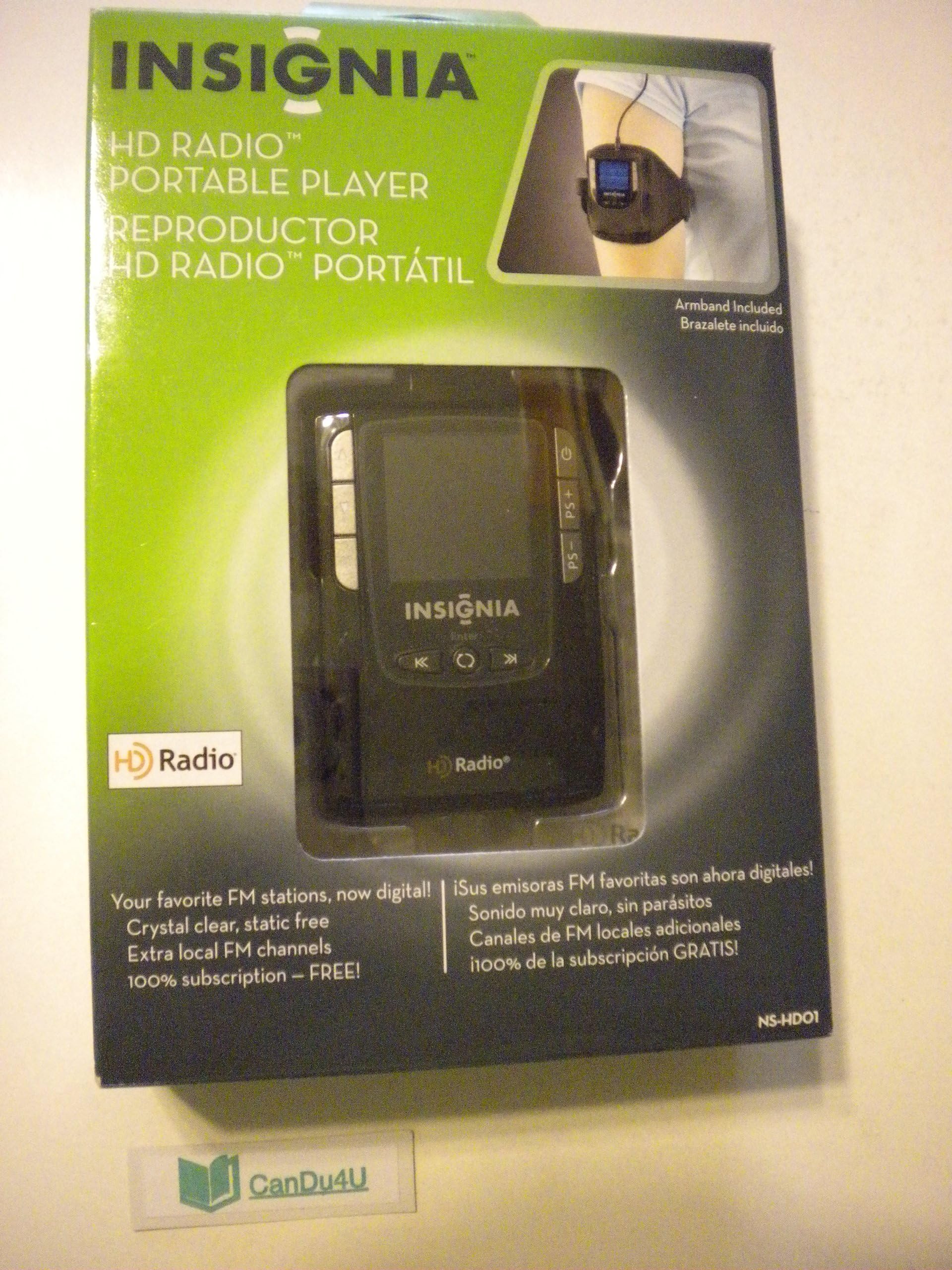
Insignia Portable HD Radio NS-HD01
Product ID: 14422347
Details
- BrandINSIGNIA
- ColorBlack/Silver
- Connectivity TechnologyUSB
- Item Weight1.76 ounces
- ManufacturerInsignia
- Power SourceBattery
desertcart.com: Insignia Portable HD Radio NS-HD01 : Electronics Review: This is an excellent radio. - My radio is firmware version 4.00.14. Just sayin'. I know it's not upgradable, I just don't know how many different versions made it to market and what the differences might be. First of all, you have to be aware of the stupid aspects of the US' HD Radio system. HD Radio broadcasts are sent out at fraction of the power of the main analog broadcast (and yet HD Radio interferes with analog reception--but that's besides the point here). So reception of HD Radio signals is going to be difficult no matter what receiver you have. This radio does very well considering that it uses the earphone wire as an antenna. The one thing I wish they had done differently is include an auxiliary antenna input--maybe that seems silly from the perspective of a "wearable" tiny radio, but it would be helpful when using the radio in the home, office, or car. Also, it takes any receiver a few seconds to sync up with the digital signal. You can listen to the main channel of any station immediately (HD1 is always the same as the analog broadcast) but if you want one of the subchannels (HD2, HD3, etc.) you have to wait a little bit. Every HD Radio receiver acts like this. Finally, HD does NOT stand for "high definition". HD Radio is about equivalent to internet radio in sound quality. The HD1 channels are going to sound fine to most people, but the subchannels are going to be noticeably lower in quality because they are sent out at lower bit rates. Many subchannels are not in stereo. With this radio, I'm able to pick up all the HD Radio stations in town, and many out-of-town stations in analog only. I consider that good performance for a radio with no external antenna. Operation is easy, after a quick read through the manual. Very slight learning curve for setting presets, and you have to remember which number you want a new preset to be, since it always comes up on #1 when you start to set one. Not a big deal, since there are only 10 presets (which is one more than I need anyway). Also, mine DOES remember whether I set a preset to the HD3 channel (for example) of a station, unlike what others have said, which is why I mentioned the firmware version. The HD Scan function works very well and is an easy way to find all the HD Radio stations in your area. It's a terrible shame this model is discontinued. I don't know of any other portable HD Radio receiver (other than the successor to this model, which people don't seem to be happy with), and there's some good content on the subchannels that you can't get with an ordinary radio. Grab one of these while you can. Review: Affordable, well-designed (but presently HD silence) - You can't get too upset over a technical malfunction with a 20-dollar HD radio, but mine suddenly has clammed up on me. The silence occurred after I left it charging for a prolonged period of time--over a day, which I may have been warned about in the instructions. Up to that point (I may still coax it back to life), it performed like a miniature champion (if not up to iPod quality). The sensitivity was about equal to my Sony tuner, and the sound as heard through high-quality headphones--both regular and HD FM--was pristine. It's definitely not a "toy" or a "rip-off" as some have suggested. I never got around to trying it with external speakers, but I see no reason that anything would limit it other than content availability in your area and the power of your amplifier. As a walking companion, it was perfectly fine, so I'm hoping it's merely temporarily on strike.] The scarcity of HD radios, and the availability of this nifty little radio only through desertcart 3rd-party sellers, does not bode well for the technology. As others have mentioned, HD can be erratic and inconsistent. There's is no static or "weakening" of the signal: it's all or nothing, which means that there are times and locations when the signal will be "stop and go" or will have flown away. Also, the search and "lock-in" of the signal takes a few extra seconds compared to the instant response from conventional AM and FM bands (though on this small unit the lock-in is reduced to a fraction of a second). With those caveats in mind, this little device nevertheless represents a good value. I find that it rapidly finds and holds on to a local signal more securely than the well-reviewed Sony HD tuner, which is 2-3 times the price. And unlike the Sony, no antenna is required (it's invisible, tucked away inside of the small case). So you can pretty much use it like an iPod, attaching it to the included arm band, carrying it in a pocket along with your favorite earphones, or even connecting it to an amplified speaker. Besides HD frequencies, the unit picks up conventional FM. In fact, you can make it scan simultaneously for both, selecting the strongest signals and best programming as pre-sets. Personally, I don't sense that the audio fidelity--even under optimal conditions--is dramatically different from that of a good conventional FM signal. So its usefulness to the purchaser is likely to depend on available content. For example, if you're a jazz fan and have a local HD station that offers continuous jazz 24/7 but only on one of its HD bands (most stations are beginning to take advantage of the opportunity to employ a single band, but only as an alternate, "cleaner" version of their primary broadcast. But a few stations are offering more than a mere simulcast, giving the listener from 2-6 different programs exclusive to their broadcasts in HD). Quibbles: 1. I may discover I'm wrong, but it appears that if an FM signal has a sufficiently strong HD alternative, the unit automatically converts to the HD signal (which is a fractional second behind a regular FM signal). I'd like the option of comparing the conventional and HD signal. 2. It appears that the unit does not receive AM, which I understand also can broadcast in HD. 3. The unit presents the slight inconvenience of having to charge it through the USB port of a computer (similar to an iPod). An AC power adapter or a couple of common AA or AAA batteries would have been preferable (though I have a hunch my iPod AC adapter will do the job). Final plus: Well packaged, with inclusion of armband, USB charging cable, earphones, complete instructions (full booklet plus quick set-up sheet, both written in clear, user-friendly prose).
| ASIN | B002YXMPPO |
| Customer Reviews | 3.7 3.7 out of 5 stars (122) |
| Date First Available | November 27, 2009 |
| Is Discontinued By Manufacturer | No |
| Item Weight | 1.76 ounces |
| Item model number | NS-HD01 |
| Manufacturer | Insignia |
| Package Dimensions | 7.5 x 5.7 x 2.2 inches |
K**N
This is an excellent radio.
My radio is firmware version 4.00.14. Just sayin'. I know it's not upgradable, I just don't know how many different versions made it to market and what the differences might be. First of all, you have to be aware of the stupid aspects of the US' HD Radio system. HD Radio broadcasts are sent out at fraction of the power of the main analog broadcast (and yet HD Radio interferes with analog reception--but that's besides the point here). So reception of HD Radio signals is going to be difficult no matter what receiver you have. This radio does very well considering that it uses the earphone wire as an antenna. The one thing I wish they had done differently is include an auxiliary antenna input--maybe that seems silly from the perspective of a "wearable" tiny radio, but it would be helpful when using the radio in the home, office, or car. Also, it takes any receiver a few seconds to sync up with the digital signal. You can listen to the main channel of any station immediately (HD1 is always the same as the analog broadcast) but if you want one of the subchannels (HD2, HD3, etc.) you have to wait a little bit. Every HD Radio receiver acts like this. Finally, HD does NOT stand for "high definition". HD Radio is about equivalent to internet radio in sound quality. The HD1 channels are going to sound fine to most people, but the subchannels are going to be noticeably lower in quality because they are sent out at lower bit rates. Many subchannels are not in stereo. With this radio, I'm able to pick up all the HD Radio stations in town, and many out-of-town stations in analog only. I consider that good performance for a radio with no external antenna. Operation is easy, after a quick read through the manual. Very slight learning curve for setting presets, and you have to remember which number you want a new preset to be, since it always comes up on #1 when you start to set one. Not a big deal, since there are only 10 presets (which is one more than I need anyway). Also, mine DOES remember whether I set a preset to the HD3 channel (for example) of a station, unlike what others have said, which is why I mentioned the firmware version. The HD Scan function works very well and is an easy way to find all the HD Radio stations in your area. It's a terrible shame this model is discontinued. I don't know of any other portable HD Radio receiver (other than the successor to this model, which people don't seem to be happy with), and there's some good content on the subchannels that you can't get with an ordinary radio. Grab one of these while you can.
S**L
Affordable, well-designed (but presently HD silence)
You can't get too upset over a technical malfunction with a 20-dollar HD radio, but mine suddenly has clammed up on me. The silence occurred after I left it charging for a prolonged period of time--over a day, which I may have been warned about in the instructions. Up to that point (I may still coax it back to life), it performed like a miniature champion (if not up to iPod quality). The sensitivity was about equal to my Sony tuner, and the sound as heard through high-quality headphones--both regular and HD FM--was pristine. It's definitely not a "toy" or a "rip-off" as some have suggested. I never got around to trying it with external speakers, but I see no reason that anything would limit it other than content availability in your area and the power of your amplifier. As a walking companion, it was perfectly fine, so I'm hoping it's merely temporarily on strike.] The scarcity of HD radios, and the availability of this nifty little radio only through Amazon 3rd-party sellers, does not bode well for the technology. As others have mentioned, HD can be erratic and inconsistent. There's is no static or "weakening" of the signal: it's all or nothing, which means that there are times and locations when the signal will be "stop and go" or will have flown away. Also, the search and "lock-in" of the signal takes a few extra seconds compared to the instant response from conventional AM and FM bands (though on this small unit the lock-in is reduced to a fraction of a second). With those caveats in mind, this little device nevertheless represents a good value. I find that it rapidly finds and holds on to a local signal more securely than the well-reviewed Sony HD tuner, which is 2-3 times the price. And unlike the Sony, no antenna is required (it's invisible, tucked away inside of the small case). So you can pretty much use it like an iPod, attaching it to the included arm band, carrying it in a pocket along with your favorite earphones, or even connecting it to an amplified speaker. Besides HD frequencies, the unit picks up conventional FM. In fact, you can make it scan simultaneously for both, selecting the strongest signals and best programming as pre-sets. Personally, I don't sense that the audio fidelity--even under optimal conditions--is dramatically different from that of a good conventional FM signal. So its usefulness to the purchaser is likely to depend on available content. For example, if you're a jazz fan and have a local HD station that offers continuous jazz 24/7 but only on one of its HD bands (most stations are beginning to take advantage of the opportunity to employ a single band, but only as an alternate, "cleaner" version of their primary broadcast. But a few stations are offering more than a mere simulcast, giving the listener from 2-6 different programs exclusive to their broadcasts in HD). Quibbles: 1. I may discover I'm wrong, but it appears that if an FM signal has a sufficiently strong HD alternative, the unit automatically converts to the HD signal (which is a fractional second behind a regular FM signal). I'd like the option of comparing the conventional and HD signal. 2. It appears that the unit does not receive AM, which I understand also can broadcast in HD. 3. The unit presents the slight inconvenience of having to charge it through the USB port of a computer (similar to an iPod). An AC power adapter or a couple of common AA or AAA batteries would have been preferable (though I have a hunch my iPod AC adapter will do the job). Final plus: Well packaged, with inclusion of armband, USB charging cable, earphones, complete instructions (full booklet plus quick set-up sheet, both written in clear, user-friendly prose).
H**N
Mediocre Performance
This unit provides standard FM reception of decent quality, but only moderate sensitivity. However, the major reason I purchased this unit was to access the HD (Hybrid Digital, not High Definition) auxilliary stations broadcast on multiplex channels transmitting classical music (e.g., KPBS HD2 in San Diego). The HD multiplex channels (HD2 and HD3)apparently are transmitted at lower power than the primary channels (e.g., HD1). The antenna is incorporated in the earphone wire, has poor gain and sensitivity. I often lose the signal when walking under trees. Due to the digital nature of the signal, the sound is either "all or nothing". No static, so the sound, if present, is crisp. Some channels have much more stereo presence, perhaps due to power of their signal. The digital display of text listing the music being played is useful, though the small screen crops part of the text. Despite these shortcomings, it does provide access to classical music channels that would otherwise be inaccessible. Battery performance seems satisfactory, though I haven't adequately tested it. Earphone buds are quite good, and effectively reduce surrounding noise.
Trustpilot
2 weeks ago
1 week ago