We remain fully operational. Our teams are working around the clock to ensure your deliveries continue safely.
DOWNLOAD THE APP


Customer Services
Copyright © 2025 Desertcart Holdings Limited
DOWNLOAD THE APP
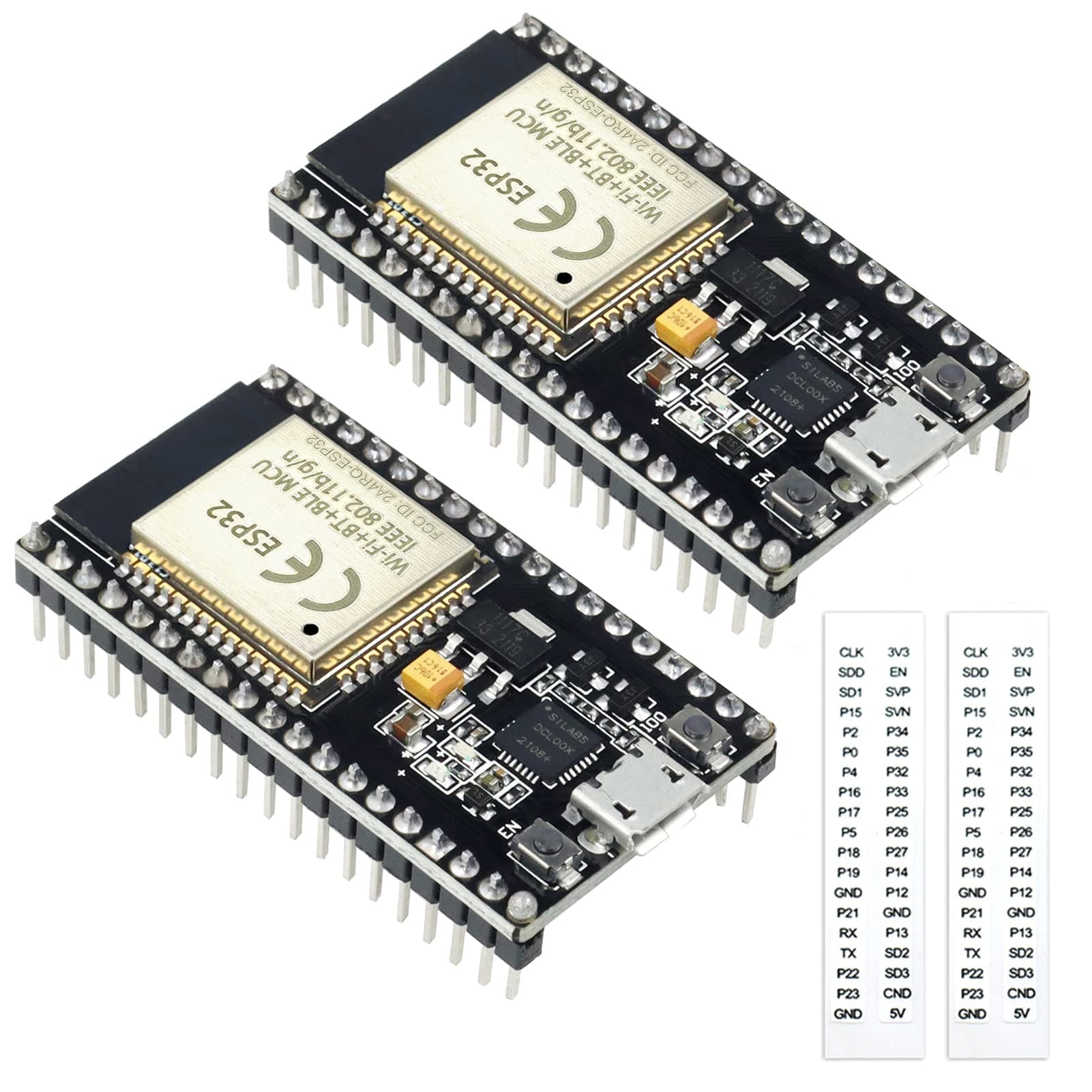
🚀 Power Your Innovation with KeeYees ESP32S – The Ultimate Dev Board for Visionary Makers!
The KeeYees ESP32S Development Board features a dual-core 0.24 GHz ESP-WROOM-32 chip with integrated 2.4 GHz WiFi and Bluetooth, 4 mounting holes for secure installation, and a compact 30-pin layout ideal for breadboard use. With 4MB flash and 512KB SRAM, it supports Lua and Arduino IDE programming, making it a reliable, scalable, and energy-efficient microcontroller solution for professional-grade IoT and embedded projects.


| ASIN | B0B9G74NNM |
| Best Sellers Rank | #1,273 in Single Board Computers (Computers & Accessories) |
| Brand | KeeYees |
| Built-In Media | Bluetooth, WLAN |
| CPU Speed | 0.24 GHz |
| Compatible Devices | Computers, Microcontrollers |
| Connectivity Technology | Bluetooth, WLAN |
| Customer Reviews | 4.4 out of 5 stars 893 Reviews |
| Manufacturer | KeeYees |
| Memory Storage Capacity | 512 KB |
| Mfr Part Number | KY88-2 |
| Model Name | ESP32S ESP32 Development Board |
| Operating System | FreeRTOS |
| Processor Brand | Espressif |
| Processor Count | 2 |
| Processor Speed | 0.24 GHz |
| RAM Memory Installed | 512 GB |
| RAM Memory Technology | SRAM |
| Ram Memory Installed Size | 512 GB |
| Warranty Description | 1 year |
| Wireless Compability | 802.11bgn, Bluetooth |
A**M
Both boards passed my simple initial tests
I had to install the CP210x USB-to-serial driver to get Windows 10 to see the device on a COM port. Also, when the Arduino IDE started trying to upload my program to the board, when the IDE output said "Connecting...", I had to press the right pushbutton on the board, for a couple of seconds, in order to allow uploading to occur. Other than those two not-serious gotchas, the board seems to work as expected. (I tested getting chip info, doing an http get via WiFi, and deep sleep with timer wakeup.) The chip is reported as model ESP32-D0WDQ6 Rev 1. Both boards work fine. Update 2022-11-23: I bought two more boards for a total of four. All 4 have functioned well without any known reliability problems. (I'm using WiFi, digital GPIO usage, internal LED, flash updates, NVS changes.) THESE THINGS ARE GREAT! Update 2022-12-08: I bought two more boards. 6 out of 6 have worked flawlessly. I wrote custom motion sensor software using PlatformIO...flashing from PlatformIO works flawlessly OTA or wired. Every pinout has behaved as expected. Update 2024-10-13: I've purchased five batches of 2 boards (10 boards in total) over the past two years, and all of them have worked flawlessly. They are 38-pin narrow boards (25.4mm/1in wide), unlike many of the other boards that are 2.54mm/.1in wider than this one. So these fit nicely on a 400 point breadboard, leaving a usable wire point adjacent to each pin on both sides of the board after it's been seated into the breadboard. They have 4MB of flash storage. Excellent quality/value.
S**K
Works, reliable, flashes with no button pressing (on linux)
I got these to replace some nearly identical ones from a different seller which had super flaky wifi (it turned out due to counterfeit USB chip leaking high voltage to the ESP32). I'm happy to report that, despite having a no-name USB chip (CP2102 clone, I think) all the voltages measure as they should (unlike the other brand) and the units work so far flawlessly. I bought these from KeeYees this time because I had purchased some ESP8266s from them a long time ago which have worked great for years, and so far it looks like their ESP32s are similarly well-enough made. So, if you are scratching your head over which brand of this board to buy when there seem to be so many that are exactly the same: Beware they may be the same design but the components matter, and so far for me at least KeeYees has sent me good, working boards, spanning multiple years, which I can't say for some other random brands/sellers.
W**T
Just received my first 2 units and both work great
I just received my first two this afternoon, and uploaded several sketches to both. They work just fine. I like the little sticky tapes with the pin names on them. A few tips: 1) For those that complain about pressing the right-hand button to start an upload in the Arduino UI, this is very common, not a quirk in these particular boards. Not a big deal, really. Watch your sketch compile, then when it starts to upload, press the right-hand "boot" button for a few seconds. In my case, I hold the button until I see upload progress start, then let go. Nothing to it. 2) The on-board blue LED is connected to D2, by the way. Try the "blink" sketch first, and just change the default pin name or number to 2 instead of whatever the sketch default is. 3) When deciding what flavor of ESP32 board to select in the Arduino UI, I just use the generic "ESP32 Dev Module" and everything works fine for me. I have several other ESP32 modules, like the WROOM, and they all work with the Dev Module selection for me. Easy. 4) I also tried the very simple Wi-Fi server that can flash the on-board LED (no external connections needed) by going to Examples/WiFi/SimpleWiFiServer. Change the default pin 5 to pin 2 in several places, and then put in your home Wi-Fi SSID and your password. Enable the serial monitor for 115200 bps, and upload it. Once it connects, the ESP32 will tell you what its IP address is. Enter that IP address (like 192.168.1.123) in your phone or computer web browser, and you'll get a simple page coming from your ESP32 (which is now an HTTP server). The page tells you something like "click here to turn LED D2 on" (assuming you edited your sketch so that it says "D2" instead of D5) and a similar line to turn the LED off. Nothing to it, and you did this with zero hardware! 5) My modules did not have any labeling or silkscreen on them, but the included sticky labels are just fine. I stuck one set on the bottom of one module, and on the connector edge of the other. They are sticky enough that I'm not worried about them falling off. I really like these units, and will definitely buy more! I also bought a pair of the KeeYees breakout boards with screw terminals, and they perfectly match the pinout of these 38pin modules.
C**R
Good board; few quirks - Arduino working notes
Writing what I got working because the Amazon reviews were the best to getting this working for me. Tried on both Windows 10 and Ubuntu Linux 18.04. Ultimately all my issues came down to a bad USB cable. Writing what SHOULD work to help others. I'm writing this for Windows 10 though I'm sure it'd work fine on Linux now that I have a good cable. Go into device manager on Windows 10. When you plug the cable in, device manager should refresh and notice a device is attached. If it does nothing, get another USB cable. When it works, you should have a "Ports" section and CP210x USB to UART bridge and a com port. If you don't have that, nothing in arduino or any other program will work. Keep troubleshooting cable and driver until you get there. When I did finally get that working I installed esp32 from boards manager in arduino (need to add the additional boards link ... google for it). I selected the port and FireBeatle ESP32. When uploading code to it, you have to push the IOO port (the one to the right of the USB connector) and hold it when Arduino gets to "Uploading" your sketch. It's a little awkward to hold this so it's best to have it in a breadboard to do this. Reset doesn't work across the cable either, but the button to the left resets it and finally blink (my hello world goto) sketch is working.
A**R
Works Great With Home Assistant/ESPHome
I've been using Arduino's for several years as part of my home automation system. I recently moved to Home Assistant and I didn't find an easy way to translate all my Arduino code to work with HA, so I decided to try this ESP32 board. All I can say is that it was the easiest board I've ever set up (using the ESPHome add-on in HA). This ESP32 board is my future and will be replacing all my Arduinos. The Wifi works great on both the boards I got and I can program and download any new files wirelessly. Pressing the IOO button was necessary to get the initial program to download but the button press isn't needed when down loading wirelessly. Research which pins to use for I/O because a few of them do weird stuff on reboots, but that information is readily available on YouTube or do an internet search. It's an amazing little board when used with HA/ESPHome. I've even got 10, 1-Wire devices daisy-chained to one of the input pins (which previously took me weeks to figure how to do on Arduino) - it took me 20 minutes on this board using ESPHome.
J**M
Works great for ESPHome and Home Assistant
Fits their expansion boards really nicely, also fits on standard breadboards with access to all the row pins (something most wider esp32 boards fail at). If you want to use ESPHome to do a simple LED test, you can add this config: switch: - platform: gpio pin: GPIO2 id: led22 name: "LED22" Which will let you toggle the blue led on/off. The red LED, from what I've read, is just on as long as there is 5v flowing into the chip. Rumor is you might be able to get around that by powering through the 3.3v pin instead, but I haven't tried that.
R**D
My favorite ESP32S - 38 pin narrow dev board when I need prime shipping.
I have a dozen or two of these. More reliable than many I tried from Aliexpress. These are only a couple bucks more the Ali and are consistent, the number and config of GPIO pins I want (38) and the narrow board that leaves one row on both sides of a standard breadboard or perma-proto boards. I use these for wled with sound reactivity and other unique custom features and for my own CircuitPython (or MicroPython) scripts or my embedded development experiments using the Rust Programming Language. Super dependable board --100% working reliably for my sample size of about 20 KeyYees ESP32S - 38 pin NARROW. Highly recommend and check out associated breakout board from KeyYees for this exact board
J**N
Great with WLED
I used one of these programmed with WLED software to run 12V LEDs on my Christmas tree. It was a big project since you need a 12V power supply, a voltage converter (to get the 5v this device needs) and a box to connect multiple strings of lights into a central hub. Worth it. In the video, you might notice the star is doing its own thing. It's got another one of these microcontrollers wired up to a dozen white LEDs with some custom code (not WLED). That one runs off a USB plug which is a lot simpler.
Trustpilot
1 month ago
1 month ago