


🌿 Grow smarter, not harder — light up your indoor jungle with YGROW brilliance!
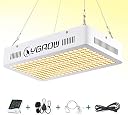
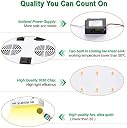
The YGROW 1500W LED Grow Light delivers a professional-grade full spectrum (380-800nm) lighting solution with UV and IR for all plant growth stages. Featuring a daisy chain design for scalable setups, advanced cooling for enhanced light intensity and quiet operation, and energy-efficient performance consuming only 270W. Ideal for indoor veg and bloom, it covers up to 4'x4' effectively and comes with a digital thermometer/hygrometer for precise environment control. Backed by a 12-month warranty and responsive customer service, it’s the ultimate tool for millennial plant pros seeking high yield and quality.





| ASIN | B07PWBZ9F7 |
| Amperage | 2.45 Amps |
| Are Batteries Included | No |
| Brand | YGROW |
| Color | c-1500W |
| Customer Reviews | 4.4 4.4 out of 5 stars (52) |
| Item Weight | 6.39 pounds |
| Light Source Type | LED |
| Light Source Wattage | 1500 Watts |
| Material | Aluminum |
| Product Dimensions | 13.9 x 7.87 x 2.36 inches |
| Shade Material | Aluminum |
| Shape | Bulb |
| Style | Traditional |
| UPC | 751498436160 |
| Wattage | 1500 watts |
A**N
Fan cooled 1500w LED - a little hot but very bright
The aluminum shell seems well made and the entire unit is very sturdy and well finished. The light is much smaller than I expected but also brighter so there is no disappointment about the size. I don't really like the cup reflectors and may try to remove them but again, the light is very well finished so I don't really want to mess with it. The fans are no louder than any fan which you might have in your grow area. The light does seem to produce a good amount of heat but for the amount of light produced it seems reasonable and is obviously a magnitude less than a comparable HPS. Along with the hanging kit and digital thermometer/hygrometer, this light is a good value especially if you get it on a promotion like I did.
W**N
1500w Led from ygrow
I would like to do a review on the 1500w led by YGROW it's a very good and powerful and bright this light is no joke folks it is excellent the footprint will cover a 5 x 5 with no problem I highly recommend this light anybody that does not have a lot of money these lights are awesome and they grow big bud 👍👌I give him a big thumbs-up in The Growers community for the prize you cannot beat it they are awesome energy efficient and just amazingly amazingly bright there is the 45 watt for seedlings the 450 watt veg and Bloom the 600 watt full spectrum the 1500 watt full spectrum and they also have an 1800 watt you have to go to their website to order that take advantage quotes you cannot beat the price these are awesome LED
R**H
Hands-down, the best and fastest customer service ever!
I've bought two of these lights. I chose to go with the 1500W Full Spectrum options. I already had a blue and red 1500W LED from anther company. That's why the middle of my plants are purple. I have YGROW lights on either end. The first light burned out in the first few minutes of use. I emailed the seller and later that same day was emailed back, letting me know they would be sending me a new light and I didn't even have to return the old light. That was a couple of months ago. Two days ago, I discovered the power cord had gotten too hot and shorted out. I emailed the sell again and in about an hour, they had responded again. The are sending me multiple lights so I can choose the power cord that will work best, and I get to keep the extra lights...AGAIN. These people are amazing. The lights work great, my plants love them. I've never had such amazing customer service treatment with any other company. Love these guys.
C**R
great light to start seedlings in house !
I've gotten a smaller unit from ygrow and absolutely loved the results so i ordered a bigger one to add more vegetables to my indoor garden. right now I have, green beans, cucumbers, cat nip and some lettuce growing inside just until we can get over the cold weather. the plants take to the light very well, just make sure you are sticking with the manufacturer instructions on light placement to get the best footprint of sun. other than that its not a difficult light at all to hang up. I review many lights from company's because I grow so many veggies and the power they use is minimal. update, 2 of the bulbs seemed to die out so I had to change the review slightly in terms of stars. I do like the light still the plants seem to still be doing well. update, after contacting company they helped resolve my issue. I will update once new one arrives.
R**N
Not a bad light, depending on your needs (see review for details)
SUMMARY ================================================== I ordered 4 different grow lights in the 1200w-1500w "sun-like" class and ran a simple experiment collecting data on the light output, noise, weight, and temperature of each of them. The results can be found below along with a discussion so you can pick the one that best suits your needs. If you don't want to read the details, in short I found that the Oneo brand produced the best light output in terms of center and spread, with a similar energy usage compared to the others. Ygrow was the quietest by about 5 db from the top and 10 db from the bottom, but it was the hottest, adding 50°F (28°C) to the room I tested the lights in, 15°F more than the next one and 30°F hotter than the coolest one. Note: While the Lighttimetunnel and Roleadro lights were individually measured, it was clear the moment I opened them that they were in fact the same exact light rebranded under different names. Since their measurements came out to be the same as well, I have collapsed them under a single name "Multi-brand" in the data section. All the grow lights had very similar contents -- all had almost exactly the same carabiners and metal wires. They all had similar NEMA15 to IEC-320-C13 power cords. Two grow lights (ONEO and Ygrow) came with the (exact) same additional rope hanging device and thermometer/hygrometer that was almost the same (one had a wire with an external sensor -- so you can measure the temperature / humidity in an area other than exactly where the device is -- and one did not, and sadly I don't remember which one came with which!). Here are the lights I compared: Lightimetunnel 1500W LED Grow Light https://smile.amazon.com/gp/product/B07RHQZVRD/ Roleadro 1500W LED Grow Light https://smile.amazon.com/gp/product/B07P3BXRDC/ YGROW 1500W LED Grow Light https://smile.amazon.com/gp/product/B07PWBZ9F7/ ONEO 1200W LED Grow Light https://smile.amazon.com/gp/product/B07RZL27YX/ As a side note, I also have a Bozily 300W LED Grow Light (https://smile.amazon.com/gp/product/B07MLVRNFF/) which is in a different class (300W). While it produces far less light output, it's advantage is that it produces almost no noise, far less heat, and is much lighter than the others. Also, it has a built in timer so that you can have it automatically turn on and off each day for a certain length of time. If you aren't going for maximum light output (i.e. around the same output as the sun), I would recommend considering lights in this class instead. The figures (pictures/charts/etc.) mentioned in this review have been attached so you can view them directly here on Amazon.com. METHOD ================================================== Using a series of poles and wire attachments, I hung each of the lights such that they were all 21.5" (54.6 cm) from the floor (a seemingly random number, but it's that height only because that was the height of the first light I put up and I put up remaining up to match that level, see fig. 1). I used a level to make sure all the lights were reasonably level (see fig. 2). I did the best to measure the features I think most people will find important. These include: light color, lux output, lux spread, noise level, energy usage, size, weight, and temperature. Each measurement was taken at least two times, so the resulting numbers you see in the data below are the averaged numbers. Light and Noise Data For recording lux data I used a URCERI Light Meter, which measured the ambient lighting in the room at the time of measurement to be 23 lux. Lux data was recorded by using the MAX function on the light meter and finding the max reading I could get while moving the light around flat on the floor under the light (in all cases, the maximum reading came when the light meter was centered underneath the grow light). For lux spread, I moved the light meter 1ft (30.48 cm) away from the point of maximum brightness (nearly touching the white wooden board as shown in the pictures). For recording noise data I used a I used a BAFX Products Decibel meter. I took measurements in two places: directly on top of the grow light, with the microphone positioned in the center, and 6" below the grow light, also in the center. The ambient noise level in the room of the experiment was 45.6db. Energy Usage and Temperature Data After taking lux and sound measurements, I plugged each device into a Kill-a-watt energy meter and left each device on for exactly 3 hours before I measured the energy usage. I divided the values by 3 to get the per-hour usage. At the same time as measuring the energy usage, I also measured the temperature 5 times by pointing an infrared temperature gun at the underside of the grow light (i.e. directly at the LEDs themselves). The experiment room had what I would characterize as "reasonable airflow" (a door was open and a cool breeze from outside could be lightly felt), with an ambient temperature of 80°F (26.7°C) and 49% humidity. See fig. 3 for a picture of the measurement instruments. DATA ================================================== See fig. 4 for a table of the data and some charts. DISCUSSION ================================================== I won't belabor this already long review with a detailed discussion of every aspect of the data, but I will cover some of the important ones. Light Although all the lights were advertised as "full spectrum" and/or "sunlight" grow lights and had similar listed wattages, the color and intensity of the lights varied surprisingly significantly. I am not an expert photographer by any stretch and the colors are a bit off but I tried to capture these differences in figures 5-7. Figure 5 shows the photos of each of the lights from the same position with the same settings in an animation and Figure 6 shows the white-balance corrected photos in an animation. Figure 7 shows the same uncorrected photos from Figure 5 all stacked vertically in case you prefer a static image comparison over a gif animation. Note that Figure 6 though corrected is still not perfectly accurate in terms of color that I saw with my eyes (it appears they all produce perfectly white light from the photos, but in reality it's not the case). The whitest white was the Multi-brand light, with Oneo coming in close second (just the slightest tint of yellow). The Ygrow lights were noticeably yellow, but not necessarily in a bad way (and notably still not as yellow as the 300w Bozily lights which I do in fact think are too yellow for my taste). Although all the lights use similar amounts of energy, the Oneo light definitely produced a significant amount more light overall than the others. The Ygrow light produced about as much light directly beneath the unit as the Oneo light, however as you moved away from directly beneath the light the output dropped much more sharply than the Oneo light. Because the difference in monthly cost was only around $1 between the Oneo and the Ygrow, it seems like the Oneo is the best value when it comes to light output. All the lights provided definitely can reach outputs equal to and exceeding what the Sun produces. The Sun was measured at a peak of 92.5 klux at 3:40pm in the afternoon in San Jose, CA, and several subsequement measurements on different days gave similar values in the low 90s. All these lights will produce that much output as long as you place your plants quite close to it (around 8" from the light). As you get even closer, you can easily far exceed the Sun (I measured 175+ klux within a few inches). Sound As the fans for the grow lights are all on the top, the sound is mostly directed upwards and therefore depending on how you use the lights you might weight the importance of the two sound measurements differently. It seems much of the sound is produced from the relatively loud fans, so one might consider replacing the fans with some quieter ones such as Noctua brand fans. Temperature These lights all generated at least an additional 20°F (11°C) and upwards of 50°F (28°C) in the room I tested them, so ventilation is certainly important when using them near areas where people will reside.
Trustpilot
1 day ago
2 weeks ago